A BFR 500 JRH/50AE Big-Hole Story
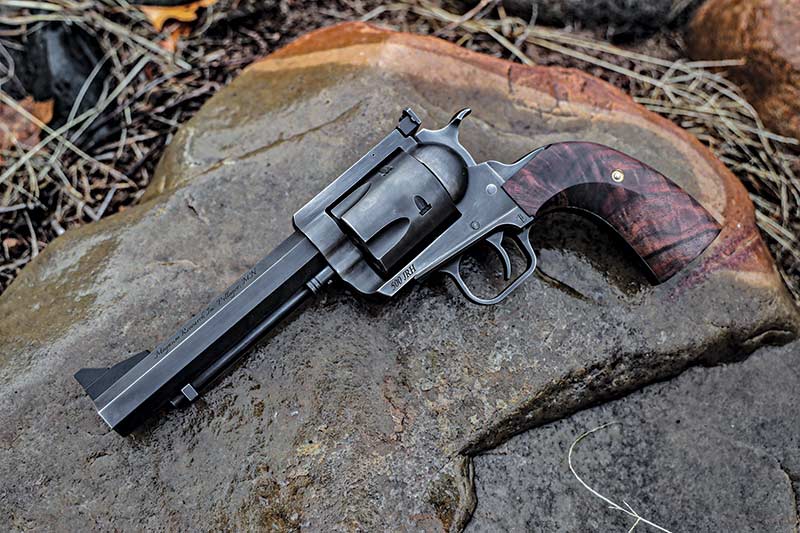
Rock solid, Tank’s Magnum Research BFR with worn finish looks tough!
Social media is dangerous. While sifting through the regular riffraff nonsense, fellow gun nerds sometimes post striking guns, catching our eye. I know, because it has happened to me on several occasions! One of my latest seductions is a Magnum Research BFR. This one has a shorter octagonal barrel and is finished in what can be described as a “well-worn gun blue.”
Since all BFR revolvers are stainless steel, I know it can’t be a traditionally blued gun, but I really like the looks of this shooter. The gun is a dual-cylinder beauty belonging to Brett Pikula, production manager for Magnum Research. Pikula pulls a fast one, posting his own personal sixgun (even though it’s a 5-shot), knowing darn well it will lure dedicated sixgunners like flies to a Venus Flytrap.
It surely captivated my feelings of lust, want and need. I couldn’t get it out of my mind. And being an addicted handloader always on the prowl for new cartridges to load, hence, more new dies, I had a double dose of good fortune. For this seductive shooter was chambered for the .500 BFR and .50AE, two cartridges I’ve never had the pleasure of handloading — yet.
I already had several bullet molds dropping beautiful .500 caliber bullets used for my Big Horn Armory model 89 lever gun chambered in .500 S&W. Plus, Buffalo Bore Ammunition provides brass, along with several good loads using a variety of bullets in both cartridges, depending on what your shooting needs desire. They even have a low velocity/recoil load for practice without beating yourself up.
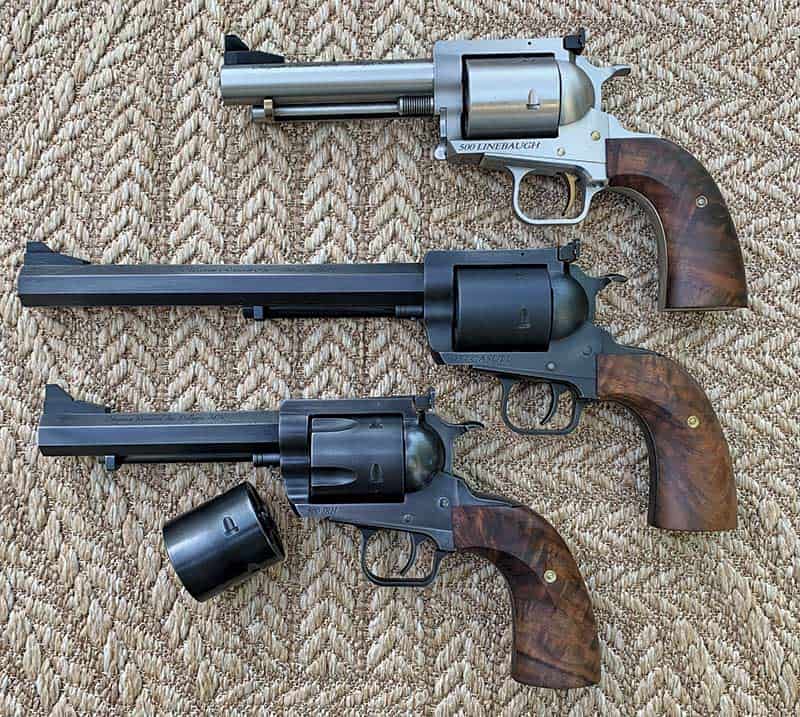
Tank is proof of, “Buy one; you’ll buy more BFRs.” Top, Elmer Keith
commemorative in .500 Linebaugh, a .454 Casull, and the dual cylinder
Secret Shooters?
For some reason, Magnum Research’s BFR line of revolvers was a well-kept secret for me until about five years ago. Sure, I’d heard of them, but never had the pleasure of shooting one of their revolvers. Best known for long cylindered single actions capable of shooting .45-70 ammunition, they also make smaller, traditional-sized “sixguns” capable of being chambered up to the .500 Linebaugh. As a matter of fact, my first BFR was an Elmer Keith Commemorative chambered in .500 Linebaugh, which I first saw on social media plugged by the late, great Jeff Quinn. It was while ordering this big-bore blaster that I became acquainted with Brett Pikula. And Brett wisely states, “If I can get you to buy one BFR, you’ll buy two.” And he’s right!
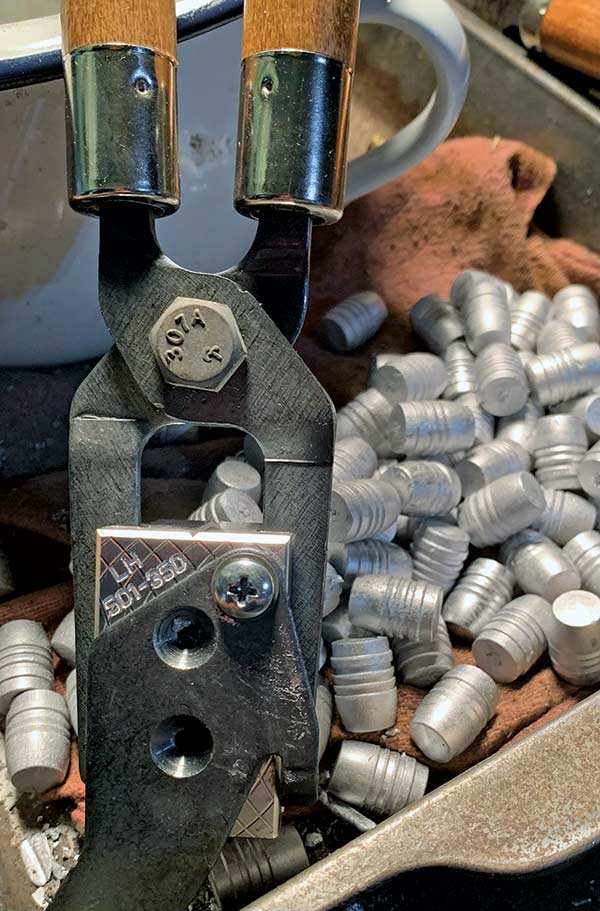
Lee Precision makes good, affordable bullet
molds for the 500JRH/50AE.
Hands On Guy
Brett Pikula has been working for Magnum Research since the beginning as an entry-level laborer, polishing barrels and frames with emery cloth. He’s worked his way up the ladder to Production Manager while overseeing the custom shop. Brett has the distinction of handling every BFR coming through the shop for one process or another before the gun is shipped out to customers.

Tank’s gun in the early stages.
Long Worn Wonder
Brett is the one responsible for coming up with the “worn look” finish on the BFR revolvers. Guns are sent out to be nitrided with a durable black finish, giving the stainless steel BFR revolvers a deep, dark blued appearance. This finish alone tones down the stainless steel and removes any possibility of glare.
But Pikula came up with something better, in my opinion. Brett uses bits of emery cloth to lightly sand the freshly nitrided guns, giving them a “worn” blued look. The first time I saw it, I knew I wanted that treatment, as it really warms up the gun, giving it the looks of a favorite carried and used shooter.
My first BFR was an Elmer Keith commemorative, complete with locking base-pin latch, chambered in .500 Linebaugh. The gun looked fabulous, was accurate, and I wondered what took me so long to try a BFR revolver. My second BFR is a 9″ octagonal-barreled 5-shot shooter chambered in .454 Casull. It, too, shoots like a lasered instrument having the warm “worn look” applied to it.
Now I “needed” a shorty big-bore to round out the “well-worn” look of revolvers.

Both handloads and factory fodder shot well in the 500 JRH/50AE.
Double Big Bore Bonanza
This latest gun is one I thought long and hard about, but I was really swayed after seeing Brett’s personal gun chambered in 500 JRH/ 50AE. What a cool combination of big-bore badassery! The 50AE was originally made for Magnum Research’s infamously famous semi-auto Desert Eagle. I never realized until a few years ago just how powerful the 50AE is. Capable of pushing 380-grain bullets more than 1,300 FPS is potent medicine indeed!
The 500 JRH is basically a shortened .500 S&W cartridge. The .500 S&W is too long for the smaller-framed BFR, but gunsmith Jack Huntington came up with the idea of trimming the brass so 440-grain cast bullets could be loaded to 1,300 FPS. Wow! That’s a powerful packing piece!

A dual-cylindered dandy, powerful enough to drive railroad spikes, the BFR is a versatile shooter.
Order Up!
The gun I ordered through the custom shop specs out like this. I wanted a 5½” octagonal-barreled gun. The octagonal barrel adds a sense of vintage craftsmanship while adding some recoil-reducing weight, taming muzzle flip. I requested the Magnum Research version of their Bisley grip frame. It fits my hand well, but more importantly, it keeps my middle knuckle away from the trigger guard during recoil. Nothing’s worse than getting your knuckle whacked during full recoil.
Stocks are burl walnut, and Pikula did his usual exceptional job fitting them to the grip frame. I had Brett flute the 500 JRH cylinder and leave the 50AE cylinder unfluted for fast recognition. The standard locking base-pin was used to prevent jumping the cylinder frame. “500 JRH” is roll-marked on the left side of the cylinder frame, as well as “Magnum Research Inc Pillager, MN” in cursive script on the barrel.
I made sure Pikula used his personal stamp of B over P on both sides of the grip frame behind the trigger guard for a personal touch. The action is typical of Magnum Research smooth. Spinning the cylinder makes you wonder, “Will it ever stop?”
The action and trigger are the same: smooth and crisp as can be! Cocking the gun is reassuring, hearing two loud clicks, followed by a tight cylinder lock-up. Barrel/cylinder gap is tight, with just a crack of light visible when holding the gun up. Cylinder throats measure a perfect 0.501″ with pin gauges on both cylinders.
The Bisley hammer spur is wide and serrated for positive cocking pleasure. The sturdy rear sight is adjustable for both windage and elevation, having a square notch wide enough to allow plenty of daylight on either side of the front sight. The top strap is drilled and tapped for a scope base. The front sight is ramped, all black, and has a flat top, providing excellent traditional sight alignment when paired with the rear sight.
The ejector rod housing is steel, as is the ejector rod button. The trigger sets back, Bisley style, when the gun is cocked, and its face is smooth. The trigger breaks at just over 2 lbs.

Typical group size for the Magnum Research BFR 500 JRH/50AE.
500 JRH?
The 500 JRH came from Jack Huntington in 1993 when he used shortened brass from the .500 S&W cartridges so it would fit in standard-sized Freedom Arms and Magnum Research BFRs. Jack asked Tim Sundles, owner of Buffalo Bore Ammunition, to help with load development. Sundles contacted Starline Brass, sending them specific interior dimensions, so the cases wouldn’t bulge when loading.
Sundles fronted the money, ordering several thousand cases with the understanding Starline would only make the cases for him, to absorb his initial investment. So, if you need 500 JRH brass, Buffalo Bore Ammunition is the place to order it, as well as loaded ammunition.
I had three of Buffalo Bore’s loads to shoot. The first is item 44C/2, a 350-grain JHP, which clocked at 1,478 FPS from my gun. The second was 44A/20, a 440-grain WFN hard cast slug clocking at 1,343 FPS. Lastly was a lightly loaded 44B/20, a 440-grain WFN at 973 FPS. All loads grouped in the 1-2″ range at 25 yards for three shots.

Sizing and crimping gas checks is a breeze with a Lee APP press.
Cast Bullets
I have three bullet molds I use for the 500 JRH; two are from Lee Precision, and the third is from MP Molds. The Lee molds are a 350-grain Wide Flat Nose and a 440-grain Wide Flat Nose, Gas Check design. The MP Molds bullet is a 386-grain, Radiused flat-nose hollow-point design. All are polymer powder coated and sized to 0.501″ with Lee Sizing dies used in an APP press. For heavy loads, Hodgdon H110 is the powder of choice. For the 350-grain slug, 32 grains were used for 1,412 FPS and 27 grains for the 440-grain bullet for just over 1,300 FPS. For the 386 MP hollow point, 10 grains of Winchester 231 yielded approximately 1,000 FPS. This load is good for all bullet weights.
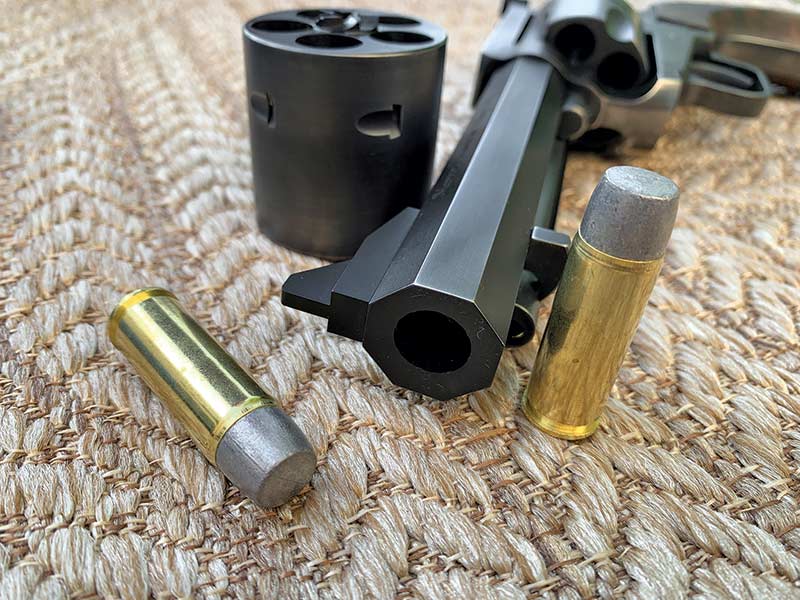
Big bore, octagonal barrel, cast bullets, these are a few of my favorite things!
50AE
The 50AE first appeared in 1988 for the Desert Eagle semi-auto pistol. Bullet weight is usually kept at 380 grains because of bullet inertia during firing, meaning they’ll creep out of the cartridge case. Bullets must be taper crimped since the cartridge headspaces on the cartridge mouth. I had three Buffalo Bore loads for testing. The first is 50AE-325, a 325-grain JHP which went 1,439 FPS, 50AE-350, a 350-grain JHP which clocked 1,353 FPS and lastly, 50AE-380, a 380-grain hard cast going 1,247 FPS. Again, accuracy was in the 1″ to 2″ category at 25 yards.
Since the 50AE is taper crimped, I only used the Lee 350-grain slug. Loaded over 31 grains of H110 it went just over 1,400 FPS with good accuracy.
Last Word
While the 500 JRH is basically a shortened version of the .500 S&W, it hardly falls short on performance like the 50AE. This dastardly duo is plenty powerful enough to handle any handgunning needs on this planet. I really like the Magnum Research BFR package and love the “well-worn” look that Brett Pikula came up with.