6 Things You Learn From…
Using a Pistol Red Dot Sight
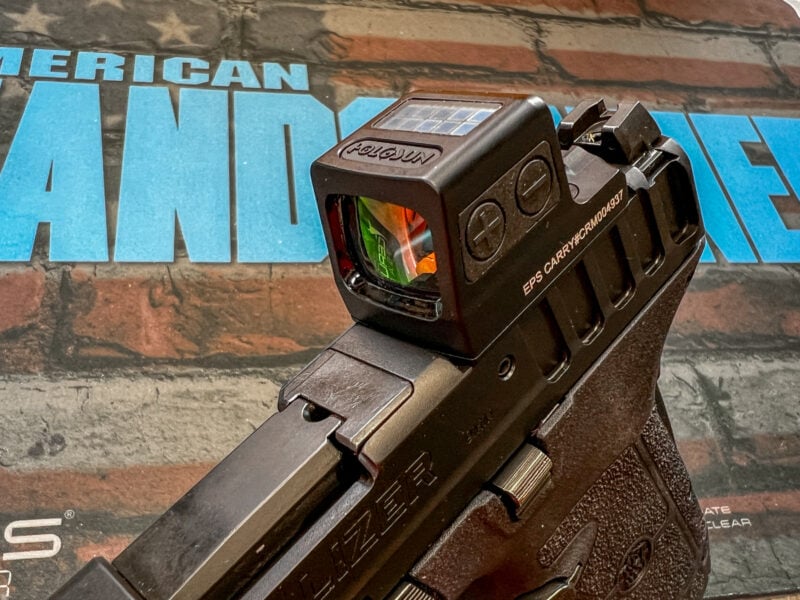
A pistol-mounted red dot sight can teach you a few things if you're willing to learn.
I sometimes think of one reader’s mail in response to a training article and the comments on it. This reader saw training as a “waste of time” as he learned everything he needed to know about concealed carry “decades ago.” As you might guess, lots of other readers took great offense to that line of thinking, correctly pointing out that those who become masters of their craft, whatever it is, never cease focusing on practicing the basics relentlessly while committing to a regimen of never-ending learning.
It’s good advice to live by. Waking up every day determined to learn something new is a great way to go through life.
It got me thinking of a couple of things I’ve learned on a years-long experiment with pistol-mounted red dots. What can you learn by using a red dot?
Your Presentation Consistency Stinks
I’ve always said that finding the dot is easy if you just stop looking for it. And that’s a serious statement. Forgetting it’s there and just looking for the front sight seems to ensure the dot is present and ready when you need it.
Another shooting technique habit makes the “finding the dot” mostly a moot point: consistent presentation from the draw. If you raise your pistol to the sight picture and firing position the same way every time, with no variance, your red dot (or iron sights for that matter) will be pretty much lined up with your eyeballs and the target. If you stop and think about it, a perfectly consistent presentation is a great skill to develop for a whole lot of reasons. Speed is a big one as, by definition, there’s no wasted motion. Flinging your gun up, then making correction adjustments up, down, or side to side, is always going to be slower than bringing the sights up to the perfect firing position correctly with the initial motion. When you’re really in the groove, you can even begin the trigger press as the muzzle travels the last couple of inches to the “on target” position.
Having to look for the red dot once your gun is raised and extended just might be telling you that your consistency of presentation might need some work.

Apples and oranges. I'd never turn down "iron sights" as they are reliable and certainly proven.
Red dots offer an alternative option for many, especially those struggling with perfect eyesight.
Your Trigger Press Stinks
I guess useful procedures stick around. Back when lasers were all the rage, one benefit of the accessory was its usefulness to highlight a lacking trigger press technique. When firing a real shot or a dry fire simulation, watching the motion of the laser on the target was a ruthless way to expose a trigger jerk or other poor press technique. Timing the shot? The laser would sit fairly still, then jump all over the place as the shot broke. Sympathetic grip as you pulled the trigger? That laser would head straight down on the target.
A red dot is a useful way to see the same types of errors. Sure, technically speaking, if you carefully watch iron sights, you’ll see movement against the target from poor trigger technique, but a red dot makes it much, much easier to see movement of the gun. Just aim at a precise and highly visible part of the target so you can tell if the dot shifts as you break the shot.
How to Get More Value From Dry Firing
Also, like a laser, a red dot sight can be a useful training aid when dry-firing.
Again, picking a small and discrete target, you can complete your dry fire exercises, carefully watching that dot before, during, and after the trigger break.
Without the bang and recoil, it’s easy to focus on the dot superimposed on your target to see if there’s any unwanted movement as you complete a full trigger press and break.
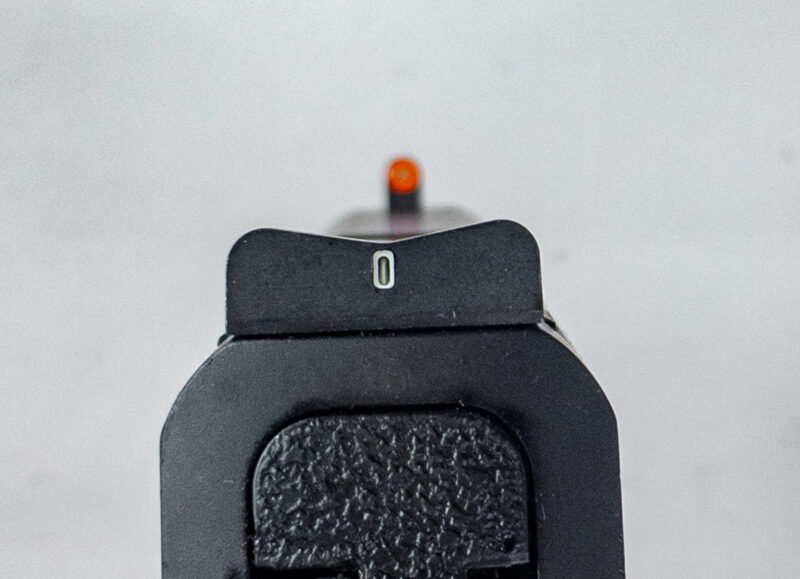
The human eye can only really focus on one thing at a time, so when sighting,
you have to choose front sight, rear sight, or the target.
How to Be An Adult
If you’re relying on an electrically-powered device for a defensive gun, it’s going to be up to you to make sure those batteries work.
Lots of people mock red dots, saying something like, “What if the batteries run out? Then what are you going to do?”
Well, for starters, you can do what everyone else who relies on electrical equipment does and be an adult. Make sure you change the batteries on a schedule that guarantees they won’t just “run out” at some inopportune time.
If you watch a professional event crew (think of one with big-time speakers, large audiences, etc.) run things, you’ll notice they constantly put fresh batteries in the speakers’ lapel mikes. Sure, they could save some money by just waiting until the batteries just “ran out” in the middle of some VIP’s speech, but that wouldn’t be very professional or “adult-like,” would it? A similar proactive habit works great on red dot sights. Just change them yearly or quarterly (depending on your equipment), whether they need it or not.
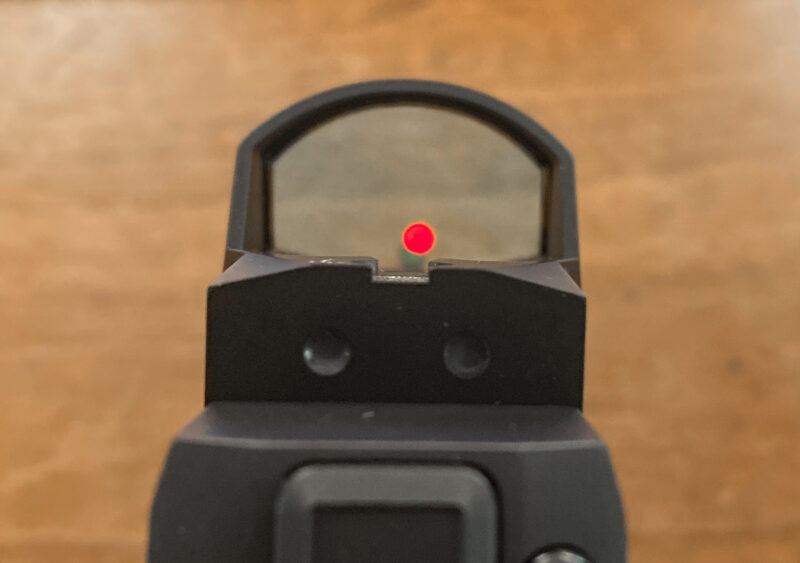
Eliminating the multi-point focus requirement can help you learn some things about your gun and its accuracy.
With a red dot, both the target and the sighting dot can be in focus.
Batteries Can Surprise You
Part of being a responsible gear operator is knowing your equipment. While testing one red dot sight that was supposed to run continuously for a couple of years, I found out it ate batteries in just a couple of months. As it turned out, using one of the reticle choices with a dot surrounded by a circle drained the batteries way faster than anticipated.
Armed with that knowledge of the realities of this equipment, I could decide whether to use another brand or replace the batteries monthly. Again, proactivity and taking responsibility are the key.
How Accurate Your Gun Really Is
With the right setup, you can test a gun’s accuracy with a lot of different configurations, including standard iron sights. However, the challenge with using iron sights is precise and repeatable alignment between your eyes, the rear sight, the front sight, and a target far enough away to be statistically significant, like the standard 25 yards for most handgun accuracy tests. Human eyes can only focus on one distance at a time, so it’s not easy to get perfect alignment.
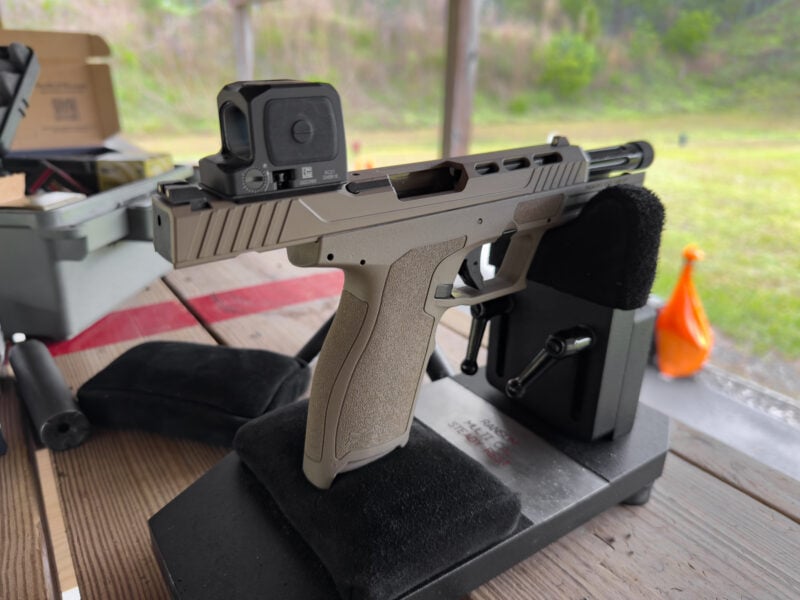
I always try to use a red dot sight when testing accuracy at 25 yards simply for its ability
to reduce sighting and alignment error.
At that distance, a fraction of a millimeter of sighting alignment error is enough to blow a group and make you think your gun just isn’t accurate.
Let’s assume front and rear sights are 5 inches apart. If the two are out of perfect alignment by a single millimeter, that results in a 7+” miss at 25 yards. Since the relationship is linear, just a 1/10th of a millimeter misalignment would result in almost a 3/4” “miss” at 25 yards.
A crisp red dot sight removes the need for front and rear sight alignment with the target and removes the problem of the human eye being able to focus on only one distance. The dot allows focus on the target and helps remove the potential for “eyeball” error.
So, a crisp and small MOA red dot (or one dimmed down so it’s not blurry) is a great way to see what your gun can really do.
How about you? Learned anything from using red dot sights?
Get more exclusive online content from American Handgunner delivered straight to your inbox. Sign up for our free American Handgunner Insider newsletter.