Fun Facts About my Favorite Caliber: .357 SIG

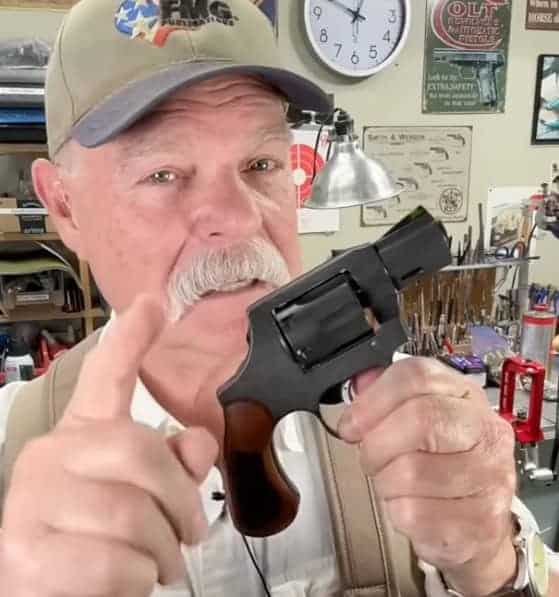
I've done lots of gel testing, with and without various barriers,
and .357 SIG never fails to disappoint with dramatic expansion.
OK, I readily admit, others may be lining up for tickets to the ancient history of the .357 SIG exhibit at the local museum. Not me. While it’s getting harder and harder to find new guns chambered in the kinda weird bottleneck caliber, there are plenty of used ones still in circulation.
And yes, I’m well aware it’s an expensive caliber if you’re buying only factory-loaded ammo. Price correlates with volume, and among mainstream calibers like 9mm and .45ACP, it’s hard for the low-volume .357 SIG to compete. I guess there aren’t enough weirdos like me in the market.
On the other hand, it’s hard to find arguments against its performance. Snappy? Yeah, a little. Effective for defensive applications? Absolutely. Reliable? That bottleneck design aids feeding, largely removing one obstacle to reliable performance.
Let’s take a look at some of the fun facts about the .357 SIG. Some are borderline myths, but like most myths, there’s usually a bit of truth in there somewhere.
.357 SIG performance is equal to the .357 Magnum? But is it, really?
The “classic” .357 Magnum load features a 125-grain bullet flung at a velocity approaching 1,500 feet per second. I know, the revolver version often uses heavier bullets too, but we’re making an effort at an apples-to-apples comparison here, hence the 125-grain version. A quick side note: the .357 Magnum projectile (jacketed versions) usually measures .357 inches. I wonder where they got the name?
Anyway, the .357 SIG can come close with many factory loads launching a .355-inch, 125-grain bullet at velocities in the 1,350 to 1,450 fps range. Some specialty loads can do a bit better, and other ammo makers take the more conservative route and load in the 1,200 to 1,300 fps range.
As already hinted, the .357 Magnum can also launch a much heavier bullet, such as a 158-grain version, at high velocity. The .357 SIG is more limited due to case length and cartridge case capacity. The Magnum sports about 35% more case volume.
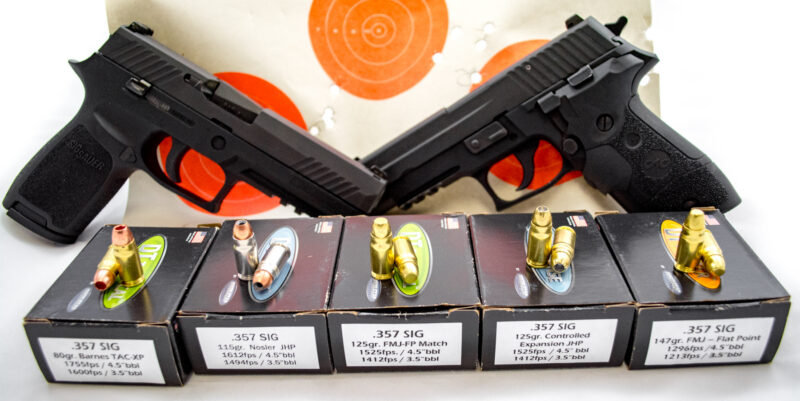
The folks at DoubleTap Ammo have found ways to equal the .357 Magnum 125-grain load velocity in the .357 SIG cartridge.
.357 SIG was designed for semi-automatics.
Traditionally, the .357 Magnum has been a revolver-only cartridge. Its cartridge length and rimmed case aren’t exactly friendly to semi-automatic design. Don’t tell that to Coonan, Inc., however. They designed and marketed a line of semi-auto pistols that seemed to work just fine with the .357 Magnum.
The .357 SIG was designed from the get-go to provide .357 Magnum-like performance in a semi-automatic handgun. Unlike the Coonan, which had a, let’s say, unusual grip profile, .357 SIG pistols can fit into the same footprint as .40 S&W.
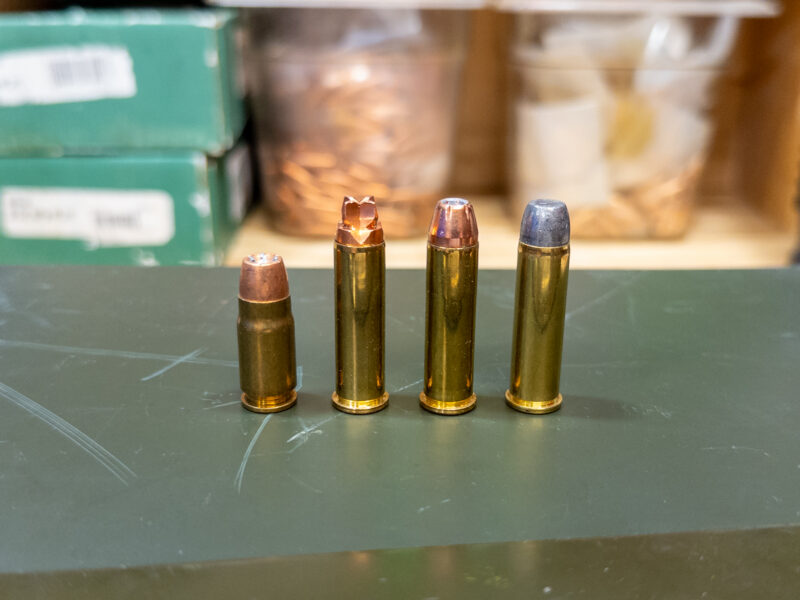
Note the difference in case capacity. It's tough to eyeball, but the .357 Magnum
generally has 35-40% more powder capacity.
The .357 SIG cartridge was invented by, you guessed it, SIG SAUER.
Projects like cartridge development are always a team effort. In this case, Sig Sauer worked with ammunition maker Federal Cartridge to develop the cartridge. It was originally released back in 1994, so it’s still a relative newcomer on the block.
The goals were simple. Achieve .357 Magnum-like performance from a semi-auto pistol without sacrificing magazine capacity of the .40 S&W guns.
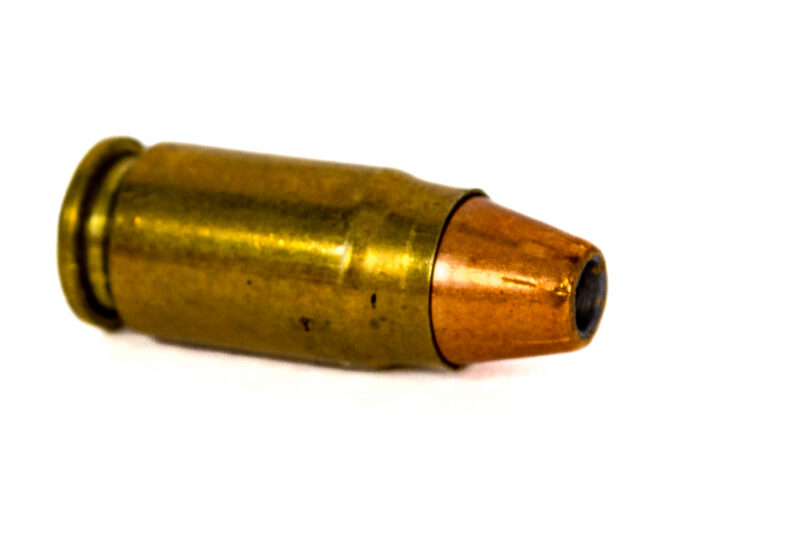
After cost, here's one potential downside of .357 SIG — the possibility of bullet setback.
Keep an eye on that first cartridge if you re-chamber it frequently.
The .357 SIG is based on the .40 S&W. Kind of.
While the lower case diameter and case rim dimensions are exactly the same between the .40 S&W and .357 SIG, the cases are not the same. Obviously, the .357 SIG has a bottleneck design, but it’s not a simple sizing operation that differentiates .40 S&W and .357 SIG cases. The .357 SIG case is about 0.009 inches longer. Some folks will make .357 SIG cases from .40 S&W brass. But then again, “some folks” do all kinds of things. I don’t and wouldn’t recommend it.
Highway Patrol agencies seem(ed) to like it.
For a while, a surprising number of state highway patrol agencies adopted the .357 SIG caliber. It’s hard to tell how many are still using it given the resurgence of the 9mm in law enforcement communities.
If I had to guess (key word: “guess”) as to the initial popularity in that specific community, I would surmise that highway patrol officers might be more likely to engage in road incidents requiring car door penetration. The extra velocity of the .357 SIG gives it better penetration performance over slower rounds like the 9mm and .40 S&W.
Other notable law enforcement organizations have used the .357 SIG over the years. Some of those include the United States Secret Service, Federal Air Marshals, and the Texas Rangers.

One of the benefits of .357 Magnum's larger case capacity and overall length
is the diversity in bullet weights, all able to be pushed at hyper-speed.
Not all .357 SIG loads are equal.
Some manufacturers choose not to provide the full performance capability of the cartridge. For example, Hornady loads its .357 SIG Critical Defense ammo with a lighter 115-grain bullet traveling at only 1,235 fps. Their 135-grain Critical Duty load moves at 1,225 fps. On the other hand, Mike McNett, the godfather of boom from DoubleTap Ammunition loads his 125-grain cartridge to cook along at 1,525 fps. If you want to be all you can be when using a .357 SIG pistol, choose your ammunition according to the specs and bullet weight you prefer. All .357 SIG loads are not the same.
SIG SAUER produced the first .357 SIG handgun.
As you might have guessed, the first handgun released for the cartridge came from one of the inventors. In 1994, SIG SAUER released a specially designed version of the popular P229 pistol to handle the higher pressures of the .357 SIG cartridge. Just in case you were wondering, the maximum pressures are either 40,000 pounds per square inch or 44,240 psi, depending on whether you get your figures from Sporting Arms and Ammunition Manufacturers’ Institute (SAAMI) or Commission Internationale Permanente pour l’Epreuve des Armes à Feu Portatives (C.I.P.).
Ever sold a gun, and sometime after the fact wondered why in the heck you ever sold it? Don’t ask me about a P229 I had in .357 SIG. It’s a sore subject.
Got power?
Kinetic energy is one measurement of the “power” of a cartridge. While you can’t make generalizations that one bullet is twice as good as another if the kinetic energy is doubled, you can use the measure as a guideline. Many other factors, like momentum, diameter, and bullet design, come into play.
With that said, here’s how the .357 SIG stacks up against some other common cartridges.
• .357 SIG with 125-grain bullet at 1,450 fps: 583.7 foot-pounds
• 9mm with 115-grain bullet at 1,150 fps: 337.8 ft-lbs
• .380 ACP with 90-grain bullet at 950 fps: 180.4 ft-lbs
• .45 ACP with 230-grain bullet at 850 fps: 369 ft-lbs
• .40 S&W with 180-grain bullet at 1,050 fps: 440.7 ft-lbs
So there you have it, a look at my favorite caliber, the .357 SIG. Expensive? Yes. Look at the bright side; it’s a great excuse to take up reloading.
Get more exclusive online content from American Handgunner delivered straight to your inbox. Sign up for our free American Handgunner Insider newsletter.