Alternative Gun Thinking
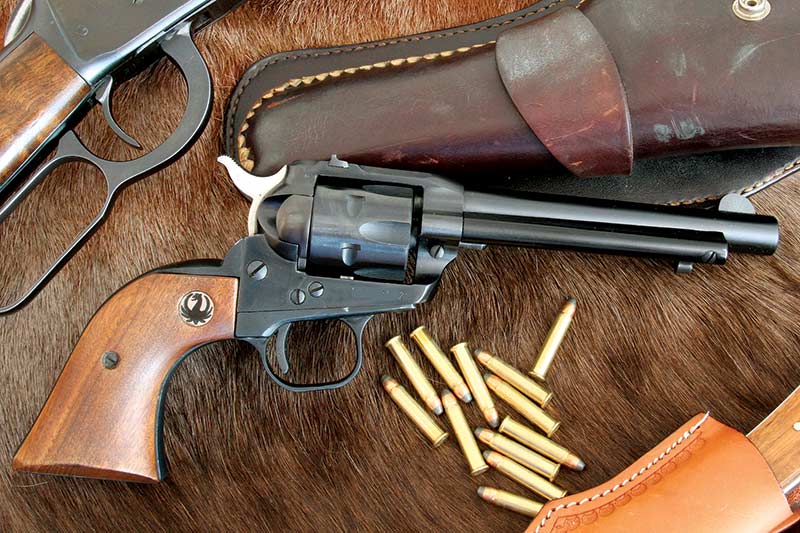
SA revolvers generally have a gate on the right side of the frame. Opening it allows
access to the chambers for loading and unloading. Centerfire or rimfire, operation is the same.
During WWII the First Special Services Force (FSSF) was armed with U.S. weapons, including Johnson machine guns. They were also trained in the use of captured weapons, including firing exercises, disassembly, maintenance and reassembly. I think there’s a good lesson there for modern handgunners.
Today, there are so many makes and models you can hardly be expected to become familiar, much less proficient, with all of them. To become familiar with them, the logical thing might be to buy one of every new gun to stay familiar with the new technology. But we all know, realistically you could likely never do that.
A variation of this plan is a procedure I follow on a small scale. When I want to learn more about a certain model I search for a clean used sample I can buy at a decent price. Then I disassemble it, reassemble, shoot it and photograph it for my files. Generally after a few months I can trade or sell it without too much loss. It’s not a quick way to learn about different guns but it is thorough.

A latch on the left side of this Enfield top-break is pressed down allowing the barrel/cylinder
assembly to pivot down, exposing the chambers for loading and unloading.
Revolver-Centric
Most handgun owners are content owning a handgun or two and really aren’t interested in building up a collection. I know our regular readers are much more knowledgeable and enthusiastic than most handgun owners, but even they have lots of interests other than shooting — and allocate time and money for those interests.
An excellent alternative is to get active in a local gun club. In many places the only place to shoot safely is at a formal range, often carrying a requirement of being a member. Don’t expect other members to offer pistols for you to try out right away — and keep in mind, it’s often considered bad manners to ask. Once you get to be a regular, you’ll find other members happy to share knowledge and equipment.
Maybe you want to learn more about revolvers. No need to go in to see if this is the club for you, just check the parking lot. If you see working pickups, a rusty tool chest bolted in back, a manual transmission with a real compound-low truck gearing, brush scratches and a cracked windshield, odds are you’ve found revolver people.
In this semi-auto era a primer on revolvers might keep you from looking like a complete newbie. Let’s assume you’re a competent handgunner well versed in safe firearm use. Here’s a few points to ponder about wheelguns — never forgetting there’re exceptions to about everything.
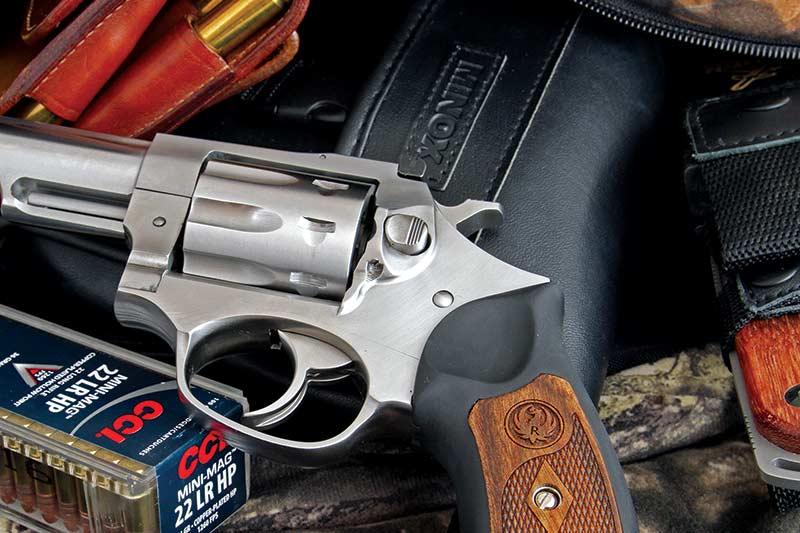
Some DA revolvers, like those made by Ruger and Kimber, use a cylinder latch pressed
inward rather than forward, like a S&W. Revolver is an 8-shot Ruger in .22 LR.
Musings
Revolvers generally have no manual safety, though usually there are internal parts to prevent firing if the gun is dropped. Single-action revolvers have just one way of being fired — the hammer is manually cocked, rotating the cylinder, bringing a cartridge in line with the barrel. Then the gun is fired by pressing the trigger.
DA revolvers have two ways of being fired. The hammer can be cocked and trigger pressed to fire as with a single-action. The gun can also be fired with one long heavy pull on the trigger — rotating the cylinder and cocking the hammer back, compressing the mainspring.
With single-action revolvers a gate on the right side of the frame is opened, providing access to the cylinder for loading and unloading. Most DA revolvers have a cylinder swinging out to the left for loading and unloading. The cylinder is released by a latch on the left side of the frame. The cylinder latch can be moved back to release (Colt); pushed forward to release (S&W and Taurus), or pushed inward to release (Ruger or Kimber).
You can learn a lot from those old revolver guys. Just remember, a mind is like a parachute, they both work better when they’re open.