Pocket Rocket Science:
FALCO Pocket Holsters
for Snub-Nose Revolvers
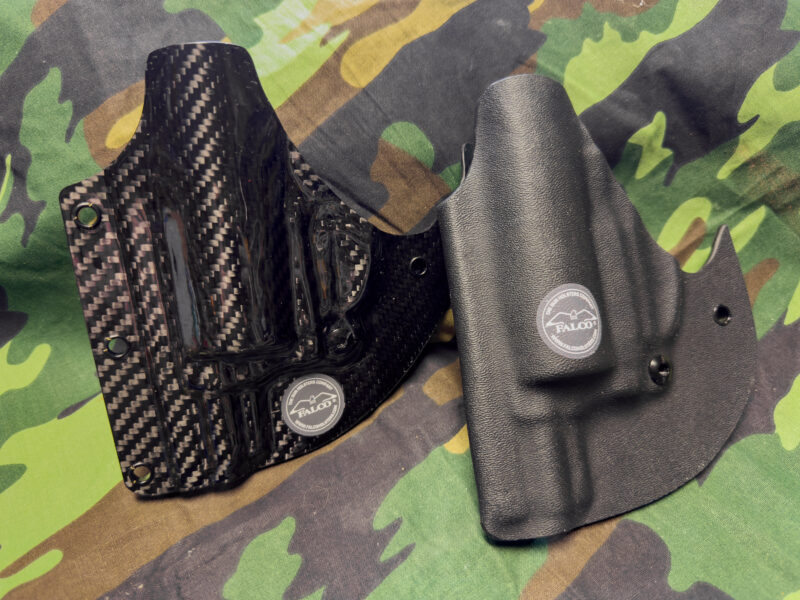
The two models are identical except for the materials used for construction.
There’s a reason the snub-nose revolver refuses to die. It’s been declared obsolete approximately 47,000 times since the invention of compact semi-autos, yet the little five-shooter persists like that one uncle at Thanksgiving who just won’t leave. And for good reason. Example: My Smith & Wesson 642 Performance Center, all 15 ounces of it, drops into a front pocket and functionally ceases to exist, at least to the outside world. No special wardrobe. No gun belt. No untucked Hawaiian shirt in January. Just a hand in a pocket and five rounds of .38 Special +P that nobody knows about.
But here’s the thing. That little revolver needs a proper home inside that pocket, and jamming a bare gun into your pants doesn’t qualify.
Why You Need a Pocket Holster (No, Really)
I know what you’re thinking. “It’s a revolver. The double-action pull on a 642 is roughly equivalent to bench pressing a Buick. What’s the worst that can happen?”
Fair point on the trigger weight. The pull weight on most double-action stubbies runs somewhere in the neighborhood of 10 to 12 pounds, which is heavy enough to discourage most accidental discharges. But “most” and “all” are different words, and they have very different consequences.

I've been using the FALCO Kydex pocket holster with my Smith & Wesson 642 Performance Center snubbie.
And don’t forget: a pocket is a hostile environment. Keys, coins, pocket knives, pens, and the occasional breath mint all share that dark little cavern with your revolver. But you’re not going to carry any of that in the same pocket as your gun anyway, are you? But you know what is there? Lint. Besides, pants pocket material is thin stuff compared to a holster body, and you certainly don’t want something from outside the pocket (seatbelts, furniture, or whatever) exerting force on the trigger either.
Bottom line: a proper pocket holster does one critical job above all others: it covers and protects the trigger. Everything else is a bonus feature.
What Makes a Good Pocket Holster?
So we agree, a pocket holster is non-negotiable. But not all pocket holsters are created equal.
A quality pocket holster has to do four things well.
1. Protect the trigger. We covered this. It’s the prime directive. The holster must fully enclose the trigger guard and prevent anything from contacting the trigger while the gun is holstered.
2. Keep the gun oriented properly. When you reach into that pocket, the grip needs to be where your hand expects it to be, every single time.
3. Aid concealment. A bare J-Frame in a pocket prints like a revolver. It’s got that distinctive shape, the cylinder bulge, the outline of the grip. A good pocket holster breaks up that telltale silhouette. The best ones make the package look like a wallet, a phone, or just a generic rectangular lump.
4. And this is the big one: Stay in the pocket when you draw. The holster stays, the gun leaves. If the holster comes along for the ride, not only do you look like an idiot, but you’ve now got a gun with a holster dangling off it. That definitely makes shooting under stress even more stressful.
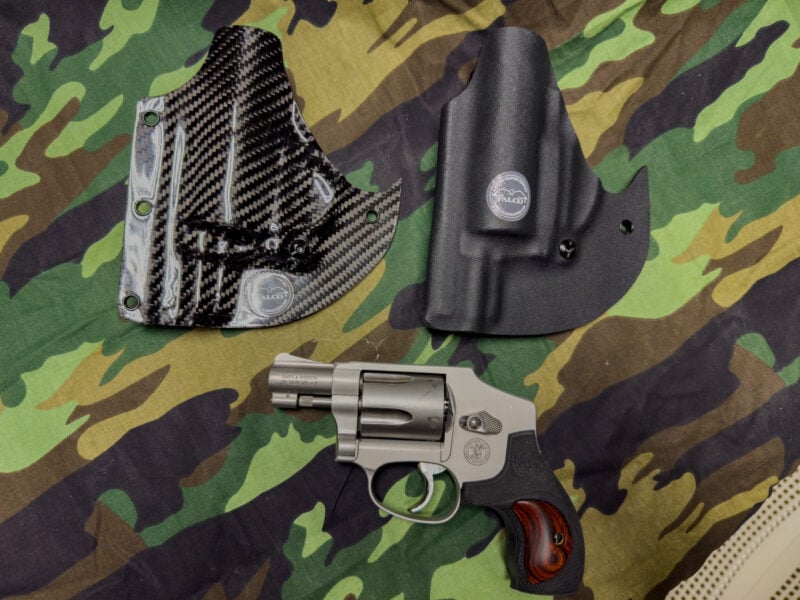
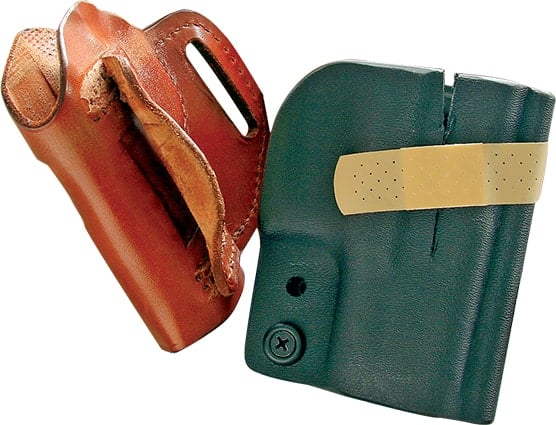
I shot this picture for scale. The pocket snubbie holsters seem very large and I wasn't sure
they'd fit in my jeans pocket, but fit they do. And the size turned out to be a benefit.
They do not move around in the pocket.
FALCO's Take on the Pocket Holster
FALCO Holsters has been making holsters since 1989, starting out in a garage in Slovakia, making leather falconry gloves. That’s right, falconry gloves. The company has since expanded somewhat; they now make holsters for over 3,600 handgun models in leather, Kydex, carbon fiber, and hybrid configurations. They supply individuals, law enforcement, and military units around the globe, which is a decent upgrade from the falcon glove business.
They recently launched a new generation of pocket holsters, and I got my hands on two of them to test with my 642 PC: the A913 Kydex Pocket Holster and the AX93 Carbon Fiber Pocket Holster.
FALCO A913 Kydex Pocket Holster
The A913 is built from genuine U.S.-made Kydex, individually molded to fit your specific handgun. Each holster is formed in-house on exact 1:1 replicas of individual firearm models.
Retention is adjustable via a screw positioned near the trigger guard, so you can dial in exactly the amount of draw resistance you prefer. Mine shipped loose, allowing me to gradually tighten to my preference. This is a personal thing. Some folks like a firm click-and-tug retention. Others prefer something that releases with minimal effort. The adjustment screw lets you find your sweet spot.
The holster supports three draw techniques, which all separate the gun from the holster.
• Thumb Push Draw: Your shooting hand thumb pushes against the exposed Kydex edge on the left side of the holster, separating the gun from the holster right inside the pocket.
• C-Shaped Hook Draw: An aggressive hook at the base of the holster catches on the lower edge of your pocket opening during the draw stroke. As you pull the gun upward, the hook anchors the holster in the pocket.
• Paracord-Assisted Draw: This one’s designed primarily for off-body carry, like in a bag or purse. A metal eyelet on the hook accepts a paracord that anchors the holster inside the bag, ensuring the holster stays put during a rapid draw.
For standard front-pocket carry with the 642, I found my thumb naturally positioned on the interior holster ridge, but there’s no need; the C-hook does its job.
FALCO AX93 Carbon Fiber Pocket Holster
The AX93 is the same basic design as the A913 but constructed entirely from genuine carbon fiber.
But before we get into how it performs, let’s talk about what carbon fiber actually is. Beware of Kydex with a carbon fiber “print” or design. This one is real through and through.
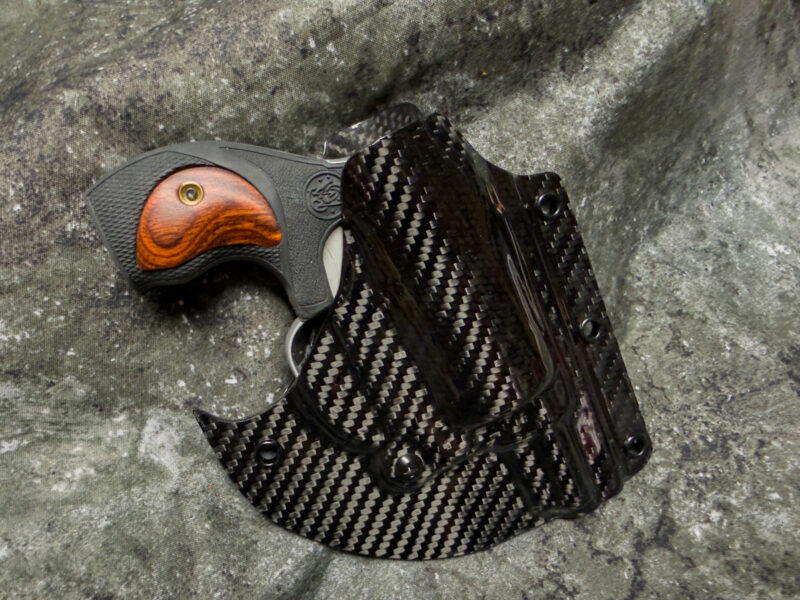
Not only does the genuine carbon fiber model look cool, but it's noticeably sturdier, thinner and lighter
than the kydex version. And both are far thinner in the pocket than leather.
Carbon Fiber: A Quick Material Science Detour
Carbon fiber starts life as thin strands of carbon filaments, each about 5 to 10 micrometers in diameter. For reference, that’s roughly a tenth the width of a human hair. These filaments are woven into a fabric and then bonded with an epoxy resin to create a composite material.
The result is something remarkable. Carbon fiber composite offers tensile strength in the range of 3,500 to 7,000 megapascals. Steel, by comparison, typically ranges from 400 to 1,200 MPa. Even high-strength steel alloys only reach about 2,000 to 2,600 MPa. So carbon fiber can be several times stronger than steel, depending on the specific formulation.
Here’s where it gets interesting for holster applications. Carbon fiber delivers all that strength at a fraction of the weight. Its density runs about 1.6 g/cm³, compared to steel’s 7.8 g/cm³. Of course, a steel holster would suck, but it’s a fun comparison. In practical terms, carbon fiber offers a strength-to-weight ratio somewhere between 40 and 50 times that of steel. This is why the aerospace industry loves it. This is why Formula 1 cars are built with it. And this is why it makes for a compelling holster material.
For a pocket holster specifically, the advantages stack up nicely:
• Thinness. Carbon fiber’s exceptional strength means you can use less material to achieve the same (or better) rigidity than Kydex. In a pocket, where every fraction of a millimeter matters for concealment and comfort, thinner is better.
• Light weight. It’s already a small holster, so we’re not talking about dramatic weight savings. But every bit counts when you’re carrying all day, every day.
• Rigidity. Carbon fiber is extremely stiff, which translates to consistent retention and a holster body that won’t flex, warp, or deform over time. It holds its shape even in extreme temperatures where some thermoplastics might become soft or brittle.
• Durability. FALCO puts it at roughly three times the durability of Kydex. Carbon fiber resists moisture, UV degradation, and general wear-and-tear in ways that thermoplastics can’t quite match. For something living in your pocket, getting sat on, bumped against chair arms, and generally abused, longevity matters.
• And yes, it looks cool. That distinctive woven pattern under a clear resin finish has a certain high-tech appeal. It’s subtle, but if you’re going to spend extra cash on a pocket holster, it’s nice that it looks like it belongs on a stealth bomber.
Pocket Carry: The Concealment Argument
Many swear that IWB carry is the gold standard for concealed carry, and rightfully so. A quality inside-the-waistband holster with a good belt provides excellent retention, a consistent draw stroke, and solid concealment for most body types. But it requires a belt. And pants with belt loops. And usually a cover garment. There are days, situations, and wardrobes where all of that just doesn’t work. Summer is almost upon us.
Pocket carry with a snub-nose revolver is the ultimate “no excuses” option. Gym shorts? Pocket carry. Dress slacks at a business dinner? Pocket carry. Running to the hardware store in sweatpants on a Saturday morning? Pocket carry. OK, it’s the no excuse not to carry option for lazy people.
With my 642 PC, this one fills my standard blue jeans pocket, which means no movement of the rig. And it does a swell job of breaking up the gun outline. If someone really is staring at my midsection, they can tell something is in my pocket, not that it’s a gun.
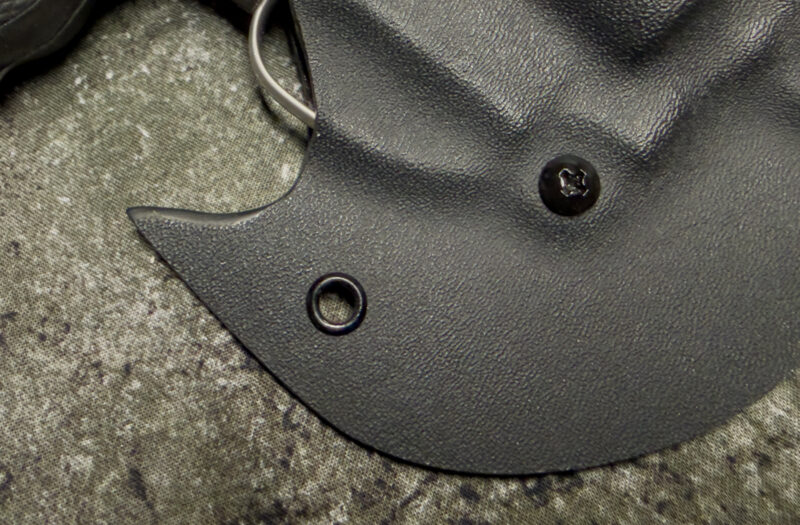
There's a grommeted hole in case you want to anchor the holster into a deep pocket
of an off-body carry bag. Note the retention adjustment screw.
Wrapping Up
A snub-nose revolver without a pocket holster is like a hammer without a handle. Technically functional, but you’re asking for trouble. The FALCO A913 and AX93 pocket holsters do the job right, protecting the trigger, consistently orienting the gun, aiding concealment, and staying put when you draw.
I hadn’t used Kydex or Carbon Fiber for a pocket snubbie before. For whatever reason, I’ve always defaulted to leather. But I was quickly spoiled by the reduction in overall thickness of the holstered revolver. It makes a huge difference.
For more info: FalcoHolsters.com
Get more exclusive online content from American Handgunner delivered straight to your inbox. Sign up for our free American Handgunner Insider newsletter.