Back to the Future:
Why DA/SA Still Deserves a Spot
in the Holster

The first double-action trigger pull of this SIG P229 provides extra protection against an unintended discharge.
And I like the visual cue of the exposed hammer as a visual and tactile reminder of its status.
I like a variety of action, how about you?
Single, double, double and single. They’re all good in my book. Striker-fired is fine too, although for reasons we’ll explore in a minute, I seem to have drifted away from that a bit for my most common daily choice. For now, I will say I seem to be a founding member of the minority group if we’re segregating by action types.
It’s no secret that striker-fired pistols have taken over the law enforcement, concealed carry, home defense and recreational shooting segments. While production figures might not map precisely what people are using right now, it’s a pretty darn good indicator.
In 2024, looking at worldwide production, gun manufacturers made a lot of striker-fired handguns. In fact, of all the handguns produced, a whopping 72.6% were striker-fired pistols of some kind.
My daily carry operating system of choice, at least recently, is a single-action 2011 design chambered in 9mm. Sometimes I go with the classic single-action semi, a 1911 design in either .45 ACP or 9mm. The operating systems between the 2011 and 1911 are virtually identical, so switching around doesn’t affect me much. Worldwide production in the same year recorded about a 15.2% share of all single-action pistols of all calibers. Another 12.2% were double-action pistols of some sort, whether double-action only or double/single-action designs.
I suppose I walk to the beat of my own drum, but about one in six of you seem to accompany me.
Recently, I’ve been pondering something a bit older in my carry history: the double-action/single-action pistol. You know, like the early classics. The Walther PPK, most Beretta models, and classic SIGs, to name just a few. And I’ve been wondering if we might be on the cusp of a resurgence of sorts of that design.
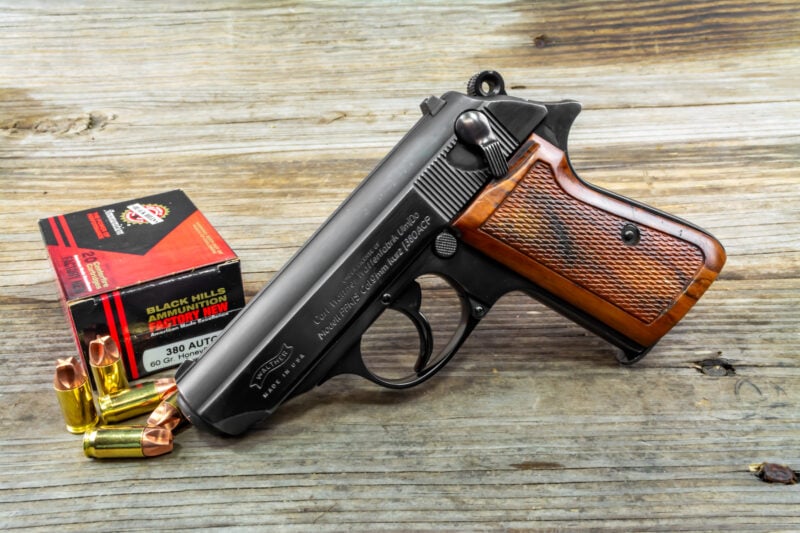
The DA/SA concept certainly isn't new. While this Walther PPK/S was made in the 60s, the design dates back decades before that.
When paired with modern ammo like this Black Hills HoneyBadger, it's a viable carry option.
Striker Drama
Unless you’ve been living in either France or perhaps California (sorry Californians, I’m just kidding!), you might have heard about the great striker-fired pistol drama of this year, and the year before, and maybe the year before that.
I am not going to step into that debate here. I’m not a ballistic engineer, and am certainly not qualified to weigh in with meaningful commentary on who’s right and who is wrong. Besides, like most controversies of this sort, there are plenty of disputed facts and anecdotes to make a clear answer elusive, maybe permanently.
While most of the panic and resulting arguments have been limited to one manufacturer and one pistol model family, the whole thing has gotten me thinking about the concept of carrying around a pistol with a pre-cocked (usually partially) internal striker. To be fair, it’s really not much different conceptually than carrying a single-action with a cocked hammer. In both cases, there are safety mechanisms to prevent firing until certain, well-defined conditions are met.
The difference is, and this is admittedly my Fudd take on the matter, that I can see and feel the safety status on a single-action pistol, or on a striker-fired model with a manual safety.
Just to be really, really clear, I have no qualms whatsoever about carrying a striker gun without an additional manual safety. In fact, most of my striker pistols are not equipped that way. It’s my next “pondering this” topic that got me thinking about this whole matter.

I find I like the comfort of extra layers of safety when carrying in the appendix position.
Both the single-action Staccato 2011 (left) and SIG P229 Legion (right) provide that, just in different ways.
Appendix Carry
The second factor is the continued growth of appendix carry as a concealment method. The figures are a bit challenging to nail down, but sources indicate that in the early 2010s, less than 10% of concealed carriers used the appendix position. By now, that number has risen to somewhere in the 40% range.
I myself have been carrying that way for a couple of years now. We’ll save the whys for another time, but for now, my primary drivers were improved concealment and gun security combined with a dramatically faster draw.
But, as we all know, appendix carry places the gun near more sensitive areas. While a holstered gun is considered a safe gun, not capable of just “going off,” we still have to contend with drawing and re-holstering, which both rely on rigorous training to engage safeties, decockers, and getting fingers out of the trigger guard.
But, in worst-case scenarios, a negligent discharge is gonna be messier in the appendix position than the traditional hip location. You’ll get perforated in both locations, but if I had to, I’d choose the outside of the leg over somewhere around the inside. A true, centered appendix position is unlikely to point at one’s femoral artery, but as I said, things would be uglier regardless.
Extra Layers
So, with all that said, I tend to like extra layers when carrying up front, which is perhaps why I’ve gravitated to the 1911/2011 choices. The addition of the grip safety and thumb safety adds some extra layers of safety, at least in my mind.
While I’m fine carrying striker guns on the hip, I’ve tended to shy away from striker guns carried up front. Of course, many thousands of people do it every day, and striker guns generally don’t just “go off” on their own either, but again, I come back to the comforting effect of layers of safety. When carrying in a more sensitive position, I just feel better with a couple of extra layers.

This Beretta PX4 Compact Carry also offers a heavier first double-action trigger pull
and an ambitious decoder to put it back in that condition.
Double… Single…
Additional protection against an unplanned or negligent discharge has always been a foundational feature of the double/single design. That heavier initial trigger pull, 8 to 12 pounds in most cases, provides enough inertia to make an unintentional movement very unlikely.
And that’s precisely why I’ve pulled two of my favorite “old” guns out of the safe: a SIG SAUER P229 Legion and a Beretta PX4 Storm Compact Carry. Both were in regular carry rotation as recently as a couple of years ago, but once I boarded the 2011 train, they ended up back in the safe.
But now I’m bringing them back into the rotation. A little smaller but still easy to handle, they’re ideal for times when I’m not inclined to carry the full-sized 2011. And, at least in my book, they provide an extra layer of security.
As for the “dreaded” double-action / single-action transition? Bah humbug. It’s never bothered me. If you shoot regularly and learn to manage a trigger, any trigger, I doubt it will bother you too much either.
So, will we see a resurgence of the classic double/single? I doubt they’ll reverse production figures with striker-fired service pistols anytime soon, but it wouldn’t surprise me if we see more classics freshened up for the growing appendix carry market.
Get more exclusive online content from American Handgunner delivered straight to your inbox. Sign up for our free American Handgunner Insider newsletter.