OODA Schmooda:
The Loop in Normal
and Useful Terms
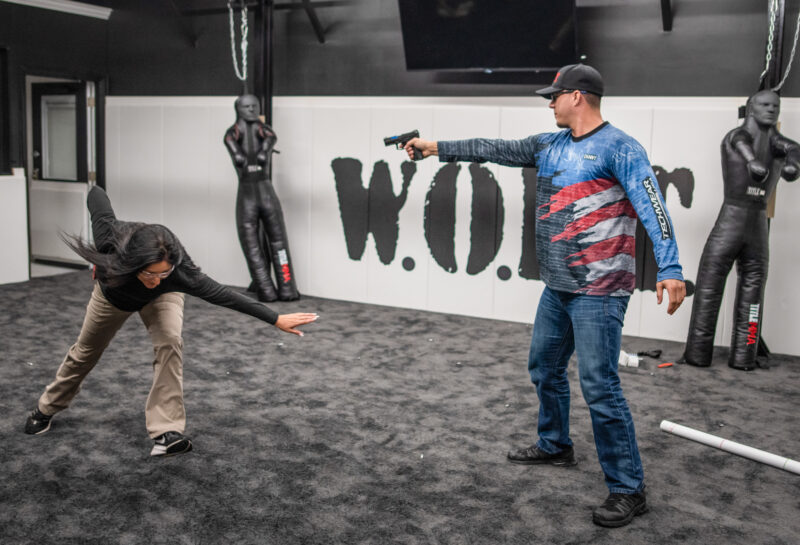
OODA. No, we’re not talking about some new yogurt that keeps you regulated.
We’re talking about the famous Air Force acronym developed by Air Force Colonel John Boyd to describe human decision processes.
In the gun community, this concept has been used, abused, misunderstood, and, in my view, misapplied to the point where it’s become some abstract bastardization of simple strategy.
Boyd, the Fighter Pilot Guy
When other fighter pilots start calling you “40-second Boyd,” you’re probably doing something right. If he had been a naval aviator, he’d have aced the Top Gun school and won the starring role in the movie.
About that 40-second thing… Boyd claimed that, from a position of disadvantage, he could “kill” his aerial dogfight opponent within 40 seconds. Apparently, there was enough truth to the claim that the nickname stuck. He did earn the pole position in his graduating class from Fighter Weapons School and was invited back as an instructor. Pretty impressive amongst that crowd that never lacks for self-confidence.
Anyway, his success derived from deep diving into the energy and maneuverability theories of fighter aircraft tactics. In addition to thinking about the constraints and advantages of physics and energy, he devoted a lot of brainpower to trying to glean an advantage through understanding how the human brain processes things during a fight. He packaged up his central ideas on the brain topic under the acronym of O.O.D.A. (Observe, Orient, Decide, and Act). Let’s take a Quick Look.
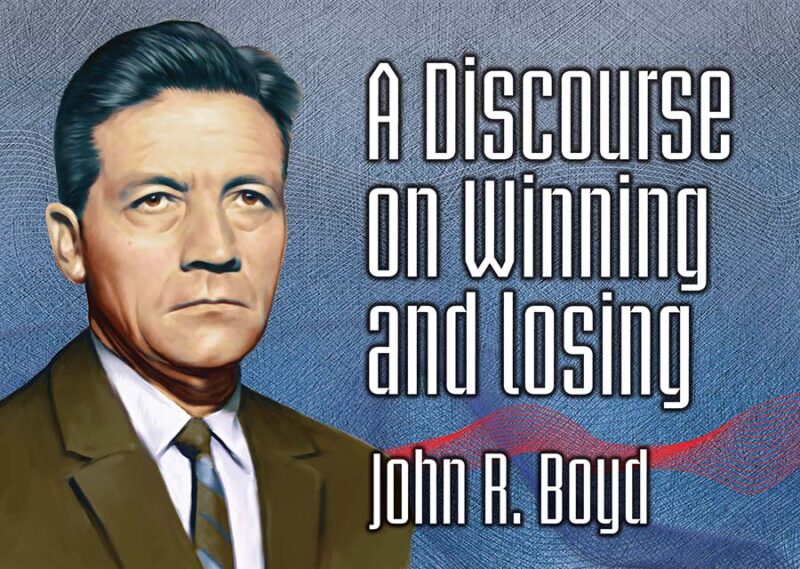
Col. Boyd rethought, and more importantly, documented both motion and energy factors of dogfighting
and the human brain response for action. Credit: Air University Press and Maxwell Air Force Base.
Observe
Step one is pretty obvious. Look around and see what is happening.
In our world, you observe a potential threat to your safety taking some observable action, like pulling a gun or knife, or moving aggressively toward you.
Orient
So, now you see something happening, and it’s time for the brain to kick into gear and figure out what it means and how it makes sense. This is the step where we apply all of our previous observations and experiences to make informed guesses at what’s happening and where it will lead.
If you’re driving and see a child running full speed through a yard toward the street, your experience tells you it’s impossible for them to stop instantly right at the curb. Your brain sees this and expects the child to continue into the street.
Decide
Now that you have an expectation of what is happening, you can begin the process of deciding what to do about it. Until you see something and understand what it is, there is no decision to make.
You see the child running, getting close to the street. You process this and understand running can’t stop instantly. Now you decide whether to hit the brakes or swerve out of the way.
Act
In the real world, if we’ve performed a “decision” many times before, the decide and act phases seem concurrent.
When the brain decides to hit the brakes, it just happens. We don’t really stop to think about issuing commands to the foot.
Of course, all of these steps happen in a fraction of a second.
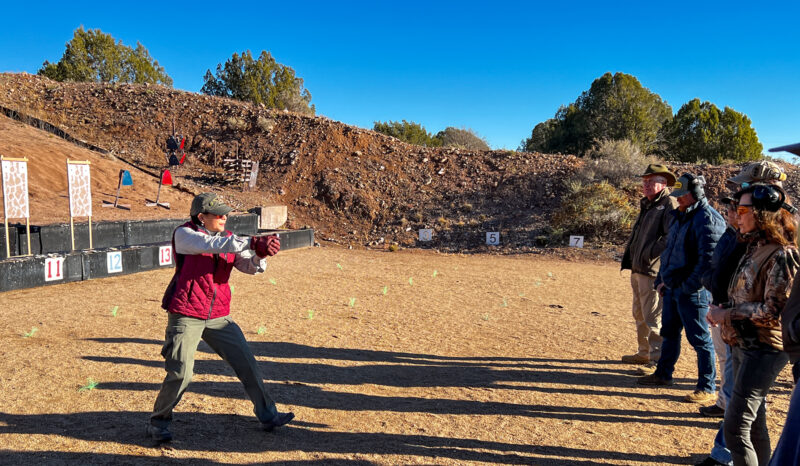
Every defensive shooting class, like this one at Gunsite Academy, teaches the benefits of moving.
Part of the reason is creating action so the attacker has to respond. Photo: Gunsite Academy
Overthinking Something Simple
Make no mistake, I credit Colonel Boyd bigly for thinking through and documenting all of this. But I think we’ve often tried to put his concepts to use in, well, a ridiculous way.
If I had a nickel for every time I’ve heard a gun guy explaining the OODA steps and definitions to a first-time gun owner or someone new to concealed carry, I’d have a lot of nickels. Some folks even perform drills on each of the four steps, thinking about “orienting” and checking their performance against the Webster definition of “orienting” as they go. OK, maybe I’m exaggerating just a bit, but not much. Stuff like this happens. I guess we humans tend to overcomplicate things in an effort to be impressively pedantic.
At the risk of committing heresy, I call, well, you know. Don’t get me wrong. The principles are fantastic, and the world owes Colonel Boyd a big thank you. But practicing this in theoretical models is kinda weird. Who’s going to be thinking about OODA loops when someone in the McRonald’s whips out a gun and demands all the money?
Boiling It Down
Here’s what we can process in training and actually apply in the real world. I’ll bet Boyd thought in these simple terms in the moment as well.
Action beats reaction.
If you’re the one who acts, the other guy has to do the OODA reacting. Sure, he’s not thinking in those terms, but that’s what’s happening in some accelerated process in his brain. When you turn the tables like that, you may not move to a position of advantage, but at a minimum, the level of your present disadvantage decreases.
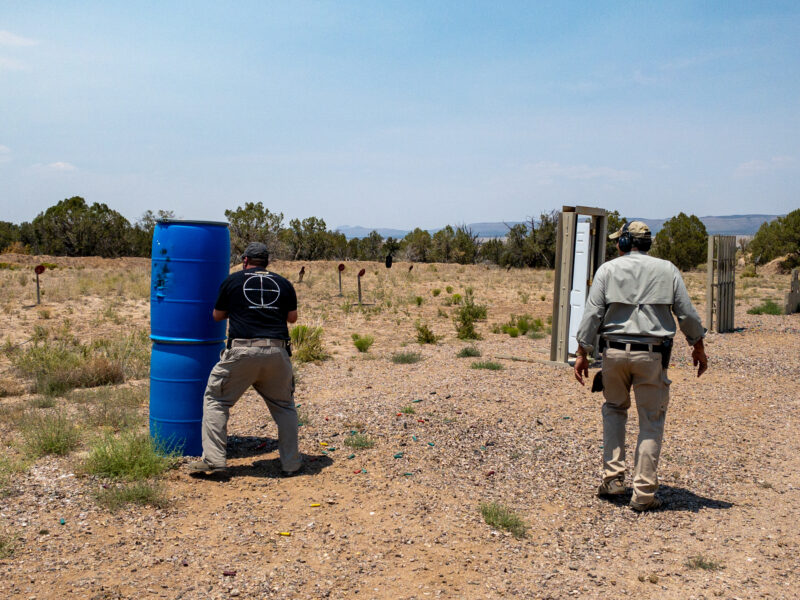
Part of the benefit to moving is cover or concealment, but the process also creates proactive "action."
A Real-World Example
How much difference can proactive “action” make? Consider the mass shooting at Virginia Tech back in 2007.
As a refresher, an armed psychopath attacked students and professors in five different classrooms in an academic building. In this case, some of the rooms took action, in a subconscious effort to disrupt the shooter’s plan. In others, students and professors got stuck in the observe and orient phases. The results of action versus inaction were stunning.
In two of the classrooms, when gunshots were heard, the students and professors took immediate action by barricading the classroom doors. In these two rooms, one professor and one student were killed. In the other three rooms where people were unable to process the situation and implement actions, 27 people were killed.
These things are always unfair to analyze in hindsight because no one expects something like that to happen to them. But, again in hindsight, this is yet another illustration of how actions that can disrupt someone’s pre-existing plan can make a real difference. The students in those two rooms didn’t have guns and body armor. They just locked and barricaded the doors. That was enough to interrupt the shooter’s action and make him create a revised plan.
An Action-Reaction Experiment
Let’s move to the action-reaction classroom.
In 2011, Dr. J. Pete Blair, a Criminal Justice Professor at Texas State University, set up an experiment to measure the impacts of action versus reaction.
He wanted to measure what reaction times might mean in scenarios encountered by police officers. So, he set up an environment where officers acted as both officers and “criminals,” all using non-lethal simulation guns. In various rooms, the “criminals” were instructed to aim their guns at either the floor or their own heads, as in a suicide scenario. The “criminals” were instructed to move from their starting position to aim their guns at the responding officers and shoot at a time of their choosing, by surprise.
Here’s the kicker. The responding officers were instructed to have their guns out and ready, and as soon as they saw the “criminals,” to aim their guns at them while they tried to de-escalate the situation. So the “criminal” is pointing their gun at either the floor or their own head. The officer is aiming at the “criminal,” ready to shoot. The officers were instructed to shoot as soon as they were directly threatened. In other words, just pull the trigger.

The "officers" and "criminals" experiment was in a facility like this, where responding officers were met
with surprise criminals who were ready to shoot.
Guess what?
The “criminals” took an average of .39 seconds to shift their gun from the starting position, aim at the officers and shoot. Remember, they started this motion by surprise. The officers, who already had their guns trained on the criminal, took .38 seconds to see what was happening, process it, and just pull the trigger on their guns.
Bottom line? Everyone shot each other in most cases. Not one officer was able to “win” the fight.
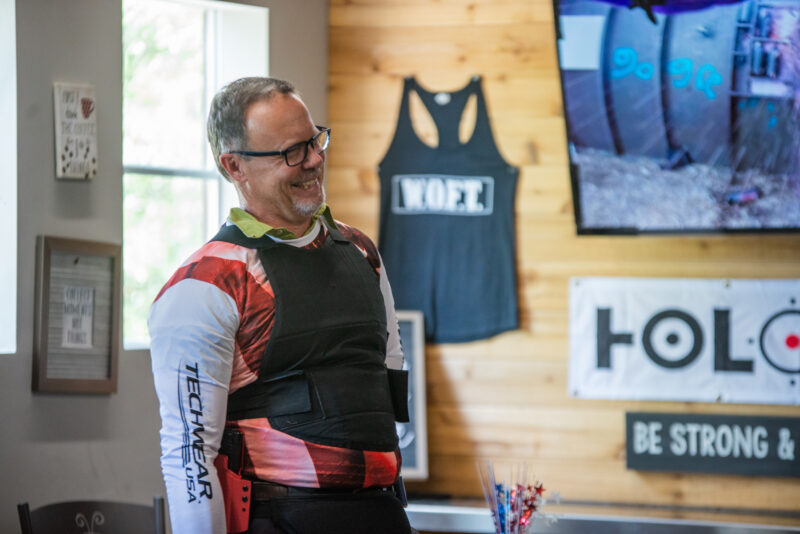
Sometimes when you get shot to pieces by not balancing the "action" and "reaction" properly,
all you can do is laugh ... and learn.
The “criminals” were at a significant theoretical disadvantage, but they had one thing on their side: action versus reaction.
For us, the lesson is simple. We don’t need to overcomplicate it. When a threat is threatening, they hold all the cards. We have to do something to turn the tables by flipping the existing action and reaction status quo.
OODA means … action beats reaction.
Get more exclusive online content from American Handgunner delivered straight to your inbox. Sign up for our free American Handgunner Insider newsletter.