Teaching the Next
Generation to Shoot
How I Trained My Kids

New Shooter = Supervision required! Frank’s daughter did
great in her first 30-minute live-fire backyard shooting session.
Years of casual preparation got her ready.
I knew this would be the year to teach my daughter to shoot a handgun. I’ve been laying the groundwork of responsible gun handling since she was 2 through grave parental warnings, imaginative playtime, laser indoor training simulators like the LaserLyte laser marksmanship trainer pistol and electronic target, and more recently familiarization with the actual manual of arms of real guns using Umarex’s realistically operating CO2 BB guns that have the slide function, safety controls and magazine releases that match the genuine guns they are modeled after.

Frank could tell Nyah-Nyah wasn’t satisfied with her marksmanship, so he informed her, “Your shooting is good enough to qualify for a Kentucky concealed deadly weapons permit.” To which she replied, “I’m only 11 years old.”

A lesson in why it’s important to know what’s beyond your target when shooting. Here, Frank’s daughter observes gouges in the soil where her shots ricocheted off the surface … and into the heavy forest behind the target stand.
It’s Time …
Last year, I could see she had reached the level of maturity, awareness and responsibility needed to make the decisions required to safely handle firearms. This year, she’s finally physically strong enough to operate a real-life handgun. When she fired her first bullets downrange, she did so fearlessly with an ease that seemed anti-climactic for me.
I was secretly disappointed later when she told me she neither liked nor disliked the experience, but I was impressed and pleased with the seriousness and attentiveness she went about it. I will give her more opportunities to shoot, at least monthly, and in doing so, she may eventually find something she enjoys. If she doesn’t, that’s okay. I will have accomplished my goal of making her, like my son, a thoroughly competent marksman. I’m sure I can find a buyer for the brace of Trump 45 laser-engraved Desert Eagles I set aside for her.
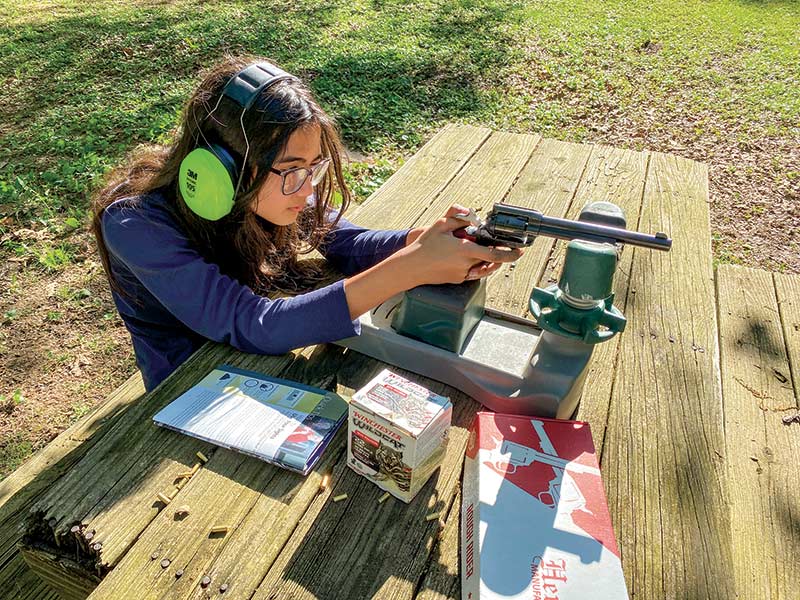
First shots! By starting new shooters from the bench, you let them
focus on the mechanics of shooting rather than juggling gun, bullets,
safety glasses and ear protection in the standing position.

Practicing the ejection ritual with the hammer at half cock to free
the cylinder for hand rotation. The simplicity of a traditional SA
revolver minimizes operator error risk. Retailing under $200, the
Heritage Manufacturing Rough Rider 22LR revolver is a good
starter pistol for a new shooter.
Long-Term Planning
The long-term teaching approach I used with my kids allowed me to impart a lot of foundational shooting knowledge a little bit here and a little bit there, reinforcing it through repetition over the years, without my kids perceiving it as onerous. I blended the deadly serious with the fun and tried to keep it engaging so they would absorb rather than deflect the information. It seems to have worked well.
When a child is ready to safely handle and shoot firearms depends on the child’s personality, intelligence, and level of development. It shouldn’t be arbitrarily tied to their reaching any particular age. I believe my approach helped my kids reach that point sooner than they otherwise might have, and it definitely made for a safer household because firearms were demystified. They were taught they could look at any of the guns in our house, but could not touch them without permission and supervision. If they wanted to do more than look, all they had to do was ask.
Dealing with guns outside our house was addressed succinctly by the NRA’s Eddie Eagle gun safety comic books. As a parent, I made their four key safety points (Stop. Don’t touch. Leave the area. Tell an adult.) real-world important by calling my son and daughter in front of the television to watch news reports of actual tragedies when kids didn’t follow these rules. I never let one of these accidental shootings go unmentioned. Each one is a cautionary tale, but the first one you share with your child is the most important. On YouTube, you’ll find more local television news segments about this than the heart can bear. Survey them, pick one that will hit your child hard emotionally, and watch it with them. Discuss it with them. Plumb the depths of damage that a moment of carelessness caused to a mother, father, brother, sister, or friend. When they are crying, you’ve made the point you need to make, that nobody can call a bullet back once fired.
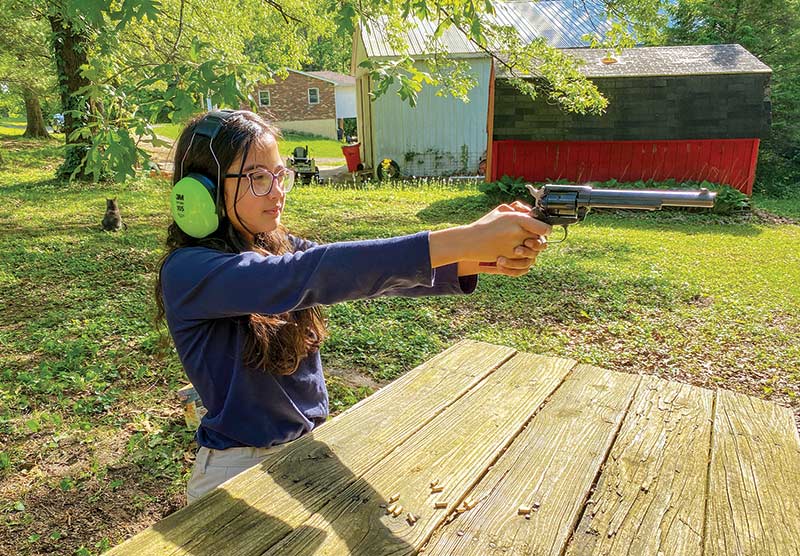
With her cat in the background, Frank’s daughter practices dry firing from the bench to familiarize herself with the operation and feel of the action and trigger pull.
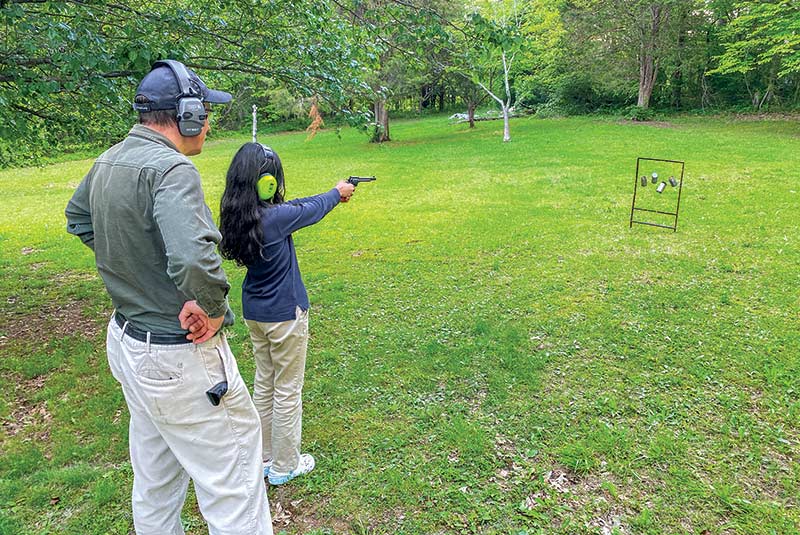
Closing the range to 25 feet and switching to the standing position,
Nyah-Nyah hit more tin cans than she missed. Here’s where a
lightweight gun really helped her.
Opposing Forces
Working against gun safety around the clock, the fantasy world of television, movies and video games is continuously propagating misinformation about firearms. To my mind, the most dangerous are unsafe firearms handling and under-representing the power of firearms. I call that stuff out when I can without spoiling the fun of the show or game my kids were engaged with. With some TV shows, you can make a game of spotting unsafe gun handling with points for fingers on the trigger, sweeping, inadequate backstop, etc. Winner gets their choice of popcorn flavoring for the next family movie night.
In the real world, we have one, and only one, precious life. Video games seem to have devalued it by creating a fictional counter-narrative where we have more than one life. When we are killed in a game, often after suffering injuries of impossible frequency and magnitude, we just reappear at the spawn point and resume playing.
A thrilling and intellectually engaging corrective to this world-of-make-believe nonsense is to actually demonstrate the destructive power of a bullet to your kids. You can use YouTube, but it’s best to do it for real. Show your kids how many boards a bullet will penetrate. Show them what hydrostatic shock can do to a body by turning a plastic jug of water inside out with a .357 Magnum. Smash a concrete block into fragments and dust with a single shot from a high-powered hunting rifle. Don’t leave out the humble .22LR. To kids, it looks small and harmless. Show them it can shoot through both sides of a tin can filled with water. They know their skin is not as hard as steel.

“It’s stinky!” Nyah-Nyah’s least favorite part was the
cleaning, though she found the comprehensive Otis Elite
Pistol breech-to-muzzle cleaning kit intriguing.
The Right Balance?
In teaching my kids, I was always concerned that if I spent too much time focused on the genuine and lethal dangers firearms present to kids, I might dissuade them from wanting to learn how to shoot at all. For balance, I insinuated shooting and gun safety into their playtime, where it was a natural fit. For my son, this was easy, since boys are still attracted to playing soldier and cops & robbers, both all the more fun since the invention of safe Nerf dart guns.
If your kids are playing with toy guns, it’s your perfect opportunity to teach them real gun safety: When they pick up a cap gun, instruct them to keep it pointed in a safe direction and check to see if it is loaded. In a Nerf dart gun fight, teach them to know their target and what’s behind by penalizing them for accidentally shooting the cat or stuffed animal bystanders. When playing dinosaur hunter in the woods, teach them to put their gun down when climbing over a fence. Imaginative play, when it involves some aspect of firearms, is an instructional opportunity. Just don’t lean too heavily on the instruction at the expense of the play. Play is supposed to be fun. Be careful not to ruin it.

After letting her shoot 30 rounds from the benchrest to get accustomed to
the revolver and confirming she could hit what she aimed at, Frank let her
try something more instantly gratifying … tin cans filled with water.
Personalize The Learning
To the extent my daughter wanted to do the same play activities my son did, I was able to teach them both at once. Once she started to develop her own feminine interests, I had to get more creative with my firearms instruction.
When Primary Weapons Systems made up miniature pewter M4 Carbine key chains, I brought home a dozen and the dolls of Barbie City armed up, learned safe storage and started practicing safe gun handling. With the dolls, we were able to explore through role-playing lots of firearms-related scenarios from the mundane to defense against mass zombie stuffed animal attacks. I knew my daughter was paying attention when I discovered my son’s toy pistol (a nearly full-size orange plastic M1911) inside the awning above the cash register of the Hello Kitty restaurant play set she operated for a year in our living room. I discovered the toy pistol quite by accident while moving the playset. It turned out she had put it there and never mentioned it to anyone. When I asked her about it, she explained that she had hidden it there, “In case of trouble.”
From age 5 to 8, my daughter was quite competitive with my son and wanted to do everything he did, which included shooting the laser training pistol indoors and BB guns outdoors. The BB guns were more readily incorporated into their play because a BB doesn’t care what its target is. My son used it to snipe Dollar Store plastic army men attacking up the slopes of Bald Hill (my yard waste burn pile) with the defenders dug in around the peak. My daughter used the same BB gun to protect her dolls from a horde of miniature Dollar Store plastic mummies. (Pro-Tip: Tie a 12″ string around the foot of your miniature targets and thumbtack the other end to a board to find and reset them quickly.) Laser and BB gun shooting helped my kids to develop the muscle memory of safe gun handling as well as proper grip, breathing, sight picture and trigger control.
By the time my kids were ready to start using real firearms, they were already quite familiar with the safety rules and basics of shooting, which permitted them to focus on learning the new manual of arms, and dealing with the report, recoil and weight of real firearms.