Goop, Gunk & Good Sense:
Cleaning and Testing for Reliability
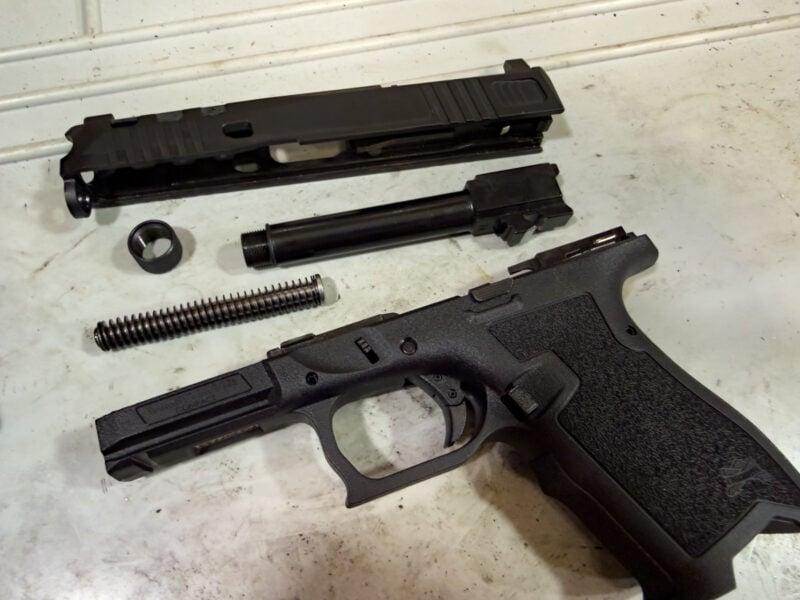
Gun cleaning marketing suffers from the same problem as diet fads: spiffy photography and sometimes questionable science. Some products are game-changers in extreme environments; most are not. For average users, what separates success from failure isn’t a proprietary magic chemical. It’s far more mundane. You know, stuff like good cleaning habits, proper placement of lubrication, and simple functional checks.
Especially for anyone whose use case is “home defense, range trips, and not making dumb decisions,” the miracle claims are mostly theater. The real work of reliability is simple: keep moving parts clean, don’t let good oil turn into bad gunk, make sure stuff stays out of nooks and crannies where it doesn’t belong, and rituals of testing your gun after you tinker. If you want the sexy miracle lore, the industry will happily oblige. If you want a gun that works, keep reading.
Accept (Some Of) the Hype
I have kind of a hate-hate relationship with the gun solvent and lubricant industry. There is so much hype over the miracle impacts of this or that CLP or lubricant product. This one is used by Thor. This other one was used in the 1911 that leveled a city block. That one was invented by General George Patton. You get the idea.
Yes, there are plenty that work just fine, but also, there are … plenty that work just fine. Obsessing over the newest miracle product on the market is usually a giant waste of money, time and effort.

I suppose this happens to all of us... The collection of the latest and greatest gun cleaning and lube products.
Here’s the thing. Knowing how good one is over another requires more time and rigorous testing than most of us could ever do in a lifetime. Think about it. We use a gun. We clean and lubricate it with some products. Next time we go to the range, we shoot said gun. And it works. Ipso facto e. pluribus unum, whatever lube we used is the best thing ever.
Here’s the dirty little secret. If I snuck into everyone’s gun room and secretly replaced their favorite miracle lube with “I Can’t Believe It’s Not Butter,” few would notice. That’s because the way most of us use guns, the “I Can’t Believe It’s Not Butter” miracle lube will work. In occasional range trip conditions, it’ll almost certainly fire and as an added bonus, the range will smell lovely.
OK, to be serious, if your use case is kicking down doors in a desert environment, you’re going to notice the butter treatment really quickly. My point is that the way most of us use guns (clean, safe storage, range trip), we’re not exactly pushing the limits of gun lubricant technology.
Get yourself a bottle of reputable stuff made explicitly for guns and just use it. Yes, gun lube companies jack up the prices of this stuff on a per-ounce basis enough to make a Saudi Oil Prince nervous, but home remedies aren’t worth the risk, especially for defensive guns. If you do your job and clean periodically, even guns that have been sitting for months (or years!), you’ll be fine.
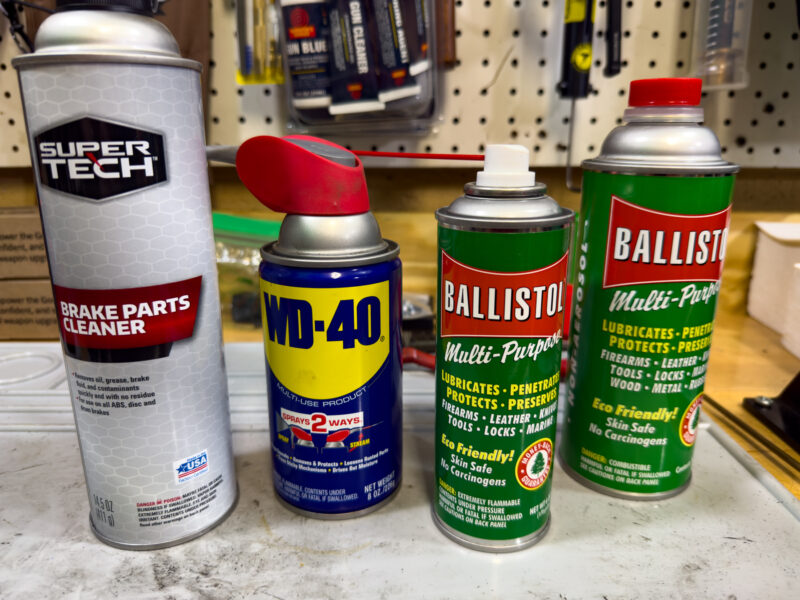
Household products have their place in cleaning and maintenance. Just be careful not to exceed
their design specifications.For example, WD-40 isn't a great substitute
for a proper lubricant designed for high-temperature operation.
Hidden Goop
Over the years, I’ve figured out it behooves one to consider the parts of your firearm that are prone to collecting goop, even the “good” goop like gun oil. Over time and basic cleanings, stuff tends to collect in certain nooks and crannies. And over time, oils and lubricants can “goop up” and collect gunk.
A quick science diversion here. Goop starts as a liquid and becomes more like sludge over time as it dries out and thickens. Gunk is born unto this earth when goop and solid stuff like pocket lint, dirt and powder residue attract each other and intermingle. While still gelatinous in nature, gunk is much thicker and even more likely to make things stop working. It’s important to use the correct terminology for serious stuff like this.
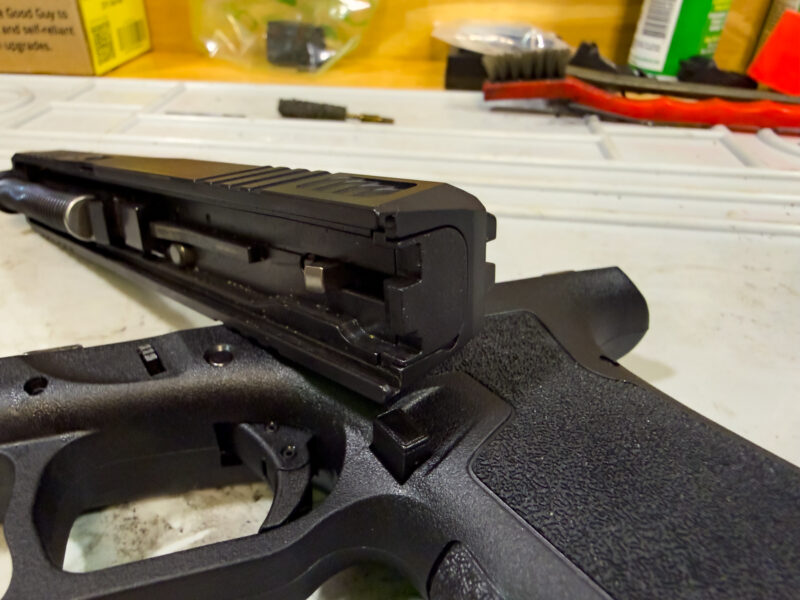
In many striker-fired models, accessing the firing pin channel is a 3-second operation
to release tension and slide the back plate out.
Anyway, one or both of these gun-jamming substances can and will collect in unlikely places. And eventually, enough can accumulate to prevent things from operating as planned. My favorite, and I’d suggest most common areas for striker-fired semi-automatic pistol users, is the firing pin channel. Think about it. With every cleaning, you’re adding more solvent, CLP, oil, or whatever mix of cleaning products you prefer. And with each application, some of that is going to seep into places that should really remain dry, like the firing pin channel. You really don’t want the carefully balanced process of your firing pin movement to be hampered by the springs having to push it through a substance analogous to a melted Jello Pudding Pop, do you?
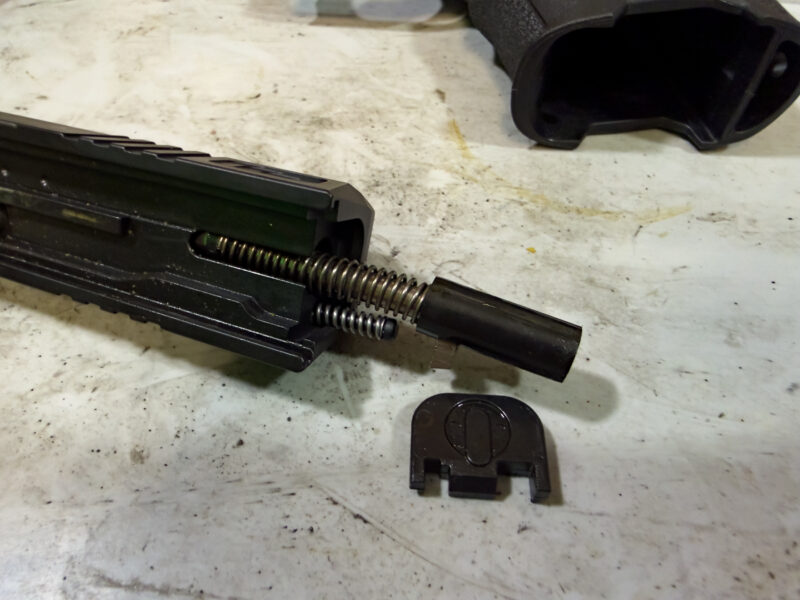
Well, this one doesn't seem very gunked up at all! Generally, the firing pin and spring should be clean and dry.
Fortunately, this is super easy to rectify. Every couple of cleanings, or ideally, with every cleaning, simply remove the firing pin, dry out the channel and clean any goop or gunk off the firing pin and spring. Put it back together. The whole operation takes less than 30 seconds, and your pistol will remain in prime operating condition.
Function Testing
After cleaning a carry or home-defense gun, I always suffer just a touch of worry. A decent cleaning involves field stripping, and in most cases, it’s nothing particularly risky in terms of potentially breaking something or reassembling parts incorrectly. So, the odds of a gun working properly after cleaning and reassembly after a standard field strip are pretty good. In most cases, there’s not much to go wrong. Most cases…
Maybe it’s just a result of the nature of my job, using different pistols all the time, but I always find myself giving the gun a thorough check after reassembly.
Rack the slide. Several times. Does everything look and feel normal?
I’m assuming you’ve already safely cleared all ammo from the area to clean, so, after double-checking that, dry fire your pistol. Then rack and dry fire again. Everything still seem normal?
Check safety functions. There are too many possible configurations to document here, but make sure a trigger leaf is blocking trigger movement. If you have a manual safety, make sure it’s working as intended. You get the idea.
Check things like slide locks and magazine releases. Some pistols, and as much as I love you, I’m looking at you, Beretta PX4s, lend themselves to letting go of slide lock springs and such.
You get the idea. Before reloading, make sure everything works properly.
Range Cleanup
As a pro-tip for the previous comments, and if your range allows and is equipped for this, consider cleaning your gun at the end of a range session. After reassembling it, load two or three cartridges and, after the dry fire function testing, fire a few shots.
What better way to be double-secret positive that your gun is back in perfect working order? A few shots aren’t going to materially impact your cleaning process, but they will give you assurance that your gun is ready to go. I really like this option for a defensive gun and do this whenever possible.
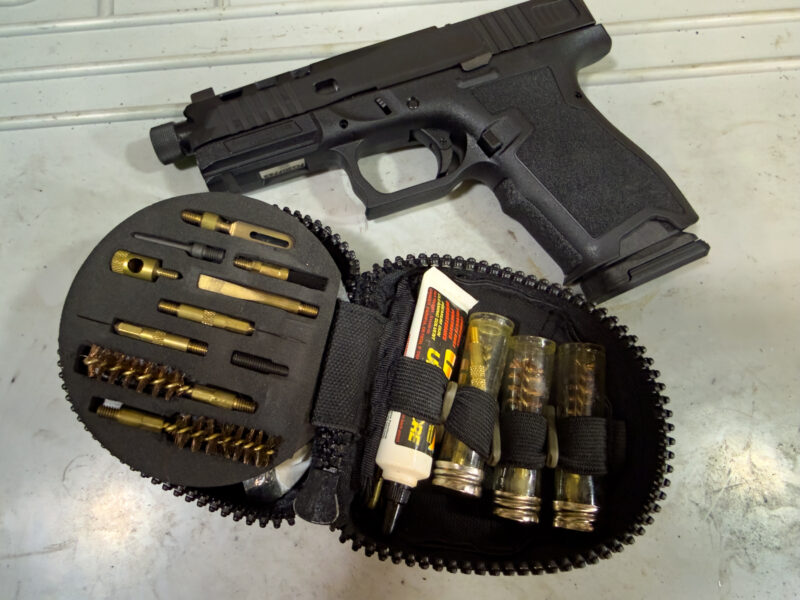
Cleaning at the range is ideal as you can test fire when you're done.
A portable cleaning kit like this one from OTIS Technology weighs next to nothing
and takes up little space in your shooting bag.
Closing Thoughts
Reliability is less about miracle formulas and more about habits. Wipe the channels that collect goop, remove and dry the firing pin on occasion, and develop a consistent function-test routine. Do that, and you’ll spend less time worrying and more time shooting. If you can, clean, then test after a range session. A few live rounds is the best way to make sure you’re good to go.
In short: pick good stuff, use it sparingly, and test like you mean it.
Get more exclusive online content from American Handgunner delivered straight to your inbox. Sign up for our free American Handgunner Insider newsletter.