A Single Action Sheriff’s Model Like No Other
The Mastery of Legendary Jim Martin

Jim Martin’s Sheriff’s Model is a work of art. Photo by Alan Garbers.
Perhaps the most recognizable single-action revolvers are the Colt Single Action Army, SAA for short. The Colt SAA was made with many different length barrels, with the Sheriff’s Model being the rarest. The Sheriff’s Model, also called the Shopkeeper’s Model, generally sports a short barrel of four inches or less. The smaller profile made the firearm easier to conceal in a pocket. Still, in most cases, it is made without an ejector to remove spent cases, forcing the user to remove the cylinder to empty it or to pick at the case rim with a fingernail.
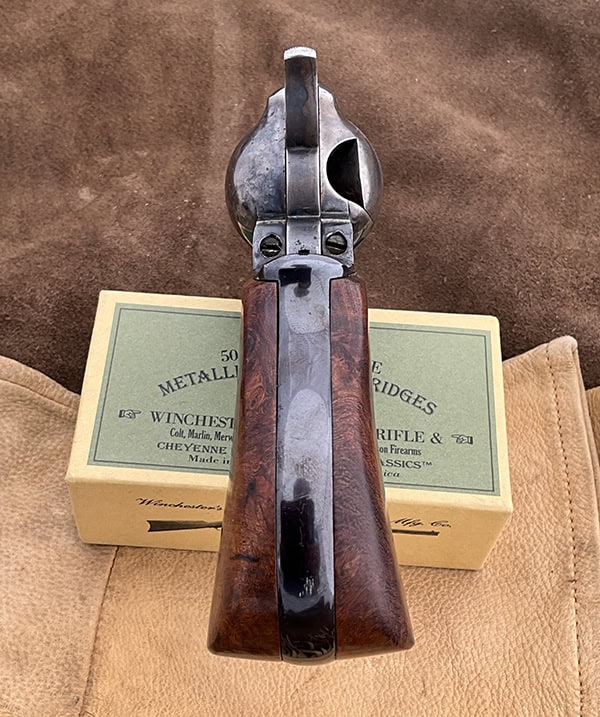
Mesquite burl grips are dense, beautiful, and designed to spread out the recoil.
Photo by Alan Garbers.
Some variations have a short ejector and housing, but the stroke is so short that the cases barely move enough to catch with a fingernail. But on these models, the ejector housing must be painstakingly removed before the cylinder pin can be fully removed, allowing the cylinder to fall free. Neither application is practical or easy to perform, making the gun impractical for prolonged shootouts and creating opportunities for parts to get lost or damaged. This was not acceptable to my friend and mentor, Colt SAA expert and trick shooter, Jim Martin.
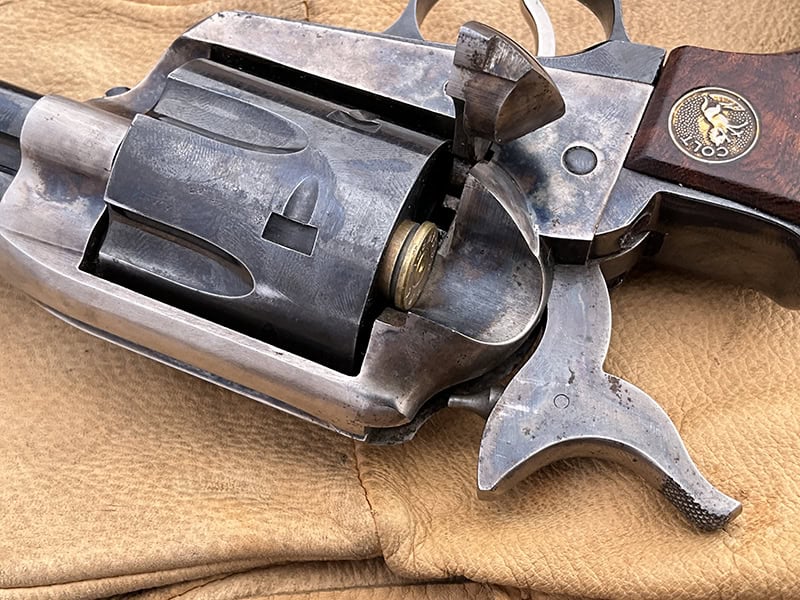
The ejector rod on many short-barreled models doesn’t push the cases out well. Photo by Alan Garbers.
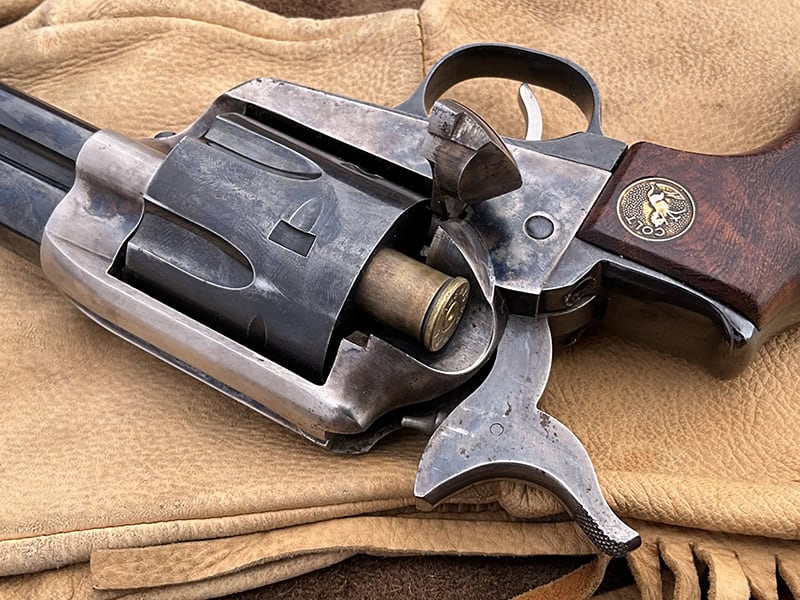
While the ejector on Jim’s gun doesn’t fully eject the case, it is much better than other designs.
Photo by Alan Garbers.
Jim’s prowess with the Colt SAA is legendary. For decades, Jim has made his mark in fast-draw and trick-shooting competitions. Along the way, Jim learned what many consider the correct way to tune and time the Colt SAA’s inner workings. Some have called him the last of the old-time Colt gunsmithing masters, including legendary author Jerry Kuhnhausen. Over his lifetime, Jim hung out with TV stars Clint Eastwood and Peter Breck during Las Vegas shooting competitions, was friends with Colt SAA historian John Kopec, and was instrumental in the birth of cowboy action shooting. With this pedigree, it’s no wonder many firearm manufacturers turned to Jim when they had manufacturing or design issues.

By allowing the ejector head to pivot into the notch, the cylinder pin can easily be removed.
Photo by Alan Garbers.
Jim thought he could improve the design of the Sheriff’s Model and set to work building his prototype. Not wanting to waste expensive Colt parts on an idea that might not pan out, he used hodgepodge parts left over from other projects.
The frame was a black powder-style doner from some forgotten Italian reproduction. The cut-down .44 Special barrel was left over from a Colt New Frontier. Jim milled a slot and silver soldered in the front sight, with the height set for a point of aim at 50 yards or slightly greater.
The cylinder, hammer, cylinder pin, and internal parts were genuine Colt. The backstrap and trigger guard were leftover Italian parts formed to conform to Jim’s liking.
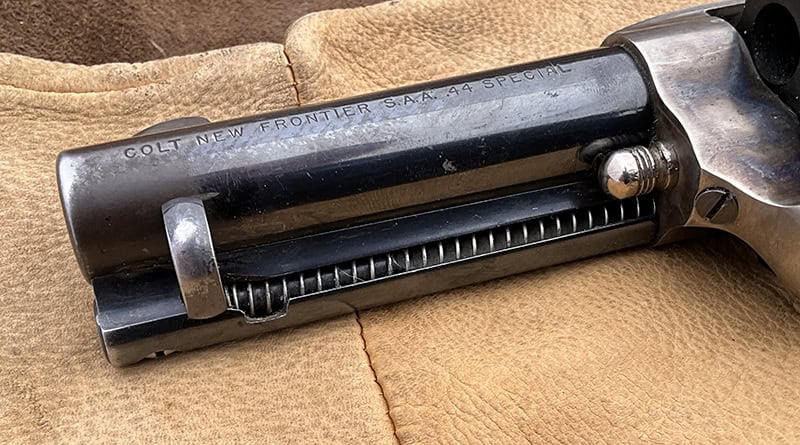
A simple notch in the ejector housing allows the cylinder pin to be removed. Photo by Alan Garbers.
The ejector rod and housing also came from a donor Italian replica. Jim purposely selected a non-Colt rod because it doesn’t have threads, whereas a Colt does. This allowed him to position the ejector head wherever it needed to be. A key feature: the ejector housing was notched to allow the ejector head to pivot down into it, creating room for the cylinder pin to travel fully out of the cylinder.

Jim’s mastery of grip making is clear. Photo by Alan Garbers.
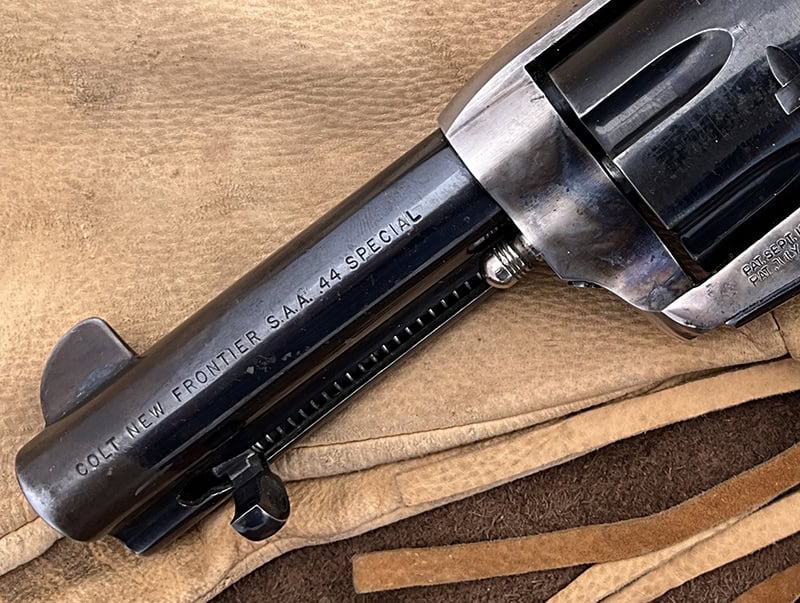
The ejector head easily pivots into a notch to clear the way for the cylinder pin. Photo by Alan Garbers.
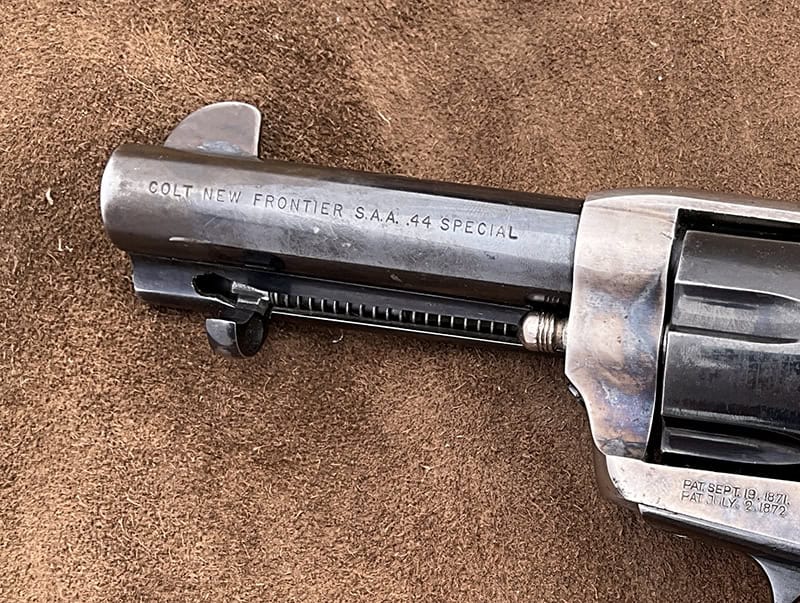
Another view of the ejector head. Photo by Alan Garbers.
The grips are Jim’s own design, made from book-sawn mesquite burl. Jim is well-known for designing extraordinary grips for single-action revolvers, and these were no exception. Since the revolver is chambered in the powerful Winchester .44 WCF, .44-40 for short, he wanted a shape that would spread the recoil out into more of the shooter’s palm. He also made the grip bevel a flatter 11 degrees versus Colt’s 17-degree bevel. This allows the shooter to cradle the gun with the off hand.
Although the finish was never completed, it remains a gem that any of Jim’s friends would be proud to own.
Get more wheelgun content every week!
By submitting this form, you are consenting to receive marketing emails from: . You can revoke your consent to receive emails at any time by using the SafeUnsubscribe® link, found at the bottom of every email. Emails are serviced by Constant Contact