Colt's New Service

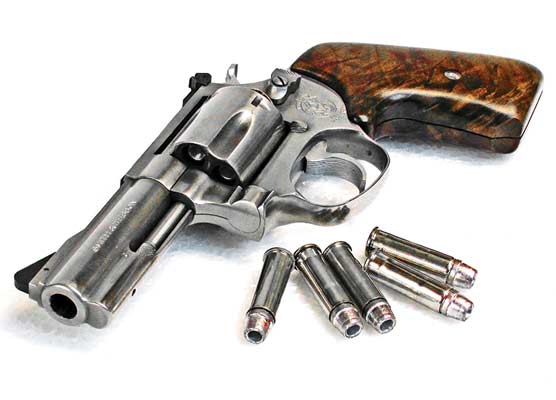
Colt’s New Service .45 Colt (top). S&W’s Triple-Lock .44 Special (bottom).
Still producing percussion revolvers in 1869, Colt was caught off guard as Smith & Wesson introduced the future. It was the Model #3 .44 S&W American chambered not for ball and powder that loaded from the front of the cylinder, but in actuality was the first big bore cartridge firing revolver. It would be three years before Colt could legally override Smith & Wesson’s patent, and the result was theSingle Action Army of 1873. Colt apparently learned their lesson from this episode and would not be caught napping with the next wave of handgun development.
Four years later, it was now Colt that introduced the first successful double action revolver, the Model 1877 in two versions. Chambered in .38 Long Colt it was known as the Lightning, which was then followed by the Thunderer as the .41 Long Colt was known. Three years later, Smith & Wesson would add the double action feature to their Model #3.
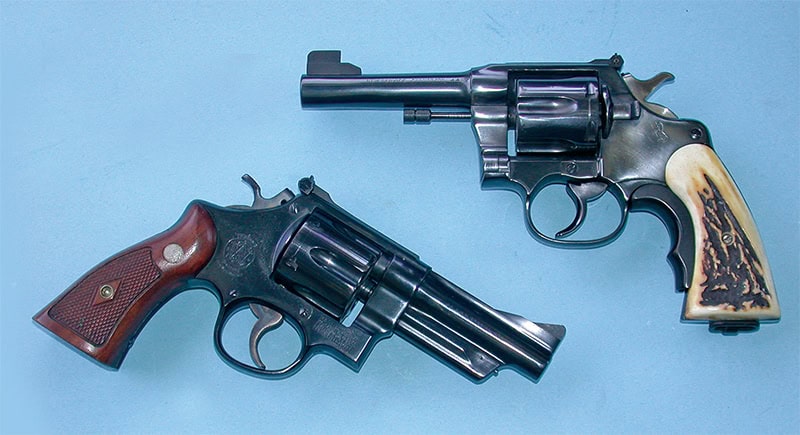
Colt’s New Service .44 Special is a larger sixgun than Smith & Wesson’s 4th Model Hand Ejector .44 Special.
By the end of the 1880s, the ball was back in Colt’s court as they began a line of Army and Navy double action revolvers that were the first to have swing out cylinders. By the end of the century both Smith & Wesson and Colt had introduced their versions of the double action sixguns that would dominate much of the 20th century.
From Smith & Wesson came the first Military & Police in 1899, however, it had been superseded one year earlier by Colt’s New Service. Smith & Wesson’s modern revolver was built on a .38 platform that would become the K-frame; Colt went much larger. The New Service holds the distinction of not only being the largest revolver ever offered by Colt, it was also the largest revolver period, until the coming of Ruger’s Redhawk and Dan Wesson’s Model 44 in the 1980s.
Ten years after the introduction of the New Service, Smith & Wesson would counter with the first N-frame, the 1st Model Hand Ejector. For the first half of the 20th century, Colt’s New Service .45 Colt and Smith & Wesson’s Hand Ejectors in .44 Special would be worthy rivals.
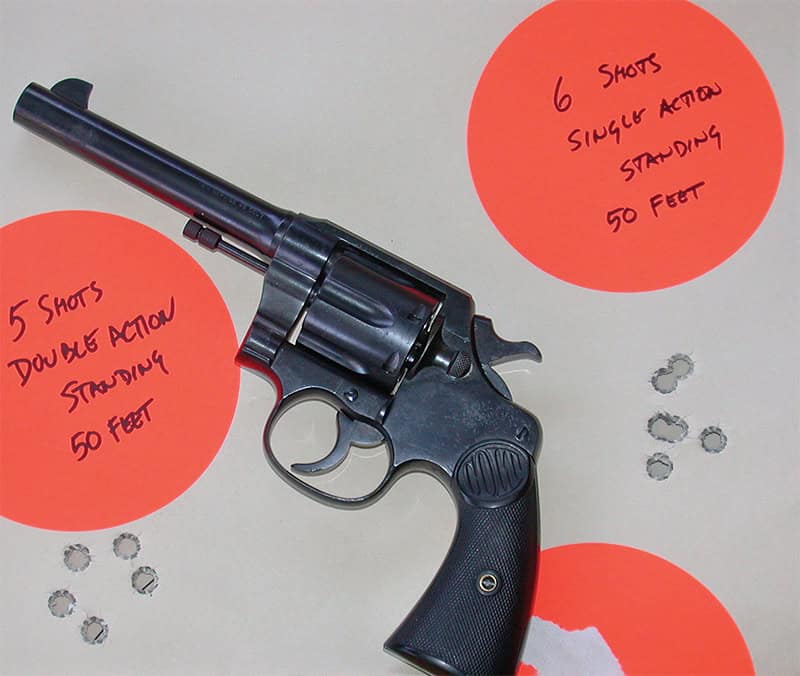
This Colt New Service Late Model .45 Colt made in the 1930s still shoots
whether in the double action or single action mode.
The Legend Builds
The New Service actually overtook the Single Action Army in total production numbers due the fact more than 150,000 New Services chambered in .45 ACP with 5.5″ barrels and known as the Model 1917 were ordered for the use in World War I. At the same time, Smith & Wesson was also producing their version of the Model 1917 using a 5.5″ 2nd Model Hand Ejector.
In the late 1950s when I first discovered the joys of double action sixguns, both surplus models were still readily available, with excellent specimens going for $15. I tried them both and selected the Smith & Wesson due the simple fact the grip frame was better suited to my large, but short-fingered hand. If the New Service had any drawback it was the fact it was definitely made for those with large hands and long fingers.
While the Smith & Wesson Hand Ejectors were going through the process of 1st, 2nd, 3rd and 4th Models that would eventually lead to the .44 Magnum in 1955, Colt was also following an evolutionary path of standard models and several variations thereof.
Collectors now apply special terms to distinguish the various models of New Services from 1898 to 1941. The Old Model, the name applied to the first 21,000 New Services, was rather ungainly looking with a straight stovepipe-shaped barrel and a trigger guard looking like it was added-on as an afterthought.
After the Old Model, about 2,000 Transitional Models were offered with mainly interior improvements, including a hammer block safety. Next came the Improved Model, which would go to serial number 328,000 and is of course the New Service most often encountered. The barrel now had a larger collar where it screwed into the frame and the trigger guard was also larger and shaped to now look like it was actually part of the frame.
We can thank the United States Army for the collar on the barrel as all Model 1917s were ordered with the collar to provide a snug fit of barrel to frame. Designed for better function, it also resulted in a better form. Sometime around 1928 the Late Model New Service arrived with a change in the shape of the top strap to give it a more flattened appearance at the same time that the rear sight was milled to a square notch.
In the 1940 Colt catalog they offered three versions of the New Service. A standard model with barrel lengths of 4.5″, 5.5″ and 7.5″ and either blue or nickel finish in .45 Colt, .45 ACP, .455 Eley, .44-40, .44 Special, .38 Special, .38-40, and the latest and most modern cartridge, the .357 Magnum. For some reason barrel lengths for the .38 Special and .357 Magnum were set at 4″, 5″ and 6″.
Colt’s advertising read, “The New Service is essentially a holster revolver for the man in the open-mounted Motorcycle and State Police; the Hunter, Explorer and Pioneer. It is the Arm adopted as Standard by the Royal Canadian Mounted Police, and hundreds of city and state Police Organizations throughout the world.”
The Colt was definitely a sixgun for both outdoor and duty use and it was adopted at the north and south ends of the country as the official sidearm of both the RCMP and the United States Border Patrol. The Mounties chose the .45 Colt, while our officers on the southern border had the New Service in .38 Special.

At the beginning of the 20th century sixgunners had a choice of three big bores from Colt:
the Single Action Army, the Bisley Model and the double action New Service.
Target Model
The second offering, one of the finest double action revolvers ever offered by any manufacturer at any time, was the New Service Target Revolver. This beautiful version of the standard model was available in .44 Special, .45 Colt, and .45 ACP in a choice of either a 6″ or 7″ barrel. Stocks were checkered walnut, the trigger was checkered, as were the front and back straps, finish was a deep blue, sights were adjustable with a choice of a Partridge or bead front sight. The final version of the New Service was the deluxe target revolver, the Shooting Master. This 6″-barreled revolver featured a “velvet-smooth” hand-finished action, sights and top strap that were finished to eliminate glare and a choice of calibers from .38 Special, .357 Magnum, .44 Special, .45 Colt to .45 ACP. The Shooting Master represented the highest quality revolver Colt could build.

A Classic New Service .44 Special totally rebuilt and refinished by Milt Morrison of QPR.
Fitz
The last time I visited Col. Rex Applegate I was treated to a tour of his private museum. The Colonel was in his mid-80s at the time and had a lifetime collection of firearms memorabilia, including the first two Smith & Wesson .357 Magnums that had been used by Col. Doug Wesson in the 1930s. Applegate also had sixguns that had belonged to Elmer Keith, Charlie Askins and Bill Jordan on display. However his two most favored items were the first you encountered as you entered the museum. Right inside the door, at eye level, was his Outstanding American Handgunner bronze. Resting at the base of the statue was a Colt New Service.
This was just not any run-of-the-mill New Service but a very special version that was inscribed: “To Rex From Fitz.” John Henry Fitzgerald was Mr. Colt prior to World War II and well-known for his shooting ability and his carrying of a pair of New Service Fitz Specials in the front pockets of his trousers. These special sixguns featured bobbed hammers, 2″ barrels, shortened and rounded grip frames, and the removal of the front of the trigger guard. Although not cataloged, Fitz Specials were offered; however, probably no more than a couple dozen were ever factory-made. Beautiful Examples of Fitz Specials are pictured in R.L. Wilson’s book The Colt Heritage.
Another fan of the Fitz Special was Charles Askins Jr. who writing as a captain in 1939, had this to say: “The grandest defense gun I ever had was a Colt .45 New Service with the barrel whittled down to two inches. The weapon was chambered for the old original .45 Colt cartridge, one of the best for serious work, and it handled like a charm. The barrel, after being shortened to two inches, had a nicely designed ramp-type front sight attached. This sight was sloping and would not catch in the clothing or in the holster. The rear sight, of course, was an integral part of the frame. The hammer had been de-horned, and the trigger guard was cut entirely away in the front so the finger found the button in a minimum of time. The grip was shortened, materially, and rounded so it lay against the side without any sharp corners rubbing or gouging the flesh. The Colt New Service .45 belly gun was scarcely recognizable as a standard Colt product after it was fully finished. However, it was a whiz for the purpose intended.”
That 1940 Colt catalog mentioned touted the Colt New Service and the Colt Single Action Army as two of the finest sixguns ever offered. They were, of course, correct. However, one year later both models were dropped from production to make way for war-time needs.
Get More Revolver Information Weekly!
By submitting this form, you are consenting to receive marketing emails from: . You can revoke your consent to receive emails at any time by using the SafeUnsubscribe® link, found at the bottom of every email. Emails are serviced by Constant Contact