The First Revolver:
How We Got From Blackbeard's Six Pistols to the Six-Shooter
Back in 1718, the most feared man on the Atlantic had a bit of a firepower problem. He solved it according to conventional wisdom: he carried more guns.
According to Captain Charles Johnson’s A General History of the Pyrates, Blackbeard prepared for a fight by donning “a Sling over his Shoulders, with three brace of Pistols, hanging in Holsters like Bandaliers.” Three brace is six pistols. Of course, he carried a cutlass as well, but one has to question his mobility with all that gear.
Flintlock pistols were one-and-done affairs when they ignited. You know the black powder muzzle-loader drill. Pour powder down the barrel, ram a patched ball on top, prime the pan, close the frizzen, cock it, and pray the flint sparks and the powder is dry when you most need the thing to work. “At the range” one could do it in 20 or 30 seconds. In the middle of a battle at sea, not so much. If you wanted more shots, you brought more pre-loaded guns.
Here’s what makes the story interesting: there actually was a “fix” for Blackbeard’s problem that had been on the scene for more than a century. It just wasn’t very reliable.
Really Old Revolvers
The idea of a rotating cylinder full of pre-loaded chambers is surprisingly old. German gunsmiths in Nuremberg were building revolving matchlocks around 1580. In 1597, a Nuremberg maker named Hans Stopler built an eight-shot revolving snaphance. It’s still in a museum in Lillehammer, Norway. By the 1660s, a London gunmaker, history implies it was John Dafte, was turning out a six-shot snaphance revolver whose cylinder turned itself when you cocked it. The Royal Armouries still has one.
So why was Blackbeard still carrying a bandolier of single-shots?
Because these guns were handcrafted works of part art and part technology. Every part was hand-filed and hand-fitted. Each chamber usually needed its own priming arrangement, and loose powder near a bunch of loaded chambers is how you generate lots of undesirable excitement. The bottom line: they were expensive curiosities for rich folks, not reliable and affordable tools.
So we had the idea in concept, and it was solid. Note that we still rely on the same general plan today. The problem was with the ignition system. And that remained in the “problems to be solved someday” bucket for a long time.
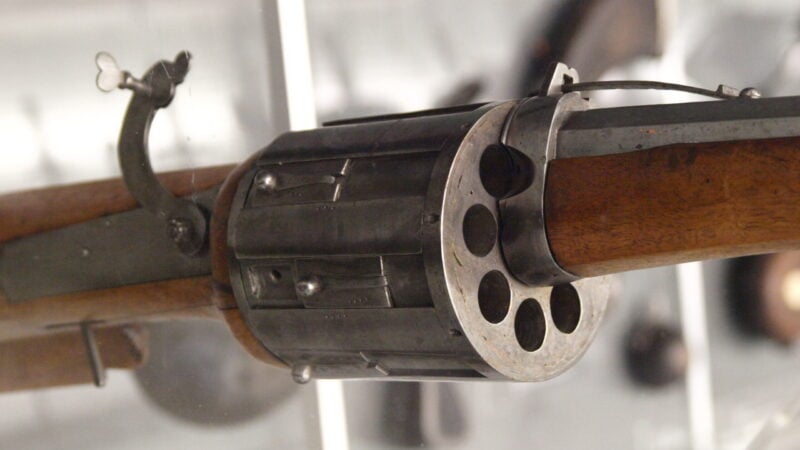
A Nuremberg revolving matchlock from around 1580. The idea is more than
four centuries old. Photo: Bullenwächter / Germanisches Nationalmuseum, via Wikimedia Commons
Wait, a Lawyer Built a "Machine" Gun?
The path to that snubbie revolver in your pocket is a long and winding road.
On May 15, 1718, the same year Blackbeard was killed at Ocracoke, a London lawyer and writer named James Puckle received British Patent No. 418 for something he called the “Defence.” It was not a handgun. It was a tripod-mounted flintlock with a 1.25-inch bore. If I’m doing my math right, that’s a bit over 30mm, the bore size used on the massive gun of A-10 Warthog tank-buster planes. Of course, the ballistics are far different, but the diameter of the “bullet” was similar.
The interesting thing in the context of this story is that it relied on the same idea that all subsequent revolvers used.
Puckle’s gun had a single barrel fed by a rotating cylinder. The cylinders held anywhere from six to eleven chambers, depending on the version. The gunner turned a crank to index a loaded chamber to the barrel, fired it, and cranked to the next. When a cylinder ran dry, you replaced it with a new, preloaded one.
Puckle also had opinions. His patent drawings show two types of ammunition: round bullets for use against Christians, and square bullets for use against the Turks. Square bullets were supposed to do more damage. Ballistically, I’ll let you draw your own conclusions.
Did it work? You be the judge. In a 1722 demonstration, the gun fired 63 shots in seven minutes. A skilled infantryman might manage three shots per minute with his musket. Did I mention it was pouring rain at the time? That was normally a recipe for failure with traditional muskets.
Apparently the British Board of Ordnance wasn’t impressed as they didn’t buy it. The Puckle gun became somewhat of a joke, with leaflets claiming it was a fearsome weapon because “they’re only wounded who hold shares therein.” The Duke of Montagu did buy two for a 1722 expedition to St. Lucia and St. Vincent, and the manifest lists “2 Machine Guns of Puckles.” Original examples survive in the Montagu family collections at Boughton House and Beaulieu in England.
OK, so it wasn’t technically a “machine” gun, but remember, we’re talking early 1700s here. The important takeaway is that people were thinking about multiple-shot systems driven by revolving cylinders a very long time ago.
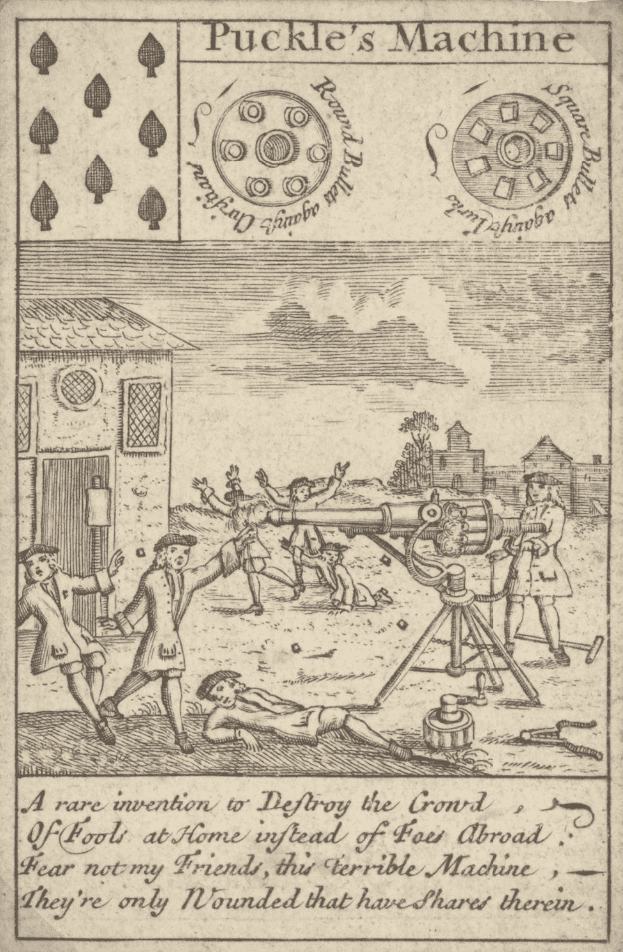
Puckle's "Machine" as it appeared on a 1720 satirical playing card mocking
the investment bubbles of the day. Thomas Bowles, 1720, public domain.
Americans Carry the Torch
In June 1818, Artemus Wheeler of Concord, Massachusetts, received a U.S. patent for a flintlock revolver. Bostonian Elisha Collier took the design, improved it, and patented his improved version in England later that year.
Collier’s revolver had striking similarities to more modern wheelguns. Although still a flintlock, the priming pan refilled itself from a magazine each time you closed the frizzen, and the cylinder pushed forward to seal against the barrel. He sold hundreds of them between 1819 and 1824, mostly in Britain. Officers headed to India for deployment bought them personally. to India bought them privately.
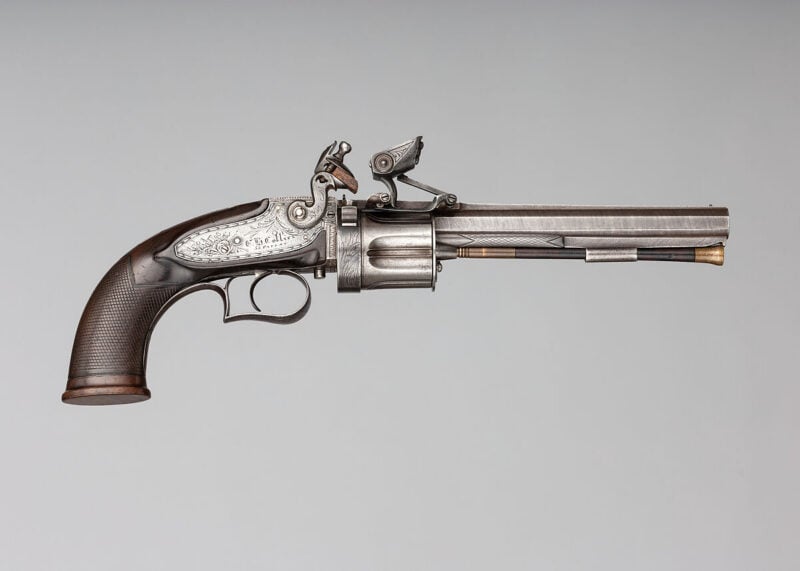
Elisha Collier's revolving flintlock, patented in England in 1818. Image: Met Museum accession 56.165.
Percussion Caps: The Bang Heard Around the World
Remember how the ignition system was holding up the show? Well, the solution arrived via a Scottish, duck-hunting clergyman. Reverend Alexander Forsyth patented a lock in 1807 that used a pinch of shock-sensitive fulminate instead of a flint and pan. A few years later, the copper percussion cap arrived, according to most accounts, by inventor Joshua Shaw.
Eureka! Now chambers were self-contained firing mechanisms. No flints or loose powder required for ignition.
One adopter of the percussion era was the pepperbox, a cluster of barrels that rotated as you pulled the trigger. Seems like a step backward from earlier systems where the rotating “magazine” shared one barrel, but Ethan Allen patented his famous version in 1837. Yes, they were heavy and didn’t impress many with accuracy. Mark Twain described a fellow stagecoach passenger’s Allen pepperbox in Roughing It and noted that sometimes all six barrels went off at once, “and then there was no safe place in all the region round about, but behind it.”
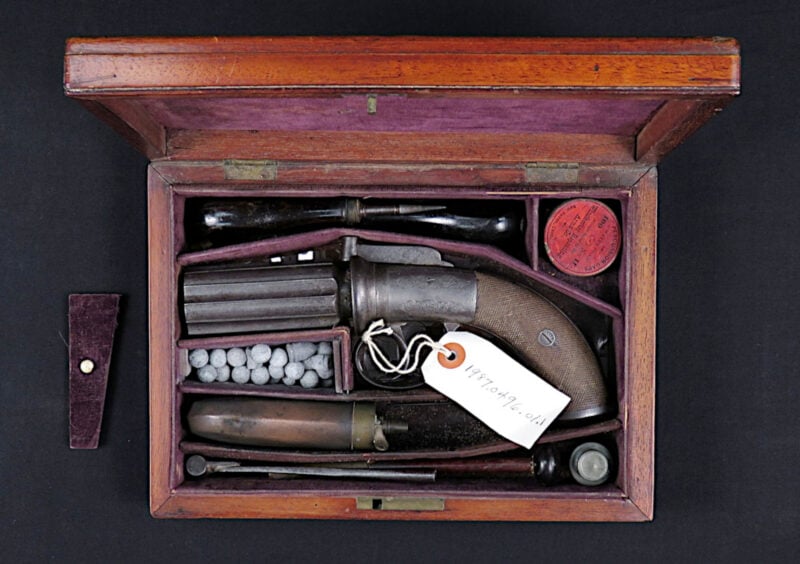
A cased English percussion pepperbox. Six barrels, no sights, and a reputation to match.
Smithsonian National Museum of American History, public domain.
The Inspiration of a Sailor Named Colt
In 1830, a 16-year-old Connecticut kid named Samuel Colt shipped out as a sailor on the brig Corvo, bound for Calcutta from Boston. According to the stories, he noticed how the ship’s capstans and windlasses worked. They turn and lock in place with a pawl. At some point, he whittled a wooden model of a revolving pistol.
To be clear, Samuel Colt didn’t invent the revolver. Rather, he worked out the mechanism that rotates the cylinder and locks it in the right place, aligned with the barrel. No more handmade mechanisms with a production run of one. These could be manufactured with machines.
He patented it in England in 1835 and in the United States on February 25, 1836. That same year, he set up the Patent Arms Manufacturing Company in Paterson, New Jersey, to build the five-shot Paterson revolver.
Strangely, the Army wasn’t interested, and the company folded in 1843 after making only a few thousand guns.
Enter the Texans. On June 8, 1844, Texas Ranger Captain Jack Hays and about 15 to maybe 20 men, armed with some of those Paterson Colts, met a 75-man Comanche war party near the Pedernales River. The lesson of the day was that the Rangers could keep shooting after they’d emptied their rifles. When it was over, the Rangers suffered one killed and four wounded while the Comanche lost 20 or more. This new revolver had made a mark.
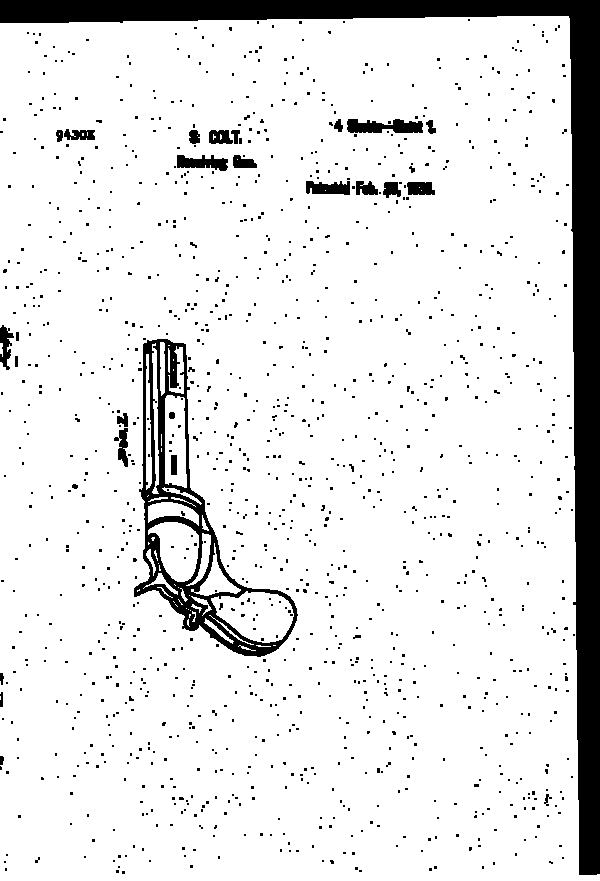
Samuel Colt's 1836 U.S. patent drawing. Image: Public domain.
Mr. Walker's Big Gun
One of the Rangers who appreciated the Paterson revolver was Captain Samuel Walker. In 1846, with war against Mexico underway, he worked with Colt on a heavier, tougher revolver. The Paterson’s folding trigger and five-shot cylinder went away.
The result was the 1847 Walker Colt: six shots, .44 caliber, 4 1/2 pounds, and a chamber that held 60 grains of black powder. Not exactly a concealable handgun. The Colt factory was gone, so 1,100 Walkers were built at Eli Whitney Jr.’s plant in Whitneyville, Connecticut.
The Walker’s success put Colt back in business, and the Dragoons, the 1851 Navy, and the 1860 Army rolled out.
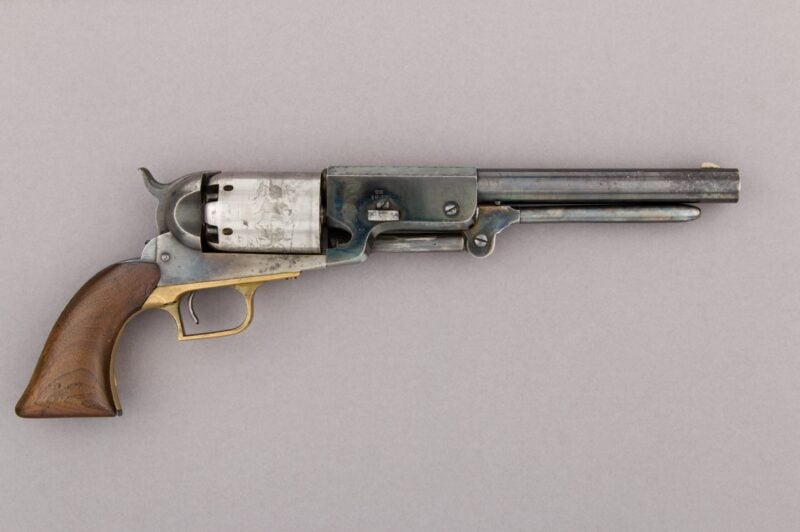
Walker Colt serial no. 1017, made at Whitneyville in 1847. The Metropolitan Museum of Art, CC0.
Cartridges: More Simplicity
We’ve almost arrived at today’s basic revolver design. That was separating the ignition (percussion caps) from the revolver itself.
Rollin White patented the concept of a bored-through cylinder (allowed by the invention of self-contained cartridges) in 1855. Smith & Wesson licensed it and introduced the Model 1 in 1857, a tiny seven-shot .22 rimfire. It wasn’t exactly a fighting gun, but the writing was on the wall. The patent kept the other companies at bay until 1869. That’s why the Civil War was chock full of cap-and-ball revolvers.
Once the patent expired, the dam broke. In 1873, the U.S. Army adopted the Colt Single Action Army in .45 Colt. You know it as the Peacemaker.
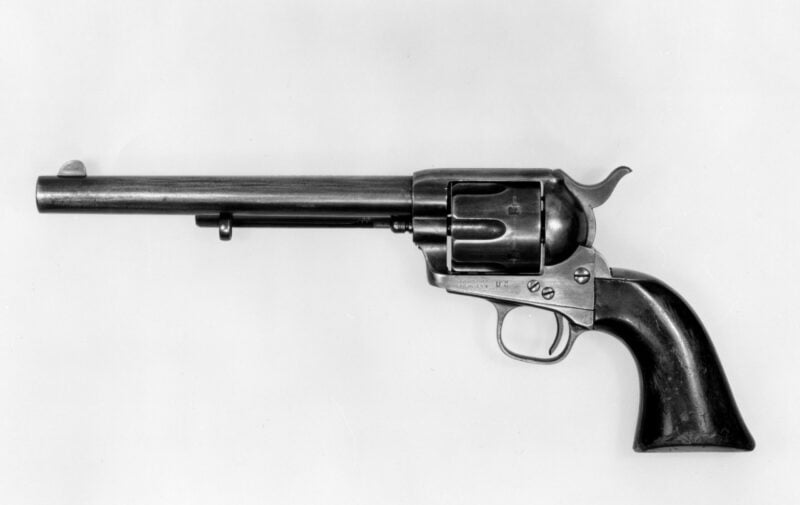
An early "Peacemaker," Colt Single Action Army serial no. 4519, from 1874.
The Metropolitan Museum of Art, CC0.
The Execution Was the Hard Part
The ideas behind today’s revolvers date back to the 1500s. It was the technical requirements to make it work that slowed progress. In hindsight, building the actual guns was the easier part. The ignition system was arguably what held up the show.
Be thankful you’re not toting around a flintlock snubbie.
Get more exclusive online content from American Handgunner delivered straight to your inbox. Sign up for our free American Handgunner Insider newsletter.