Some People Still Like Single-Action Sixguns For EDC

The single-action revolver may seem an anachronism to most people,
but it still has a place in the 21st Century.
In this age of modern semi-autos and double-action revolvers capable of chambering 7 or 8 cartridges, get ready for a surprise: The single-action sixgun is still alive and well, and more than a few people pack one every day.
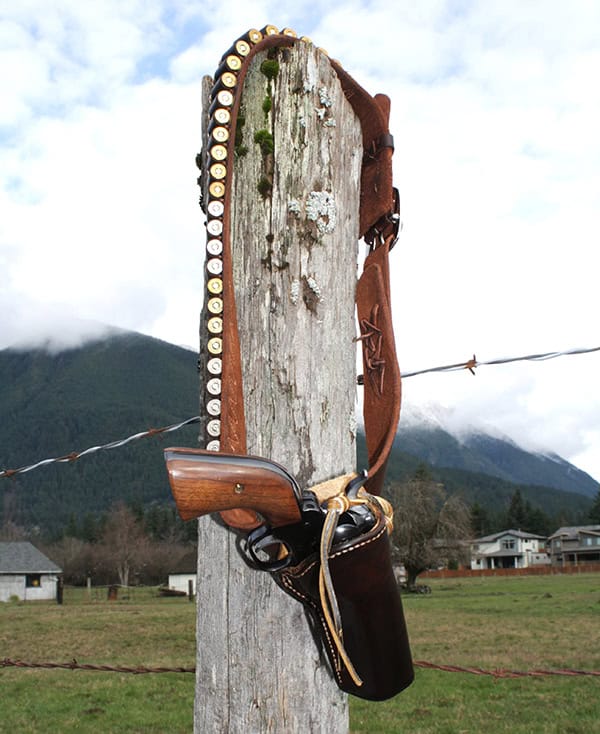
America may think the single-action belongs in a holster on a cartridge belt,
but it turns out a fair number of people think otherwise.
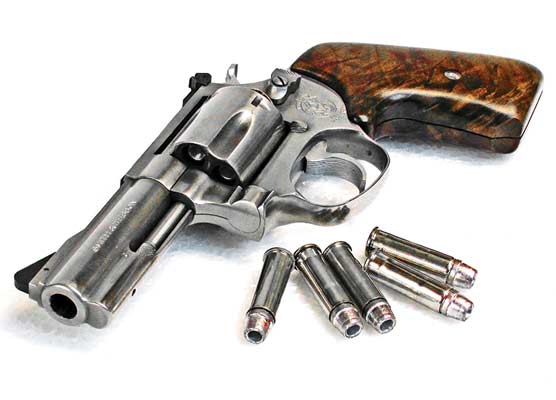
Whether chambered for .357 Magnum, .44 Special, .44-40 or .45 Colt—the latter more often than the others—the single-action “cowboy gun” may not be the wisest or best choice, according to some people, but it’s not up to me or anyone else to second-guess the person who prefers the old over the new. That said, let’s focus on the act of carrying, itself, and the most common cartridge involved, the .45 Colt.
Ballistically, the .45 Colt is not all that different from the .45 ACP, with comparable loads. Just look in any reloading manual and the data tells the tale. The .45 Colt can launch a 230-grain cast lead round nose flat point projectile anywhere from about 750 fps to more than 975-1,000 fps, depending upon the propellant. A 230-grain RNL, FMJ or JHP fired from a .45 ACP pistol will zoom across a chronograph at speeds ranging from about 750 fps to more than 900 fps, again depending upon the propellant. Try it over a chronograph for verification. Translation: They’re both going to hurt when crashing into flesh and bone.
I traded some email with longtime pal Harry Thomas, a long-retired police lieutenant who served with the Cincinnati, Ohio Police Department. He sometimes carries a single-action second generation Colt .45 with a 5 ½-inch barrel or a Cimarron Thunderer with a 3 ½-inch barrel. He’s got two of each, so he’s never under-gunned!
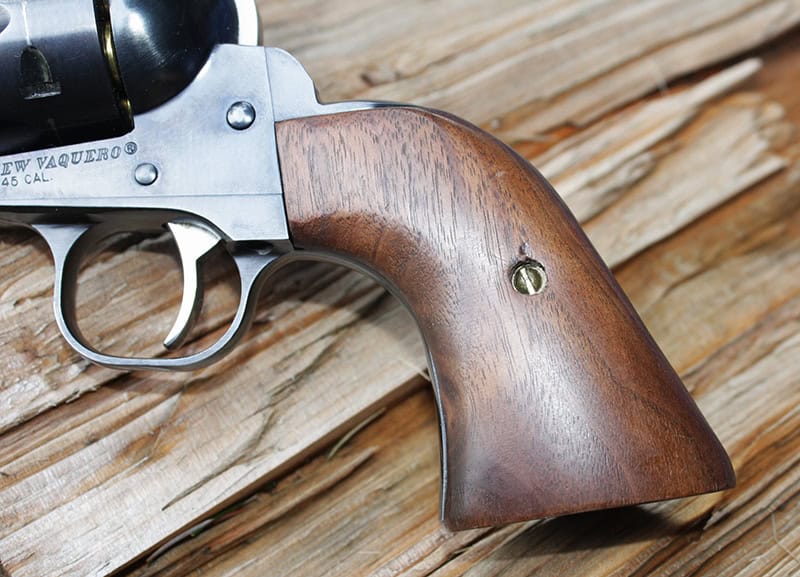
Dave handcrafted a set of walnut grips for his Ruger New Vaquero, finished to fit his hand size.
Did Some Homework
Also in preparation for this story, I reached out to fellow shooters at two different single-action sixgun chat groups, and got a lot of responses from folks who carry .44s or .45s. Colts, Ruger Blackhawks, Ruger New Vaqueros, and one guy even sent a photo of his single-action chambered for the .500 Linebaugh!
Others offered their own revelations. One fellow wrote, “I carried one when it was all I had and I was quite proficient with it. Then I got Colt and Smith double-actions and carried those for many years. It may be a single-action but its efficacy is fully dependent upon your ability to efficiently and effectively use it. And it will always be better than throwing rocks.”
Another man told me, “A single action and one double action is all I’ve ever packed.”
And there was the guy who said he carries a single-action chambered for .44 Magnum in the field and woods, which, he observed, “Covers most all potential threats.”
Of course, others chimed in, explaining why carrying a single-action is a poor idea for personal protection, especially against multiple opponents. Just a personal observation here, but if one stays away from places where that might be a possibility, it makes the day more enjoyable.

Dave loads .45 Colt ammunition for his sixguns. Bullet choices include (from left)
the 250-grain Hornady XTP, the 255-grain Hornady RNFP, and
the 250-grain Speer lead SWC.
The Mystique Endures
I own a couple of Ruger New Vaquero revolvers, both chambered for the .45 Colt cartridge. One has a 7 ½-inch barrel and the other a 4 5/8-incher. My journey to finding good loads for these sixguns was not that long, but it was noisy! I tried Hodgdon’s Trail Boss behind lead pills weighing 250 or 255 grains, and never got to 750 fps, but then I started pushing Hornady’s 255-grain lead pill (0.454″ diameter/sectional density: 0.177) ahead of their maximum recommended charge of 6.9 grains of Hodgdon’s P-38, and my horizons expanded. I’ve also experimented with CFE Pistol and HS-6 behind this bullet with satisfactory results and no discernible leading.
The propellant/bullet combination proved to be accurate and reliable, clocking sometimes nudging 850 fps out of the longer gun and just under 800 fps out of my wheelgun with a 4 5/8-inch barrel. I use a standard large pistol primer on all of my .45 Colt loads. Once decades ago, chatting with my pal, the late Jackson Beard, who at the time was a deputy with the King County, WA sheriff’s department produced this gem of wisdom. “I’m a firm believer in a big, slow-moving bullet.” While Hornady’s lead bullet may be considered by some to be a bit on the soft side—I’m not sure what the Brinell hardness number is—they work fine for me.
I also currently load Hornady’s 250-grain XTP (0.452” diameter/sectional density: 0.175) ahead of the maximum recommended charge of CFE Pistol, found in the 2026 Hodgdon Annual Manual, to reach a muzzle velocity bumping 900 fps, especially when fired from my 7 ½-inch Ruger. It’s slower out of my shorter gun, but goes where it’s supposed to.
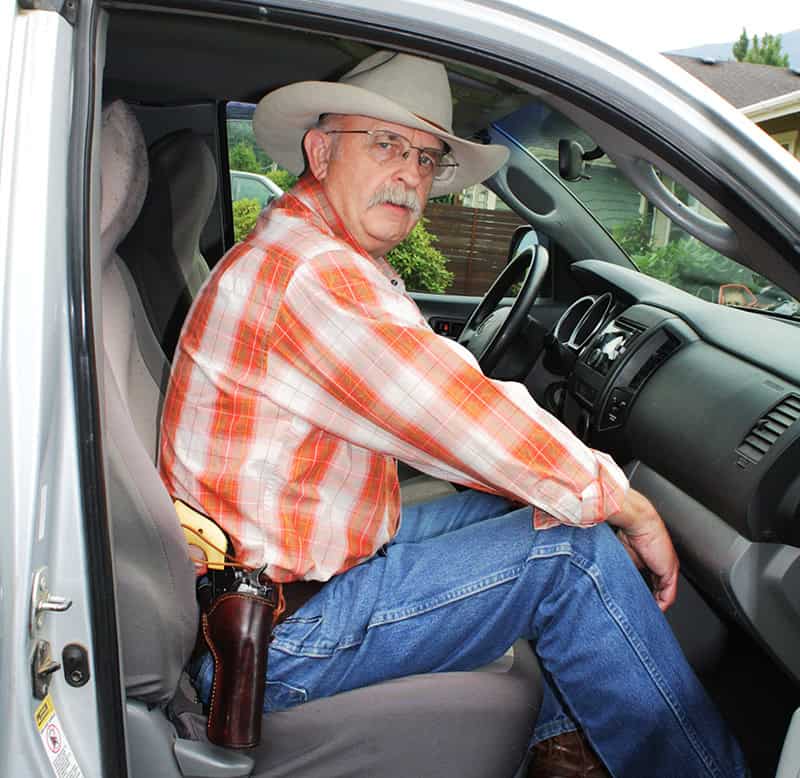
Dave occasionally carries a Ruger Blackhawk single-action on his travels around the
Pacific Northwest, where he might encounter “things with teeth and claws.”
It’s Part Nostalgia
I suspect anyone packing a single-action does so partly out of nostalgia, partly because they’re comfortable with the 150-year-old action, and partly because of the mystique. We all grew up with a steady diet of network westerns, from Rawhide to Bonanza, and history reminds us that the single-action revolver served people from the 1870s well into the 20th Century. Legendry Texas Ranger Frank Hamer carried a single-action he called “Old Lucky.” General George Patton carried an engraved single-action Colt through WWII.
Of course, single-action revolvers are slower to reload, and in an emergency, that can be deadly. On the other hand, someone who is competent with a sixgun can be a formidable opponent, as headstones in Old West cemeteries might attest.
And let’s not forget, especially in the West, a lot of people carry big bore single-action revolvers because they happen to live in bear and mountain lion country. Count me among them, as I habitually pack my .45-caliber Ruger with a full cartridge belt during the early grouse season, or a Ruger Blackhawk in .41 Magnum. Where I typically hunt, I have found fresh bear and cougar tracks on occasion, and the weight of that “big iron” on my hip has been reassuring.

If you’re planning to leave cartridges in a belt for long periods, Dave suggests using
nickel-plated brass (right) because it is less prone to get cruddy with verdigris and turn green.
Practice and Maintenance
Several sixgunners responding to my request for comments emphasized the necessity of practice, which is just common sense. After my shooting sessions, I’ll pull the cylinders, run a patch soaked with Hoppe’s No. 9 and then use a bristle brush down the bore to scrub out the residue.
Lube the cylinder pin, add a drop of oil to the ejector rod and housing, and another drop around the cylinder stop and the slot where the pawl comes up to engage the cylinder and rotate it.
Brush around the cylinder window, especially around the barrel breech and forcing cone. Then put it all back together.
Candidly, it would seem someone carrying a single-action revolver as an EDC (everyday carry) is putting himself/herself at a serious disadvantage in the event of a life-threatening emergency. However, depending upon an individual’s skill –i.e. speed and capability of making an accurate shot—that just might not always be the case.
There are various holsters suited for the purposes of daily carry. Among them is the pancake, from Simply Rugged Holsters, and a Summer Special-type of IWB rig with a roughout surface from Barranti Leather. And one can find suitable holsters from El Paso Saddlery, Mernickle, Bianchi and others.
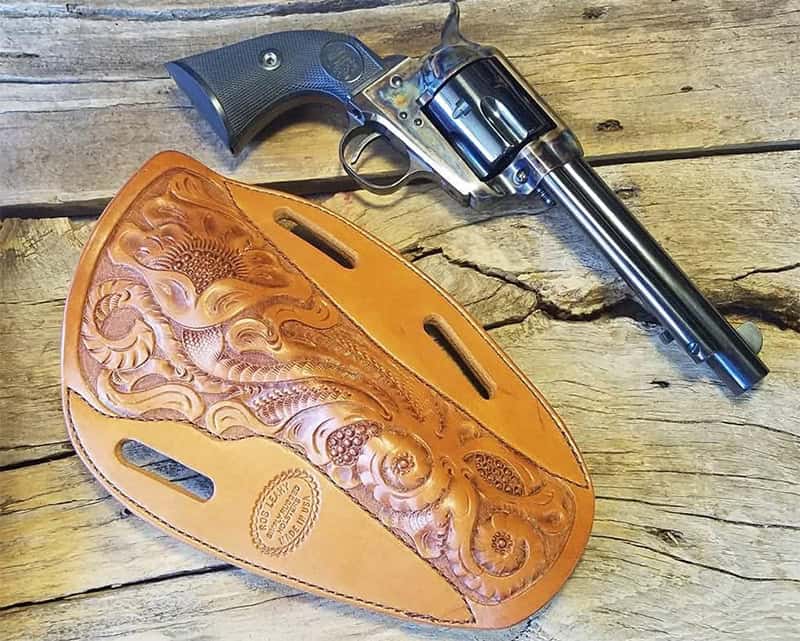
Rob Leahy at Simply Rugged Holsters still produces the excellent pancake holster,
which is a good choice for concealing a single-action wheelgun. (Image courtesy of Rob Leahy)
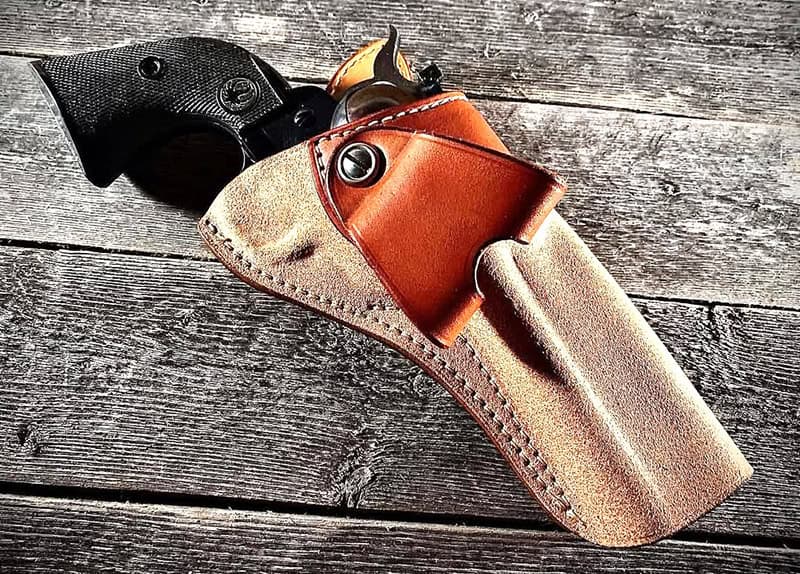
The Barranti Leather IWB with its roughout surface can conceal a sixgun rather well.
Dave received a photo from one fellow who packs a Linebaugh .500
in his Barranti IWB rig! (Image courtesy Barranti Leather)
Elmer Was Fast
In his autobiography, Hell, I Was There!, Elmer Keith wrote about how in his younger days he practiced for trouble in Ovando, Montana against a couple of characters. Keith practiced with his .45 Colt. “I was very good with a single-action then,” he wrote, “and could draw and hit a gallon can at ten yards in about a quarter of a second or a shade over.”
While that sort of speed may not be common in this day of people using semi-autos or double-action revolvers, even drawing in a second or 1.5 seconds, which is achievable, can still surprise the heck out of an overly-confident thug, and just might spare some unpleasantness with an angry bear, cougar or wild canine.
One final tip: If you’re going to leave cartridges in a leather belt or a cartridge slide for any length of time, it’s best to use nickel-plated brass. It doesn’t end up turning cruddy with verdigris. Otherwise, when not in use, remove the cartridges so the brass doesn’t start turning green.
Single-action revolvers are enticing for many handgunners. We can’t leave ‘em alone. In a social breakdown, you certainly might prefer something else, but as John Wayne said in Rio Bravo, when Ward Bond asked, “That’s all you’ve got?” The Duke replied, “That’s what I’ve got.”