The Colts That Never Were
Thanks To Cimarron Arms, Several Classic Sixguns From The 1870 To 1890 Period Are Now Faithfully Recreated.
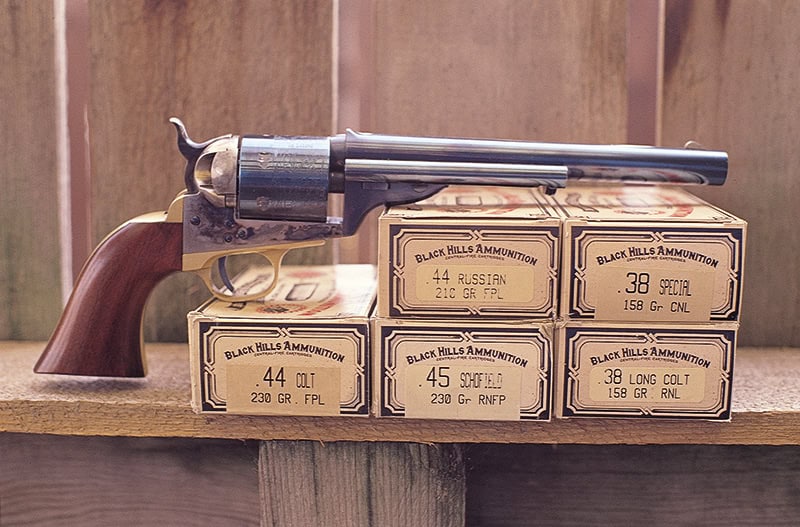
Cimarron’s Open-Top is available in .38 Special, .38 LC, .44 Colt, .44 Russian and .45 Schofield.
Replica sixguns are very popular today with both the percussion Colts and the Single Action Army being faithfully offered in the original designs. Because of various reasons, including the calibers they were originally chambered for, there are also several other models that are modernized versions of the old Colts. These include the Cartridge Conversions, the Open-Top, the Lightning and Thunderer. All of these in their original form were important parts of the period from 1870 to 1890.
Today, for Western reenactors, history buffs or cowboy shooters these guns are offered in a much more usable form that can be described as the “Colts That Never Were.” This is not to disparage them as the new versions are better in many respects than the old originals.
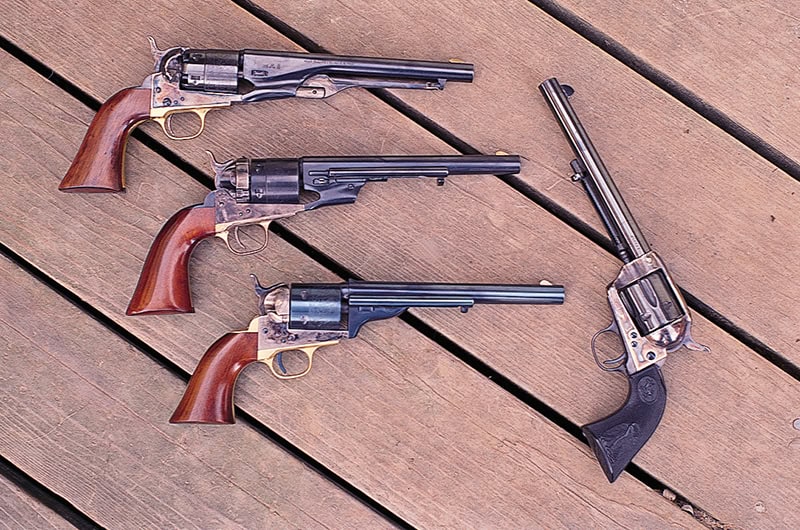
The Colts of the 1860’s to 1870’s are represented by these Cimarron sixguns: 1860 Army,,br>1860 Conversion, 1871-72 Open-Top, Single Action Army.
High Quality Reproductions
Thanks to Cimarron, we now have high quality reproductions of the Cartridge Conversions on both the 1851 Navy and 1860 Army, the Open-Top and modern versions of the double-actions of the 1870s.
During the late 1860s the Thuer Conversion was performed on approximately 5,000 Colt cap-n-ball sixguns. With the originals, it was necessary to load powder, ram a ball home and then cap the nipple on the back of the cylinder. Thuer’s invention altered the cylinder of percussion revolvers with a conversion ring added at the back end after the original cylinder was turned down. This allowed a tapered metallic cartridge, .36 caliber for the 1851 Navy and .44 caliber for the 1860 Army, to be inserted from the front end. Quite ingenious, but not tremendously successful.
Next came the patent for the Richards Conversions in 1868. Richards’ patent was used by Colt to convert thousands of cap-n-ball sixguns to the new fixed ammunition style. The Richards Conversion used a frame-mounted firing pin and can be recognized by an ejector rod that sticks out about an inch behind the ejector rod housing.
These conversions were followed with the Richards-Mason Conversions with a hammer mounted firing pin and ejector rod housing that extended all the way to the front of the cylinder. The non-exposed ejector rod would be one of the ideas incorporated in the great design ascribed to William Mason a few years later– the Colt Single Action Army.
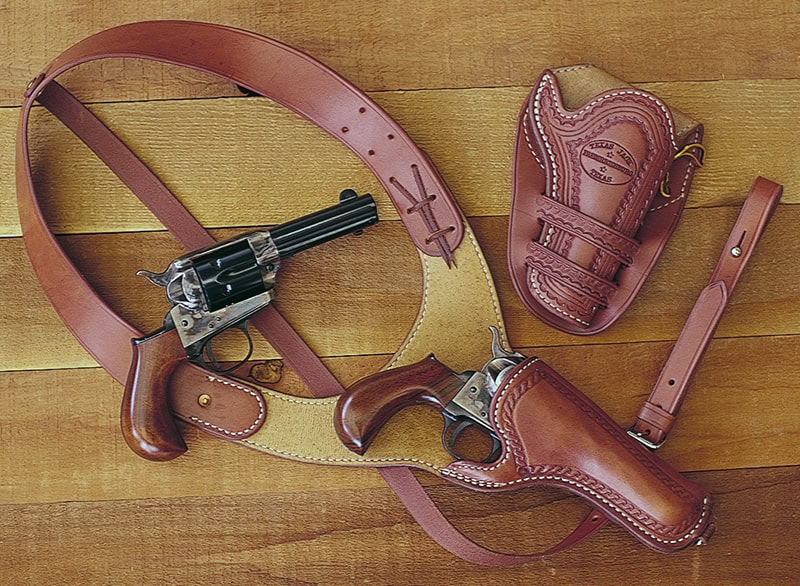
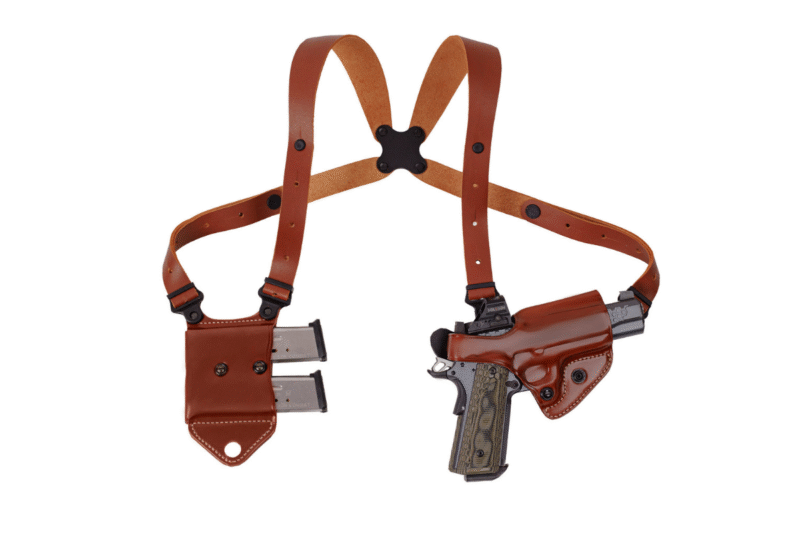
Cimarron has both shoulder holsters and Mexican Loop holsters for the .38 Lightning.
Before The Peacemaker
The Cartridge Conversions are an important part of sixgun history spanning the time frame between Colt’s percussion revolvers and the Peacemaker. It is evident from the examination of original Cartridge Conversions remaining from the 1860s and 1870s that these sixguns were well-used.
The original Colt Cartridge Conversions were chambered for rounds that used a heel-type bullet, that is a bullet whose base was smaller in diameter than the rest of the bullet. This resulted in a bullet that was the same diameter as the outside of the case much like today’s .22 rimfire. The original Colt 1860 was a .44-45 caliber with a groove diameter of .449″ as compared to today’s .44 Magnums and .44 Specials with a groove diameter of .428″ to .430″. Likewise the 1851 Navy .36 cap-n-ball sixguns had barrels that measured at .375″ to 376″.

Thunderer from Cimarron (center) is a blending of the Colt Single Action Army (top) and the 1877 Double Action.
Cap-N-Ball Sixguns?
The Cimarron Cartridge Conversions are supplied with the 1851 Navy using standard .38 Special loads, or .38 Long Colt loads which are available from Black Hills Ammunition. However, the cylinder of the 1860 is not large enough in diameter to accept six rims with the diameter of modern .44 Special or Russian brass, so we now have the .44 Colt in modern form. Today’s .44 Colt uses a .429″ to 430″ bullet and is made by simply trimming the .44 Special by approximately .06″ with the rims being turned down to .487″.
At first glance, the Cimarron Colt Cartridge Conversions appear to be cap-n-ball sixguns. A more thorough examination reveals the absence of a rammer to seat the round ball home and the addition of a loading gate and ejector rod for the entrance of loaded rounds and the exit of fired cases. They still field strip like the original percussion sixguns by removing a wedge pin from in front of the cylinder and then removing the entire barrel assembly from the main frame.
My test guns are in .38 Special and .44 Colt chamberings. Both were test-fired with smokeless loads and blackpowder handloads. These modern versions probably shoot better than their original counterparts ever did! The original 1851 had a 7 1⁄2″ barrel; however, Cimarron offers the option of the 5 1⁄2″ barrel found on my test sixgun. This 1851 Navy Conversion preferred the .38 Special Cowboy loads from both Black Hills and Winchester. These clocked out at 700 and 740 fps respectively and put five shots in 7/8″ and 1 1⁄8″ at 50 feet.
With blackpowder loads the 1851 binds up very quickly, but this problem can be overcome with Pyrodex loads. I loaded 17 grs. of Pyrodex P in .38 Long Colt brass from Starline, which averaged 860 fps and shot into 2″ at 50 feet. This is right with today’s .38 Special loadings.
When Smith & Wesson brought forth their first bigbore cartridge-firing sixgun in 1869, Colt was still producing cap-nball sixguns. Smith had always been a fixed ammunition revolver manufacturer going all the way back to 1852 and their pocket pistols in .22 rimfire.
The Open-Top
In early 1872, Colt brought forth their first model originally designed as a cartridge-firing sixgun. The Open-Top was not a conversion of a Conversion or a capnball of any sort, it was a new sixgun with new parts, while keeping the grip frame of the 1860 Army. It gets its model name from the retention of the basic profile of the Colt Cartridge Conversions with no top strap on the frame. This would change the following year with the advent of the 1873 Colt Single Action Army.
Approximately 7,000 Open-Tops were manufactured in .44 Rimfire. This made them very practical for the man who already had an 1860 Henry or 1866 Yellow Boy levergun chambered in .44 Rimfire. But again practicality butts up against authenticity if one decides to resurrect the Open-Top as a replica. Today’s Open-Top from Cimarron uses modern centerfire ammunition and is offered with both the 1860 and 1851 Navy grip frame. The latter is most familiar to most shooters as it would become the Colt Single Action grip frame in 1873.
Today’s Open-Top is chambered in .38 Special, .38 Long Colt, .44 Colt, .44 Russian and .45 Schofield. The latter, also known as the .45 S&W, is the original chambering of the Smith & Wesson Schofield Model of 1875 and is the chambering of my test gun from Cimarron. The cylinder of the Open-Top is large enough to accept the rims of the .44 Russian round and chambered deep enough to handle the longer .44 Colt round.
Open-Tops from Cimarron are offered in four finishes– standard blue, the brilliant but fragile fire blue, charcoal blue and Cimarron’s “Original Finish” which is an antiqued finish that looks like a 100-year-old gun. Grip frames are either an 1860 Army-style steel or 1851 brass Navy, and barrel length can be 5 1⁄2″ or 7 1⁄2″. Factor in all finishes, grip frames, barrel lengths and calibers and one has 48 choices when it comes to selecting an Open-Top.
My test Open-Top is a 7 1⁄2″ .45 Schofield, charcoal finish, with a brass Navy grip frame. Unlike the percussion revolver with the rear sight in the tip of the hammer, or the Cartridge Conversion with the rear sight on the frame behind the cylinder, the Open-Top’s rear sight is on the back end of the barrel and consists of V-notch mated up with a silver front sight.
With Black Hills 230 gr. .45 Schofield, the Open-Top put five shots into 1 1⁄4″ at 50 feet and does the same with my handload of the same weight bullet from Oregon Trail over 5.0 grs. of Accurate Arms N-100. Velocities with both loads are 723 and 654 fps respectively.
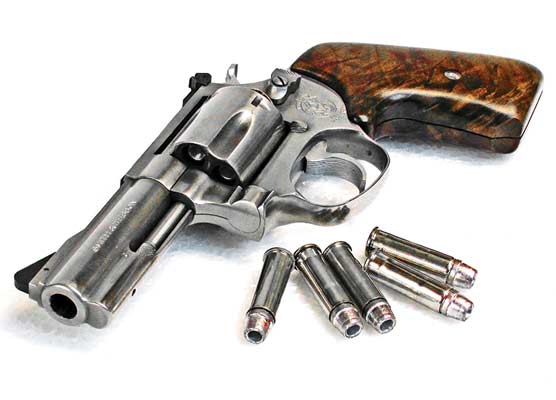
The original Model 1877s were a departure from the sixguns offered by Colt for the previous 40 years, just like the double-actions. The loading and unloading was still accomplished like with the SAA, by using a loading gate and an ejector rod on the side of the barrel. But these guns could be fired by cocking the hammer first or simply by pulling the trigger. Offered in two calibers, the .38 Long Colt came to be known as the Lightning while the .41 Long Colt version was the Thunderer.
The double-action mechanism was extremely fragile and double-actions are not permitted in SASS competition, so Cimarron modernized the 1877 by keeping it as a single-action, changing the grip frame by combining the trigger guard and front strap of the SAA with a backstrap that is a dead ringer for the Lightning and Thunderer.
A Wonderful Step Back In Time
My Thunderer, with a 3.5″ barrel, is extremely well-finished with deep dark bluing on all parts except hammer and frame which are case colored. Metal to wood fit is excellent and the dark walnut grips are fine lined checkered and look and feel very good. The grip frame shape may look strange, but is extremely comfortable when firing .45 Colt loads in the short barreled Thunderer, feeling more like a double-action grip, and the sixgun does not twist or roll in the hand.
Sights are as found on the original 19th century sixguns consisting of a very thin front sight blade that literally tapers to a point and a shallow notch rear sight. Since the Thunderer and subsequently tested Lightning both shot low, filing the front sight to bring the elevation up also serves the purpose of making the top of the sight wider and easier to see.
The Thunderer was tested with four .45 Colt factory cowboy loads, with the results being nothing to get excited about the average group size was 2 3⁄8″. However, when I switched to Black Hills .45 Schofield load, groups shrank to 1 1⁄2″ and with one of my favorite handloads (Oregon Trial 255 gr. SWC over 8.0 grs. of Unique) groups were one ragged 1″ hole at 50 feet with a muzzle velocity of 735 fps. This once again points to the fact that every sixgun has its own personality.
For those of us stuck in the 19th century, the “Colts That Never Were” make for a wonderful step back in time. Even if they never existed, they should have.
Get more revolver stories every week!
By submitting this form, you are consenting to receive marketing emails from: . You can revoke your consent to receive emails at any time by using the SafeUnsubscribe® link, found at the bottom of every email. Emails are serviced by Constant Contact