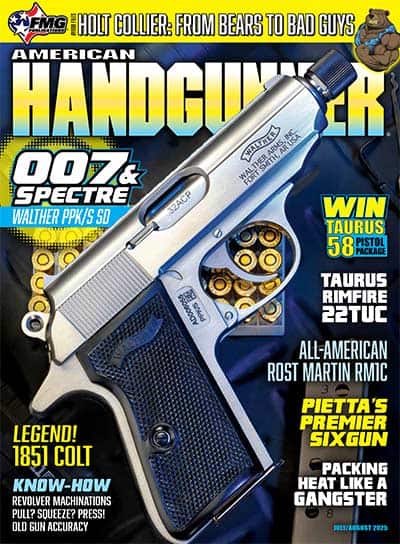
From Bears to Bad Guys
Ayoob Files
Situation: The man ultimately responsible for the teddy bear was no teddy bear himself.
Lesson: Even in the times of slavery and segregation, skill in hunting and shooting won an African American respect across racial and social lines.
We all learned the story as kids in American History class. Someone tied a bear to a tree for President Theodore Roosevelt to shoot, and ever the sportsman, Roosevelt declined. Newspaper men were along to record the hunt, and a famous cartoon went viral, as we’d say today. It depicted TR raising his hand in a “stop” position, his rifle pointed at the ground, as a white man in a slouch hat held a cute little bear cub on a leash. Roosevelt’s compassion touched America’s heart; an enterprising toymaker came out with a stuffed bear cub toy; and what the maker called the “teddy bear” became a symbol of child-like innocence to this day.
There is, of course, more to the story.
To start with, the man who captured and tethered the bear in question wasn’t a white guy. His name was Holt Collier, an African American born into slavery in Mississippi in 1846. He was a legendary hunter said to have killed 3,000 bears. He had also killed his share of men, in war and in peacetime.
Backstory
Collier was owned by cotton plantation owner Howell Hinds, a devoted hunter. Holt had a talent with dogs and horses, and as a child was appointed caretaker of Hinds’ hounds. He wound up being taken along on hunting trips, where it turned out he was also a preternaturally talented marksman. Minor Ferris Buchanan, author of the primary Collier biography, tells how the boy became a bear hunter: “Crashing through the underbrush and the canebrake, they saw a black bear trying to fight off the angry pack of dogs. Taking careful aim, Holt squeezed the trigger, dropping the bear to the ground. At 10 years old, he had killed his first bear.”
From then on, he was given a pony and a shotgun and instructed to “keep the tables high with fresh meat.” The kid became so proficient with the shotgun that Hinds allowed him to compete in live bird shooting matches, on one occasion winning a then-princely $1,000 for his master. Buchanan writes that Hinds “bought him a $215 12-gauge Scott shotgun. If converted into today’s money, the shotgun would cost somewhere over $7,000.” By now, Hinds was treating the young slave like his own son, and the affection and loyalty were returned.
Which is why, when the Civil War broke out, the boy went to war. Slave-owners who donned butternut and fought for the South often brought a slave along as valet, but it was all but unheard of for a slave to be actually fighting the Yankees who fought to free them. Holt Collier, however, had led a life of relative privilege. Hinds, a personal friend of Confederacy President Jefferson Davis, went off to fight. When Hinds told him he was too young and had to stay home, the lad rebelled, took a horse from the Hinds’ stable, and followed his master. Once he was at the front, Hinds assigned him to be a valet. At age 14, Collier was tending a wounded soldier when a skirmish broke out. He would say later in the dialect of his time and place, “Somebody had left a musket an’ a sack full of cartridges. So I jes’ buckled on the cartridge belt an’ follered along ’til I got to where the shootin’ was goin’ on … I got to a place where I could see real good an’ commenced to a-shootin’ too.”
Biographer Buchanan writes, “Holt, happy to be part of the action, kept pouring fire into the advancing Yankees. It was there, outside of Nashville, that he proved his willingness to kill or die for what he considered his country, regardless of his status as a slave.” Collier fought in the battles of Corinth and Shiloh, where according to one account he was wounded. He found himself a trusted scout under the command of Nathan Bedford Forest, who would later be a founder of the Ku Klux Klan and still later renounce that organization. Collier would later say he had been treated as an equal by the white Confederates in his company, although he said he was “the only colored man in the regiment.”
When the war ended, Holt Collier was officially a freedman, and by one account had been freed by Hines even before the latter went off to war, but he chose to stay with his benefactor. It was a relationship that would end with gunfire.
Collier’s First Shooting
It happened in 1866. His most thorough biographer, Buchanan, wrote: “The incident occurred when Holt entered Howell and his daughter Alice’s room to help them get ready for the night. The train conductor, who would not stand for a Black man being in a White person’s cabin, grabbed Holt and dragged him out like a ‘dog,’ Holt later stated. Flying into a rage, Howell shoved the conductor, who unsheathed a Bowie knife, threatening Howell. Shoving Howell aside, Holt drew his pistol and fired a round into the conductor’s hip. Fortunately for Holt, Howell had many friends aboard the train. Howell was able to defuse the tense situation, which could have gone very badly for Holt.”
Collier’s Other Shooting?
Yes, the question mark in the line above is intentional, because accounts differ. In December of 1866, a man from the Freedmen’s Bureau who’d had a conflict with Hinds was found shot to death. Holt had been the last person to see him alive, and he was arrested for murder but soon acquitted, according to one account.
Another version of the story can be found on Facebook attributed to Colonel Charles T. Zachry. It reads: “During the time of Reconstruction, Collier was accused of murdering a Yankee soldier, Captain James King, but was acquitted by a military tribunal in Vicksburg. King and Howell Hinds were involved in a fight and during the dispute, Hinds, though a much older man, knocked the youngster down several times. King’s anger grew with every knockdown. Finally, the thoroughly infuriated young man drew a knife on his unarmed opponent, but a bystander fired shots killing King, preventing him from drawing blood with his knife. It was never fully proven that Holt Collier was the man behind the gun.”
Vigilantes often lynched black men who killed white men in that time and place. Holt Collier finally left his former master and went to Texas to become a cowboy, where his skill with horses turned out to be more important than his skill with guns.
The Prolific Hunter
Before long, Collier became homesick and returned to his native Mississippi. With slavery gone, cotton plantations were no longer very profitable, but the state was rich in forests and the lumber industry soon became huge. Meat was needed to feed the lumbermen, and Mississippi forests at that time were also rich in bears. Doing what he had always loved and excelled at, Collier became a professional hunter. Collier killed a great many whitetail deer to feed hungry workers, and to most, venison tastes better than bear meat, but his job demanded volume more than cuisine. Per Buchanan: “A full-sized black bear carcass brought around $60. A whitetail deer would earn Holt 30 cents per pound when field dressed.” Male black bears in Mississippi ran 150 to 350 pounds, females 120 to 250. Small wonder that Collier focused on ursine targets.
When demand from the lumber industry slowed down, Collier focused on feeding railroad workers as train networks burgeoned in the state. By his own count at the end of his life, Holt Collier had killed some 3,000 bears.
Collier’s Famous Gunfight
Fast forward to 1881. Across the Mississippi river in neighboring Louisiana, specifically West Carroll Parish, there was a rogue sheriff’s deputy with a mean streak named Travis Elmore Sage who liked to drink on duty. A man he disliked named Richard Lott rode up with his family near where Sage was standing. The latter started badmouthing him and then, without warning, shot him dead in front of his family. Lott’s brother, who owned a store nearby, saw the whole thing and ran to the scene, grabbing his brother’s gun from his corpse and attempting to shoot Sage, but the gun misfired. Sage’s didn’t: He shot and killed the brother, too. Not too drunk to realize he had just committed a double murder, Sage fled. The crime became a cause célèbre and warrants and wanted posters spread throughout the Southland.
Travis Elmore Sage made the mistake of showing up in Holt Collier’s hunting grounds. Someone recognized him and reported it to the local constable, who assigned Collier to go and identify him, and bring him in. Holt did indeed find and identify him. Sage was astride his horse outside a business establishment at Washburn’s Ferry when, in a subterfuge worthy of famed lawman Bass Reeves, Holt Collier approached Sage and told him how much he admired his Winchester rifle. Could he examine it, please?
The prideful fugitive handed his rifle to Holt, who then made a mistake that almost cost him his life. He handed the rifle to a bystander and asked him to hold it, and then announced to Sage that there was a warrant for him and he was under arrest.
The killer drove his horse into Holt, who was in front of him, and pinned him to a hitching post as he demanded the bystander to give him back his rifle. The bystander obliged. Sage grabbed the Winchester and was seen to lever a cartridge into the chamber as he swung it over his horse’s head to bring to bear on his trapped would-be captor. However, the rifle barrel struck the horse on the head between its ears and the animal shied.
It gave Holt Collier time to draw his revolver and shoot Elmore Travis Sage in the heart. The double murderer toppled off his horse, dead when he hit the ground. No one ever questioned whether or not it was a justifiable homicide. Collier was lauded as a hero. He humbly returned to his profession of hunting.
Hunter To Guide
Time went on. The bear population of Mississippi decreased profoundly, due in no small part to Collier’s own efforts, and the demand for meat hunters dried up. Determined to keep doing what he loved, Holt Collier reinvented himself again, this time as a hunting guide. His reputation as the best bear hunter in Mississippi brought wealthy sportsmen to him in droves … which led to his most famous engagement as guide to President Theodore Roosevelt, the most avid hunter to ever occupy the White House and widely recognized as the father of the conservation movement in the United States.
The Teddy Bear
osevelt on a bear hunt in the Mississippi Delta. Placing the President on a stand, Collier was unable to drive a bear to him until mid-noon, by which time an impatient Roosevelt had gone back to camp for lunch. Collier’s dogs bayed the bear some 50 feet from where the guide had left TR. When it appeared the bear was going to kill one of his favorite dogs, Holt waded in and clubbed the bear at the base of the skull with his rifle butt, rendering it semi-conscious. He then tied it to a willow tree with a rope and fetched his client back. It was then that Roosevelt famously refused to shoot the staked animal.
What they didn’t usually tell us in history class: The bear in question was not a cub, but a full grown male measuring 6′ 7″, weighing 300 lbs. and ferocious enough to fight off a pack of dogs. What popular history also left out: The animal was obviously brain damaged by Collier’s powerful blow to its head, and TR ordered it put out of its misery. The skull was later shipped to him at the White House. Roosevelt’s hunt ended without him shooting a bear with the .40-90 Winchester he had brought along for the occasion.
The highly publicized “spare the bear” story inspired New York toymaker Morris Mitchtom to create the little stuffed bear cub toy that, with TR’s approval, he dubbed “Teddy’s Bear,” and the rest was history. Mitchtom went on to found the Ideal Toy Company, a giant in its industry.
In 1907, Roosevelt returned to the Delta for another try at a bear, and Collier, now 61, guided him again along with another nationally famous bear hunter, Ben Lilly. This time, TR bagged his quarry with two shots from his Winchester Model 1886. During the course of the trip, one of TR’s parties was charged by a huge wild hog. The beast was coming at Dr. Presley Rixey, the President’s personal physician and Surgeon General of the Navy, when Holt Collier leaped between man and beast and stabbed the animal to death before it could reach its target with tusks that were later measured at seven and a half inches.
Upon his return to Washington, Roosevelt reportedly shipped to Collier a Winchester Model 1886 in .45-70 as thanks and pronounced him the best guide he had ever hunted with: High praise from a man who hunted all over the world.
The Guns Of Holt Collier
Remember the Scott shotgun his biographer mentioned? I suspect it was a Webley & Scott. It fits the time period: The British gunmaker had been producing fine firearms since 1790 and quality English doubles were popular among Southern sporting gentlemen such as Hines. During the Civil War, Collier rode with an elite group called the Titus Grays. Says biographer Buchanan, “Armed to the teeth, the Titus Grays carried multiple pistols, a musket, a double barrel shotgun and a Bowie knife.” Under the terms of the armistice, the disbanded Confederate soldiers were allowed to take their weapons home with them. Collier was under the command of the wealthy Forest, who paid out of his own pocket to arm his troops with .36 caliber Navy Colts.
Little is known about the details of Collier’s armament throughout his career. He is most often depicted with a Winchester rifle. We know he had the 1886 Winchester gifted to him by the President, and we know he had at least one revolver when he confronted “the most dangerous game” at Washburn’s Ferry.
Fully aware of how dangerous bears could be, it would seem likely that he’d have at least one serious caliber revolver on his person when hunting them, but none of the photos I can find show him so armed and there seem to be no records of him ever killing a bear with a handgun.
It’s possible that he didn’t feel he needed one. This was a man who had clubbed a 300-lb. bruin into semi-consciousness with a rifle butt, and used a knife to kill an enraged, charging “hogzilla.” Buchanan tells us of another occasion on which he slew a bear without resorting to any firearm at all: “One of his most well-known feats of bravery happened when a bear cornered one of his favorite dogs in a hollow tree. Without hesitation, Collier crawled inside the tree, armed only with a knife, to save his dog from what he feared was imminent death. Coming face-to-face with the angry bear, Holt acted quickly, stabbing the bear to death as it tried to crawl past him. Amazingly, Holt suffered only minor scratches.”
Lessons
Holt Collier lived to the ripe old age of 90, passing in 1936. His name lives on at the Holt Collier National Wildlife Refuge in Mississippi.
He showed us how to earn a living doing something one loves. He was known to carry as much as $2,000 in cash, which would equal more than $60,000 today. He preferred a tent in the woods to a roof over his head and didn’t buy a house until surprisingly late in life. Collier was an inveterate gambler, fond of saying there was nothing to spend money on in the canebrakes and a man’s dog didn’t care if he was rich or poor.
Over history, American warfighters from Sergeant York to SEAL sniper Chris Kyle found growing up hunting prepared them to be especially deadly riflemen in combat. Holt Collier had demonstrated the same, earlier. Some historical accounts describe Collier as having been a sniper during the War Between the States.
We can learn from the mistake that almost got him killed at Washburn’s Ferry: If you’ve taken a gun from a dangerous man, don’t hand it to a stranger. If Holt had simply kept Elmore Sage’s rifle in one hand or put it on the ground, it would likely have spared him from a near-death experience.
In the bigger picture, Holt Collier’s life teaches us that talent, skill and determination can make a sport a life’s work, and can breach socio-economic barriers. Buchanan wrote, “Long before the advent of Jack Johnson and Willie Mays, hunting was a factor that promoted integration.”
Read Holt Collier: His Life, His Roosevelt Hunts, and the Origin of the Teddy Bear by Minor Ferris Buchanan, Collier’s most prominent biographer. Google and even YouTube will give you more info on this fascinating figure in American history, who righteously earned his fame with a gun in his hand.