Down And Dirty

Once you have developed a training regiment that reflects the needed skills you feel are important, it’s time to define any other specialty areas that may be important to your selfdefense while using a handgun. Many people spend extra range time developing weak-hand firing skills. While I agree this is useful, the facts are that under life and death stress, few people actually use their weak or non-dominant hand to fire their handgun. Yes is does happen, but not nearly as often as most people assume. So, train with both your weak and strong hand, but don’t waste a great deal of ammo doing it, unless your ammo is free. Learn the mechanics of one-hand shooting, and do a few drills when range time permits.
One area that is often not addressed properly is the basic skills of “ground fighting” with your sidearm. Simply put, what do you do when you have been knocked to the ground, or take a topple when you trip over an obstacle? Can you access your sidearm and put it into action from the ground? You should try drawing your sidearm while on your back or stomach.
You can practice these skills at home on the floor with an empty weapon. Make sure regardless of how you land on the deck, you can move to access your handgun and present it to the threat. I recommend you practice this at home before going to the range for live-fire. A key issue is if you are struck or shoved to the ground, that you land in such a manner that you can still fight. If your head hits the pavement, you may be knocked unconscious or be temporarily dazed. If knocked back — or you find yourself falling backwards — be sure and tuck your chin to your chest to minimize the chance your cranium will get its bell rung.
When falling forward, try to roll your torso to land on your arm and shoulder. Trying to stiff-arm your impact will often lead to a broken wrist or arm. Most folks do this reflexively with their strong hand, and as you may have noted, it’s pretty difficult to run a handgun well with a fracture of the wrist, hand, or arm. Note that while the middle-of-the-back holsters look real cool, imagine what happens if you were to fall back onto your back — with your handgun placed on your spine. Spinal injuries are bad enough without putting your sidearm in such a critical area. If you don’t like a normal, strong side hip carry, then try something like a shoulder rig, ankle or pocket holster.
Do you know where your bullets are going — after the target?
No Big-Toe-Holes, Please?
When you go off to the range to practice your ground fighting skills, I suggest you use a ground cloth or old piece of carpet to position yourself. Do your first practice without a concealment garment to get the moves down correctly. Then, once you have the techniques down, add your normal concealment coat, shirt, or vest.
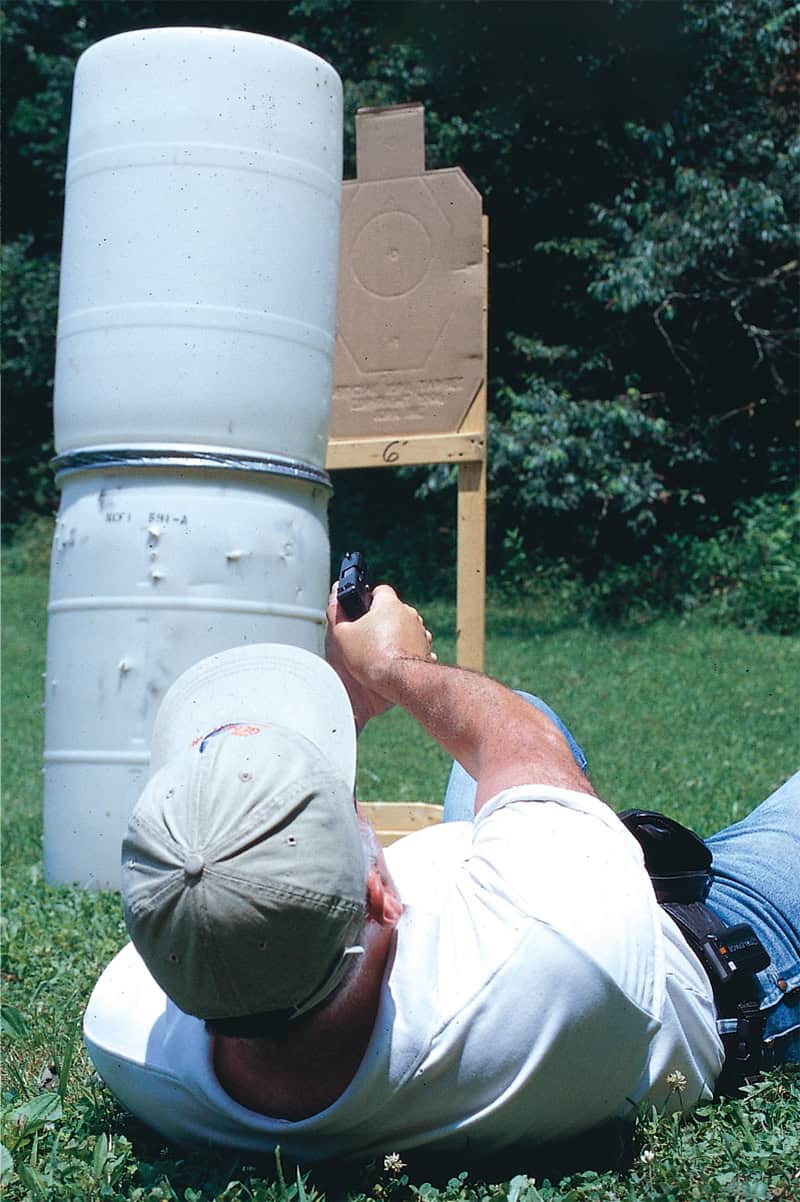
I prefer to start teaching students lying on their backs with their feet down-range. Raise the torso to give a clear line of fire to the targets and insure you don’t put a hole in your big toe. Next, start on your stomach with your feet still down range, then roll over to your side, draw your gun and engage your target. After these skills are mastered, start with your head down-range and on your stomach. You’ll find you may have to push your body up with your support hand while you engage the threat with your strong hand only. Or, simply roll to your side and fire with both hands. Try placing your body parallel to the firing line and practice engaging target from both sides of your body.
NOTE: when laying on the ground and shooting up at your targets, it’s easy to not realize your bullets may be passing OVER the backstop or berm. Always check to insure you have a proper angle and that any rounds being fired are safely trapped by the backstop.
Gut It Out
Once you have mastered the basics here, try engaging targets as if they are off to your flanks, and set up problems with multiple targets. If you are lacking in mobility do to a physical limitation or age, getting up and moving quickly to cover may be difficult. Try rolling to get out of the kill zone if you can’t move like you did when you were 16 years old. These ground-fighting skills may not look pretty on the range, and may even result in a good razing by your buddies, but most survival skills aren’t very fancy or ninja-like. But, they can save your life and allow you to win.
Being down does not mean being out in a gunfight. After a range session training on ground-fighting skills, you may return home dirty and sore, but you’ll be way ahead of the shooting range princes who adore their perfect shooting stances — and brag about the tiny groups their wonder-blaster produces time and time again. Train the way you fight. Winning isn’t always about who has the best group or fastest time. Sometimes it’s just who stayed in the fight.
Get more personal defense content every other week!
Sign up to receive the Personal Defense newsletter.
By submitting this form, you are consenting to receive marketing emails from: . You can revoke your consent to receive emails at any time by using the SafeUnsubscribe® link, found at the bottom of every email. Emails are serviced by Constant Contact