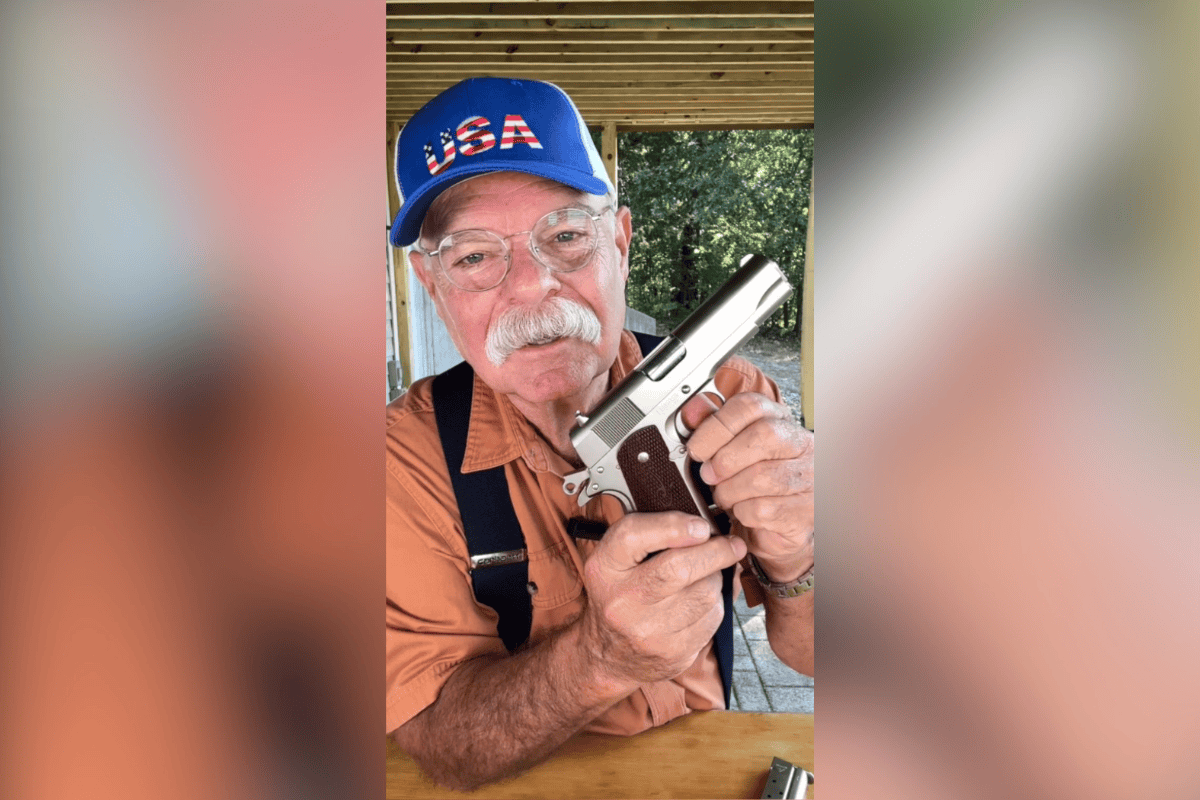
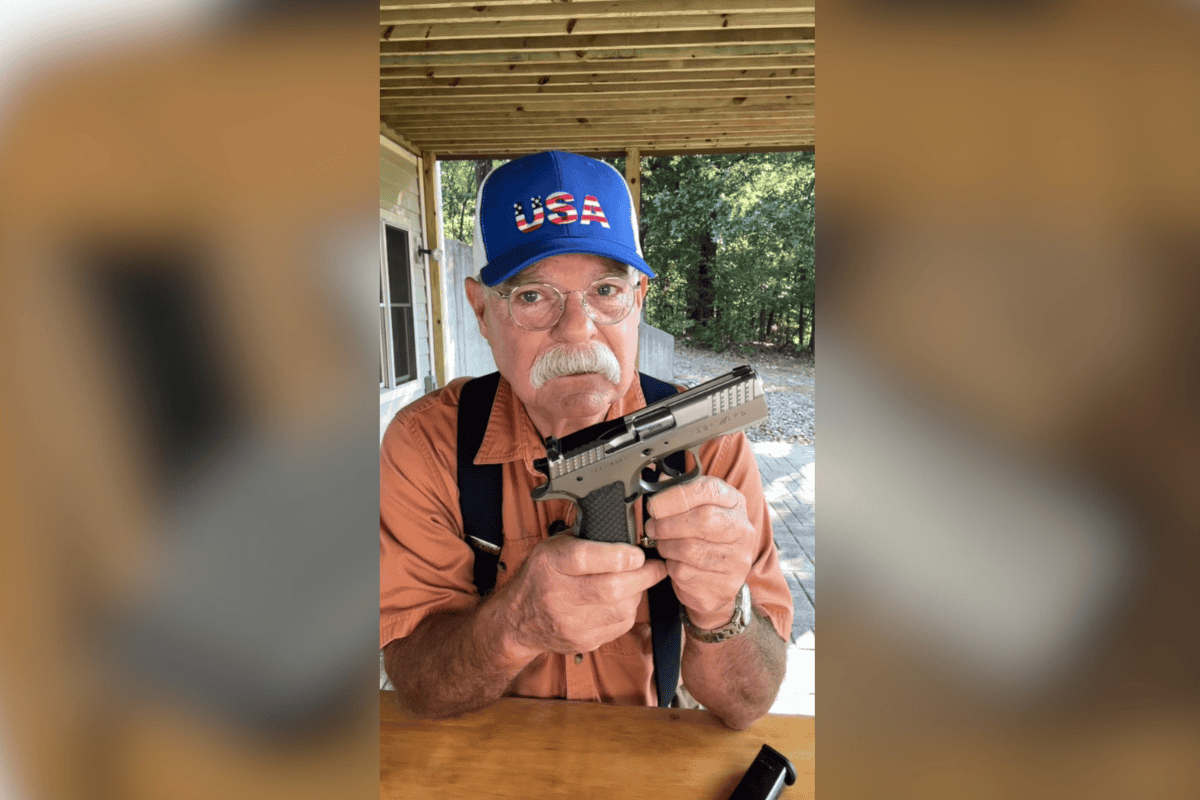
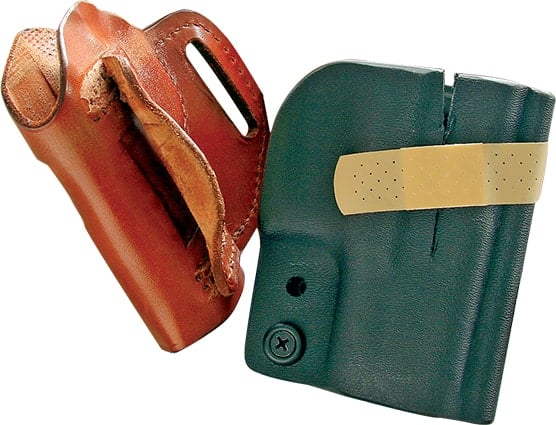
Who Says You’ll Have Two Hands?
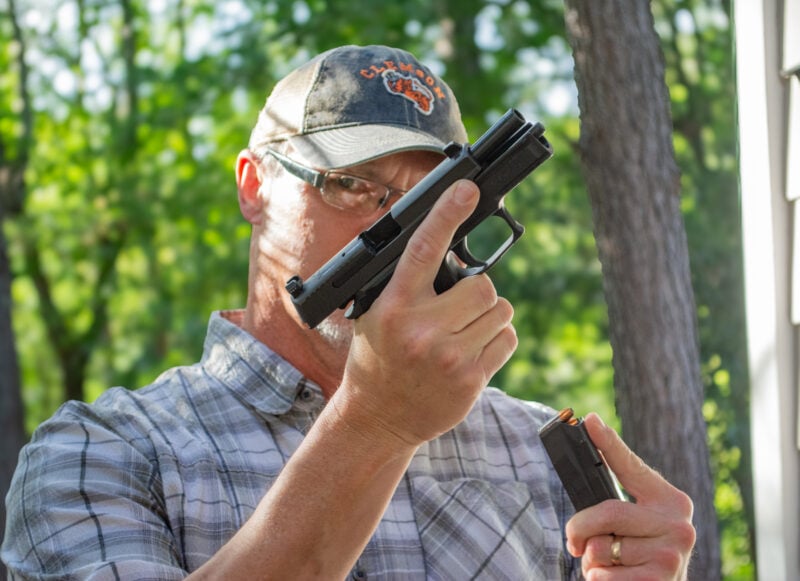
While a remote possibility, have you ever thought about changing a magazine if one hand is not available?
Your attacker gets a vote. Well, then again, when you stop to think about it, your attacker gets lots of votes. Time. Place. Method. Choice of equipment. You get the idea.
Actually, he gets almost all the votes, and that’s the annoying part about self-defense. We like to imagine ourselves choosing the time, place, distance and background music for whatever ugly event might come along. The other guy has different plans. He picks the moment and starts the festivities while we’re still trying to figure out why a perfectly normal day or night just went sideways.
The ramifications of all these votes you’re not a part of yet include a conflict between reality and preparation strategy. An amazing amount of concealed carry quietly assumes you’ll have two available hands with which to mount your defense.
We draw with the support hand clearing the cover garment. We learn and practice how to build a proper and repeatable two-handed grip. We rack the slide with two hands. We reload with two hands. If something stops working, we use both hands to fix it. Then we admire the target, pack up and go home feeling pretty good about all that practice and preparation.
Don’t get me wrong, this is great stuff. Two hands give better control, faster follow-up shots and overall improved performance. Use both whenever both are available.
But here’s something to ponder: who says they will be?
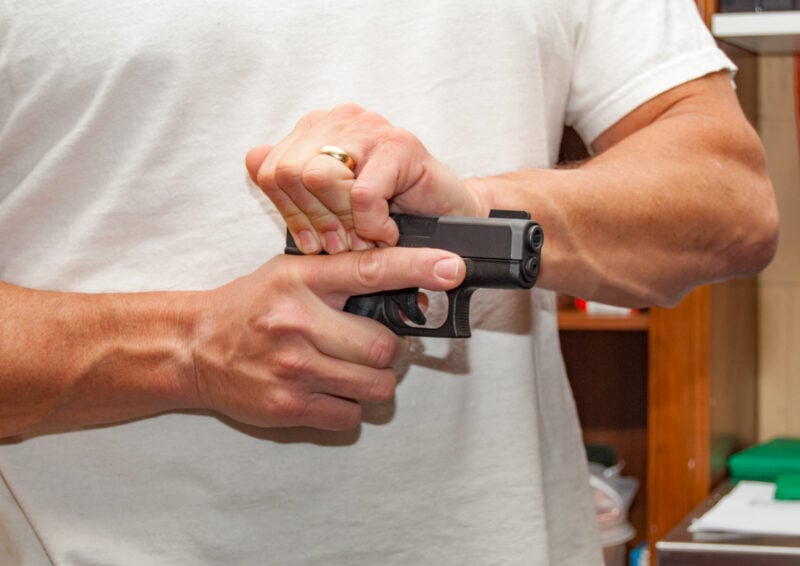
Racking the slide is a simple, ideally thoughtless habit we build.
But if you carry with an empty chamber, you may not have both hands
free to finish loading your gun.
The Missing-Hand Problem
Consider spending a few minutes on a thought exercise about why you may not have the opportunity to put both of those hands to work implementing all of your practiced concealed carry skills. There are plenty of other reasons your spare hand may be in the penalty box.
Maybe it’s holding a phone while you’re calling 911. Maybe it’s opening or closing a door. Maybe it has a flashlight, grocery bag or child. Maybe you fell and instinctively planted that hand on the pavement. Or maybe the person who started the fight has grabbed your wrist, trapped your arm or turned the encounter into a wrestling match at face-to-face distance.
The preceding examples all assume issue with your support hand. Of course, the firing hand may be the one that’s unavailable. Now the gun has to come out and work with the hand that normally gets more of the administrative tasks.
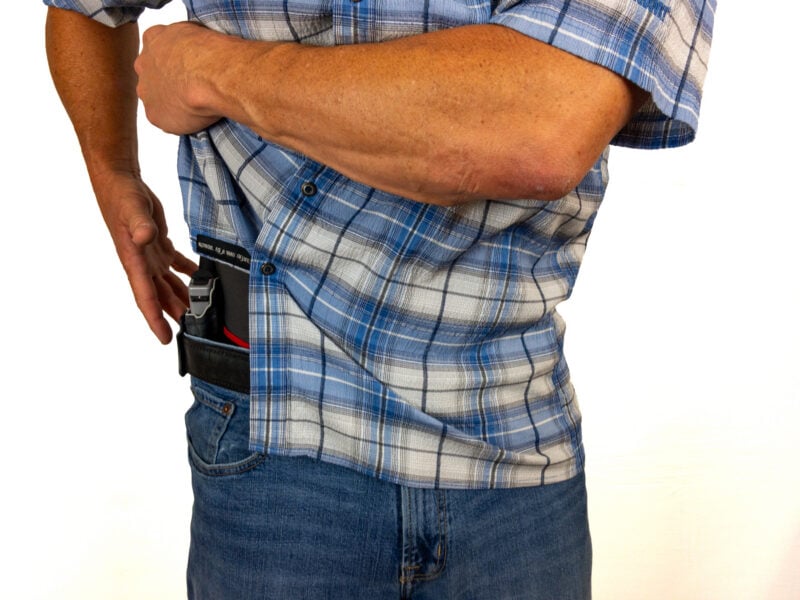
A two-handed draw from the traditional hip carry position has enough reach.
Now imagine doing it with the off-hand only.
This isn’t action-movie ninja material. It’s ordinary life, which always seems to include a second helping of Murphy’s Law, meaning perfectly ordinary things might be happening at very inopportune times. People carry things. They open doors. They fall down. They get hurt. Violent encounters happen close enough for grabbing, pushing and punching. Any plan built on the assumption that both hands will be ready for action requires some backup scenarios.
This issue sits at the center of the never-ending debate over whether to carry with an empty chamber. On paper, the benefits to the “not-ready-to-fire-just-yet method sound reasonable. The common answer is, “I’ll just rack the slide if I need the gun. I practice and can do it really fast during the draw, so there is no time lost.” That works beautifully in the classic fantasy encounter where the bad guy stands 15 yards away, clearly announces his intentions and waits for everyone to get ready.
In a real encounter, you don’t get to decide whether your support hand is free to rack the slide because you didn’t plan and start this encounter. The other guy gets to make that decision. Did he decide to start it from five or 10 yards away? Or was he the guy standing in line behind you who suddenly pulled a gun? If you think about it honestly and analytically, even with the best situational awareness skills on planet Earth, there are infinite scenarios where something bad can happen very close to you or when that other hand isn’t really available.
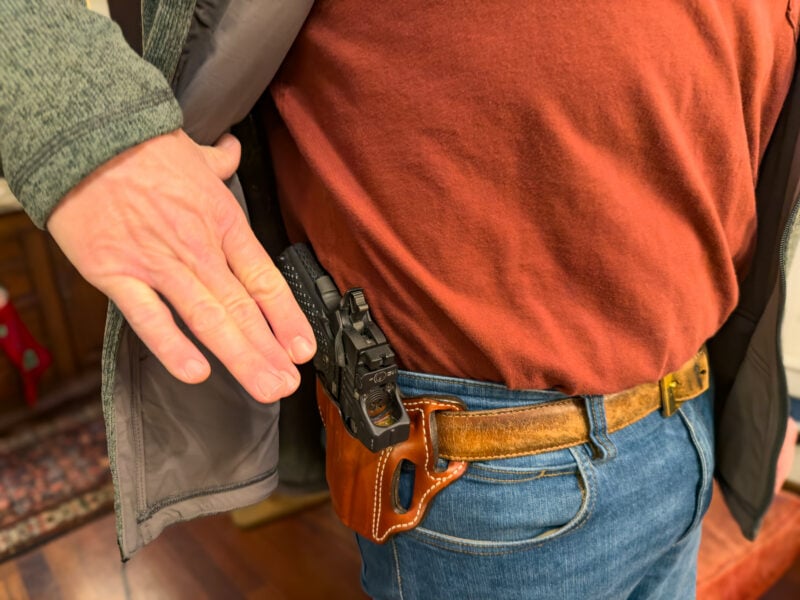
The thumb hook method is actually a good default motion when using an open front
cover garment like a jacket or vest.
Start With Shooting
One-handed shooting is the easier part of the problem, which doesn’t mean it’s easy. It only means the other parts get weirder and the corresponding practice more awkward.
At a safe distance, begin from low ready and fire deliberate single shots with the dominant hand. As always, don’t go for speed. That comes with lots of slow and perfectly consistent repetition. Pay attention to grip pressure and trigger movement. With only one hand on the gun, sloppy trigger work really shows on the target. A small movement that the support hand used to help mute can become a very big miss.
Then repeat the exercise with the support hand.
The transfer deserves care. At the range, with the muzzle pointed safely downrange and the trigger finger indexed, pass the pistol carefully from one hand to the other. In an actual fight, whether a transfer makes sense depends on what happened to the original firing hand, what the attacker is doing, and roughly eleventy-nine other variables. The range goal is simpler: learn what the gun feels like and where the controls live when you operate it with the “wrong” hand.
Don’t be surprised if the first few shots look like they came from a blunderbuss filled with nuts and bolts. That’s OK, it gets better with practice.
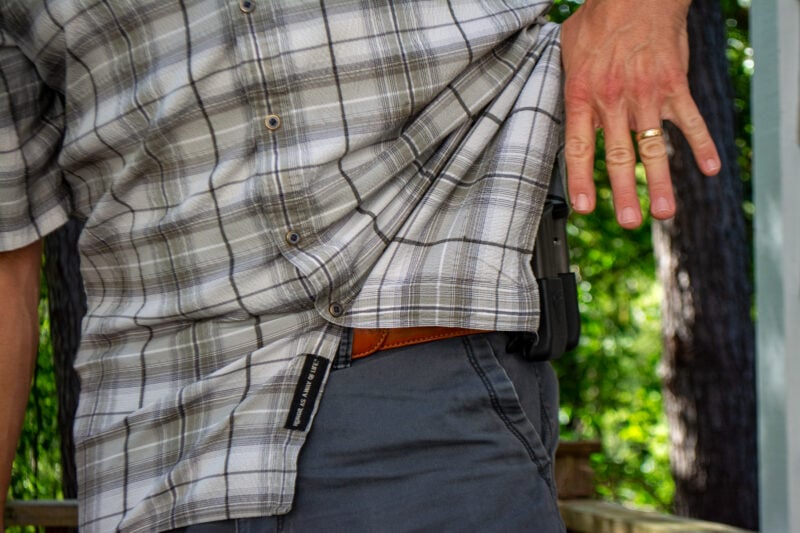
The thumb hook method is a must for accessing a concealed magazine as the gun is already in the other hand.
The Draw Changes
A one-handed draw from an open holster isn’t terribly mysterious. A one-handed draw from real concealment can be an adventure.
Many of us use the support hand to lift a shirt while the firing hand gets the handgun. Remove that support hand, and everything changes. The firing hand may have to hook, sweep or lift the garment before moving to the pistol.
This is an excellent dry-practice problem you can address at home. Unload the pistol completely, remove all live ammunition from the room, verify the chamber and magazine well, and use a safe backstop. Then work slowly with the clothes and holster you actually wear. Don’t worry about speed. Rather, get the motions right. Figure out how you can uncover the gun, establish a firing grip and draw without muzzling yourself, getting a finger in the trigger guard or becoming tangled up in clothing.
For most waist-carry positions, I like to use the thumb-hook method. Extend your firing hand thumb perpendicular to your fingers and use that as a “hook” to lift your shirt or jacket while you “hook” the gun grip with your remaining fingers. Get the hang of when you can transition the thumb from lifting duty to getting on the gun.
Repeat with the support hand only, but don’t assume the normal holster position will permit a safe cross-body draw. Body shape, carry position and holster design matter. This is one of those times when competent in-person instruction is worth every penny.
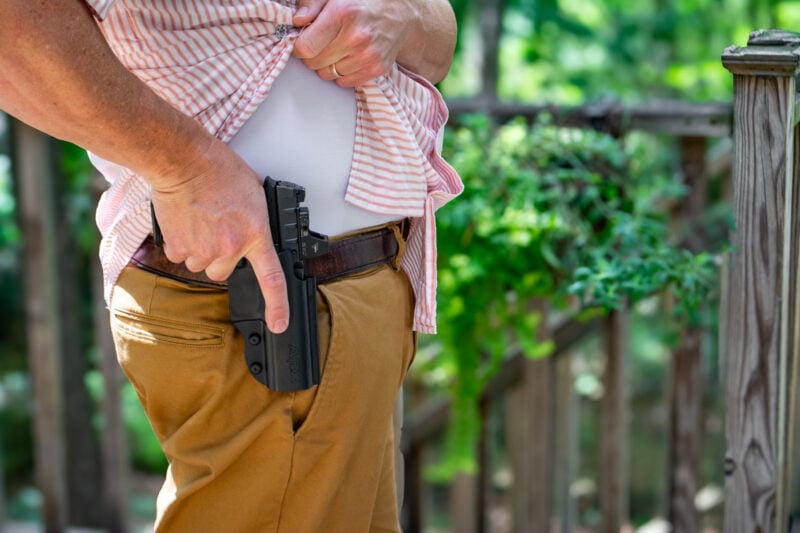
The most basic concealed carry skills, like drawing from a concealed holster,
usually assume the availability of two hands.
One-handed Gun Running
While a rare possibility, reloading or clearing a stoppage with one hand introduces a basic leverage problem: to rack a slide, the pistol and its parts need something to push against.
With two hands, you can easily hold the frame while the other inserts a magazine or cycles the slide. With one hand, you need a safe way to secure the pistol or catch the rear sight on something solid enough to operate the slide. Depending on the technique and circumstances, instructors may use a holster, belt or other rigid edge for that job.
This is also where casual experimentation can become dangerous. Learn one-handed loading and malfunction techniques from a qualified instructor. Always use a verified gun in safe dry-fire condition and snap caps instead of live cartridges.
Equipment matters here too. Tiny or sloped rear sights may be difficult to catch on anything. Some sights provide a useful squared surface while others don’t. Optics carry an advantage in this situation, as you’ve got a large object attached to the slide which can be used against a handy surface. A little one-handed practice may reveal that the “minor” controls and sight shapes on a carry gun aren’t so minor after all.
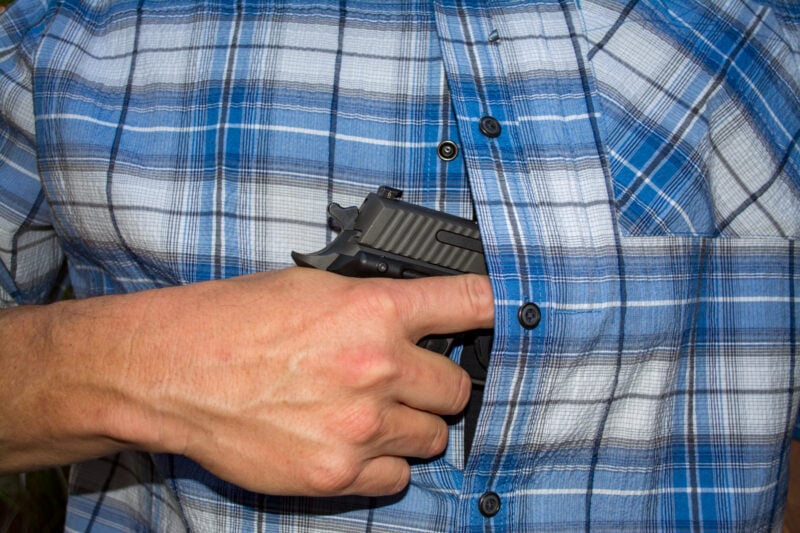
Interestingly, one of the harder and slower carry methods, the undershirt holster, is among
the easier one-handed draw scenarios, assuming you're using a snap-button shirt.
Use Both!
This isn’t an argument for choosing one-handed shooting when two perfectly good hands are available. A solid two-handed grip is always preferable. Nor is it a demand that every range outing has to involve spastic body gyrations. Some simple and thoughtful practice can answer a few important questions.
Can you draw with either hand? Can you get shots on target with your support hand without a meditation session between each shot? Can you draw from concealment one-handed?
If the honest answer to any of those is “I don’t know,” good. That’s useful information, and you can build solutions to any challenges that surface.
Two hands are better, but the other guy might vote for one to be excluded.
Get more exclusive online content from American Handgunner delivered straight to your inbox. Sign up for our free American Handgunner Insider newsletter.