The Quiet Woodsman:
Military Life of a .22 Plinker
In previous stories here, I’ve talked about a treasured handgun handed down: a Colt Woodsman pistol. Back around the year 2000, my grandfather said he bought it “about 25 years ago.” Turns out he lost track of time. When I did some quick research, I quickly found it to be a Series 1 Woodsman manufactured in 1936. You’d never know it from the unblemished, mirror-polished blue and long slender barrel, all in mint condition. You don’t see this kind of metalwork much these days.
While he, like many in his generation, endured the horrors of World War II (the Normandy landing and the long march through Europe), this particular gun was a non-combatant. It lived on a farm split across Maryland and Pennsylvania.
What I didn’t dig into at the time was the Woodsman’s other life. The one that took a target plinker from the civilian range and put it in military crates, Arctic survival kits, and, for a short time, the race to build America’s first serious silenced .22.
Woodsman Origins
Colt introduced this model in 1915 as the Automatic Pistol, caliber .22 Target Model. Not the catchiest of marketing jingles, but hey, it was John Browning’s design, refined at Hartford by G.H. Tansley and F.C. Chadwick. Turns out the raked magazine well and grip are what finally made a pile of stacked, rimmed .22LR cartridges behave in a magazine-fed autoloader. The Colt folks discovered marketing and renamed it the Woodsman. Homey and down-to-earth, isn’t it? Farmers (like my granddad), hunters, hikers, campers, fishermen and the like all felt it was designed just for them. The First Series production ran into the early 1940s. Then that disagreement in Europe began to rearrange production lines when the government started placing big orders and many civilian product lines shut down.
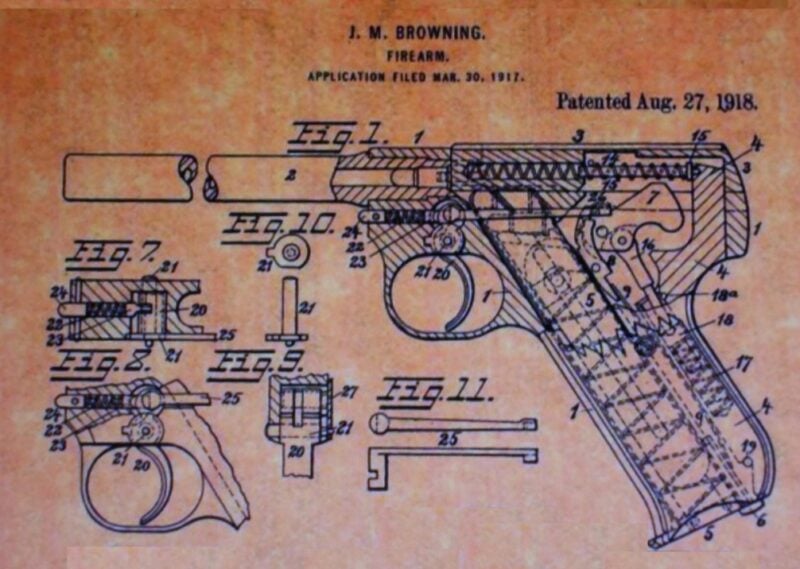
Browning's U.S. patent drawing for the Woodsman.
Reporting for Duty (Sort Of)
For years, I’ve heard stories about the secret ninja types using Woodsman pistols for all manner of secret missions. While there was military use, some of the secret-squirrel stuff has been exaggerated.
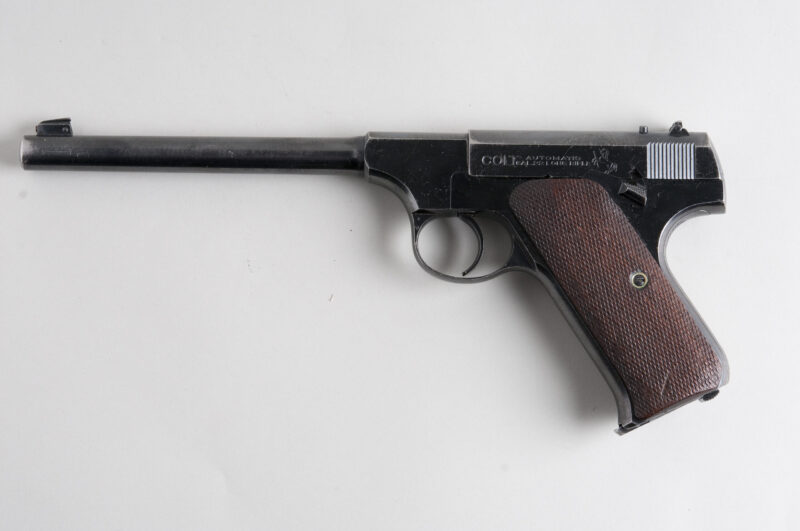
Early, pre-"Woodsman"-marked Colt .22 Target Model with a long pencil barrel.
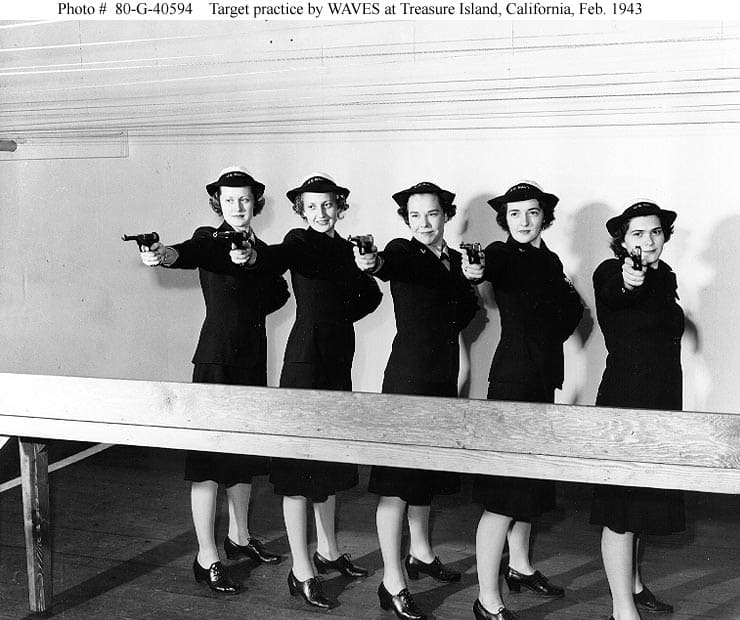
The U.S. government took delivery of 4,000-plus First Series Match Target Woodsmans during World War II. They wore U.S. Property and Ordnance marks and had plain plastic grips instead of the fancy “elephant ear” wood of the civilian retail models. The Army Ordnance Department received the shipments but distributed them across the military, including the Navy.
The best we can determine from available records is that these were used as training guns. It’s a lot easier to teach recruits with a rimfire and a heck of a lot cheaper to burn through .22LR on the training ranges than .45 ACP and .30-06 if you’re trying to teach firearm fundamentals like grip, aim and trigger control.
One concrete trail is easy to follow. On October 4, 1943, Match Target MT13722 shipped with 299 of its siblings to the Naval Supply Depot at Norfolk, Virginia. Inspector mark G.H.D. — Guy H. Drewery — and the Ordnance crossed cannons under THE WOODSMAN.
So, at least in the beginning, Q Branch of James Bond fame wasn’t ordering these for covert use.
The Secret Squirrel Bake-Off
Later came the undercover and special forces spy-pistol chapter, and this is where the internet gets a little creative.
By 1943, Ordnance and the OSS (think precursor to the CIA if you’re not familiar) crowd were hunting a silenced rimfire pistol. Aberdeen tested a variety of guns, including the Colt Woodsman and several High Standard models. Spoiler alert: High Standard’s USA Model H-D ended up winning. Let’s dig into that a bit.
It was a wartime initiative, so there are a lot of moving parts.
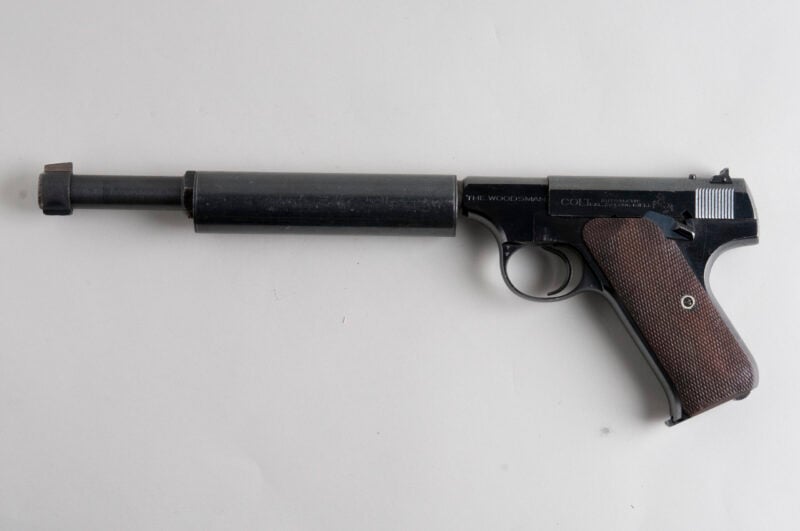
A suppressed First Series Woodsman in Norway's military small-arms collection.
The OSS experimented with similar setups in 1942–43.
The NRA Museum reported that as early as 1942, the OSS experimented with both Woodsman and High Standard Model H-Ds fitted with a special Maxim silencer. It was an off-center design, similar in function to the much more modern SilencerCo Osprey, with the idea of creating baffle space away from the sights so they could still be used. But reports from the hush-hush tinkering suggest users found the combination of the long-barreled Woodsman and Suppressor a bit unwieldy.
Later, in response to an April 1943 contract, Western Electric built silenced Woodsmans for the OSS. The pistols didn’t make the cut because they only cycled properly with high-velocity ammunition. The resulting combination of silencer and moderately higher-power ammo made the pistols too loud for their intended use.
Bell Labs also got into the action for hushed pistols and was contracted in January 1943 to design the suppressor. They ended up delivering 66 Colt Woodsman and Match Target pistols plus 44 High Standard Models A, B, D and E.
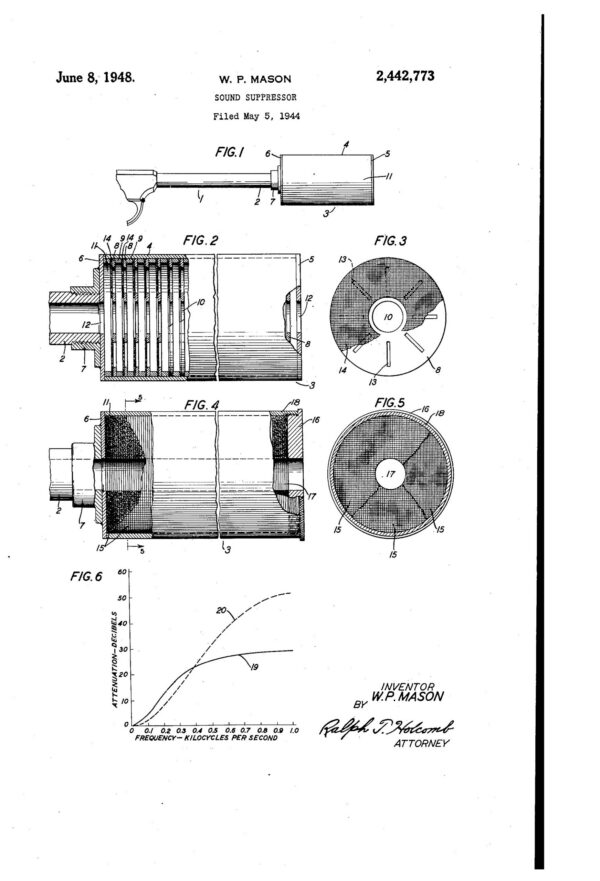
Bell Telephone Labs "Sound suppressor" patent, inventor Warren P. Mason, filed 1944.
In the end, it was High Standard that took the prize with their USA H-D M/S. During the war, about 2,620 were delivered. An interesting side note. The cover name for the contract was “Impact Testing Machine.” I guess that’s accurate if you stretch the intended use. You can find some extra documentation on the matter via the CIA’s own OSS exhibition catalog, which lists a High Standard pistol.
While we’re on the secret stuff topic, it’s worth mentioning a couple of other common misconceptions. The Mark 22 Mod 0 “Hush Puppy” SEALs carried in Vietnam was a Smith & Wesson Model 39 in 9mm, not a Woodsman or High Standard rimfire. Not to say they were never used. Considering all the creative armament in those teams, who knows? What reporting there is regarding Vietnam and CIA activities mostly points to High Standard as well. Another interesting tidbit is this. U-2 pilot Gary Powers’ “spy pistol” in Moscow is a High Standard HDMS, serial 120046.
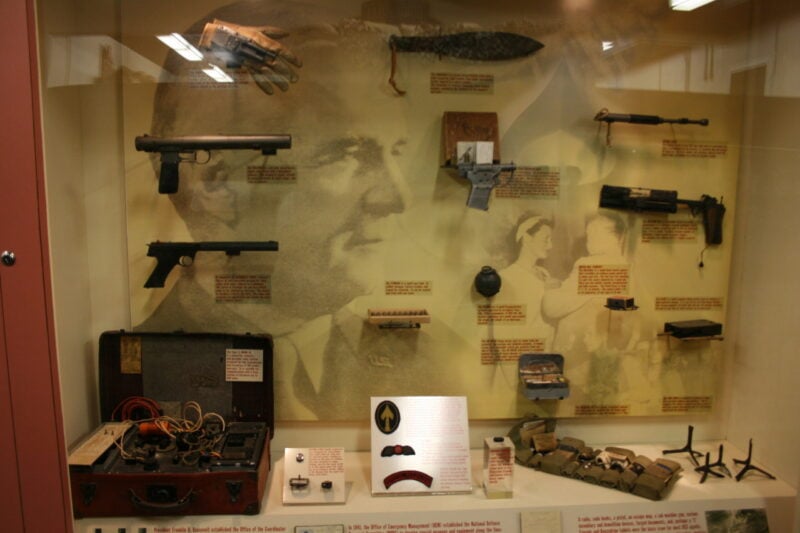
OSS weapons case at the JFK Special Warfare Museum, Fort Bragg.
It includes a High Standard HDM with suppressor. Image: CC0 (Gary Todd).
Cold Weather Cousin
After the war, Second Series production resumed in 1947–48. Then came one of the more interesting documented military niches of the whole Woodsman story.
In the summer of 1949, the Air Force ordered 950 Second Series Target Woodsmans for Arctic Survival Kits to be used as bomber and crew kits for the polar route. Most went to Ogden Air Material Area on August 24, 1949; a small batch ended up at Springfield Ordnance Depot. Serial numbers were clustered in the 64000-S / 65000-S range.
These were, as far as Woodsmans go, a little more bare-boned. They came with fixed or semi-fixed sights, no slide stop, no magazine safety, no lanyard loop. Interestingly, they also had no U.S. Property roll mark. Down the road, lots of these ended up in private hands through sales from the DCM. Wish I’d found some of those.
Collector catalogs also mention smaller Second Series contracts to the Marines and Coast Guard. Sadly, many of these pistols were destroyed when the water-bound folks were done with them.
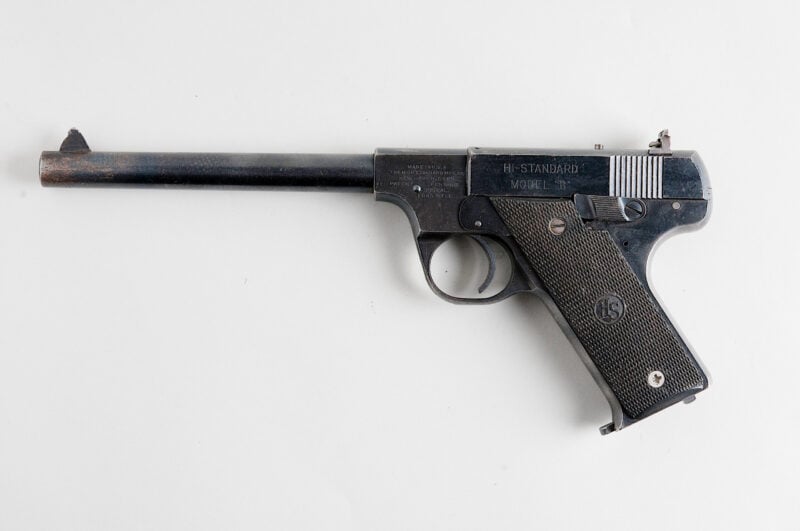
High Standard Model B.
The Real Woodsman
So where does that leave the Woodsman in uniform? Given the pistol’s quality, longevity and character, I’d really like for some of the lore to be true.
Alas, no. We’ll have to remain satisfied with it being a superb peacetime target pistol that became a wartime trainer. While it did lose the covert and silent-.22 job and lost to High Standard, it did get some respect from those early Cold War bomber crews.
My grandfather’s 1936 Target never wore an Ordnance stamp. It never rode in an Arctic kit. It never got a Maxim can screwed on the muzzle. It just sat on a farm for decades, and eventually landed with a grandson who still thinks it’s the best-looking gun in the safe.
Get more exclusive online content from American Handgunner delivered straight to your inbox. Sign up for our free American Handgunner Insider newsletter.