.32 Magnum Shotshells
Handloading

Patterning at 5 yards was excellent. Lindsey found that the .32 Magnum shot shells probably could be used out to 7 yards, but 3-5 is nominal.
I’ve been loading .32 Magnum shotshells. I chose the .32 Magnum because it is an amazing and versatile caliber. There are several options for shot shells in a straight-walled cartridge. One can use plastic shot cups, micro wads, or do it the old-fashioned way, like I’m doing here.
Loads for Evolving Shot
I was going to try this with lead shot, but steel shot has become more prevalent in the industry. I knew that density would be an issue. I needed enough space for an effective load. This meant fast-burning powders and thin wads.
I started with Bullseye — a double-base flake powder that is easily compressed, and a little goes a long way. Although Bullseye is narrow-banded, I didn’t think that overpressure would be an issue with shotshells. There is little to no resistance when propelling a shot down a barrel, compared to bullets engaging rifling. I also tried N310, which is a single-base extruded powder. N310 burns cleanly, but it does not compress as easily as Bullseye.
I used Fiocchi small pistol primers. I had a large case of them shipped to me a couple of years ago. I have yet to have one issue with them after thousands of rounds.
I purchased some #8 steel shot from Ballistic Products. Their steel shot is very uniform. Each pellet weighs about 0.75 grains.
Considering the case volume of the .32 Magnum, I knew I would be lucky to get 30 grains of shot inside.

The expansion plug on the Lyman Neck Expander has two steps, designed to gently open up a neck for lead bullet shooters. It is perfect for .32 Magnum cases. Note the flat surface of the plug. Lindsey used this to compress the load.
Construction
I figured the best way to encapsulate the shot in the case was to use Hornady .30 caliber gas checks, which I used for my .308 GC bullets for rifle matches. I measured them at 0.315″ to 0.319″, which is fat for the 0.312″ inside diameter of the .32 Magnum. I figured it would create a pretty good seal over the powder if I set the gas check over the powder, cup up.
I tried several methods of forcing the gas check on top of the powder, including muscling it with the tip of my Otis Armorer’s Pistol Tool. I put 40 grains of shot on top, and put another gas check on the top, cup side down. The top gas check never stayed in place — it would tip, spilling the shot out.
Sizing the gas checks didn’t work. I needed much better equipment to keep them concentric. I decided to go with cardboard from some shotgun overshot card material. This is about half the thickness of an album cover, and just as sturdy. I hole punched little round circles of this stuff and put one circle over the powder of each shell.
I finally arrived at using these little discs over the powder, putting the shot over it, and adding a gas check, cup-side-up on top. Cup-side-up worked perfectly well as I could crimp over the top, and the gas check centered itself in the brass.
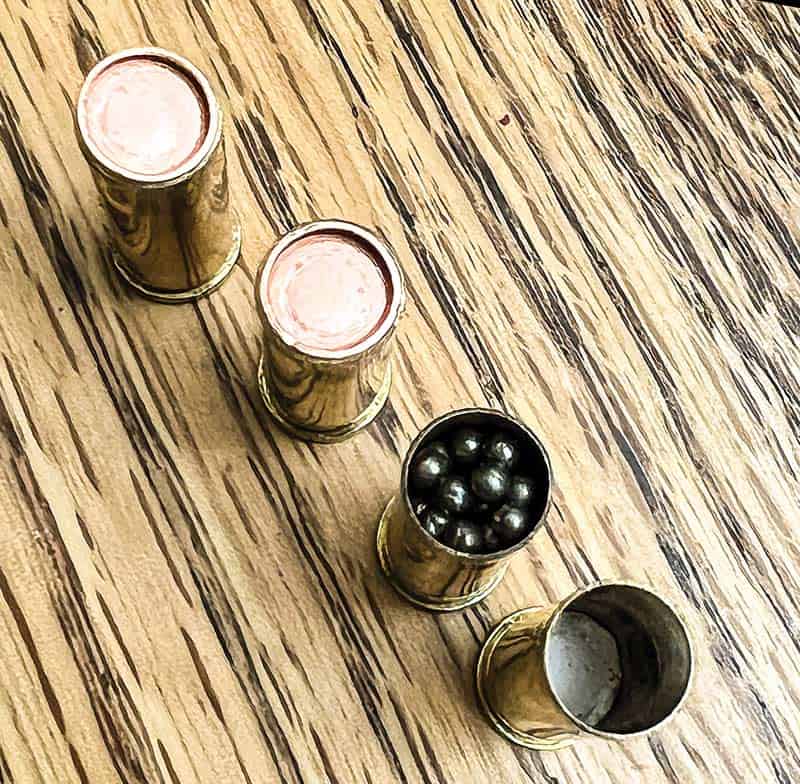
The top two are completed loads. Notice that the gas check is
cup-side-up. The third from the bottom is a case with powder,
wad and shot. The shell on the bottom has just powder
and an overshot card.
Finishing Touches
I used a Lyman M-1 rifle neck expander die (the one for calibers .21-.308) to expand the neck and, this may surprise you, push the gas check down to compress the load. For expanding the case mouth, the M-1 has a two-step expansion plug, which gave me a gradual inside taper to gently open the case mouth.
Once I got the powder, card, shot and gas check in the brass, I used the M-1 die again. This time I used the flat face of the expander plug to compress the load into the case. Because of the way it was expanded, the gas check found its perfect resting spot and stopped. I used a Lyman .327 FED MAG seating die (E19) to crimp over the top of the shell.
The best I could do was a payload that consisted of shot and gas check that weighed 41-42 grains. That is, 35.6 grains of shot (about 48 pellets) and a 4.6-grain gas check.
My initial load was 1.5 grains of Bullseye. It was so light, I questioned whether I forgot the powder. It was not enough to even expand the brass into the chamber.
I was developing loads with N310 at the same time. I quickly moved to 2.0 N310 for one load and 2.0 Bullseye for another and settled there, for now.
Performance
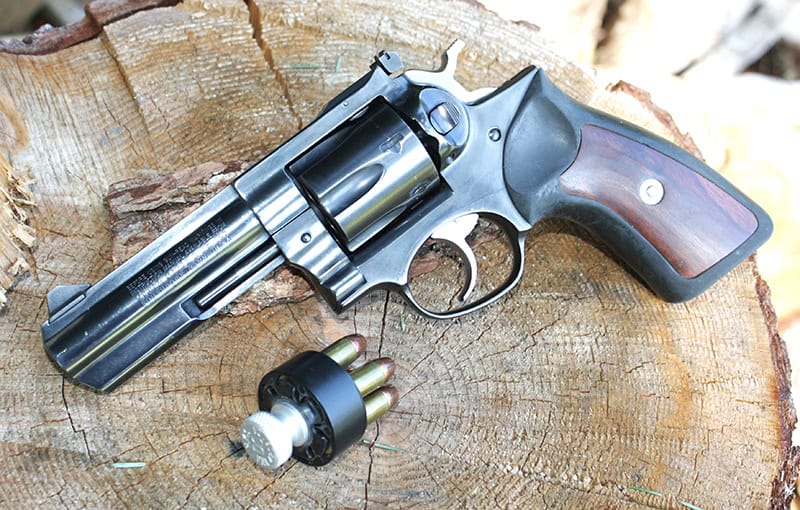
At the range, I was surprised that the pattern stayed tight enough to be effective out to about 7 yards. Usually, shot loads from a handgun opened up so much they are useless after 3 yards. I shot these from my Charter Arms and my Ruger, both snub-nosed guns, and they patterned well, and recoil was mild. I wouldn’t put this load to work outside of 5 yards, but this was good news.