Blackhawk Down … But Maybe Not Entirely, Only Sorta, Hopefully
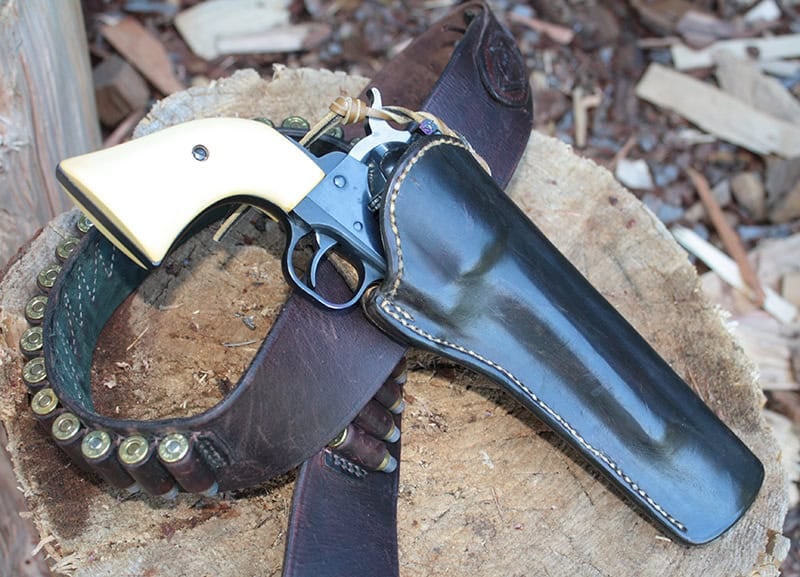
Dave’s first Blackhawk, a .41 Magnum New Model, has never failed him,
and he frequently packs it along in the outdoors.
The recent announcement from Ruger to distributors about “suspension” of several classic revolver models — essentially the wheelguns which made the company famous early on — seemed devastating to a lot of people at first glance, me included.
But as I quickly realized upon reading that “Distributor Update” word-for-word at least twice — which evidently a lot of people didn’t — Ruger did not say various iconic firearms, including the Blackhawk, were being discontinued. The memo stated clearly, “Suspending production does not necessarily mean saying goodbye to these product families.”
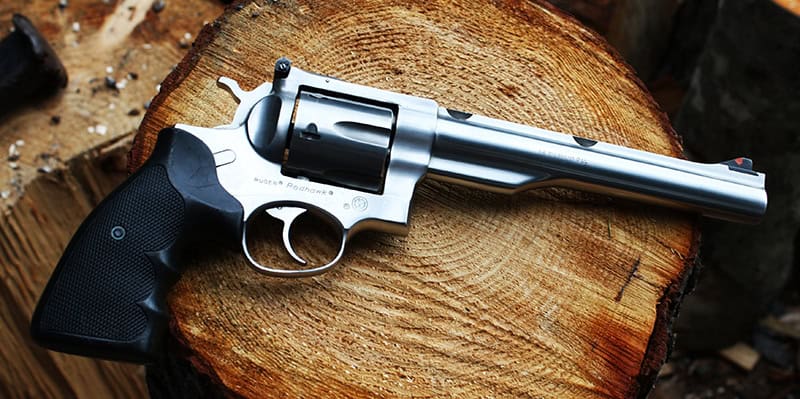
Also on the “suspended” list is the Ruger Redhawk, a beefy big more double-action.
My first big bore magnum handgun, purchased for the express purpose of shooting a deer in my home state of Washington, was a Ruger Blackhawk chambered for the .41 Magnum, with a 6 ½-inch barrel, its front sight just slightly cockeyed. At the time, one of my pals even noticed it, but it has never made a difference. I advocated for big game handgun hunting in the state more than 40 years, and the then-Game Department ultimately went along with the idea. My Blackhawk has put down two of the three bucks I’ve dispatched with handguns over the years, and it remains one of my most prized possessions. I have written about it many times.
Originally introduced in 1955, in .357 Magnum, the Blackhawk appeared at what some historians refer to as the heyday of the television western. During that era, I think all three networks had westerns as their family-hour fare pretty much every night of the week except when the evening programs were about private detectives. Some you will remember, others maybe not so much.
There was Trackdown, the Lone Ranger, Gunsmoke, Wanted Dead or Alive, Lawman, Have Gun Will Travel, The Alaskans, The Adventures of Wild Bill Hickok, Black Saddle, Bat Masterson, Wyatt Earp, Bronco, Broken Arrow, Cheyenne, Cimarron City, Death Valley Days and many more. What they all had in common was the main prop, a single-action revolver carried by the main male characters.
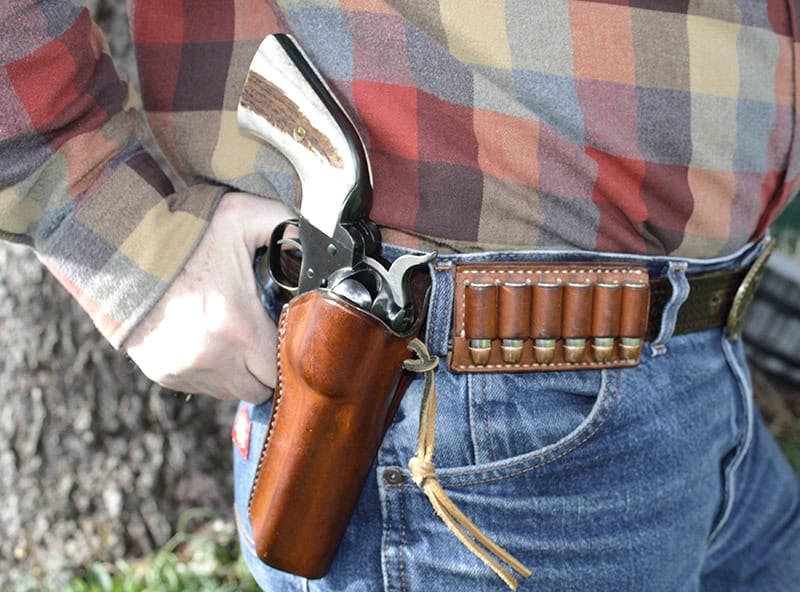
The “New” Vaquero is also sidelined, at least for the time being, but don’t plan on
attending its funeral. Dave fitted it with elk angler grips from Eagle Grips.
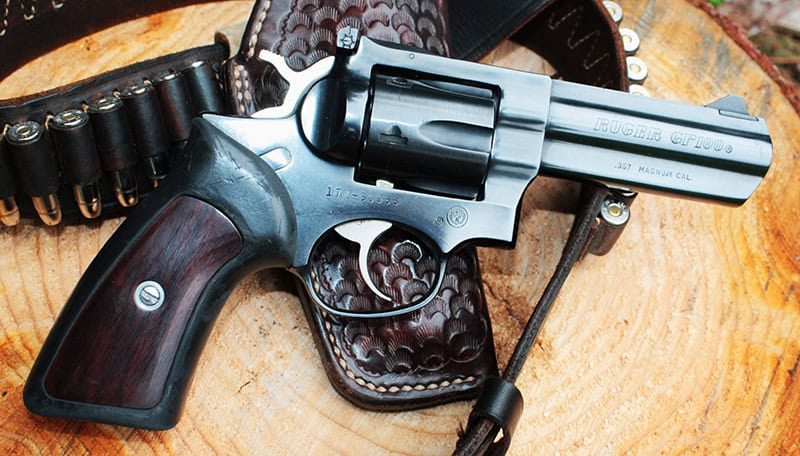
Likewise, the GP100 double-action’s production will be suspended,
but nobody said this gun is being discontinued.
Into that arena came Bill Ruger, first with the Single Six in mid-1953, a .22-caliber rimfire with the visible profile of the “cowboy gun” seen every night on the small screen. Its success spawned the Blackhawk, and the rest, as they say, is history. A .44 Magnum chambering quickly followed the .357, then along came the Super Blackhawk with its Dragoon-style trigger guard, and then the .41 Magnum, .45 Colt, .44 Special and .30 Carbine versions; let’s just call it a versatile platform.
I knew Bill slightly—I interviewed him for the record once many years ago and exchanged brief pleasantries at a couple of SHOT Shows—and never got even a hint of disappointment from him about the Blackhawk. After all, one might say the Blackhawk platform was a cornerstone of his company’s huge success. I’ve met a lot of folks in the field who were carrying Blackhawks, and that says much about the popularity and reliability of the model.
Most of these folks used factory ammunition, but now and then I run into another handloader and that fact has been known to ignite some lengthy conversations!
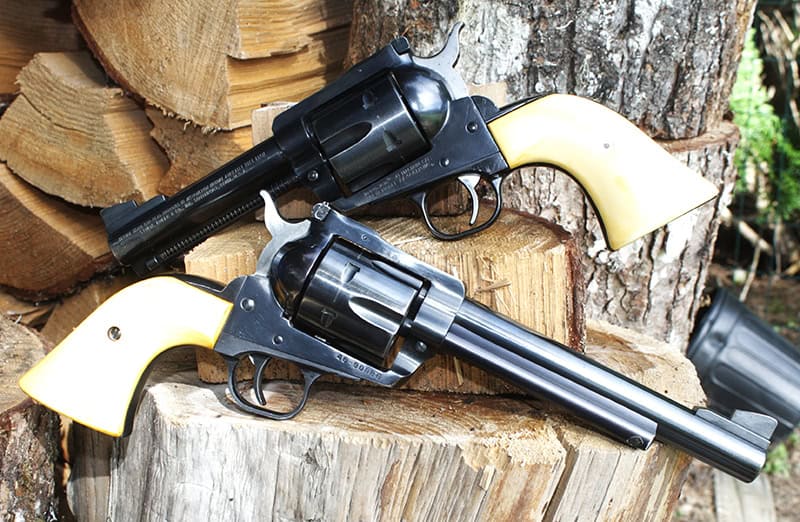
Dave’s two Blackhawks are the epitome of rugged reliability.
Here, they’re both wearing Magna Tusk grips from Arizona Custom.
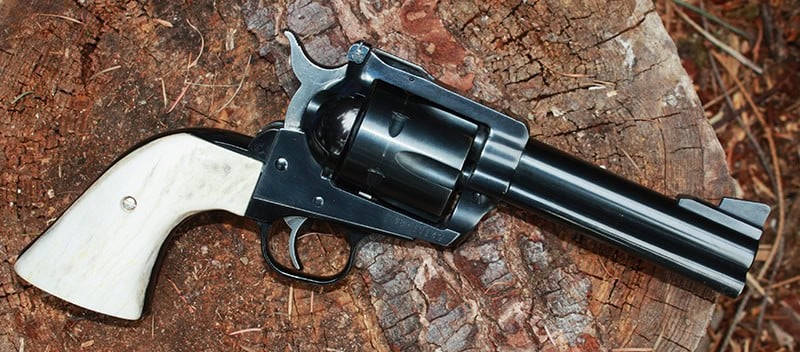
At one point, Dave crafted elk antler grips for his Blackhawks,
made from an antler shed he found while hunting.
Several Adventures
My Blackhawks—I bought a second one, also in .41 Magnum, with a 4 5/8-inch barrel—and I have shared many adventures, across several western states. One or the other has been with me hunting in Alaska, Montana, Wyoming, and one summer plugging prairie dogs and ground squirrels down in Oregon. I replaced the aluminum alloy ejector rod housing on the shorter-barreled gun with a steel housing several years ago.
The Blackhawk is a remarkably tough single-action wheelgun. Some people might consider it over-built, which brings up the obvious when the company had to make some business decisions. Revolvers, including single-actions, require a lot of hands-on attention, which translates to man-hours, which, in turn, translates to labor costs. One just doesn’t crank out revolvers like cookies. Each sixgun cylinder must rotate so that each chamber lines up precisely with the forcing cone to prevent shaving lead and ultimately damaging the firearm. Every moving part inside a revolver has to “tick” along with the other moving parts.
I can attest to the end result of this workmanship; one mule deer and one coastal blacktail in the family cooler, one very surprised coyote on a deer season opener about 30 years ago, and many hours at the range punching holes in black circles, all without a single malfunction. My 6 ½-inch Blackhawk has been camping, scouting, and hiking all over the map. It was my companion on countless September grouse hunts in bear country, and it was at my side in the tent one night when I was aroused from sleep by the sound of something rather large wandering through my campsite during a muzzleloader elk hunt. It was breathing heavily, sniffing around, and it obviously didn’t care about me being in the tent.
The Blackhawk has also been my “test” gun through which I have run several different handloads, checking for signs of pressure and accuracy. Even with the slightly cockeyed front sight, I’ve hit targets at better than a hundred yards with this revolver, and that’s not something one takes for granted. It has launched hollowpoints, softpoints, hard cast lead semi-wadcutters, and an assortment of plated bullets.
The rifling twist changes with caliber. For example, the .357 Magnum features a 1:16-inch right hand twist rate, while the .41 and .44 Magnums are cut with a 1:20-inch twist, all with six lands and grooves.
Thanks to my Blackhawk, I’ve gone through a few pounds of the old Hercules 2400 and newer Alliant 2400, Hodgdon’s H110 and lately Accurate #9. I’ve used this gun to test maximum load recommendations published in at least three different reloading manuals, discovering in the process that the hottest loads are not always the best, while downloading isn’t such a great idea, either, as exemplified by some reported jacket separations experienced with the discontinued 200- and 220-grain half-jacket SWC-type projectiles from Speer, with light loads; great bullets, faulty reloading strategies.
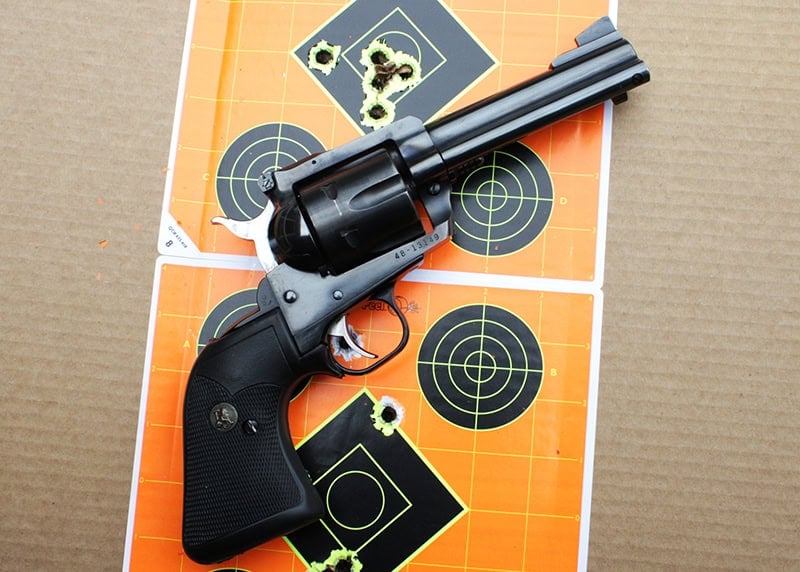
Nobody can question the ability of a Blackhawk to shoot straight.
Dave produced this group using handloads, and a sandbag rest.
The first Blackhawks did not have transfer bar actions, a feature that did not appear until 1973, with the introduction of the “New Model Blackhawk.” This update featured not only the transfer bar mechanism, but also did not require the hammer to be placed in the half-cock position in order to rotate the cylinder for loading and unloading. One merely has to open the loading gate to release the cylinder for rotation and loading.
From the beginning, Bill Ruger’s iconic sixgun used coil springs instead of leaf springs as found on Colt single-action revolvers and their clones. The Rugers also had an adjustable rear sight not found on other single-actions. The first models had flat tops, while later models introduced the two “ears” protecting the rear sight. These are the humps at the rear of the frame.
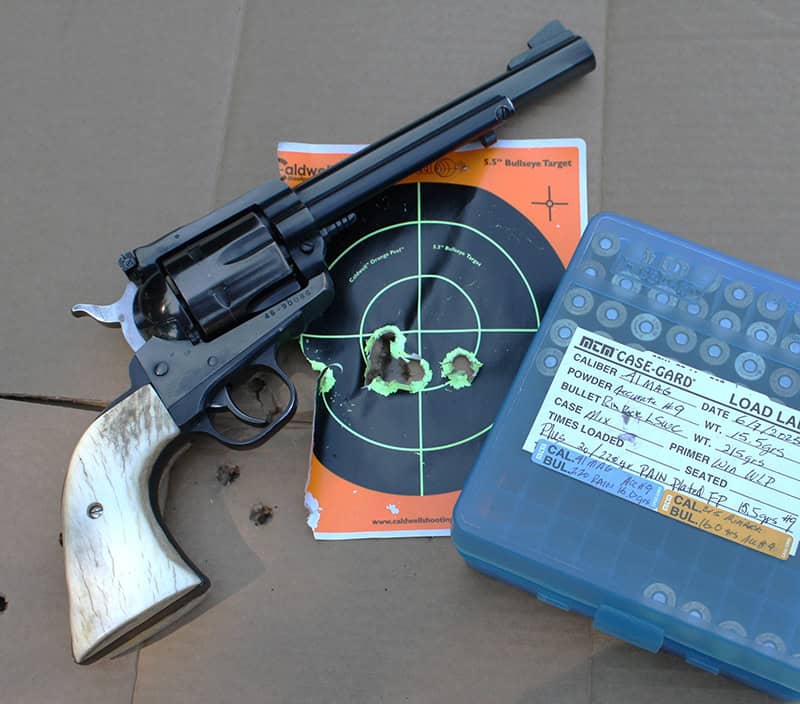
Dave fired this group using 215-grain LSWC bullets over Accurate #9. He’s taken two deer with this sixgun.
Let’s put this into perspective, as my pals Roy Huntington and Brent Wheat — both GUNS and American Handgunner regulars — did recently on their GUNS magazine podcast. I’ll address this Ruger development as putting some players on the bench for the time being. They haven’t been kicked off the team, they haven’t sustained career-ending injuries, and they haven’t been traded to another team.
This is my best analysis of where this situation currently stands. It should be noted that the Ruger memo to distributers also stated, “We recognize the importance many of these products have to Ruger, our distributors, retailers and consumers. This is precisely why we view these decisions as part of managing their evolution – not simply ending their history.”
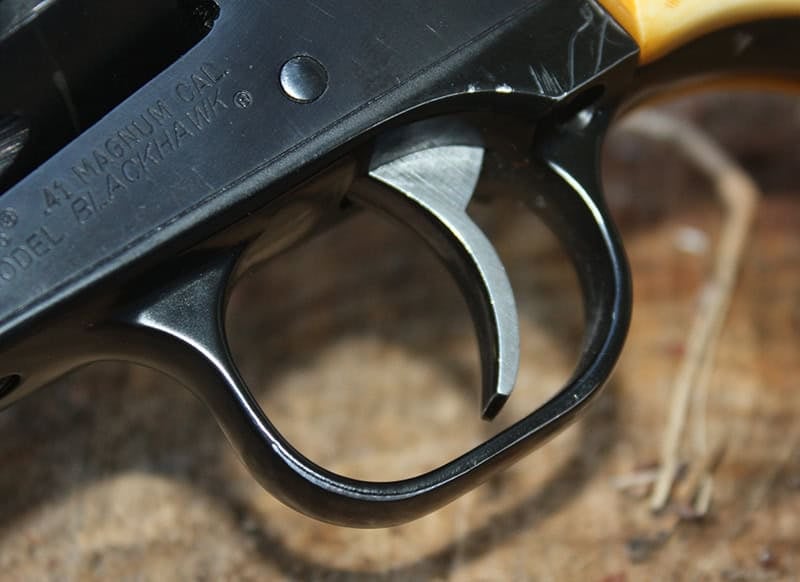
Trigger on his newer Blackhawk with a 4 5/8-inch barrel is stainless steel …
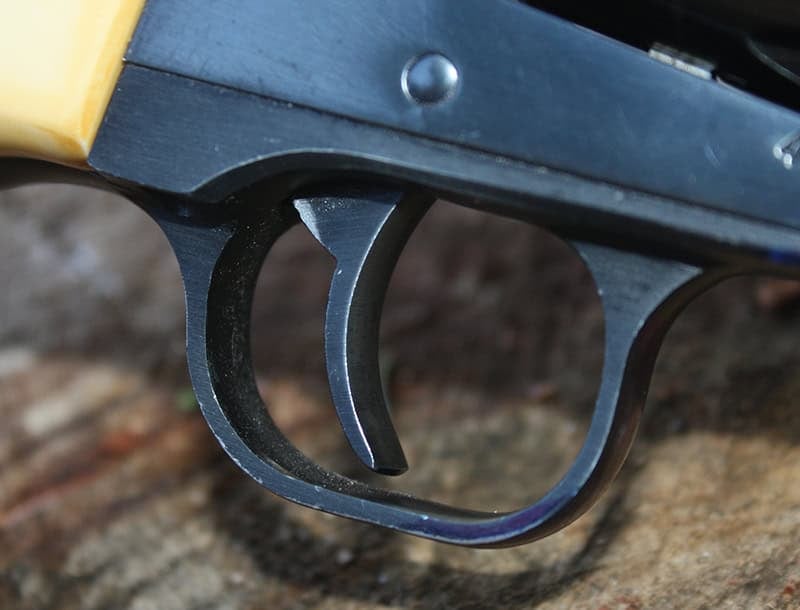
… While on his first gun with the longer barrel, the trigger was blued, demonstrating
that the Blackhawk has gone through several changes, some very subtle, over the years.
Just Some Players On The Bench
Let’s put this into perspective, as my pals Roy Huntington and Brent Wheat—both GUNS and American Handgunner regulars—did recently on their GUNS magazine podcast. I’ll address this Ruger development as putting some players on the bench for the time being. They haven’t been kicked off the team, they haven’t sustained career-ending injuries, and they haven’t been traded to another team.
This is my best analysis of where this situation currently stands. It should be noted that the Ruger memo to distributers also stated, “We recognize the importance many of these products have to Ruger, our distributors, retailers and consumers. This is precisely why we view these decisions as part of managing their evolution – not simply ending their history.”
By now everybody knows the other “players” that have joined the Blackhawk on the sidelines. The were identified in the Distributor memo as the LCR, Ruger SP101, GP100, Bearcat, Redhawk, Super Redhawk, Super Blackhawk, Single-series revolvers, Vaquero, the No. 1 rifle, 77-series rifles, Hawkeye and Ruger Precision Rifle.
My recent columns on my brother’s Redhawk Hunter and GP100 reminded readers about Ruger’s double-action success stories. I consider both models to be among the finest double-action revolvers on the planet, which is no small feat because they have plenty of competition. They followed the “over-built” heritage of the Blackhawk; tough as nails and reliable, in my experience.
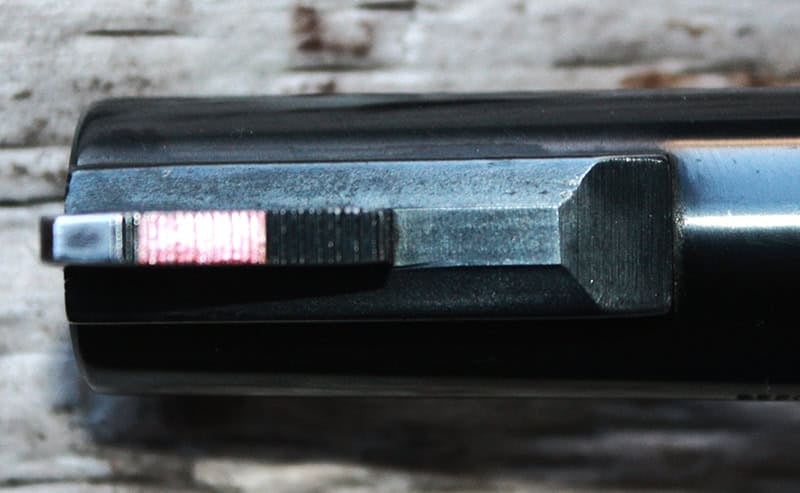
Front sight on Dave’s first Blackhawk was just a little cockeyed, but the gun shoots great!
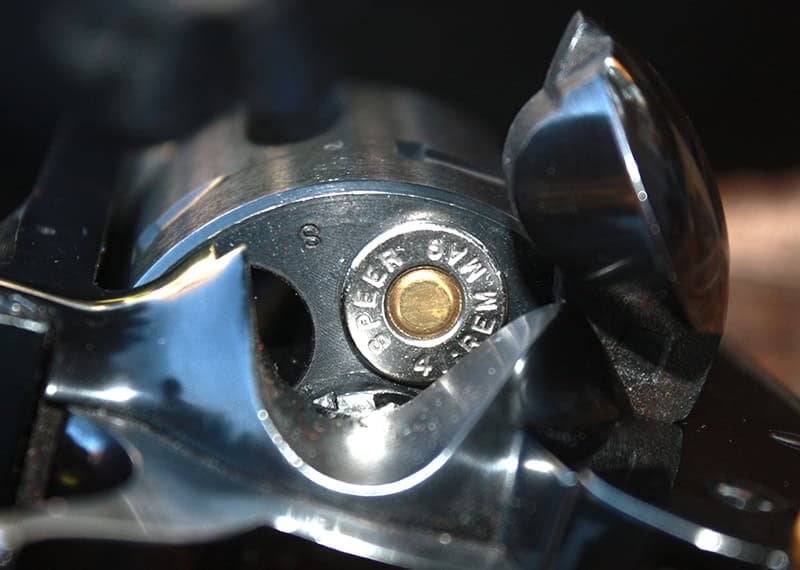
Unlike newer models, Dave’s Blackhawks do not feature reverse pawl indexing
alignment of the chambers with the loading gate. He still loves ‘em!
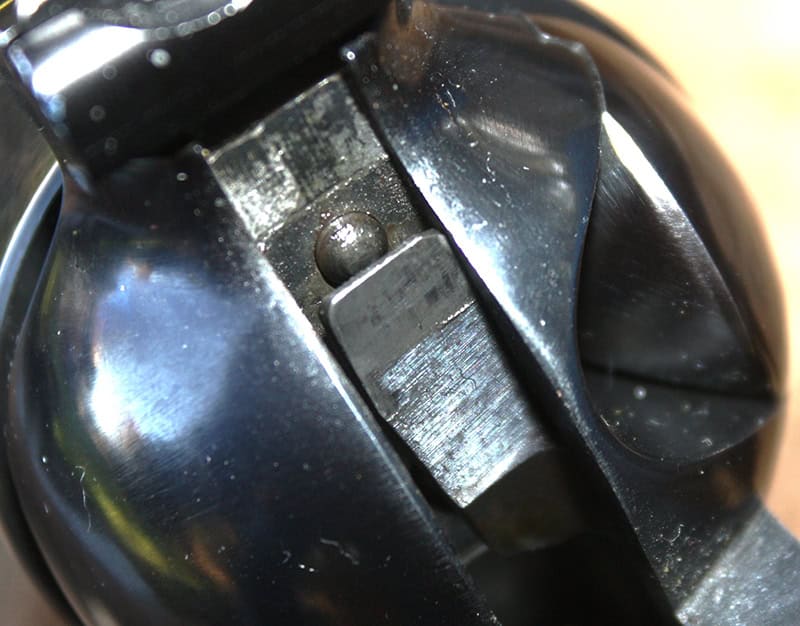
Ruger introduced the transfer bar firing mechanism in 1973 with the “New Model Blackhawk.”
Still Active
Ruger’s business decision, temporary or otherwise, was initially announced at the time of the National Association of Sporting Goods Wholesalers (NASGW) show. What has not been even hinted at is any problem with any of the guns whose production has been suspended. Indeed, Ruger’s memo states, “As part of our Ruger 2030 product portfolio review, we have taken a closer look at several of our lower-volume and legacy product family, considering current market demand, changing consumer interests and opportunities for future redesign, modernization and innovation.”
And later, the memo also states, “In many cases, we believe there are opportunities to bring important Ruger platforms forward through new designs, improved features, modern manufacturing methods and meaningful innovation. We expect many of these names and product families to return in new forms in the months and years ahead.”
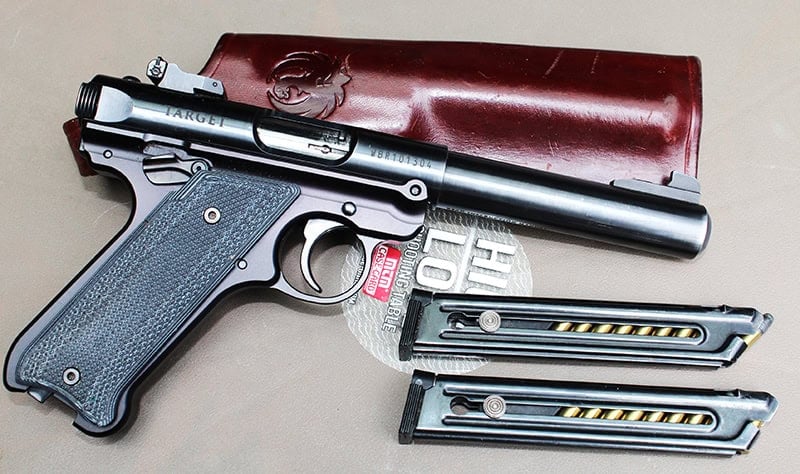
The popular Ruger MKIV is still on the active list. Dave’s gun has taken small game and is deadly accurate.
Which brings me around to a pistol not on the suspended list, the semi-auto MKIV, the newest incarnation of the first Ruger pistol, the .22-caliber “Standard” model which became the MKI, and then evolved into the MKII and MKIII.
I bought an original Standard pistol years ago, and even in its used condition, once I cleaned it up, it was delightfully accurate. When the MKIV was introduced, I got a test gun and was so impressed, I bought it. The MKIV is quite possibly the most accurate rimfire semi-auto I’ve ever fired, and I’ve taken small game with mine. Far as I can tell from Ruger’s memo, production of this model will continue.
Likewise, it looks like the Ruger Wrangler will remain in production for single-action fans, as apparently will the 22/45 and other popular firearms, including the 10/22.
One thing to watch for will be a rush to gun shops by people looking for remaining new Blackhawks or used guns. I have no doubt the Blackhawk’s eulogy is premature, and while it is down for the time being, along with the other models whose production is suspended, this single-action wheelgun will eventually return. I’m definitely keeping mine!
Get more revolver content every week!
By submitting this form, you are consenting to receive marketing emails from: . You can revoke your consent to receive emails at any time by using the SafeUnsubscribe® link, found at the bottom of every email. Emails are serviced by Constant Contact