My Brother’s Keepers, Part II
Frank Chose a Ruger GP100 and He’s Never Been Disappointed

Dave babysat his brother’s Ruger GP100 long enough to really take a liking to it. Rugged,
reliable and capable of handling full house .357 Magnums all day.
When it comes to the .357 Magnum, a lot of handguns have been wrapped around this sizzling cartridge since it was introduced in 1935, and thanks to an interesting career which has included writing about, researching and reloading, I’ve had the chance to shoot a lot of them, both single- and double-action.
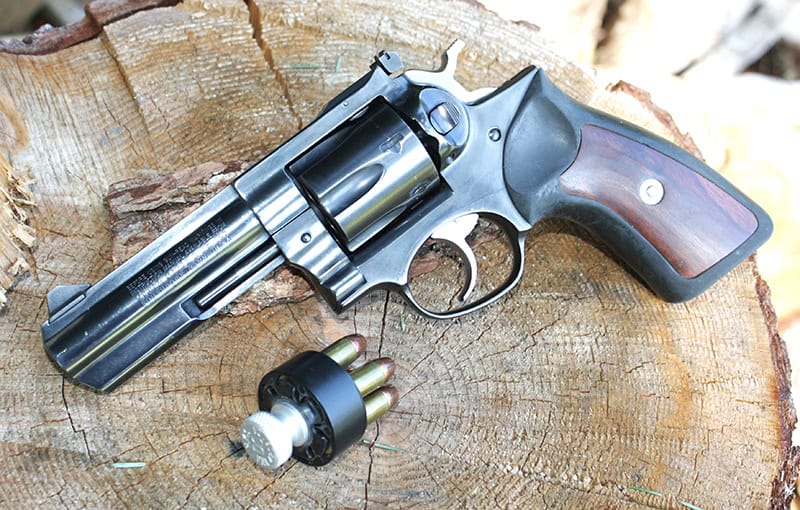
Ruger designed the GP100 with a full underlug barrel, adding weight forward, and stability.
Certainly at the top of the proverbial heap, where one finds names such as Colt and Smith & Wesson, there is also room for what I consider a very good D/A sixgun, the Ruger GP100. It’s one of the toughest .357 Magnum revolvers on the landscape, and when it comes to the specimen owned by my brother, Frank, I’ve become more familiar with it than one might expect, having replaced the rear sight blade last year for him, and more recently, when I babysat this boomer while he took a road trip.
Introduced back in 1985, the GP100 was considered an evolutionary step up the ladder from Ruger’s earlier double-action wheelgun, the Security Six. My brother’s specimen wear’s a nice deep blue finish except for the exposed hammer and smooth trigger, which are stainless steel. The action is pretty smooth, and the single action letoff is crisp with no discernible any creep in the process.
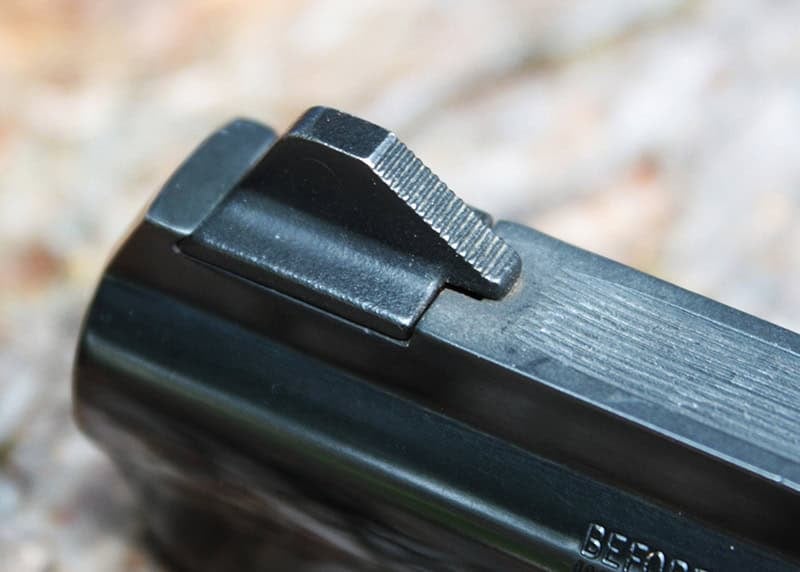
Front sight is dovetailed into the rib and the serrations reduce glare…
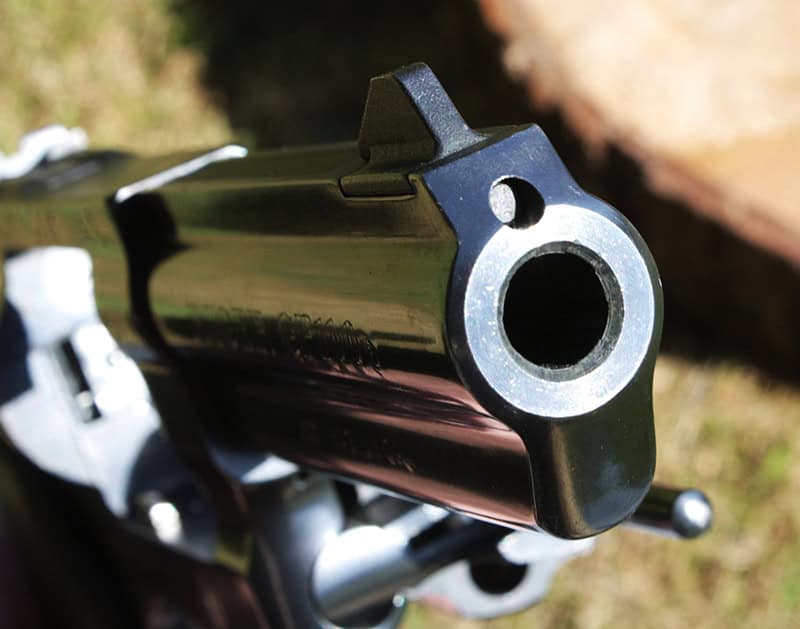
… While a pin holds the sight in place.
The full underlug barrel measures 4.2 inches and is cut with five lands and grooves on a 1:18.75-inch right hand twist. It is topped by a ramp front sight dovetailed into the top rib, with a pin inserted from the front, above the muzzle, to hold it in place. While not touted as a target-grade wheelgun, the GP100 is capable of pretty decent accuracy, thanks to the adjustable rear sight. Some models are fixed sight versions, but I think my brother may have paid attention many years ago when I said any magnum sixgun ought to have an adjustable rear sight since the cartridge is capable of good downrange accuracy.
Weighing a hefty 40 ounces (unloaded), it has long been my belief the GP100 is one of the toughest of all .357 Magnum mid-range revolvers, and could probably digest full house loads all day long. Because of its weight, and the presence of Ruger’s trademark Santoprene grip with wood inserts, the GP100 sucks up the recoil.
Like his Redhawk .44 Magnum discussed earlier, Frank’s GP100 is a certified keeper in every sense.
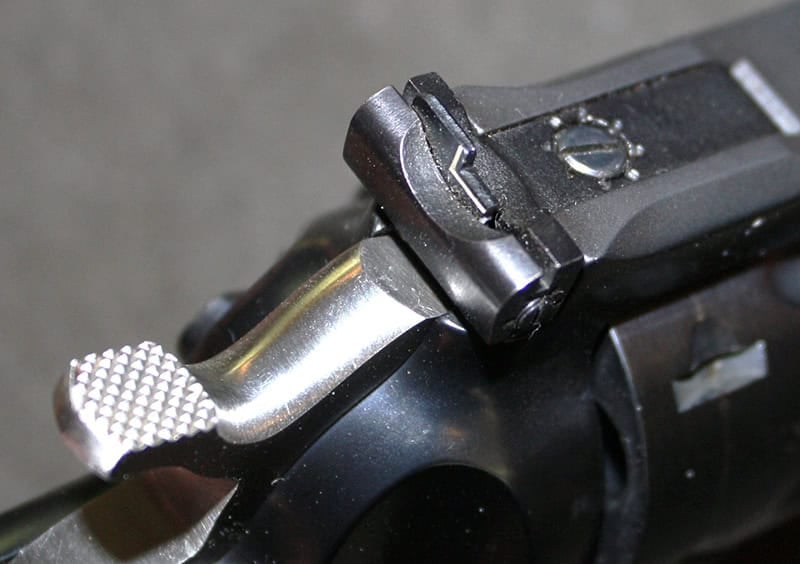
Last year, Dave replaced the rear sight blade for his brother — Ruger customer service quickly provided
the replacement.
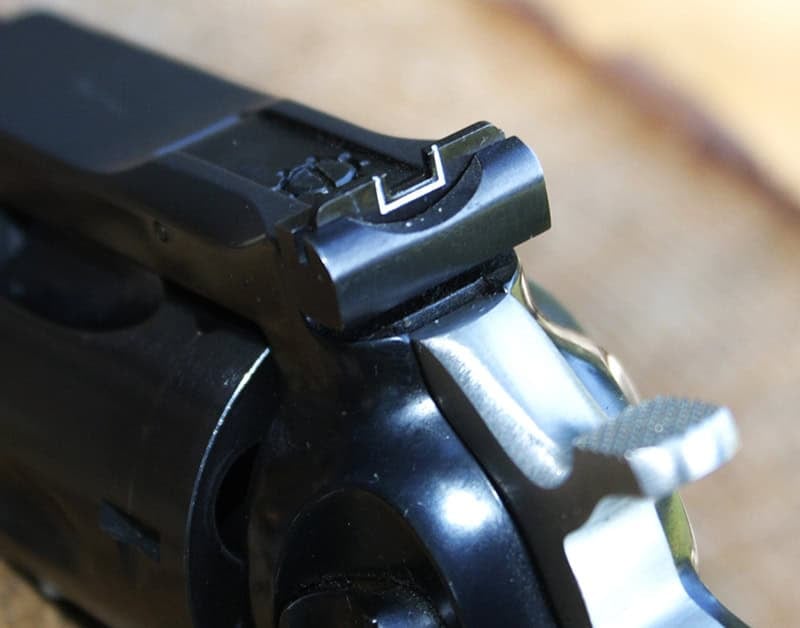
The finished product turned out just like new!
Inherently Versatile
While the cartridge is renowned for handling all kinds of chores, Ruger’s GP100 is a likewise versatile handgun, as I’ve discovered while babysitting Frank’s sixgun. Since my youth many decades ago, I’ve always packed one sidearm or another in the wilds, and definitely during the fall hunting seasons. Whether my handgun was a Ruger, Smith & Wesson or Colt, they all had a purpose, and the GP100 is definitely capable of handling any challenge.
I think what has impressed me about Frank’s gun is that it is not a beater. He has taken very good care of it over the years, and despite the fact that I had a bit of trouble re-sighting it after the sight replacement project, I wouldn’t hesitate to take it beyond where the pavement ends.
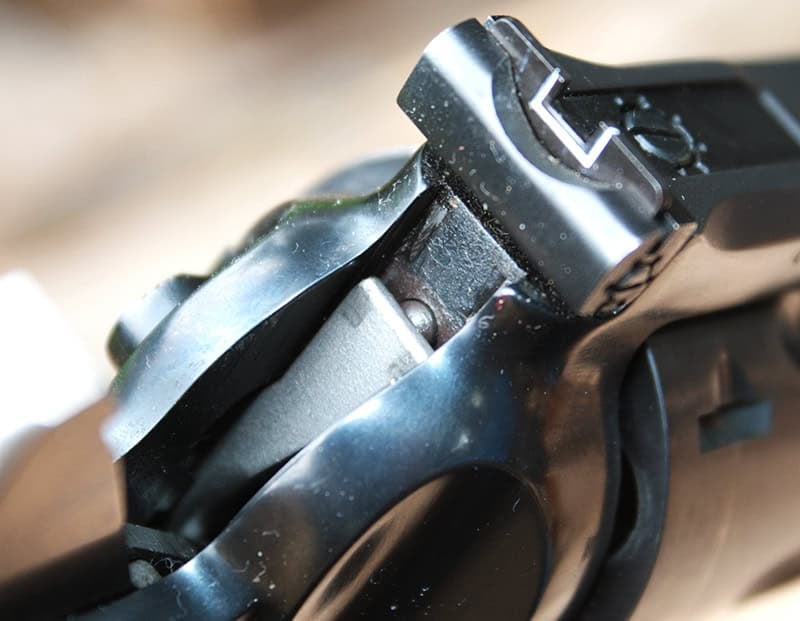
The GP100 features a transfer bar firing mechanism, which enhances the revolver’s safety.
One thing most people don’t notice until they start disassembling the GP100 is that the grip frame isn’t like anything they’ve ever seen. Instead of a frame that generally follows the outline of the actual grip panels, Ruger designed this gun with what has been referred to as a “peg.” It’s similar to the grip frame setup of a Dan Wesson revolver, but definitely not the same.
Dan Wesson designed its grip to be secured with a screw from the bottom, where the GP 100 has the more traditional lateral screw which goes in from side-to-side at mid-grip.
To remove the grip, unscrew it, remove both inset panels (wood or some other material), and push through the large metal pin which holds the grip onto the peg frame. Once that is out, the body of the grip simply slides off.
Beneath the left insert panel is a small pin, which is used to further dismantle the handgun. Don’t lose it! This pin is inserted into a tiny hole at the bottom of the mainspring guide, which becomes visible only when the revolver is cocked. Slide the little pin into the hole, then nudge the trigger assembly out the bottom of the frame.
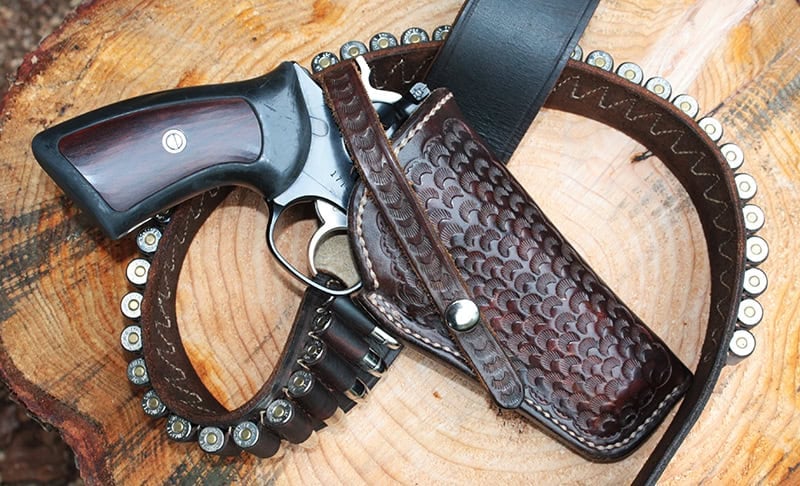
Dave dug out a holster which just fit the Ruger wheelgun perfectly.
Getting back on the versatility track, I think the GP100 can survive in any environment. It has a smooth trigger, and a delightfully smooth double-action pull. The single-action trigger break is crisp with no discernible creep, and thanks to the revolver’s weight, recoil even with full-house loads is easily managed.
I’ve known a couple of peace officers who carried them where departments allowed officers to pack their own guns, and in the outdoors, this sixgun will handle small to medium-sized game, and I suspect in an emergency, you could stop a pretty good sized bear or take down a moose with the right load.
Add to all of these qualities the fact that the GP100 can digest .38 Specials from standard loads up to Plus-P rounds makes this a very versatile wheelgun for which ammunition is available virtually anywhere in the country.
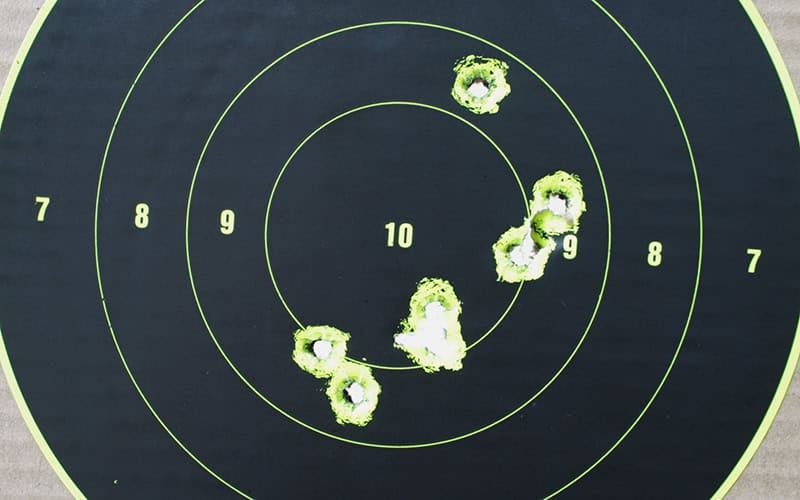
Now begins the sometimes tedious process of re-zeroing the gun,
which brother Frank will have to do the fine-tuning. Gun was shooting low/right.
At the Range
Never judge a book by its cover, or any handgun by its handsome exterior appearance. While I had custody of Frank’s GP 100, it seemed the responsible thing to do to cruise down to the range and re-zero with the new rear sight blade installed.
Naturally, I had a bunch of factory ammunition on hand, and I grabbed boxes of Black Hills, Winchester and Sig Sauer cartridges with different bullet weights. My first foray found the GP 100 rather inconsistent, punching holes all over the target. So, I calmed down and started taking more time, shooting from a solid rest.
Over the chronograph, out of the Ruger’s 4.2-inch barrel, Black Hills 158-grain lead semi-wadcutters crossed the screens at an average of 930.2 fps, with a high mark of 984.3 fps.
I switched to Winchester 158-grain JHPs, which left the muzzle at an average of 1,035 fps with the screens set 20 inches ahead of the gun.
Shifting to Winchester 145-grain Silvertip loads, I was not surprised to see the muzzle velocity kick up a notch, delivering an average velocity of 1,148 fps, after hitting a high of 1,181 fps.
Then came the Sig loads, pushing a 125-grain FMJ out of the tube at an impressive 1,343 fps. The highest velocity I recorded was 1,367 fps.
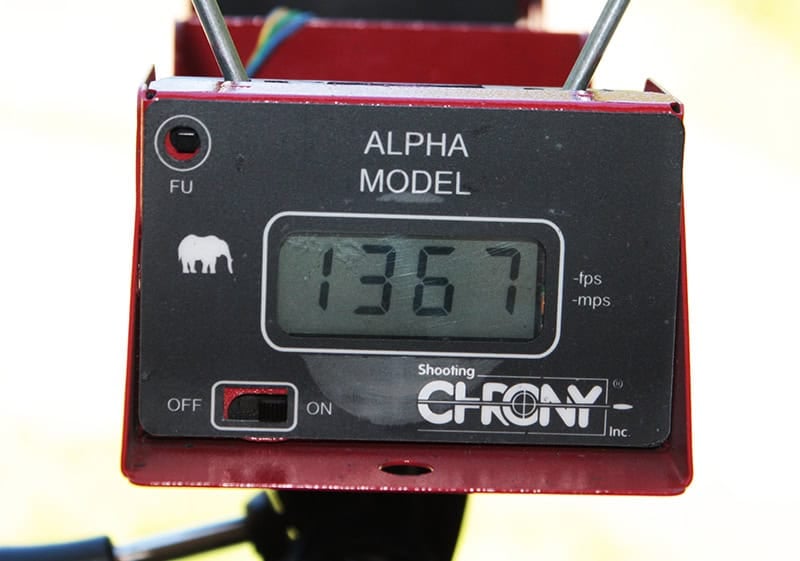
Top velocity from 125-grain Sig FMJs during early range sessions shows GP100 can deliver a punch with the right loads.
Fit, Finish and More
As mentioned earlier, the GP100—which has been in circulation for just over 40 years—is a rather handsome sixgun, in my opinion. I am impressed with the deep blue finish, and a look down the bore shows it has nicely-cut rifling.
It has a triple lock cylinder, a transfer bar mechanism with a frame-mounted firing pin, and thanks to the full underlug barrel, it has a bit more weight forward, which contributes to the revolver’s overall balance.
The fit of the crane to frame is nice and tight, and when the trigger is pressed to release the hammer, the cylinder locks up for the chamber to align with the forcing cone.
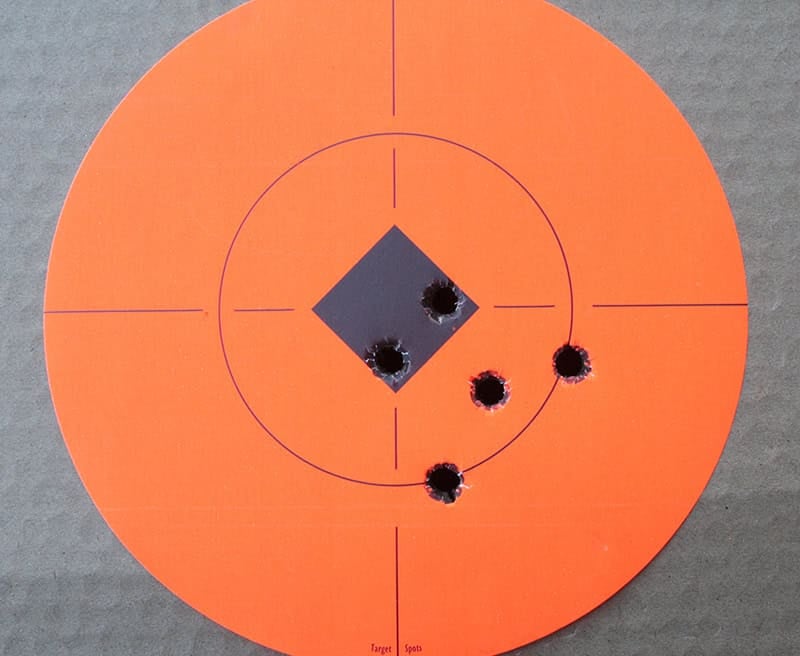
Now we’re starting to cook! This five-shot group was fired off-hand with Winchester 145-grain JHPs
from 10 yards. The first three still went low and right, but Dave whipped out a tiny screwdriver
and the last two went in the black.
After year of shooting, I could discern no damage to the inside of the cylinder window above the breech, and a quick wipe with a patch soaked in Hoppe’s No. 9 cleaned up the powder residue immediately. The hammer cocked smoothly and the hand came up reliably to rotate the cylinder.
While I was digging around for something, I came across an old holster which, despite being built for an N-frame S&W, actually fit Frank’s GP100. When the gun goes back, the holster goes along.
If I were in the market for another .357, I’d be tempted to offer Frank several Ben Franklins just to keep things in the family. If he’s as smart as I think, he’d impolitely tell me “no” and bid me good day.
It’s a keeper … his keeper!
Get more wheelgun content every week!
By submitting this form, you are consenting to receive marketing emails from: . You can revoke your consent to receive emails at any time by using the SafeUnsubscribe® link, found at the bottom of every email. Emails are serviced by Constant Contact