My Brother’s Keepers, Part I
Dave’s Younger Sibling Went Whole Hog—Or Should We Say Whole Redhawk

While babysitting his brother’s .44 Magnum Ruger Redhawk, Dave couldn’t resist
“taking it out for a spin” just to see what the big double-action wheelgun could do.
Let’s say he was impressed.
So, when my younger brother, Frank, recently decided to tour around several western states, it became a chance for me to “babysit” a couple of his sixguns, and being a guy who hardly ever lets an opportunity slip by, I took more than a good look at his choice of artillery.
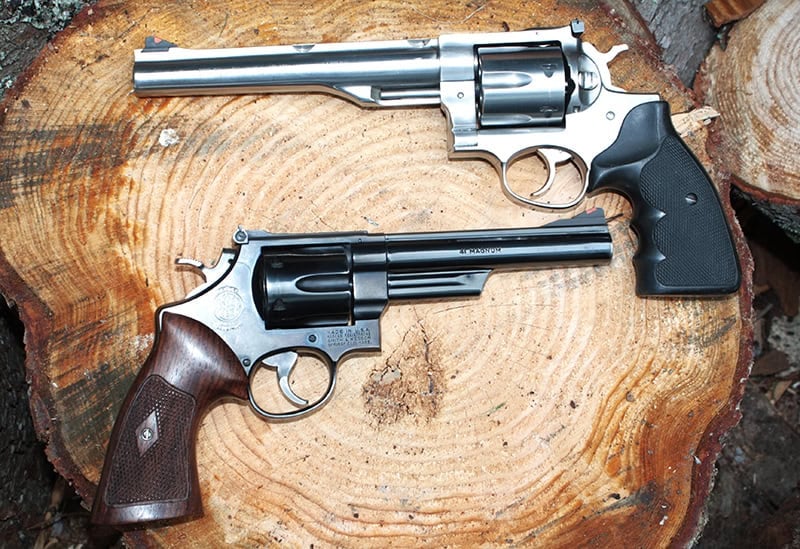
Compared to author’s N-frame Smith & Wesson, the Redhawk is one big sixgun!
Let’s just say his preferences run toward wheelguns wearing the Ruger brand, and I know he also has a couple of semi-autos from the famous American company. I built a holster for one of ‘em. And, when he decided to adopt a big-bore model, his choice was indisputably blue ribbon quality: Ruger’s massive Redhawk chambered in .44 Magnum. His specific preference was the Redhawk Hunter variation.
Wearing a 7½-inch barrel with scope bases cut into the thick rib, the stainless steel Redhawk is one awesome handgun. It weighs more than 50 ounces, the black front sight with a red insert is dovetailed into the rib and pinned from the front, and the adjustable rear is also black. At some point, he slapped on a checkered rubber grip with finger grooves. Overall, stretching 13 inches from butt to muzzle, it is simply impressive.
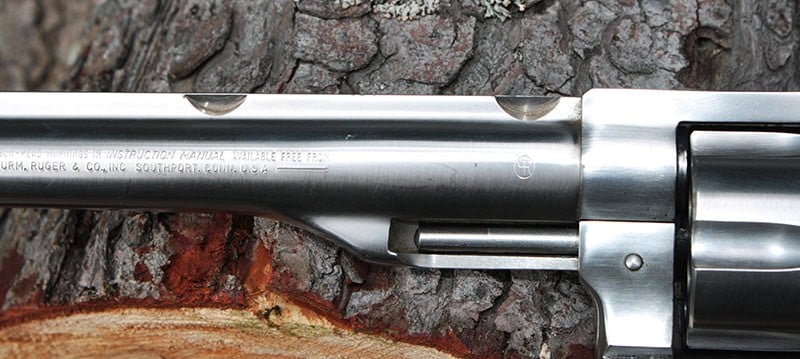
Brother Frank’s model, dating back to 1984, is the Hunter variation with scope bases milled into the top rib.
To Dave’s knowledge, this gun has not been fitted with a scope; brother Frank evidently prefers factory sights.
The Redhawk was not Ruger’s first foray into the .44 Magnum realm. That honor goes to the Blackhawk and Super Blackhawk, both robust single-action revolvers and legends among discerning handgunners. They have been favorites among silhouette shooters, and I know people who have hunted big game with Blackhawks—my own Blackhawk in .41 Magnum has a couple of deer to its credit—and many years ago I had an acquaintance employed as a security guard who carried a Super Blackhawk simply to discourage troublemakers.
But the Redhawk; now this is a sixgun! Is it a keeper? You betcha!
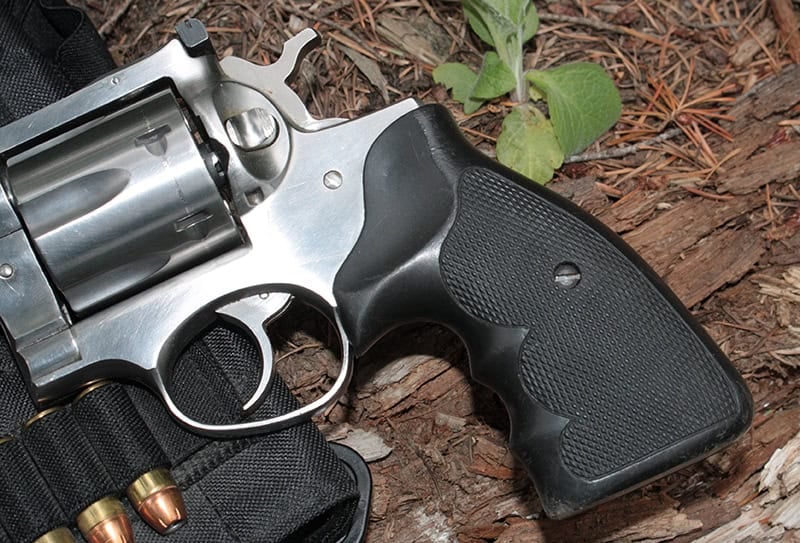
Checkered rubber grips absorb plenty of recoil, and they’re sized to fit most hands.
The Redhawk was announced in 1979 but didn’t actually wind up in circulation until the following year, initially chambered for the .44 Magnum and capable of handling the heaviest loads. Naturally, other chamberings followed. It first arrived with two barrel choices, 5 ½ and the longer tube model selected by my brother.
The barrel is cut with six lands and grooves on a 1:20-inch right-hand twist, topped by a dovetailed front sight and featuring an adjustable rear sight. The cylinder release is Ruger’s trademark “push button” on the left rear of the frame. Frank’s gun is definitely used and it’s not for sale, but a new one will set you back about $1,449 (MSRP) as posted on Ruger’s website. I’ve seen used ones at gun shows on sale for anywhere from $950-$1,000 on up, and if I was shopping for a double-action .44 Magnum, the Redhawk would get serious consideration. I have personally never heard of a Redhawk malfunctioning. That’s not to say it has never happened, but it’s never happened to me or anyone I know.
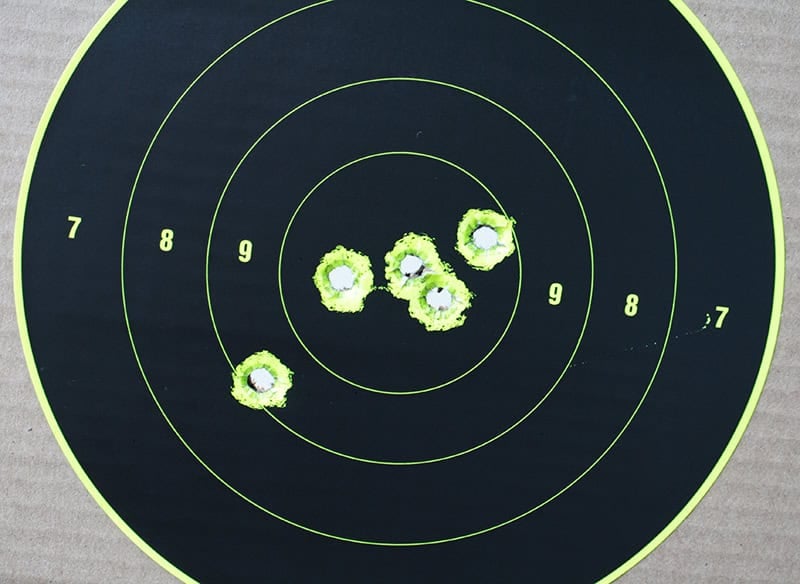
Where accuracy is concerned, Dave shot this group—and several like it—from a solid rest
and found his brother’s wheelgun likes ‘em all!
What does someone do with such a handgun? Just about any darned thing you might think of, from hunting to home defense. Because it is crafted from stainless steel, the Redhawk is very much at home in my Pacific Northwest, with its rainy weather, sometimes heavy snow, summer heat-with-occasionally-depressing-humidity, and anybody packing one of these hoglegs is suitably armed for pretty much any emergency.
If this were my handgun, it would be invariably carried in a shoulder holster, just to keep the weight off my midsection and hip.
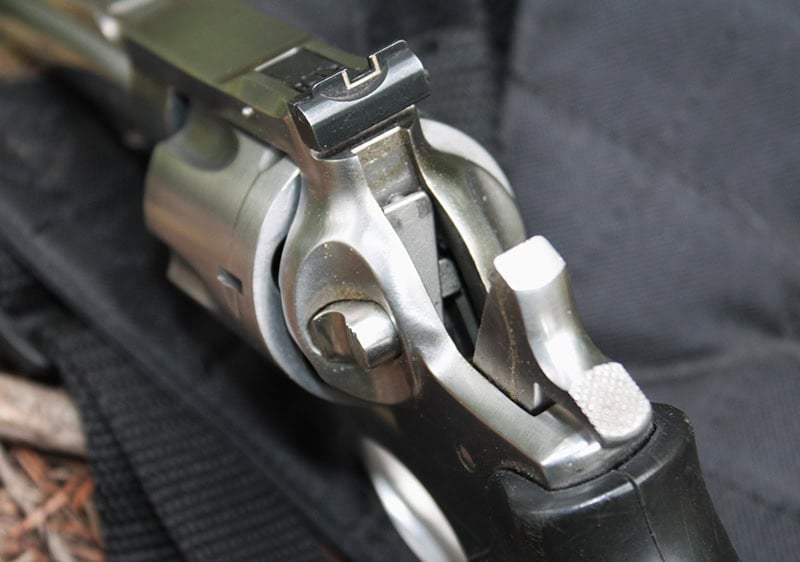
Ruger designed the Redhawk with a transfer bar firing mechanism, preventing the gun
from accidentally discharging if dropped.
Rugged and Reliable
Okay, we’re past the sales pitch information. What makes the Redhawk in .44 Magnum a smart pick?
Well, let’s talk about strength. The Redhawk’s cylinder is impressive because the cylinder stop notches are not centered over the chambers, but slightly off to one side, contributing to chamber strength. I wouldn’t be the least sheepish about running full-house loads, either factory fodder or handloads. Because of the barrel length and sight radius, the Redhawk seems inherently accurate.
Ruger’s Redhawk design features a triple lock, with the cylinder locking in place at the front, rear and the bottom. I’ll say this without fear of contradiction: Whoever at Ruger designed this cannon, they really knew their stuff. I did a cursory check of Frank’s serial number and his specimen dates back to sometime in 1984, so it has been around for more than four decades.
I’m not sure how many rounds he’s put through this sixgun, but it shows no sign of wear or tear, although I discovered he doesn’t clean it up too well! That little chore fell to me following a couple of shooting sessions, and it was accomplished with a smile. A little Hoppe’s No. 9 and some gentle scrubbing, followed by a wipe down and drops of oil here and there always works wonders.
I managed to clean off the powder residue and associated burn marks around the front of the cylinder, and removed residue from the rear of the frame around the firing pin hole. Likewise, on the top inside of the frame, just above the forcing cone, I cleaned it up with a bristle brush and No. 9.
At the range, I found the Redhawk to shoot pretty well to point of aim when fired off a sandbag rest, with just a minor adjustment for windage and elevation to match the ammunition I was using.
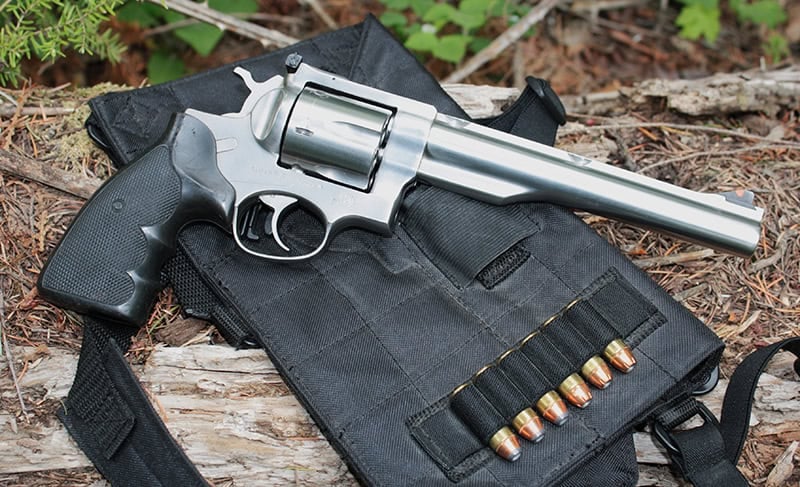
Shown here with its rugged Gunmate nylon shoulder rig, Ruger’s Redhawk would be quite at home
in any outdoor environment, especially in bear country.
Over my Chrony chronograph screens, set about 20 inches ahead of the muzzle, factory-loaded 240-grain Speer Gold Dot hollowpoints warped along at an average of 1,459 fps, with the highest velocity hitting 1,475 fps.
Winchester’s 240-grain JSP loads moved out at an average of 1,392 fps, which is enough horsepower to anchor an elk, caribou or any bear I’ve ever seen. Recoil wasn’t unmanageable and I was able to whack a 10-inch steel plate at 50 yards with some consistency off a sandbag rest.
Switching over to some older El Dorado Starfire 240-grain JHPs I’ve had sitting around for quite a while, the Redhawk sent them flying across the screens at an average of 1,279 fps. While not quite as accurate as the Winchesters, this ammunition could hold its own in the field.
I tried a couple of .44 Special loads as well, including a 200-grain SWCHP that clocked 909.3 fps on the average, while a Black Hills 250-grain load topped with Keith-style SWC bullets which left the muzzle at an average of 802.4 fps.
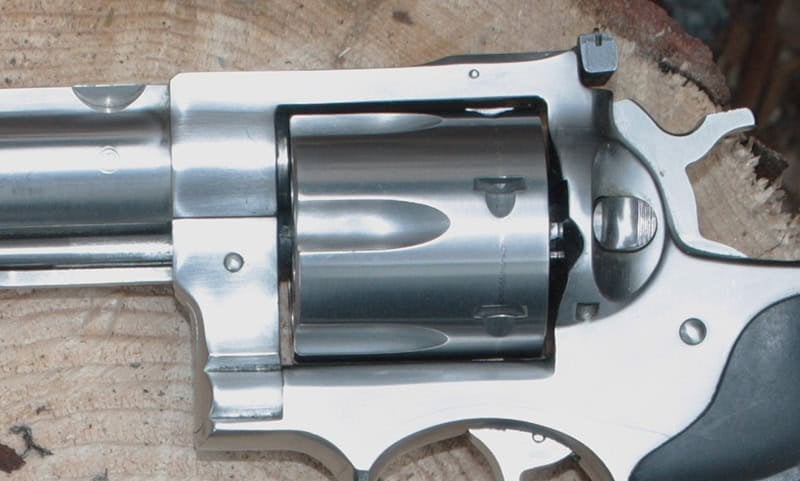
The Redhawk features a triple lock setup, secure at the front, rear and below.
Ruger’s trademark push button cylinder release works superbly.
Tough As Nails
I’ve always considered Ruger revolvers to be strongly built, and that especially goes for their big bore double-actions.
Some years ago, I did a field test on the Ruger Alaskan, chambered for the fierce .480 Ruger cartridge, and it had a very short barrel. Still, thanks to the synthetic grips, I found that little cannon to be controllable, which allowed me to shoot it accurately out to about 100 yards. Recoil was impressive, of course, and the muzzle blast was somewhere between field artillery and total deafness.
So, Frank’s Redhawk .44 Magnum with full house factory loads was not much different from shooting my slightly lighter and a bit smaller dimensionally N-frame Model 57 Smith & Wesson in .41 Magnum.
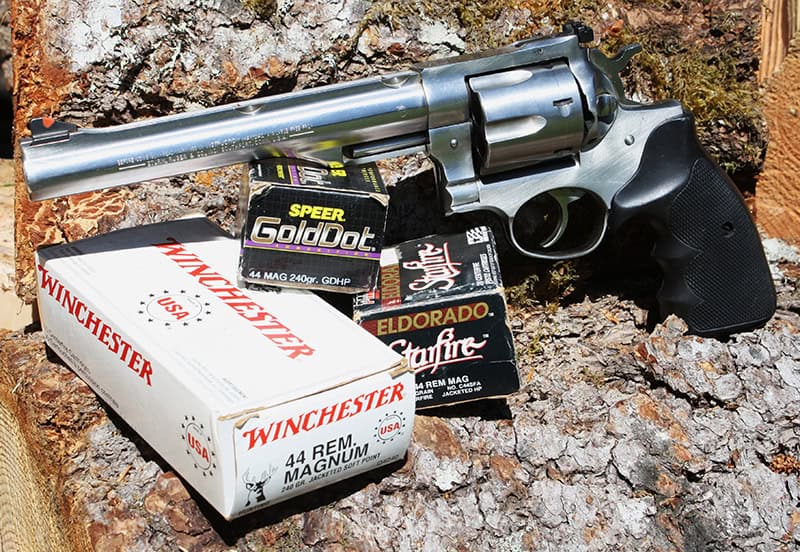
Dave grabbed 240-grain factory loads from Winchester, Speer and El Dorado
he had on hand to run the Redhawk through its paces.
Long story short, I think the Redhawk could take some banging around and still keep shooting. I don’t recommend this, of course, but this is a comparatively massive wheelgun when stacked next to my big bore S&W and Ruger Blackhawk revolvers.
That said, I’ll remind (admonish?) Frank to clean his Redhawk after shooting it, and find a clean-burning powder for reloading. I’ve had good luck with H110, Alliant 2400 and Accurate #9 for my personal magnum loads over the years, with a minimum amount of cleaning.
When I was a little kid, someone recited the Ten Commandments to me but I don’t recall anything in there which said I couldn’t covet my brother’s sixgun. It’s a keeper, and I will admit to some jealously that he’s keeping it all to himself.
Get more wheelgun content every week!
By submitting this form, you are consenting to receive marketing emails from: . You can revoke your consent to receive emails at any time by using the SafeUnsubscribe® link, found at the bottom of every email. Emails are serviced by Constant Contact