The Tunnel Rat QSPR Revolver
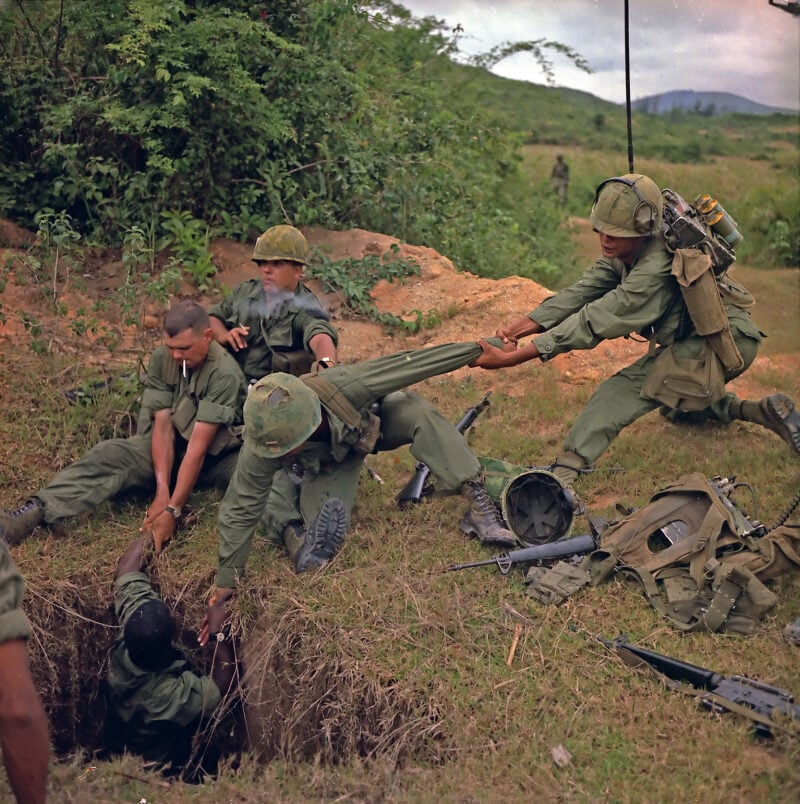
Soldiers lower an infantryman into a tunnel west of Duc Pho during Operation Oregon on April 24, 1967.
Photo: SSG Howard C. Breedlove, U.S. Army Signal Corps / National Archives, NARA 530613.
Maybe there’s a bit of claustrophobia at play, but it’s hard to imagine something more terrifying than diving into a “barely shoulder-width” underground tunnel, alone. Oh yeah, as if that’s not enough, the tunnels are filled with hardened enemies intent on killing you. One more thing: they’re also filled with all sorts of booby traps: poison spikes, explosives and… poisonous snakes.
Such was the mission of Tunnel Rats during the Vietnam War.
Any sane person wouldn’t want to go in there in the first place, but the ones who did felt they needed to be armed with something useful. Clearly, rifles weren’t a viable option because of the size, bulk, and inability to handle them in exceptionally tight spaces.
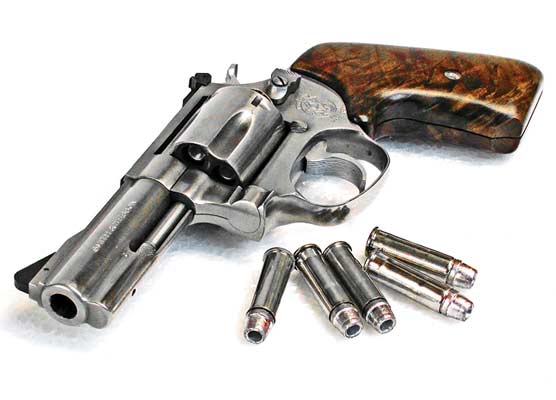
Enter the Smith & Wesson Model 29. Yep, you’re thinking of the right one: a massive .44 Magnum of Dirty Harry fame. Before you call foul and write me off as some ill-informed loon making up stories from my couch, read on. Here’s a hint: this one was called the QSPR. That stands for Quiet Special-Purpose Revolver, and the name tells you a lot.
A handgun for tiny, enclosed spaces
I’m not sure any military force in history has made better use of tunnel networks than the North Vietnamese during the Vietnam War. These tunnels served not only as hiding places, bomb shelters, and routes between fighting positions but also as supply depots, command posts, and even hospitals.
So we’re not talking about a singular location, meaning if you find an entrance somewhere, you can simply fill it up with dirt or blow it up, and the job is done. We’re talking multi-level networks in many cases, with numerous entrance and exit points, some of which were just decoys. When a tunnel entrance was found, someone had to go inside, figure things out, and destroy it from the inside.
You’ve probably seen some of the photos. Tunnel rats had to shed all extra gear, especially equipment that rattled around and made noise. The basic toolkit: a pistol and a flashlight. The stereotypical handgun used for this purpose was the United States Army’s M1911 .45 ACP pistol.
While portable and maneuverable in tight spaces, it did come with some drawbacks. We’re all familiar with those. It is very loud and, like any full-caliber centerfire, is going to make significant muzzle flash, especially in confined and dark places.
So, the Army experimented with alternative handgun designs. An early option was a suppressed .38 revolver. Later it was a suppressed .22 High Standard pistol. The rimfire addressed the noise problem, but the Army wanted better effectiveness.
The Land Warfare Laboratory and AAI Corporation followed a different path. Instead of making a conventional cartridge quieter after it fired, they put the noise-control machinery inside the ammunition itself.
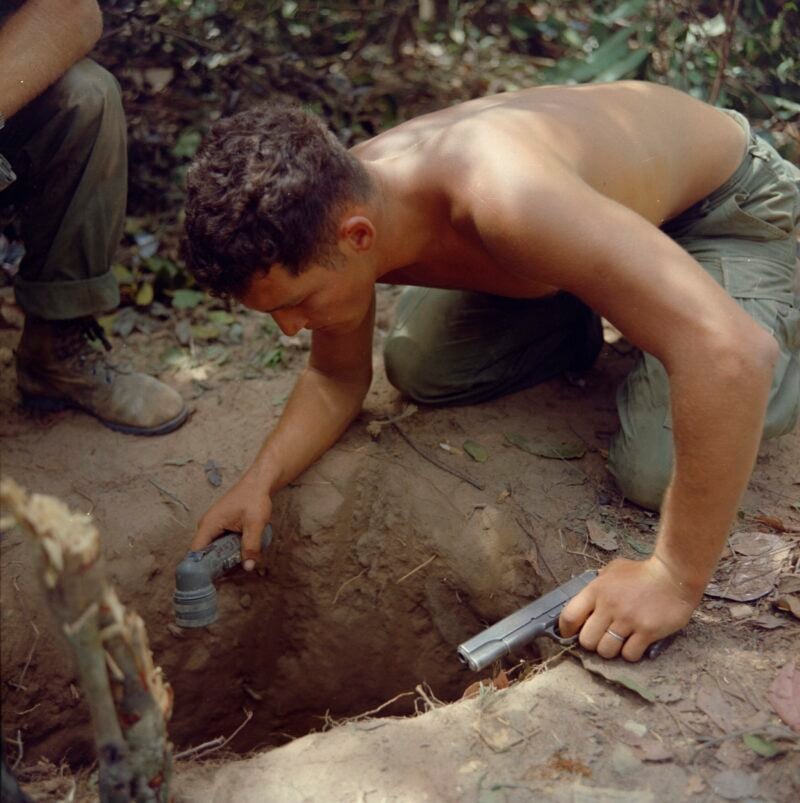
Sgt. Ronald A. Payne checks a tunnel entrance during Operation Cedar Falls on January 24, 1967.
His M1911 and flashlight illustrate the equipment tunnel rats carried before the QSPR field trial.
Photo: SP4 Robert C. Lafoon, U.S. Army Special Photo Office / National Archives, 111-CCV-529-CC38112
Containing gas
You’re probably familiar with the normal configuration. When a cartridge fires, the powder inside ignites and creates a large volume of high-pressure, hot expanding gas that forces the bullet out the muzzle. This, in turn, is followed by a high-speed and high-pressure expulsion of gas also from the muzzle. As with the balloon popping, all that release of pressure at once makes a very loud noise.
The QSPR took another approach. Its special cartridge used a captive piston inside the cartridge case itself. The expanding gas drove the piston forward, pushing the shot load out, but the piston stopped inside the case and trapped the gas behind it.
It was like a tiny engine piston that cycles through just one forward stroke, all inside the cartridge case.
This clever arrangement also solved another problem. The Model 29 is a revolver, and revolvers don’t suppress particularly well because of the cylinder gap. Some of that expanding gas is forced out of that gap and creates its own noise. With the piston arrangement, the gas never makes it so far as the cylinder gap.
AAI built the QSPR around the Model 29, but with some modifications; it still had a six-shot cylinder revolver layout, but the barrel was replaced with a shortened stubby smoothbore version. Published specifications describe a barrel about 1⅜ inches long and a bore of approximately .40 caliber. So it was more than a Model 29 with a cut-off barrel.
Each cartridge carried 15 tungsten pellets in a plastic carrier. The idea was to create a shotgun-like pattern at close quarters. The hope was that a reasonably aimed shot would be effective on a moving target at short range. Everything about the project was geared around up-close and personal fighting in small spaces.
As for the quiet part of this design, physics is physics. We’re still igniting a charge, albeit a smaller one, and although the same volume of gas never made it out in terms of muzzle blast, it still made some noise. Most users at the time likened it to the volume of a suppressed .22 pistol. That’s quite an improvement over the noise of a 1911.
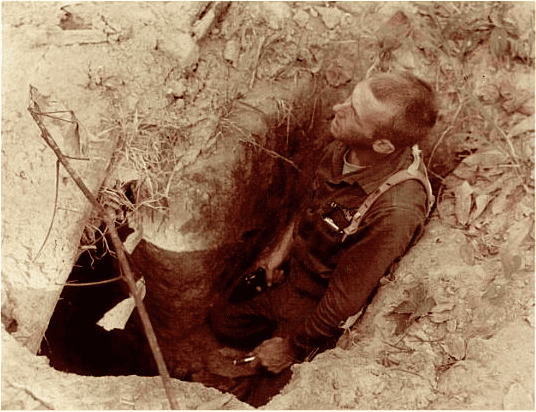
A soldier enters a tunnel during Operation Crimp, January 1966.
Source: U.S. Army Center of Military History
Field testing
In 1969, ten QSPR revolvers were sent to Vietnam. The evaluation ran from July through October, and the resulting feedback revealed something interesting: soldiers found additional jobs for the test pistols outside of enemy tunnels.
The July 1972 design-improvement report describes use in ambushes and search-and-destroy operations, including encounters with bunkers, houses and spider holes. Users valued the low firing noise and the compact weapon’s usefulness in tight spaces.
The evaluation also exposed some problems. Misfires were a recurring theme. This isn’t necessarily surprising, as an entirely new take on cartridge ammunition was also being tested. According to the reports, there were issues with marginal firing pin energy, and the ammunition’s primer arrangement left something to be desired.
AAI revised both the weapon and its ammunition. Its report records 200 improved rounds fired during assurance testing without a misfire, followed by 125 rounds in final acceptance testing, again without a misfire. Keep in mind these were “lab” tests, not reputation developed through years of combat use.
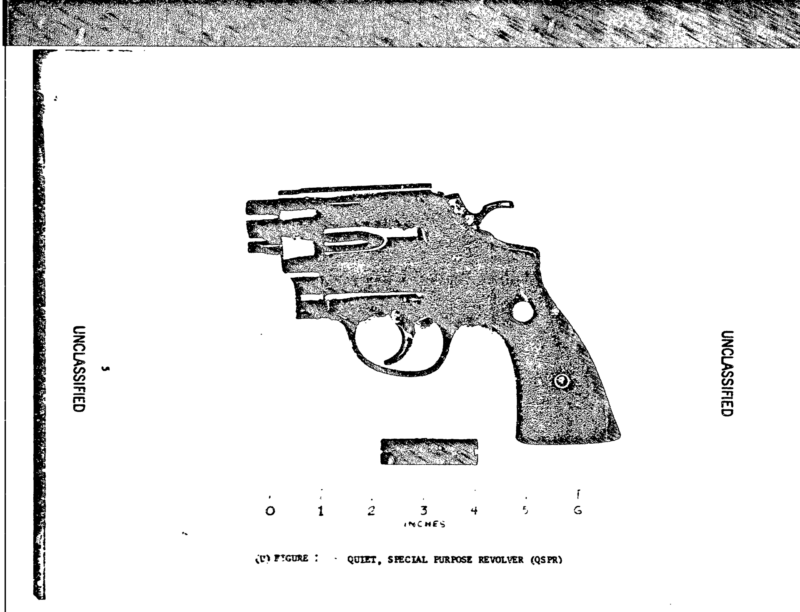
Figure 1 in the July 1972 AAI report identifies this weapon as the Quiet, Special-Purpose Revolver.
Source: AAI Corporation for U.S. Army Land Warfare Laboratory, AD524796, printed page 5.
Anecdotal reports
Here’s what some field testers had to say…
“The NVA was sitting and just as surprised as me, but I was able to fire the Tunnel Weapon…before he could use his rifle. I drug him outside, but he was dead.”
“…during one night ambush operation, two members of the Americal Division’s Ranger Company, using a single Tunnel Weapon, killed one NVA officer and two NVA soldiers. In the first instance, the officer was shot at a distance of approximately ten feet. The respondent reported the first round struck a large leather pocketbook, filled with papers, that was being carried across the officer’s chest. The second round struck his stomach, knocked him over, but failed to kill him. After this encounter, the Tunnel Weapon was given to another member of the team, who subsequently shot and killed two NVA soldiers as they were walking along the same trail. They, too, were engaged at a distance of approximately ten feet.”
“Four rounds out of twenty-two failed to fire the first time around.”
“If we had five such pistols, we could stay out for a week at a time…without giving our position away.”
A close-quarters niche weapon
Development continued into 1972, but the American withdrawal from Vietnam reduced the need. The QSPR never became a widely issued service handgun.
Exactly how many made their way out of the factory remains murky. Published estimates vary, so anyone’s take should probably be considered a guess. The ten weapons sent for the 1969 trial are a much firmer number than the total production claims that circulate online.
While the concept never took off in terms of volume and widespread military use, you’ve got to admire the innovative approach to suppressing gunshot noise using a completely novel approach. Who would have thought installing a piston-driven engine inside of a cartridge case might be the ticket?
Get more exclusive online content from American Handgunner delivered straight to your inbox. Sign up for our free American Handgunner Insider newsletter.