10mm Penetration
Handloading

The GLOCK 20 SF is the ideal outdoor companion. It can be
employed as personal protection for 2- and 4-legged threats.
The only thing it needs are Talon Grips.
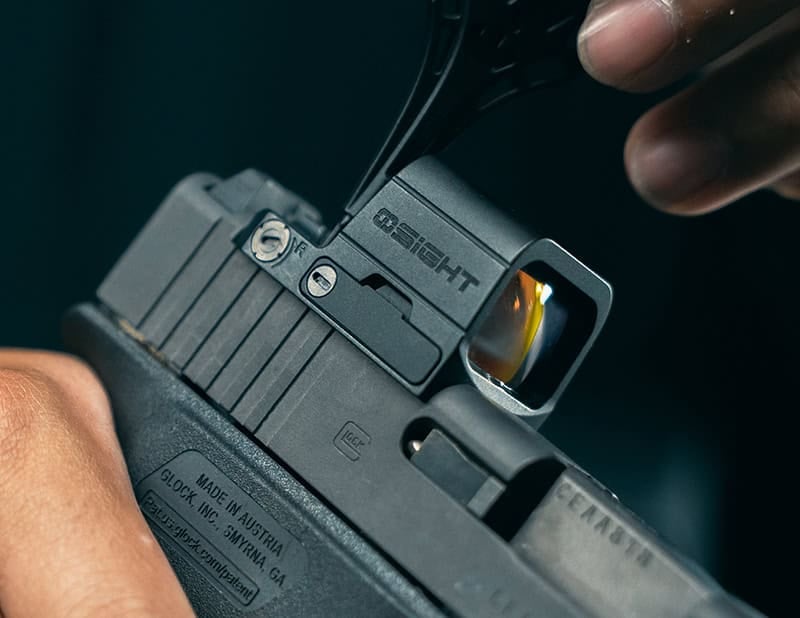
My favorite gun for running 10mm is the GLOCK 20SF. It serves not only a personal defense role but also dangerous game beasts.
Getting 10mm loads to penetrate sufficiently is never a problem. The important reloading skill is to find a bullet that controls the level of penetration for the desired effect. Using only 180-grain bullets and similar loads, I made my GLOCK 20SF suitable for personal defense, hunting and last-ditch animal attacks.

This is what a bullet looks like when it comes to rest in ballistic gelatin.
This 180-grain Nosler ASP bullet delivered consistent performance in tests.
Testing Tools
I use a Garmin Xero Pro Chronograph for testing; compact and versatile, it also figures Standard Deviation (SD). The larger the SD, the wider the spread of the velocities and usually group size.
I shoot ballistic Clear Ballistics 10% gelatin blocks and remelt them for reuse. They are easy to calibrate and give consistent results. I have been testing cartridges so long that I had a mixing station in my garage for Knox gelatin. This was the “old school” style of ballistic testing. I used to arrive at the range with a pickup bed full of coolers packed with gelatin.
The FBI standard for ballistic testing includes shooting through bare gelatin, auto glass, clothing, and various materials, seeking bullet weight retention and proper penetration between 12″ and 18″. Both the Nosler ASP and Northern Precision Sabre Star do well in these tests, retaining their weight after striking a barrier.
The 10mm can be pushed to rather high velocities for a handgun. The loads here are mild. As far as pressure is concerned, most of these loads are right in the middle. For example, my Ultimate Pistol load for the Nosler ASP can be run up to 7.8 grains. It really doesn’t gain much in velocity from 7.0 grains. Why not coast along?
Nosler ASP 180
I found this bullet has a very controlled expansion in gelatin, expanding 150% and averaging 15.5″ of penetration. More importantly, the SD was 9.4. The low SD translated to a very encouraging 20-yard target. Using AA#9 raised the velocity to 1,105.5 fps average, and an SD of 11.1. This gave it 17″ of penetration. Using 7.4 grains of 3N37, it only went 1,008.4 average, with an SD of 14, and penetrated 14.5″ average.
If I were hunting something with a thick hide (like hogs) where overpenetration was an issue (like hunting with dogs), the Nosler might be an option.
Northern PRECISION
This bullet delivered dramatic expansion and created large wound channels. It is a bonded core, meaning the manufacturer has done something to keep the core and the jacket from separating under stress. Non-bonded bullets often lose jacket and core pieces when fired through barriers. This one doesn’t. The Sabre Star bullets expand quickly, even at lower velocities.
Working up to 12.4 of AA#9, it averaged 1,114.3 fps, with an SD of 12.2. It averaged 18″ in gelatin. With 7.4 of 3N37, the bullet went 1,100 fps, and penetrated 20″. The cleanest burning, most consistent load was 7.0 grains of Lovex Ultimate Pistol. The Sabre Star averaged 1,050.8 fps, penetrated 18″, and had an SD of 8.6.
This bullet is a good choice for defensive purposes, but it would likely overexpand when pushed to higher velocities.
Berry’s BULLETS
Berry’s bullets are generally swaged lead with a copper plating. They’re generally “softer” than jacketed bullets.
For 10mm, this can be problematic as 180-grain bullets are long enough that it takes more force to seat them into the thick walls of the case. It’s easier to load them into 40 S&W cases, where the thinner wall gives less resistance.
I used an RCBS seating die with a slightly rounded seating stem. The force of seating the bullet, even with a well-expanded case mouth, deformed the bullet tip. I figured the design of the hollow point and the softness of the plating would cause it to expand quickly.
I was wrong. No matter the velocity, I could not get it to expand. It also ran slower than its jacketed counterparts using the same load. For example, 7.0 of 3N37 only got this bullet to 968.4 fps.
There are two caveats with the Berry’s bullets. First, they were accurate when I started shooting them at 20 yards. I was using 7.0 Ultimate Pistol, and I was keeping the groups under 2.5″. Second, even though the bullets did not expand in my tests, they sailed through nearly 30″ of gelatin with ease. If it won’t expand, at least the penetration is good.
What did I learn from this adventure? I think I answered all my questions about which load to use for bulk reloading.