What You Need to Know About Powder Charging
The Ultimate Reloading Series Part 7
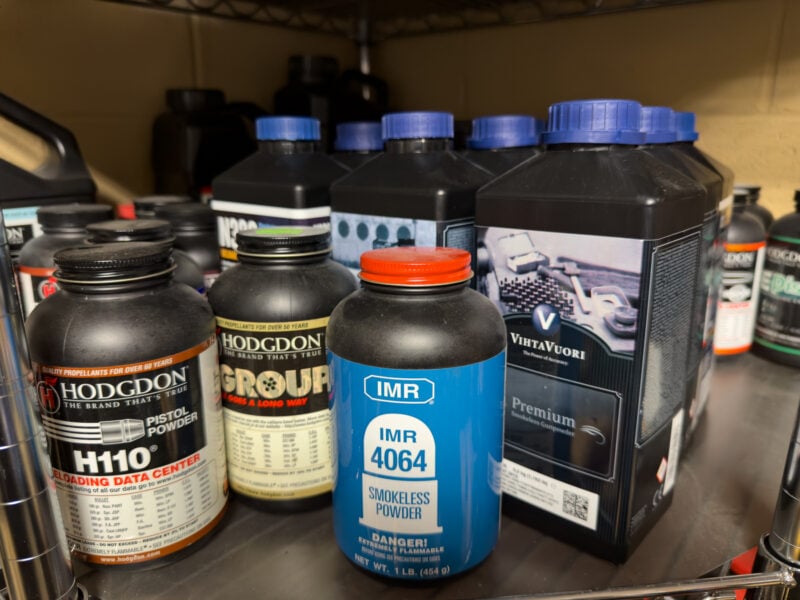
While you can get by with a handful of powders to cover multiple calibers, you'll quickly begin
to appreciate the different performance characteristics offered by the variety. You'll begin to
even "feel" the difference when shooting.
Don’t let the terminology spook you. “Charging” sounds like something a bull does, but in reloading, it just means putting powder into your empty brass. That’s it. Fill ‘er up.
There are a dizzying number of options out there, each engineered with a specific burning rate suited to particular cartridges and bullet types. Manufacturers manipulate kernel shape, size, and chemical coatings to control exactly how fast a given powder combusts.
New reloaders sometimes assume a faster-burning powder automatically means a faster bullet. Not quite. What matters is the pressure curve, which is the relationship between how quickly gas builds up inside the case and how that pressure behaves as the bullet travels down the barrel.
Safety First: Powders with similar names or numbers are not interchangeable. “Close enough” doesn’t exist here. Use exactly what your load recipe calls for. Period.
Here’s the short version of how pressure works. Ignite powder in a sealed cartridge and you get rapidly expanding gas. That gas has to go somewhere, so pressure climbs until it overcomes the friction holding the bullet in place. The bullet moves, the available space behind it grows, and pressure starts to drop. Once the bullet clears the muzzle, pressure returns to zero.
Why does this matter for powder selection? A short-barreled pistol cartridge like .32 ACP needs a fast-burning powder to build pressure quickly before the bullet exits. A big rifle cartridge with a long barrel benefits from a slower-burning powder that keeps generating gas over a longer travel distance without spiking pressure dangerously high at the peak.
The bottom line: burn rate, cartridge volume, barrel length, bullet weight, and the gun’s design strength all have to play nicely together. The good news? You don’t need a physics degree. Published load recipes in reputable manuals have already done that math for you.
Safety First: The wrong powder type or charge weight can destroy a gun and hurt people. Stick to published recipes. Stay within the listed minimum and maximum charge weights. No freelancing.
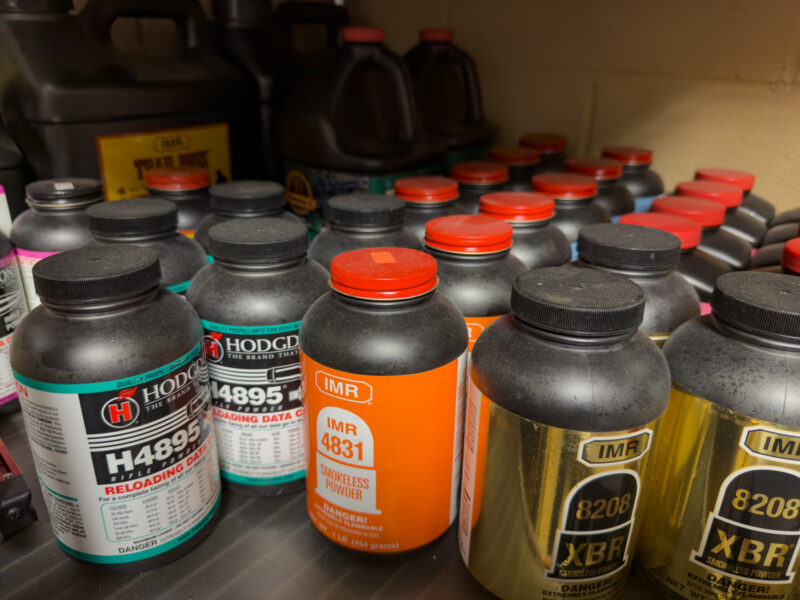
Powders come in lots of varieties, sometimes with similar names. Take care, they're all designed
with different performance characteristics. Using the wrong one can be dangerous.
Weighing Your Charges
Powder charges are measured by weight in grains, not by volume or by counting individual kernels. I’ve seen questions online asking how one is supposed to count kernels. Don’t laugh too hard, it’s a natural question if you’ve never heard of “grains” as a weight measure! One grain equals 1/7,000th of a pound, so we’re talking about small, precise quantities.

For rifle cartridges, I almost always use this RCBS unit.
It automatically dispenses to a precise weight and is surprisingly fast.
Getting this right is non-negotiable. Overcharge a case, and you create a pressure spike that can turn your gun into shrapnel. Undercharge it, and you might not generate enough force to push the bullet clear of the barrel. Fire a follow-up round into that obstruction, and you’ve got a catastrophic failure on your hands. If a shot ever sounds or feels wrong, stop immediately and inspect everything before pulling that trigger again. Yes, reloading is a hobby that calls for care and attention to detail.
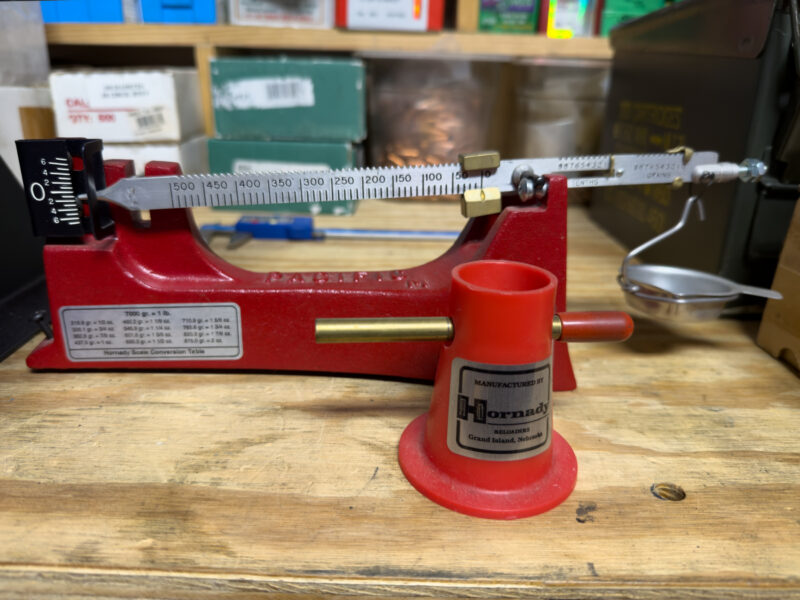
For precision work, you'll want a powder trickler. A twist of the cylinder dispenses
a few grains (granules, not weight) at a time into the scale.
Before every loading session, verify your scale. Zero out a beam scale or run the calibration weight on a digital one. And watch those batteries on digital models. Low power makes them unreliable in ways that aren’t always obvious.
Tip: Keep only the powder you’re currently using on the bench. Everything else stays on a separate shelf. Eliminates any chance of grabbing the wrong container.

Here's the powder dispenser on my Hornady Lock and Load progressive press.
I guess I have a thing for duct taping my gear. The thumbscrew adjusts the precise
powder charge for each drop.
Use a Powder Dispenser
Forget using the scoops that sometimes come with reloading kits. A hand-operated powder dispenser is more precise, faster, and you won’t need a collection of different sizes. For reloading anything beyond a box or two, it’s the only way to go.

Lee Die sets often come with powder measuring scoops for the designated caliber.
While not exact, they're calibrated to be in the safe range if you follow the included
load instructions. The big one is for 7.7 Arisaka while the small one is from a .380 ACP set.
The concept is straightforward. A hopper on top holds your powder supply. Below it sits a metering chamber with various adjustments to control the precise volume of powder allowed in.
Getting dialed in takes a few tries the first time around. Throw a charge, pour it onto your scale, check the reading, and tweak settings. Once you’re on target, lock it down. But don’t start filling cases just yet. Run a dozen or so test charges first. Dispensers tend to settle into a rhythm, and you may need a small correction. Keeping the hopper reasonably full helps too, as a nearly empty reservoir doesn’t have enough weight behind the powder to feed the metering chamber consistently.
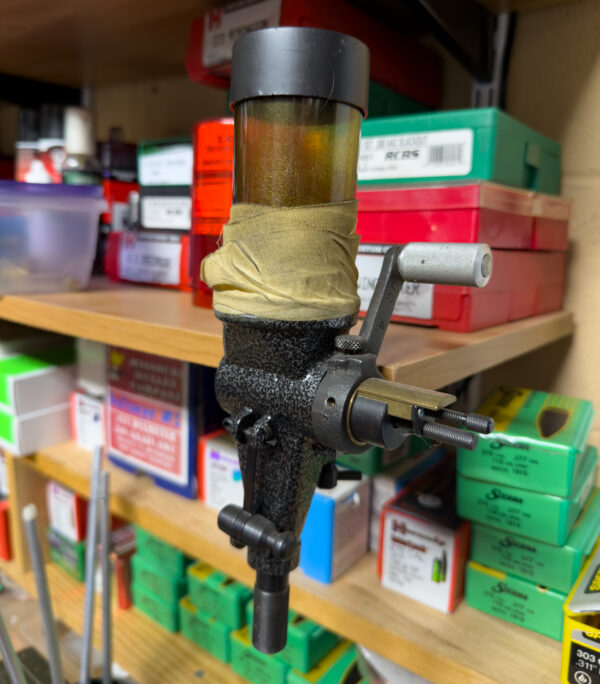
I find this Lyman dispenser handy for batches of pistol cartridges I'm not running
through a progressive press. You can hold a whole tray of cases under it, moving to
a fresh case while dropping a charge.
Here’s the workflow I’ve settled into over the years. After belling a batch of cases, I pull one at a time and drop a charge. Quick peek inside to confirm it looks right, then into the loading tray it goes. Every 5 to 10 rounds, I’ll dump one onto the scale as a spot check.
Once a tray of 50 is full, I hold it up to the light and scan the rows. Every case should show roughly the same powder level. This is your final gut-check for a missed charge or a double dose.
Tip: When selecting a powder type and charge weight from your manual’s options, lean toward combinations that fill the case most of the way. A nearly full case is easy to verify visually, and it makes an overcharge practically impossible since the powder would overflow. It’s a built-in safety margin that costs you nothing.

Amongst the chaos, you can spot one thing. I always keep the powder bottle matching what's in the hopper
on the bench — no other powders. Not the Hodgdon CFE Pistol container in the background.
More to Follow
Down the road, we’re going to do an appendix section on powder itself. You know, the types, properties, and general things you need to know that will help you with optimal powder selection for certain loads. For now, we’ll focus on the process.
Safety First: Never blend or combine different powders. Follow published data without exception. If you make a mistake, or even suspect you might have, stop everything. Pull the round apart with a bullet puller and start fresh. It’s always cheaper to waste a few components than to deal with the alternative at the range.
Read Part 8 (Bullet Seating).
If you missed Part 6 (Priming).
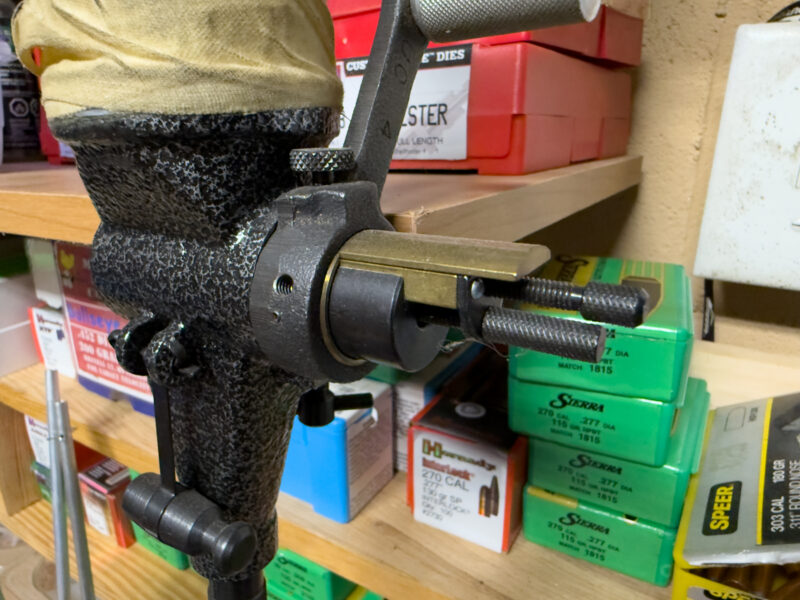
This well used Lyman dispenser offers three layers of adjustments to get a precisely measured charge, over and over.
Get more exclusive online content from American Handgunner delivered straight to your inbox. Sign up for our free American Handgunner Insider newsletter.