Favorites, According to My Belt
A look back at the handguns that earned the most carry time
My wrist apparently disagrees with my brain.
Years ago, I found a swinging deal on a Breitling Aerospace, a watch I’d wanted for a long time. Ask me to name my favorite timepiece, and I’ll probably tell you all about that one, more than you want to hear. But ask me to roll up my sleeve, and you’ll almost certainly see a Seiko Turtle dive watch. It cost about $400 new, which isn’t pocket change, but doesn’t get you much attention in fancy-watch circles. It gets the daily wear time, though, nine days out of ten.
I suppose the Breitling wins the interview, but the Seiko gets the job.
I’ve noticed the same disconnect with shooting gear. Ask me about my favorite products, and I’ll come up with an enthusiastic list. Look inside my range bag I actually take out the door, or the desk drawer holding my current rotation of holsters, and the answers might be different. Admiring something and reaching for it every morning aren’t necessarily the same thing. It can all be “good,” but there’s the factor of “that little extra something” that moves stuff into the first picks.
That got me thinking about carry guns. The nature of this job brings a lot of handguns through here, and a proper evaluation means living with them for a while. Shooting, carrying, trying different holsters and figuring out which parts become annoying after the novelty wears off.
But what happens after the review? Which guns keep ending up on my belt?
Looking back over the years, these are the ones that earned the most carry time. This isn’t a ranking of the newest guns, the best bargains or what anyone else ought to buy. It’s a look at what I actually carried when I had to choose one each morning.
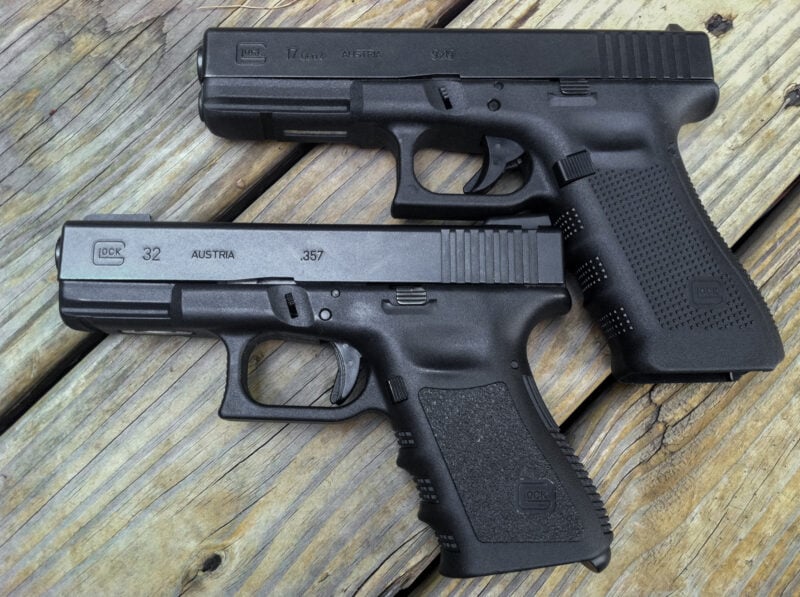
The GLOCK 32 was a long-term carry choice. It's hard to beat the GLOCK 19 format in terms of
balance between handling and compact size.
GLOCK 32
The GLOCK 32 got me hooked on .357 SIG. That probably explains a lot on its own. It was also in my earlier carry years, so I probably put a little too much emphasis on “power.”
It’s hard to argue with what that cartridge does with a 125-grain bullet, but a cartridge still needs a gun appealing enough for daily carry. The 32’s middle-sized frame, same as the universally popular GLOCK 19, hit a great balance for me. It was substantial enough to handle, yet manageable in an inside-the-waistband holster.
I also appreciated the feeding reliability. Part of that is the bottleneck cartridge design, and part is just… GLOCK. Whatever the balance was, I could shoot that gun from the worst grip platforms, and it just worked. I found the recoil manageable, too, although that doesn’t mean everyone will prefer it to 9mm. It’s definitely snappier.
It was a solid carry choice. In fact, its only drawback was the cost of practice ammo. I didn’t care about defensive ammo pricing as I only rotated that once a year.
Springfield Armory XD-S
The Springfield Armory XD-S has been my recurring exception to the bigger-is-better preference. It’s small, but not so small that I feel like I’m trying to shoot it with tweezers. Maybe that’s why it stuck around in the rotation so long.
My original attraction was the balance. The 9mm version had enough weight and usable grip to make defensive ammunition controllable, while the slim single-stack profile opened up carry options that thicker guns didn’t handle as gracefully. I used the original variant of the XD-S forever, usually inside the waistband but also in ankle and undershirt holsters.
The later Mod.2 OSP kept those virtues and added an optic. I’ve carried mine with a Holosun HE407K when the day’s clothing called for something flatter than a double-stack. It also hides nicely in an appendix rig.
Yes, newer designs squeeze more ammunition into a similar amount of space. But capacity isn’t the only thing I’m buying with a carry gun. I like how the XD-S behaves in my hands, and I actually enjoy practicing with it. A small pistol that doesn’t make me eager to finish the range session has a lot going for it. I’ve kept both the original and Mod.2 pistols and carry both frequently.
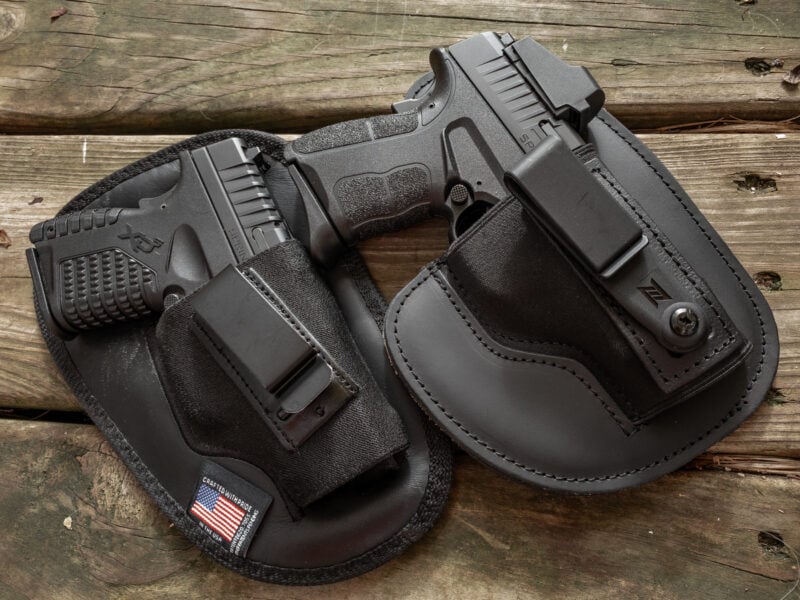
I still carry both of these: the original Springfield Armory XD-S and the newer, optics-ready Mod.2.
Staccato C2
The Staccato C2 makes a pretty persuasive argument for carrying more gun. It gives me the single-action trigger I like, a grip I can get hold of and 16 rounds in the magazine. More importantly, I find it unusually easy to shoot well. For me, it checks all the boxes. I love and respect the 1911 platform, but I have to admit I was always kinda looking for more capacity than single digits.
When I tested the C2 alongside the larger Staccato P, the soft recoil was immediately apparent. That’s a feature for sure, but the useful part is how little effort it takes to control the pistol. My test gun’s trigger broke consistently at 4.25 pounds with very little movement before or after the break.
Of course, none of that matters much for daily carry if I leave it at home. The C2 isn’t tiny, but the right holster makes it surprisingly manageable. I’ve carried it in LAS Concealment appendix rigs with and without an extra magazine (different LAS models) under shorts-and-T-shirt attire. With that carry configuration, it’s shockingly easy to conceal. I didn’t say small, just easy to conceal.
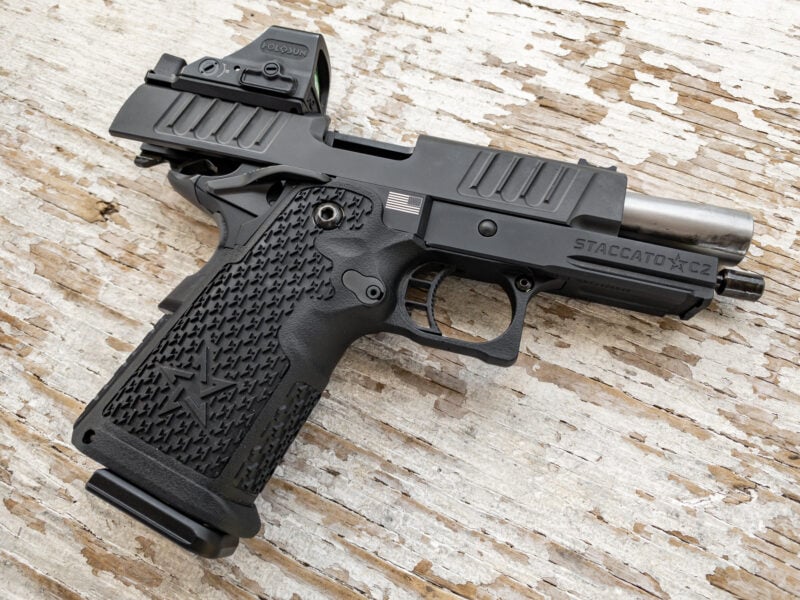
OK, the Staccato 2011 is large, but it sure is easy to shoot well. And you can't beat the capacity.
SIG SAUER P229 Legion 9mm
The SIG SAUER P229 Legion is one of those guns that seems to agree with my hands. It points naturally for me, stays manageable through recoil and makes accurate shooting feel less like work.
I’m also a long-term fan of the double-action/single-action design. A deliberate first press, a lighter press after that and a decocker rather than a separate manual safety offer layers of carry safety. The proverbial “transition” between trigger pulls has never been a big obstacle for me. Learn how not to move the gun when pressing the trigger, and the double-single stuff becomes moot.
The Legion’s upgraded trigger and short reset add to the appeal, but the confidence came from using it. By the time I wrote one of my earlier reports, I’d put more than 2,000 rounds through mine, covering nearly 20 types of ammunition, without a malfunction. Hard to argue with that proof point when choosing a carry pistol.
I spent plenty of time carrying this one in an Alien Gear Cloak Tuck, and eventually fitted XS Big Dot sights. It’s not the smallest 15-round 9mm, but that extra grip has space for my entire hand. Given the choice between a little less gun to hide and a little more gun to shoot, I tend to lean toward the latter. Seeing a pattern here?
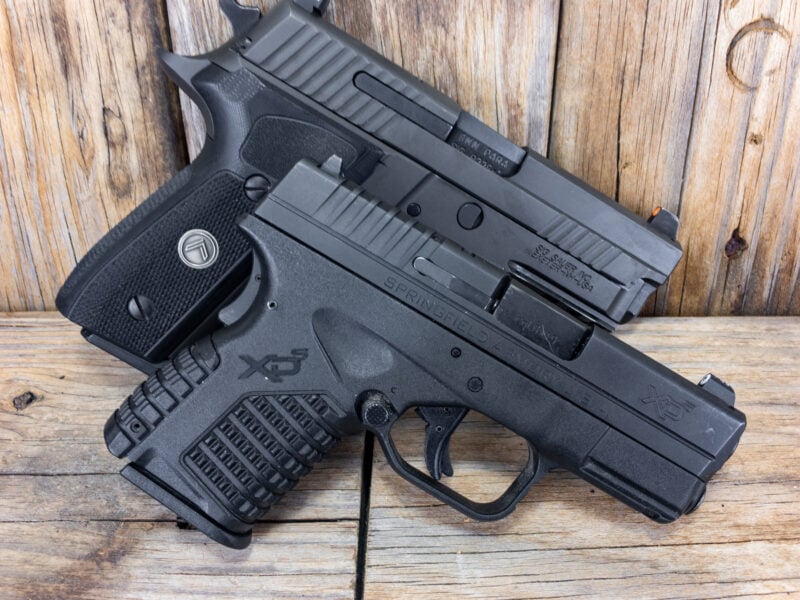
SIG SAUER P229 Legion (back) and Springfield Armory XD-S.
Beretta 92 FS
This was my first carry pistol. Apparently, I skipped the part of the beginner’s handbook recommending something small. I was never all that great at following directions.
The Beretta 92 FS is a large gun, especially through the grip, but it introduced me to some qualities I still appreciate: mild recoil, generous capacity and a double-action/single-action operating system. It was comfortable to shoot, and its reliability was and is outstanding. I’ve lost track, but I can’t recall a jam in all these years.
At the time, I also appreciated the manual safety-ish lever. As a new concealed carrier, I wasn’t entirely comfortable with the idea that a trigger press was all that stood between a holstered gun and a shot. My thinking and preferences evolved, but the Beretta’s controls made sense to me then.
There’s certainly some first-gun sentiment involved now. Looking back, starting with a gun that was easy to shoot, rather than one that was merely easy to hide, wasn’t such a bad decision.
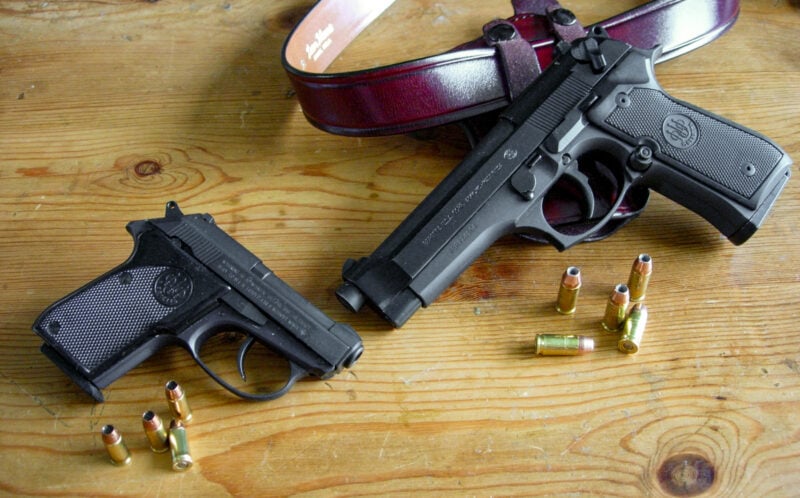
My first regular carry gun, the Beretta 92. The Beretta Tomcat (left) got a fair bit of use also.
SIG SAUER P320 XCompact
This one needs a little explanation because mine isn’t quite the pistol that came out of the box. I did carry it in stock condition for quite a while, but then I found some extra awesomeness.
I liked the XCompact’s trigger, optics-ready slide and compact proportions. I carried it with a red dot, but eventually decided to try out a grip upgrade. Hey, one of the selling features is its modularity. I installed a Wilson Combat WCP320 replacement grip model. Wow! What a difference. Being modular, I chose the taller version, which allowed me to use 17-round magazines instead of the original 15s.
That combination fit my hand the way I’d wanted all along. I still had the compact upper portion and optic, but now had a fuller grip and a couple of extra rounds. It wasn’t a complete custom Wilson pistol, just my SIG with a different grip module.
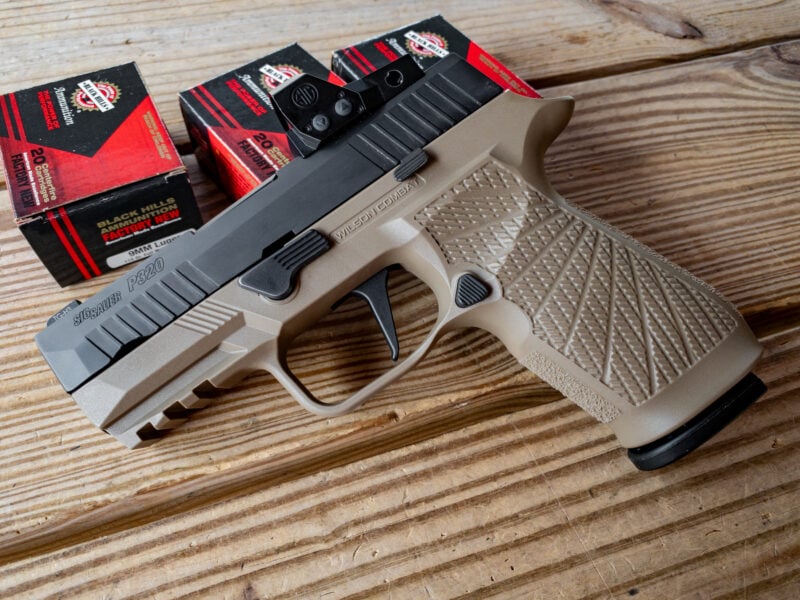
The addition of the Wilson Combat grip module made this SIG P320 XCarry a solid choice.
And the grip swap added two rounds.
Springfield Armory 1911 TRP
The Springfield Armory 1911 TRP makes no attempt to win the lightweight contest. On some days, I’d swear it weighs 19 pounds. I’ve owned mine since 2012, and the holster wear tells you it hasn’t spent all that time collecting dust in the safe.
What kept it in use was how well it worked. When I wrote about it in 2018, I still hadn’t experienced its first malfunction. With several different factory loads, it was producing five-shot groups between roughly 1.75 and 2.5 inches at 25 yards. Those are old test results, and I’m confident it would do better now because the guy running it has improved his skills a bit more over the years.
The trigger on mine measured five pounds, yet its clean break made it feel lighter. Combine that with a solid grip and the familiar 1911 controls, and I had a .45 I could shoot comfortably and accurately.
There are obvious costs in weight and capacity. I won’t argue about that. But the TRP illustrates the preference running through this list: I’ll put up with more on the belt for a gun I know well and shoot well. It still frequents the carry rotation.
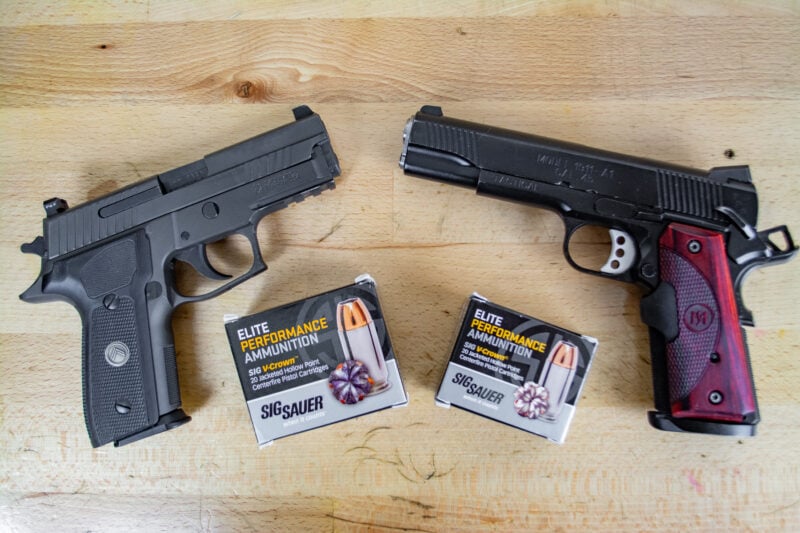
The classic tradeoff. 16 rounds for the SIG P229 on the left and 8 for the Springfield Armory 1911 TRP on the right.
Walther PPK/S
Mine began as an Interarms-imported “gunsmith special,” which turned out to be a remarkably accurate description. It didn’t run properly when I bought it, and my attempts to inflict DIY wreckage did not improve matters. Eventually, I sent it to Cylinder & Slide and let people who knew what they were doing take over.
The pistol that came back was a different proposition. They corrected the feeding problems, fitted and bedded the wood grips, refinished it and improved the trigger’s feel. The rounded, polished trigger face made the double-action press much more pleasant. In my subsequent reports, I described years of reliable operation with both ball and defensive ammunition.
That’s the distinction here. I wanted to carry the Walther because I liked it. Secondarily, it was “small enough” to easily conceal in business attire.
The professional restoration gave me a gun I could actually trust enough to carry. It wasn’t an economical route to a carry gun, but it did turn a questionable purchase into a long-term keeper.
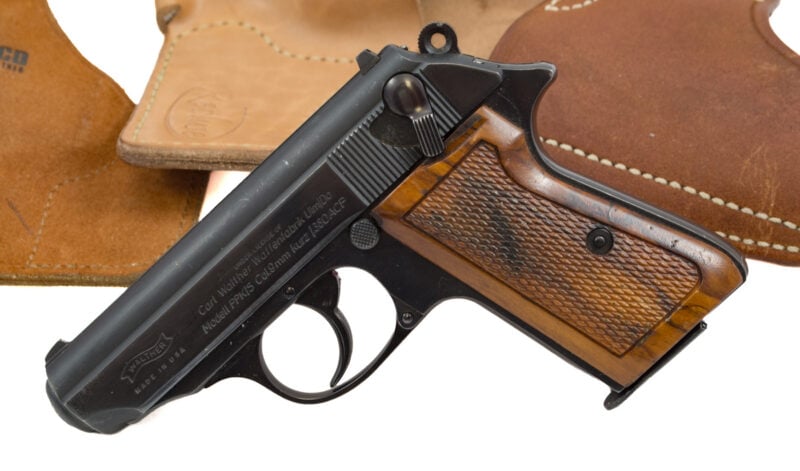
Once I got this Walther PPK/S back in working condition, it turned into an everyday carry option.
What Didn't Make the List
A glaring omission surprised me: the .38 Special snubbie. If you’d made me answer the “what have you carried the most” question without stopping to think, this classic would have made my list. But when I pondered the actual math, it spends more time waiting to be carried.
This isn’t a rejection of the little revolver. My Smith & Wesson Performance Center 642 has been a preferred pocket option, and I’ve written about liking its grip, improved trigger feel and provision for moon clips. For that particular job, I’m comfortable with the hammerless double-action design in a proper pocket holster.
But “my preferred pocket gun” and “the gun I carry most” are different distinctions. Once I include belt carry and look across the years, the larger pistols account for more of my choices.
Looking at the whole collection this way, the pattern is pretty clear. I tend to carry what gives me confidence on the range, even if I have to work a little harder to conceal it.
The watch gets judged by which one I strap on every day. So does the carry gun.
Get more exclusive online content from American Handgunner delivered straight to your inbox. Sign up for our free American Handgunner Insider newsletter.