Elmer Keith’s Last Laugh
From Editorial Struggles To Safari Success
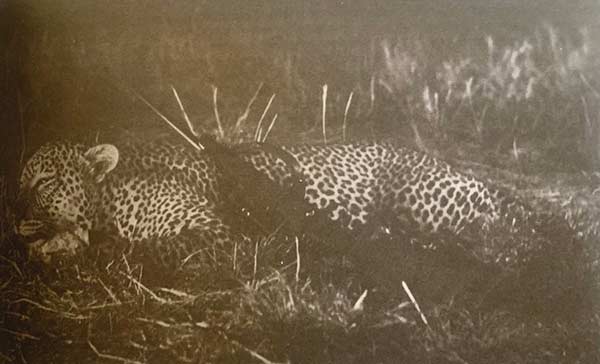
Elmer Keith’s leopard taken with his .333 OKH Mauser. Headlights were used
to illuminate it for the picture, as it was pitch black when they recovered it.
What more can be said of Elmer Keith that hasn’t already been written, re-written, chewed up and spit out about his many hunting feats and handloading innovations? From mold design to gun development, including helping design the Winchester Model 70 in 1936, his contributions are undeniable.
Keith got his start as a writer with American Rifleman, the NRA’s flagship publication when Chancey Thomas asked him to report on the Camp Perry matches he participated in as a National Guardsman in 1929. The rest, they say, is history.
Keith contributed to American Rifleman for years before his name graced the masthead as a staff writer, a position he maintained for the next eight years. Things were going smoothly until he got a new editor. Besides editing, he started changing Keith’s script on his accounts, unintentionally making him look like a fool.
In one article, the editor changed a bull elk into a caribou from one paragraph to another. In another, he changed a 450-pound goat to a 150-pounder. The old timers in Salmon, Idaho, chided Keith, putting their arm around him and saying, “Elmer, why didn’t you just kick that little kid (goat) off the ledge?
Keith said he was constantly asked why he was “writing the way he did” and explained the situation with the new editor. “The people then went after the editor, and he, in turn, jumped on me, and I told him he’d h have to accept the blame for any changes he made to my material.”
Keith was paid $400 monthly from American Rifleman, where his duties included answering 300-500 letters each month, in addition to writing his column.
Bev Mann, who was a former Rifleman editor, offered Keith a column for $150 per month as well as the arms assignments for GUNS Magazine. The staff for American Rifleman didn’t like Keith writing for another publication. They removed his name from the main masthead and instead changed it to contributing editor in small print at the bottom.
Things sour fast, leading Keith to accept the offer from GUNS Magazine.
Keith explained to American Rifleman’s technical editor, General Hatcher, that he had no intention to stop writing for the publication, telling him he wanted to make it his life work. When they objected to him writing for two publications, Keith told them they better read his contract, which allowed him to write for any and all magazines.
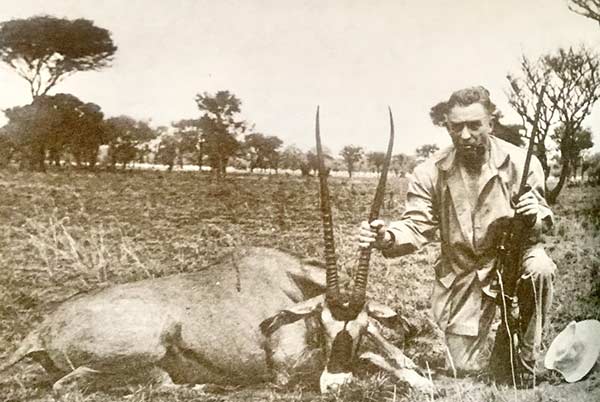
Keith with a fine gemsbok, or oryx, taken with his .333 OKH.

Keith’s tusker taken with his .476 Westley Richards double rifle.
Stubborn?
Hatcher wanted Keith to write a letter to that effect, to which Keith responded, “You have ears. I’m not going to write a letter.” Two weeks later, Hatcher asked Elmer where the letter was.
“What letter?” he said.
“The one telling me you are going to write for GUNS,” Hatcher responded. “Mr. Lucas and I would take a very dim view of you writing for two magazines at once.”
“Mister, and you can tell Mr. Lucas, you can take any damn view you desire,” said Keith.
In 15 minutes, Keith was terminated from American Rifleman. Keith’s wife, Lorraine, asked, “What are we going to do now, Dad, on $150 a month from GUNS Magazine?” Keith answered as only he could, saying, “I’m going to Africa!” And that’s just what he did.

A fine, heavy-horned Sable, the prince of Africa, taken by Elmer Keith.

A good warthog Keith shot with his .333 OKH Mauser.
The Connection
Writing this, I’m a few days from leaving for Africa. It’s funny how the brain works, remembering reading about this incident. Things were sure different back then. Thankfully, our staff at both GUNS and American Handgunner are great. I’ve never experienced any of the negativity Elmer Keith did at American Rifleman.
Keith was invited two years earlier by John Lawrence of White Hunters Limited as long as he paid airfare, licenses, shipping of trophies, etc. He told Lawrence he would accept but needed another year to save up for the trip. I understand his financial situation; what writer doesn’t?
Lawrence responded, “Elmer, you have done enough for us over here recommending adequate rifles to Americans coming over that we feel we owe you a trip and we are going to give you one. So, you pack up, be here in Nairobi on the first of November next year, and I’ll take you on a safari myself.” This was before the NRA fired Elmer from American Rifleman, but he didn’t let it stop him from going to Africa.
Keith went on to have a very successful safari, taking leopard, elephant, Cap Buffalo, Kudu, Oryx and other game. For rifles, he brought his 26” barreled 333 O.K.H. Mauser with Weaver 4X scope and his .476 best-quality Westley Richards with detachable locks and single trigger. The safari gave Keith much to write about, with his readership greatly enjoying the stories of traveling to get there, the hunt, guns used and bullet performance. It was during this safari that Keith learned his 300-grain steel jacket Kynoch soft-nose bullets for his .333 OKH were blowing up badly and not penetrating.
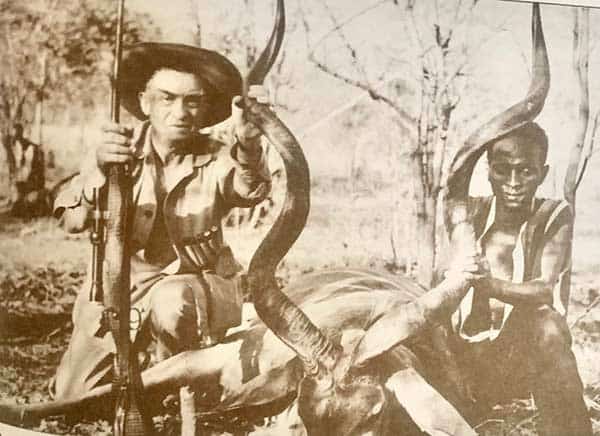
A beautiful kudu taken by Keith.

The two rifles Elmer Keith brought to Africa for his first safari,
.333 OKH Mauser and .476 best quality Westley Richards double rifle.
Lastly
Reading about this trip and going down memory lane was significantly fun. Elmer Keith was quite the man, and there will never be another like him. While many mourn his passing, there are some who couldn’t care less, believing his exploits were nothing but exaggerations. I’m deeply rooted in the first camp, having no doubts about his many accomplishments. Everyone needs a hero, and Elmer Keith has filled that role very well.