Shape Coding and Human Engineering
Keeping Aviators Alive Since 1936
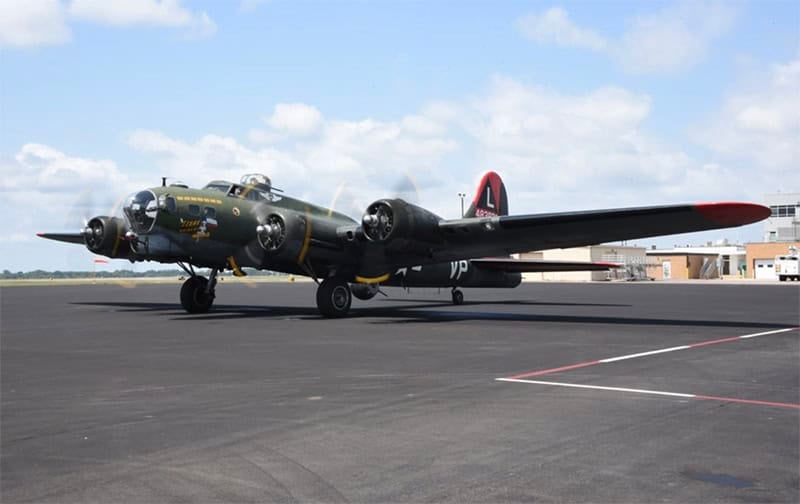
The B17 Flying Fortress was the mainstay of American strategic bombing during World war 2.
US Government image.
Military flight training is about as cool as it sounds. One moment, you’re driving onto Fort Rucker all wet-behind-the-ears and googly-eyed. Soon thereafter, you’re turning and burning in an Army helicopter mere feet above the southern Alabama woodlands. However, the transition from rank pedestrian to professional stick wiggler is nonetheless still fairly involved.
You don’t start off Day 1 in the cockpit of a $40 million helicopter gunship. Once the administrative tripe is out of the way, you report to the Cockpit Systems Trainer (CST). In my day, this was a dead ringer for a UH1 Huey cockpit assembled atop a plywood platform.
Nothing in it works. If I recall correctly, the lights don’t even illuminate. However, time in the Cockpit Systems Trainer is a critical step towards becoming a safe and effective Army aviator.
The Cockpit Systems Trainer is basically a Huey cockpit that isn’t actually connected to anything. I don’t know if they built these things up from scratch or harvested them from old operational helicopters well past their prime. They were all pretty tired back in the early 1990s when I haunted the place. The point of the CST was to get us students familiar with where everything was before we began wasting valuable aircraft time.
The cockpit layouts in the four Army airframes I flew were all fundamentally dissimilar. Single-engine Cobras had vastly different stuff from twin-engine Chinooks. However, in each case, the switchology was well-reasoned and logical. The interface between pilot and machine was the end result of generations of mechanical evolution. Much of that evolution occurred during World War II.
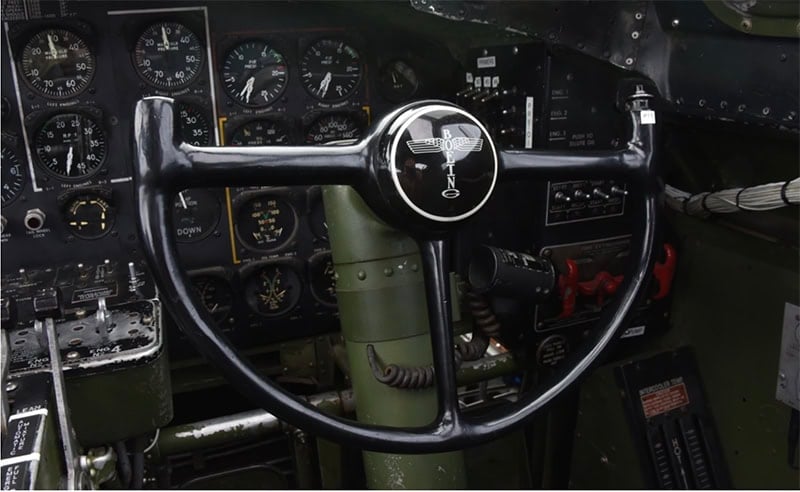
The front office of the B17 bomber was a pretty complicated space. US Government images.
The Plane
The B17 Flying Fortress first flew in 1936. This massive four-engine heavy bomber changed the way the world waged war. The Fort was eventually supplemented by the B24 Liberator and the B29 Superfortress. However, it was the B17 that carried American forces onto the offensive during the early days of the fight.
12,731 of these machines eventually saw service. Three remain flyable today, with another 50 or so in storage or on static display. Of the approximately 1.5 million tons of bombs dropped on Nazi Germany during the Second World War, around 43% of that chaos came from B17s.
It is amazing how far and how fast aviation has come since the Wright brothers’ first flight in 1903. In a short 33 years, powered flight went from 12 seconds and an average of 6.8 mph over the course of only 120 feet with Orville at the controls to the B17’s cruise speed of 182 mph while carrying 4,500 pounds’ worth of bombs. However, that’s not to say the B17 wasn’t still fairly crude by modern standards.
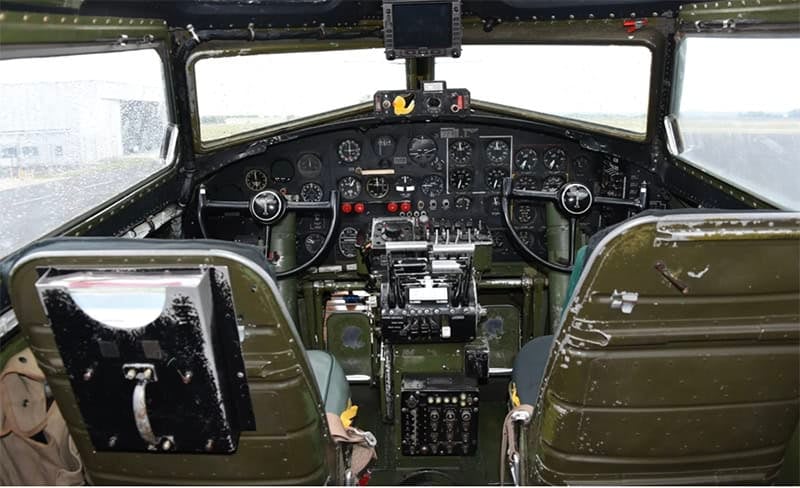
Finding the right control in best conditions was challenging. US Government images.
The Problem
One glaring error in the Fort’s cockpit layout was the arrangement between the flap and landing gear switches. In early versions of these planes, the two controls were side by side and identical. They were each smooth, small pegs.
Landing an airplane is the only part of the process that is reliably daunting. The machine wants to fly, so takeoffs are pretty easy. Any ape can manage an airplane straight and level. Landing, however, does demand a little attention. Even with two pilots, juggling four engines while keeping a 50,000-pound bomber aligned with the runway and maintaining a landing attitude can be a big ask. Mix in a little crummy weather or battle damage, and now the pilots are earning their flight pay. Under these circumstances, pilots were fumbling the switches and not infrequently landing the big planes with the gear up.
At first, these accidents were attributed to pilot error, the catch-all wastepaper basket used to crucify pilots by guys on the ground who weren’t actually there. Then somebody noticed it was happening a lot. One reference I found claimed that 400 planes had been lost to this sort of accident over the life cycle of the Fort. That’s a lot of very expensive warplanes.
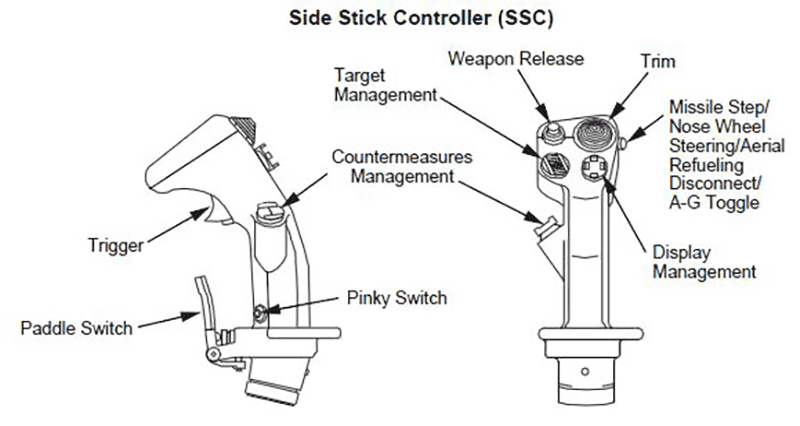
The control stick on an F16 incorporates a great deal of human engineering. Public domain.
The Solution
The solution was something called Shape Coding. The landing gear switch became a small rubber wheel. The flap control became a flat, wedge-shaped thingie. Given a little familiarity with the machine, a decent pilot could immediately identify which switch was which by feel, even in the dark. Inadvertent belly landings dropped off to literally nothing.
That seems simple and intuitive, but it took a bunch of busted airplanes to get there. That same logic eventually bled over into all aircraft design as well as both automobiles and video game controllers. Tactile differences built into the controls allow the operator to manage the systems without diverting attention from the runway, sky, screen, or road.
The pinnacle of this concept is found in modern fighter planes. The F16 Viper employs something called HOTAS or “Hands-On Throttle and Stick.” This design allows the properly trained pilot to manage most of the plane’s critical systems without taking his or her hands off the primary flight controls. The stick and throttle look like the love child between a game box and a porcupine, but it works.

Much of the ergonomic evolution that shaped modern aviation bled over into automobiles.
Mercedes photograph.
So, the next time you’re cruising down the road and stroke that weirdly shaped button on your steering wheel to toggle between calling your spouse and listening to your favorite 1970s classic rock and roll, just remember that it all began with some unfortunate switch placement in the WWII-vintage B17 Flying Fortress. With a little experience, you really can safely do those things without taking your eyes off the road. We have WWII-era aviation to thank for that.
Get More Guncranks Every Week!
By submitting this form, you are consenting to receive marketing emails from: . You can revoke your consent to receive emails at any time by using the SafeUnsubscribe® link, found at the bottom of every email. Emails are serviced by Constant Contact