Reload Now, Regret Never:
A Practical Guide to Getting Started
What You Need (And Don’t Need) to Start Reloading

Yes, over time, this can absolutely happen. But you only need a small fraction of all this gear to get started.
Is it absolutely insane to observe that things are stable in the political climate right now?
Okay, let’s narrow that down so it makes some sense in a rational world. As far as gun rights and the seemingly never-ending assault on the Second Amendment go, things are more stable than usual. How’s that? Better?
Sticking within the context of that observation, I’m gonna put forth a thought. Now is the perfect time to start reloading. If you wait until the next political panic sets in, it’s just not gonna work. Prices will be sky-high, but that won’t really impact you because you won’t be able to find any products that you need, so you won’t spend a dime. At least you won’t be paying through the nose for gear and components. Then again, you won’t have any gear and components.
Why Reload?
I’m not going to spend all the time in this article discussing reasons why you should consider taking up reloading. Just do it. Here is a quick list of reminders.
If you consider the time you spend doing it as a fun hobby rather than hourly work with an opportunity cost, you can save money on ammunition. Especially during times of political panic. And you’ll be shooting while your friends are whining about how they can’t buy ammo anymore.
It’s fun! Wanna relax after a stressful day? Hit the reloading bench for a little while. It’s a miracle cure for whatever ails ya.
You can shoot more for the same amount of money.
You can customize your ammo for your preferences and your specific guns.
The list goes on, but you get the idea. Just take my word for it and get started.
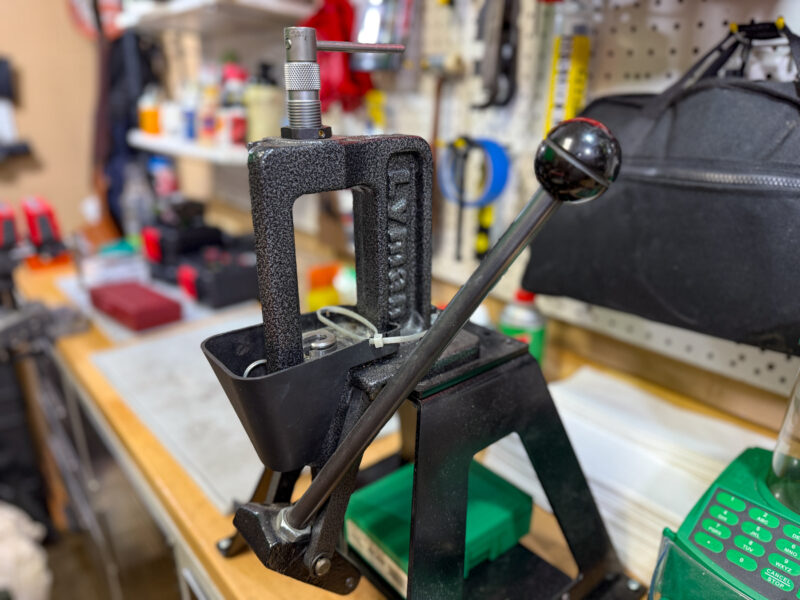
I've been using this Lyman single-stage press for over 20 years. It's indestructible.
The Barriers … Broken
Now, let’s get to the theme of this discussion. A lot of people don’t want to take the plunge into reloading because of all the gear, investment, and knowledge required. Let’s fix that.
Through my book, The Practical Guide to Reloading Ammunition, I’ve taught somewhere over 10,000 people to reload safely, in a non-intimidating fashion and with a dose of fun. You can do it. The trick to getting started is learning enough to know what gear you absolutely need and how that’s different from “optional” stuff that helps the process, makes you more efficient, expands your capabilities, and so on. It’s all nice to have, but there’s a relatively short list of things you must have to reload safely.
Let’s dive into that. The good news is that there are only four pieces of gear you absolutely, positively need to reload your first cartridge.
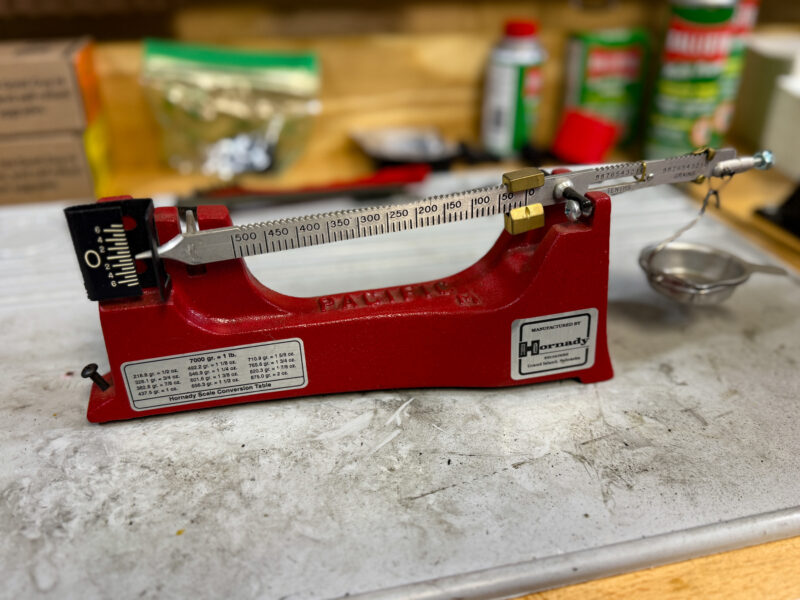
A close-up of a Hornady gun scale used for precise firearm weight and load development,
showcased in a gun enthusiast’s workspace.
A Reloading Press
The reloading press is a device that provides enough technical advantage to do things like press a spent cartridge case back into its original shape, flare open the case mouth enough to allow insertion of a new bullet, press that new bullet down into the case, and squish that flared rim of the case back into position. That’s it. It’s kind of like the lever on a wine opener, except you’re generally putting the cork back in rather than pulling it out.
At first, you’ll want what we call a single-stage press. It’s a single-operation tool that does one thing at a time. To do a different operation, change the die (hold that thought) and reconfigure for the next step.
I’ve used a Lyman press similar in design to this new model for 20 years or so. Money well spent! Lee Precision also makes a number of very affordable presses, including a hand-held model.

MEC, the shotgun reloading people, even got into the centerfire reloading market with some very nice single-stage presses.
A Die Set
The dies are the changeable inserts for the press that perform four operations:
- Resizes the slightly bulged, fired cartridge case and punches out the old primer.
- Expands the case mouth just enough to insert a new bullet.
- Pushes the new bullet down to the proper depth in the case.
- Squish the expanded case rim back into position. Reloaders call this “crimping.”
A die set is caliber-specific since these operations require precise dimensions all around for each caliber. For handguns, you’ll find them packaged in three or four die sets, with each performing an operation in the list above. The three die sets combine steps 3 and 4 into one die.
I’ve always had great success with Lyman die sets. You can find solid options from Lee Precision, Hornady and RCBS also.

Reloading dies fit into a press and perform specific functions like resizing cases to spec and seating bullets.
A Scale
This is a bit of a judgment call, but for absolute safety, I want a scale in the starter “must-have gear” set. It’s the surest way to make sure you have the correct amount of powder in each reloaded case. The scale is also handy for verifying bullet weights and even loaded cartridge weights as an extra “check” to make sure your loads are consistent, assuming you’re using the exact same make and type of brass cases. Case weights can vary significantly.
The beginner recommendation used to be an affordable beam scale like this one. But with the advent of digital everything, a small digital scale is a lot faster and affordable, too.
Calipers
You’ll need a tool to precisely measure the lengths of cartridge cases and reloaded cartridges. An analog or digital reloading caliper will do this and will last near forever.
There are a million options. I’ve been using a Lyman caliper forever , but I have a digital one too. They’re both fast and precise.

You'll need a caliper tool. This one is digital, but the analog dial versions are just as fast and plenty accurate.
But What About …
Sure, there are other steps in the reloading process, and more gear that will help you, but it can wait if necessary. For example…
A reloading guide. Powder and bullet companies produce books chock full of safe and tested “recipes” for each caliber, bullet type, bullet weight, and powder combination. For starters, you can also find this information online from reputable company websites.
A tumbler to clean dirty brass. But for now, you can wash it and set it outside on a towel to dry.
Some type of priming tool to set primers quickly or with more control. Yep, but if you choose the right press, it’ll do that too. Maybe not as fast or efficiently, but it’ll get you started.
A powder dispenser helps improve your speed by dumping just the right amount, but you can start by weighing each charge with a scale. Or you can use the pre-sized scoops that come with Lee Die sets for now.
Reloading trays to hold work in progress are a lifesaver. But at first, just drill cartridge-sized holes in a 2×4 piece of scrap. It works just fine.
You get the idea. The other gear you’ll want as you go is just that. A want. Not necessarily a “must have now” item.
Buy Once, Cry Once
If I knew then what I know now…
The universal rule of buy once, cry once always applies. You can absolutely start with the least expensive gear, and it’ll probably work. But the less you spend, the more time you’ll have to spend overcoming little quirks. Some parts don’t operate perfectly consistently every time. Something else is not in perfect alignment. Whatever the reason, you’ll spend some time figuring out and debugging the quirks.
If you need to go with an absolute minimum budget, that’s OK. You can upgrade later and either sell the original stuff or keep it for a second setup.
Now, get out there and start reloading!
Want a more in-depth, step-by-step guide? Check out Tom’s 10-Part Ultimate Reloading Series.
Get more exclusive online content from American Handgunner delivered straight to your inbox. Sign up for our free American Handgunner Insider newsletter.