I Was Wrong? Sorta
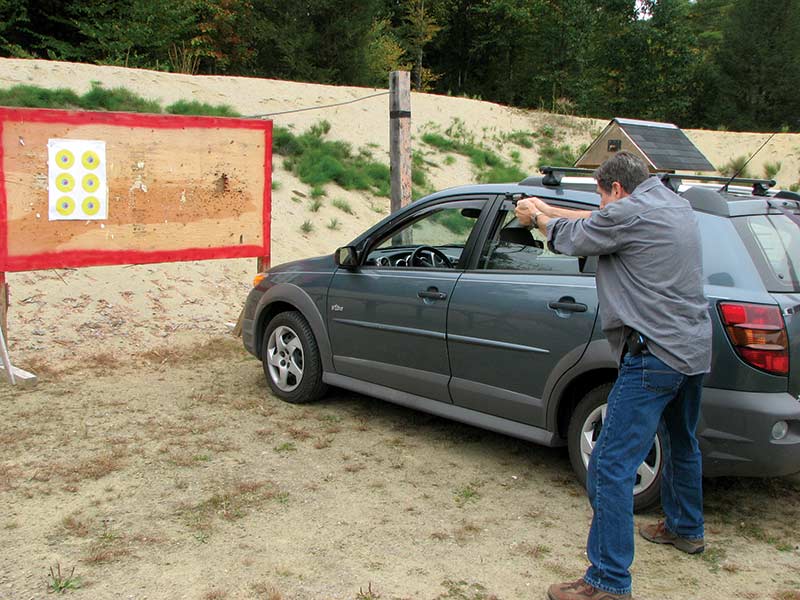
This is what the data indicates the staple of armed citizen training
should be like: combat precise shooting at 5 to 10 yards. The car is
there to indicate most civilian shootings take place at about a car’s
length, and often around cars.
For years I promoted the practice of extremely close-quarter shooting, or hands-reach to contact-distance shooting, as a greater priority than traditional-distance shooting from 10 to 25 yards. My reason stemmed from the persistent — and now well-known fact — half of law enforcement officers killed are killed at 5′ or less, and 75 percent killed are killed within 1′. While we didn’t have similar statistics for civilian defensive gun uses or fatalities (although we do have a bit more info these days), we assumed the distances involved would be similar. Of course, the distance at which cops are killed isn’t necessarily the distance at which most of their gunfights occur.
But, knowing arms-length to contact-distance is the distance at which cops are most likely to lose their lives does tell us we need to get better at skills relevant to those close distances. However, it does not tell us the whole story of where we should place our training emphasis.
We now have the only good data set on civilian defensive uses of guns (Tom Givens’ data published HERE) which indicates most civilian deadly force encounters happen at about 5 yards, at least in his data set. This means we definitely need to train at that distance — plus or minus a couple yards, so say 3 to 8 yards. Further, the astonishing success rate of Tom’s students suggests we need to pay attention to Tom’s fairly traditional training too — sighted shooting with two hands on the gun.
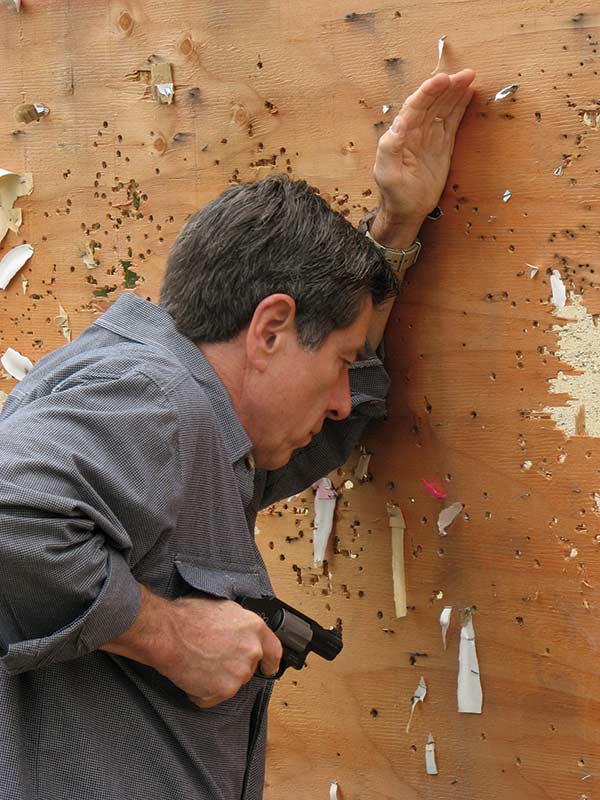
Ralph believes in contact distance shooting practice which serves to instill a
real fighting attitude. But he now believes this distance to be less important for
the armed citizen than he used to.
Close Or Far?
With regard to law enforcement shootings, the same shift seems to apply. As Claude Werner — a skilled shooter and instructor, and a very serious analyst of the shooting data we have — points out: “The only study that actually looked at distances of [police] gunfights in a detailed and methodical way was done for Police Marksman magazine by Richard Fairburn in the 1990’s. The average distance reported in that study was 14 yards.”
That study had some methodological flaws and I suspect 14 yards is probably further than the true national average for cop shootouts, but nonetheless the study did point out police gunfights as a whole — not just the ones resulting in police fatalities — also are likely to occur at what are traditional shooting-skill distances.
This is buoyed by Claude’s analysis of the 2012 NYPD Firearms Discharge Report: “The distances that officers shot it out was: 0–5 yards: (41 percent); 6–15 yards: (34 percent); 16–25 yards: (11 percent); 26+ yards: (14 percent). Contrary to popular opinion, over half (59 percent) of NYPD gunfights took place at six yards or more.”
All of this has caused a change in my approach to training. I now place much more emphasis on traditional shooting technique at the traditional distances of five to ten yards. That’s good news for most people, because it’s the way they’ve probably been trained. However, I still believe very close-quarter shooting skills, which integrate empty-hands skills with the handgun, are necessary for a truly well-trained fighter. I also like the fact these very close-in shooting skills demand a true fighting attitude to practice. It’s all too easy, in your mind, to merely shoot, and not fight, at traditional distances.
Accuracy Counts Too
I also subscribe to the notion expressed by most trainers as well as most top competitive shooters, the neglected skill of shooting for accuracy at 25 yards may in fact be necessary — think active shooter — and helps to build skill at closer distances.
There’s one area, however, in which Tom and Claude agree with my old, and also present, self: reloading is an over-emphasized skill. The fact is you will have to look long and hard to find a law enforcement example of a cop reloading in a fight and that reload making a difference in the outcome. You’d have to look even longer and harder to find a citizen-example. While everyone should definitely know how to reload smoothly, with relative speed, and from odd positions, I now pretty much regard the over-emphasis placed on reloading practice as just a way to eat up training class time. And with that, let the hate mail begin!
For more info: Claude Werner (tacticalprofessor.wordpress.com)
Note: The photos here are taken without the requisite eye and ear protection because Ralph’s contract with the Ford Modeling Agency doesn’t allow his face to be obscured. Just kidding. Also, he’s not really shooting.

Get More Personal Defense Tips!
Sign up for the Personal Defense newsletter here: