The Enterprise, Alabama, Boll Weevil Monument
Because People are Just So Freaking Weird
There is this peculiar artificiality intrinsic to modern life. Inundated as we are with modern conveniences, one might be forgiven for believing that chickens are born shrink-wrapped in Styrofoam trays, that tuna fish are hatched in cans, and that corn springs forth from the ground in tasty flakes covered in sugar. In reality, a simply breathtaking amount of industrial processing stands between the raw material and what we all cram into our pie holes.
This artificiality breeds a certain unfortunate complacency. We assume our food will always just miraculously appear at the local Kroger, Walmart, or Trader Joe’s. We may rightfully grouse about the price, but the fact that the shelves will be fat with prepackaged protein is a given in the United States of America. We have engineered buffers that protect us against such unpleasantness as drought, pestilence, and natural disaster. If a domestic crop fails, then we just pay extra and have it all shipped in from someplace else. However, that was not always the case.
The average life expectancy for an American male in 1900 was 47. Stuff like typhoid and yellow fever were still scourges, and agriculture performed at the whim of the environment and the weather. A century ago, we lacked those artificial buffers that make life so predictably comfortable today. In many cases, farmers’ margins were razor-thin.
The Setting
Back in the Dark Ages, when I attended flight school at Fort Rucker, Alabama, the Yankees in the class called the region UCLA. That was short for the Ugly Corner of Lower Alabama. I didn’t think that was quite fair.
I loved the Alabama Wiregrass region. It was a short hop down to the beautiful sugar sand beaches of the Florida panhandle, and the winters were mild. The several small communities surrounding Mother Rucker appreciated the troops, and learning to fly helicopters was a serious rush. That’s not to say that this part of rural Alabama didn’t have its own eccentricities.
All serious Army bases enjoy nearby communities that support them. The troops and their families need homes, restaurants, and churches, and all those overpriced used sports cars aren’t going to sell themselves. In the case of Fort Rucker, the nearby satellite communities are Enterprise, Ozark, Daleville, and Newton.
When my wife and I first explored the place back in 1989, I was surprised to discover a life-size Greco-Roman statue of a woman standing at the crossroads at the very center of the small town of Enterprise, Alabama. Adorned in a traditional chiton, this not-unattractive lass towered above the traffic and pedestrians passing by with her hands held skyward. What makes the whole scene fairly surreal is that she is holding aloft a big honking bug. This was my first introduction to the Enterprise, Alabama, Boll Weevil Monument.
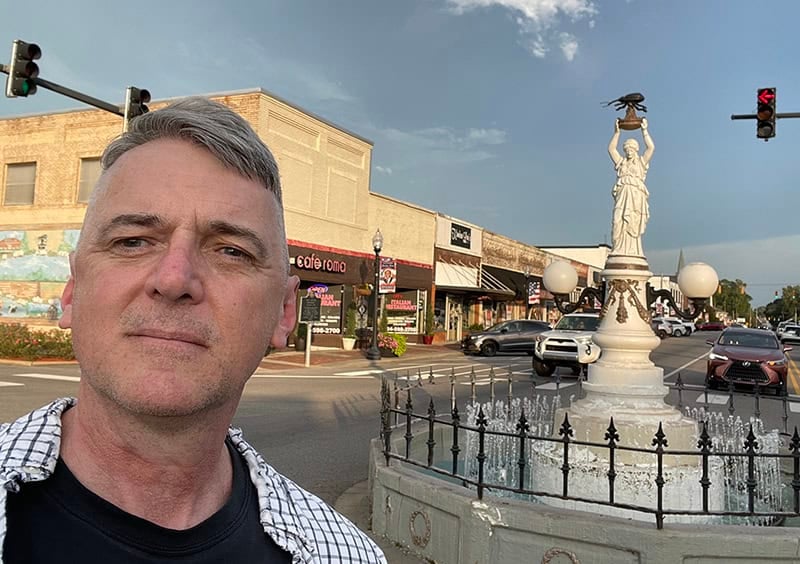
The Boll Weevil Monument is the literal centerpiece of the delightful little Southern town
of Enterprise, Alabama. Enterprise stands just outside the gate to Fort Rucker, the home of Army Aviation.
When Life Gives You Lemons
Back in the early 1900s, this part of agrarian Alabama supported itself with cotton. The American Deep South makes the finest cotton on Earth, and this part of Alabama rode that wave. And then there was the invasion.
Anthonomus grandis is the snooty scientific term for the Mexican cotton boll weevil. Originally indigenous to our friends south of the border, the boll weevil marched north and invaded southern Alabama in 1915, like Sherman and his marauding blue legions. Three years later, entire cotton crops were falling prey to this rampaging pest. The region was threatened with cataclysmic economic collapse.
Faced with such a dire crisis, a local gentleman named H.M. Sessions had an idea. He convinced an indebted farmer named C.W. Baston to go out on a limb and sow his fields not with cotton but with peanuts. This crop was resistant to pests and produced a splendid bounty. In short order, UCLA was dirty with peanut farmers, and the economy was thriving again.
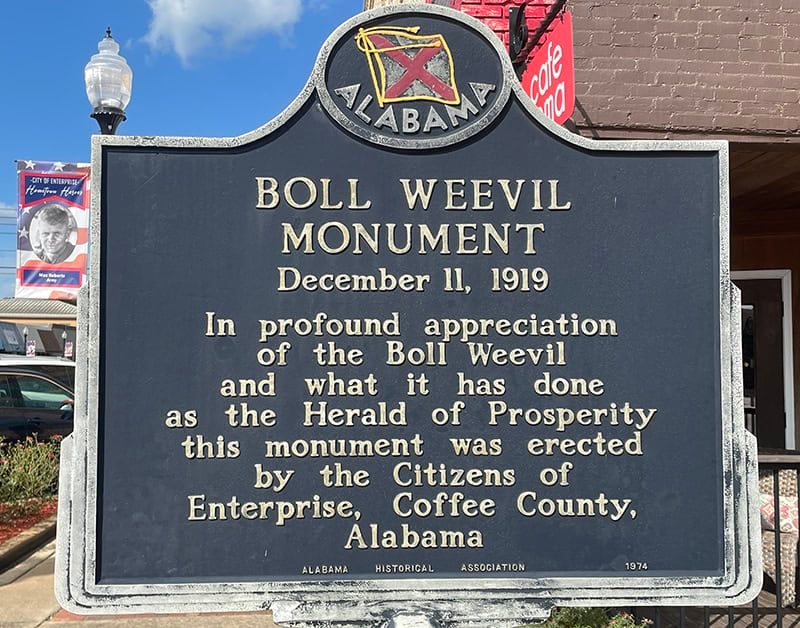
This historical marker explains the significance of the statue of the stately woman
holding a big honking bug that occupies the center of Enterprise, Alabama.
Credit Where Credit is Due
In recognition of this divine serendipity, local businessman Bon Fleming proposed that the community craft a monument to show their corporate appreciation for the humble boll weevil. He praised the little bug as a “Herald of Prosperity” and paid for most of the $1,800 cost himself. That would be about $33,000 in today’s money.
They had the statue crafted in Italy. The whole shebang stands about 13 feet tall and includes a modest fountain along with a wrought-iron railing. A plaque on its base reads, “In profound appreciation of the Boll Weevil and what it has done as the herald of prosperity this monument was erected by the citizens of Enterprise, Coffee County, Alabama.”
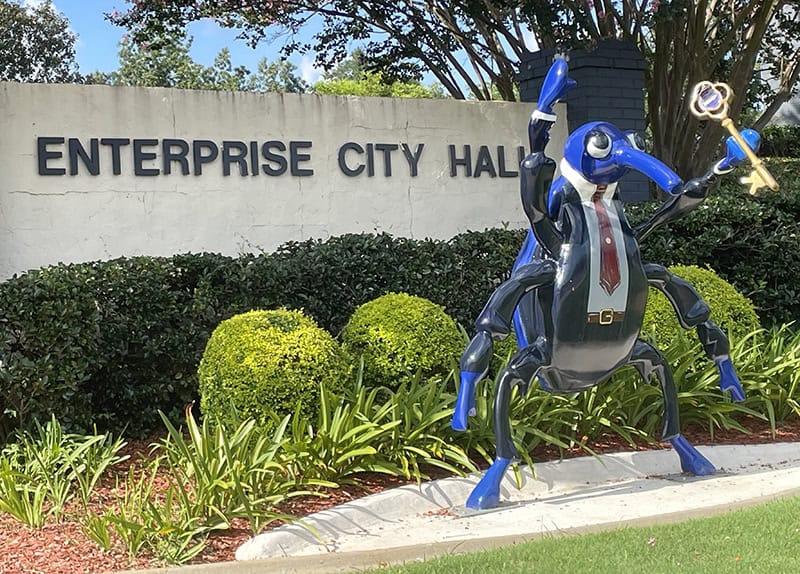
These curious stylized boll weevils can be found all over Enterprise, Alabama.
This one stands outside city hall. The good folks of Enterprise really lean into the boll weevil thing.
Ruminations
Of course, people are bad, so the thing has been repeatedly vandalized over the decades. The whole rig has been stolen a time or two, and vandals have relieved the svelte stone lass of her signature bug. Some young pranksters have even charged the fountain with dish soap and flooded the intersection with mountains of suds.
Eventually, in 1998, the city fathers moved the original monument to the nearby Pea River Historical and Genealogical Society’s Gift Shop, where security cameras could oversee it 24/7. The version standing guard at the intersection of Main and College Streets today is a polymer and resin replica. Regardless, the Enterprise, Alabama, Boll Weevil Monument is a quirky piece of Americana that actually pays sincere tribute to a rampaging agricultural pest.
Get More Guncrank Stories Every Week!
By submitting this form, you are consenting to receive marketing emails from: . You can revoke your consent to receive emails at any time by using the SafeUnsubscribe® link, found at the bottom of every email. Emails are serviced by Constant Contact