Like Father, Unlike Son:
The Maxims and the Birth of the Silencer
The Maxim family had a noise problem. You might say that Dad caused it, or at least made more of it. His son built a business based on quieting things down.
In 1884, in a London workshop, Hiram Stevens Maxim built the world’s first fully automatic machine gun. It used the recoil of each shot to load the next one, and in testing it fired around 600 rounds a minute. If you wanted to turn lots of ammo into noise in the late 1800s, this Maine-born tinkerer turned British knight was your Huckleberry.
His son, Hiram Percy Maxim, went the opposite direction. He invented a way to make guns quiet. Well, quieter.
Father and son lived on opposite sides of the big Atlantic pond for most of the son’s adult life. That may be just as well. I can only imagine the dinner-table conversation. More noise! Less noise!
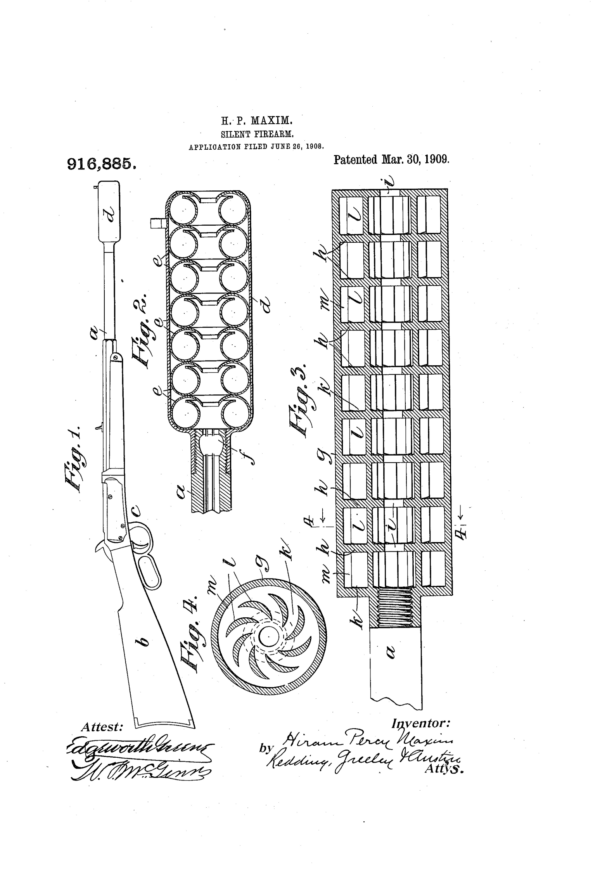
U.S. Patent No. 916,885, "Silent Firearm," granted March 30, 1909.
Figure 1 shows it on a lever-action rifle. U.S. Patent Office, public domain.
Silencer or Suppressor?
I’m not normally one to get all cranked up about specific gun terminology. If someone calls something a clip instead of a magazine, I’m going to ignore it and move on with the conversation because I know exactly what they’re talking about. However, if someone calls me an idiot because I referred to this muffler device as a silencer instead of the “correct” term, suppressor, that’ll get my hackles up. I won’t hesitate to correct them because this type of device was patented as something called a “Silent Firearm.” And the device was sold as the “Maxim Silencer.”
Hush, internet.
A Young Man Interested in Loud Things
Hiram Percy was born in Brooklyn in 1869 and finished MIT’s mechanical engineering course in 1886, at age 17. In the 1890s, he was building gasoline-powered vehicles for the Pope Manufacturing Company in Hartford, Connecticut. In 1899, he drove a Pope Columbia to victory in the first closed-circuit auto race held in the United States. Yes, this young man was mechanically inclined to say the least.
With this background, he knew engines, and he also knew engines and guns have a little something in common. They make lots of noise by spitting hot, high-pressure gas into the open, lower-pressure air.
Hiram Percy also loved to shoot, but the noise annoyed him. Years later, he explained that he built his invention to “meet my personal desire to enjoy target practice without creating a disturbance. I have always loved to shoot, but I never thoroughly enjoyed it when I knew the noise was annoying other people.”
That’s a considerate guy. Not exactly the assassin’s workshop origin story Hollywood would portray.
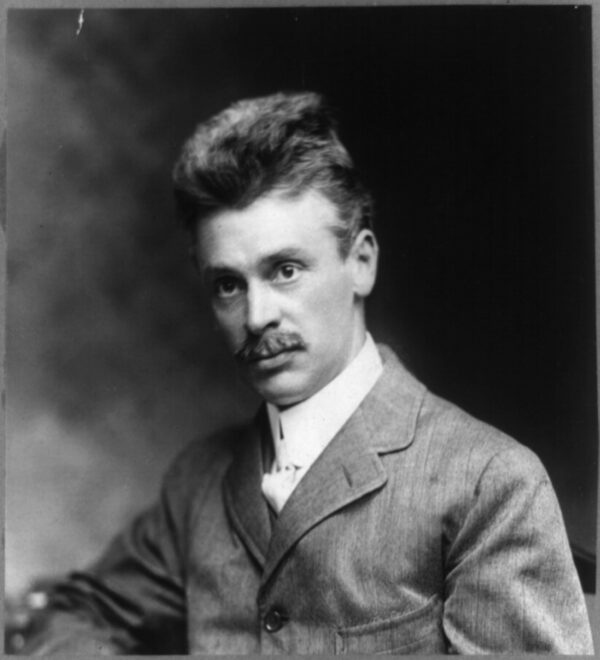
Hiram Percy Maxim around 1914. Library of Congress, public domain.
Eureka! The Bathtub Breakthrough
For about two years, he tinkered, fabricating different valves, vents and bypass systems. But nothing worked.
Like many flashes of inspiration, his appeared at an unusual time and in a place you wouldn’t expect. In his own words: “I noticed in the bathtub the miniature whirlpool that forms over the drain hole when the plug is pulled, and the water starts to run out.” The water drained slowly because it was spinning. What if powder gas could be spun the same way?
“In a flash I saw the ‘hole’ for which I had been looking for nearly two years.”
According to his son, Hiram Hamilton Maxim, version one of the muzzle blast spinning device looked something like a conch shell stuck on the end of a Winchester .30-30. It worked, sort of, which was a big step forward from previous efforts. He tossed it and kept going, eventually settling on a tube full of baffles that trapped and slowed the gas. Sound a bit familiar? He filed for a patent on June 26, 1908, and received U.S. Patent No. 916,885 on March 30, 1909.
As it turns out, he wasn’t the first guy to patent a gun silencer. A Swiss inventor named Jakob Stahel patented one in 1892, mostly to keep cattle slaughter quiet. Maxim’s was the first that worked well enough to succeed in the marketplace.
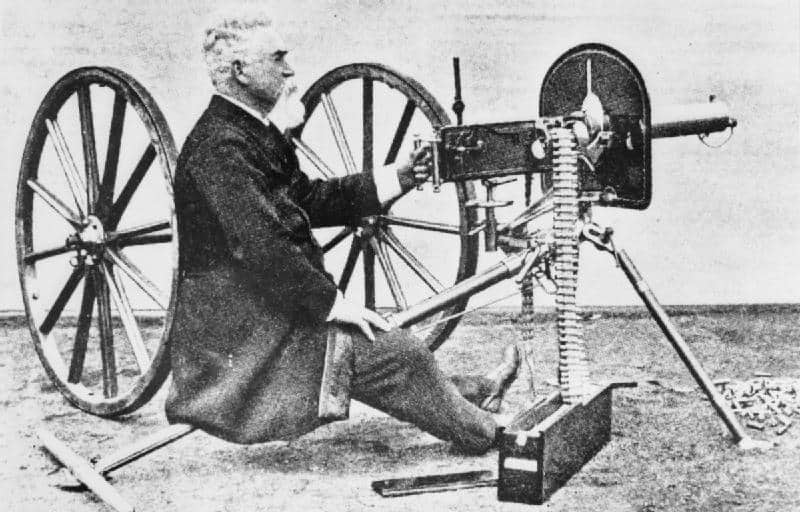
Sir Hiram Stevens Maxim with his machine gun, the loudest idea in the family.
Imperial War Museums, public domain.
Mail Order: A Few Bucks and a Stamp
His Maxim Silent Firearms Company, based in Hartford, sold the Model 1909 for $5 (or, by some accounts, less), including the coupling to attach it to your rifle. You could buy one at the hardware store or order one by mail. It showed up in a postage-stamped cardboard tube.
No paperwork. No waiting. No fingerprints. Those were the days.
The Model 1910 fixed the same annoyance addressed by some of today’s silencers, like the SilencerCo Osprey. The Model 1909 ran straight down the bore line and blocked your sights. The 1910 sat off-center, so you could still aim. It sold for about $5 in rimfire and $7 in centerfire versions.
One famous customer was Theodore Roosevelt, who put a Maxim on a Winchester Model 1894 in .30-30 to deal with varmints at Sagamore Hill without bothering the neighbors.
The Army Ponders Silence
The Army tested Maxim silencers on the Springfield 1903 around 1909 and again in 1912. They cut the muzzle blast part of the noise signature, but as we all know, you can’t quiet a supersonic bullet. It carries its own sonic boom along after leaving the muzzle and silencing device. Julian Hatcher, who was involved in the testing, reportedly said the bullets downrange sounded like “someone was tearing a rather large bedsheet.”
Some Maxim-silenced Springfields saw limited sniper use in World War I, but the big military contracts Maxim hoped for never came.
Silencers for Cars
Let’s step back to Maxim’s racing interests for a minute. He used the same basic ideas for automobile exhaust, and his company ended up building mufflers for engines, too. There’s a reason the British still call a car’s muffler a “silencer.” Interestingly, many British refer to “silencers” and “suppressors” for air rifles as “mufflers” or “moderators.” Over the years, the Maxim Silencer Company quieted everything from factory machinery to the engines of World War II tanks and submarines. Kind of like Swiffer isn’t really in the “rag on a stick” business, but rather the “clean floor” business, Max was in the “make less noise” industry.
Gun silencers didn’t last. In 1930, Maxim stopped making them, saying people had come to see the invention as an aid to crime. Four years later, Congress put a $200 tax on them. Well, more specifically, on each and every one. Keep your eyes open for a separate story on that.
Like many tech startups today, he simply pivoted when circumstances changed. In 1914, he and 17-year-old Clarence Tuska founded the American Radio Relay League, the ham radio organization that’s still around today. His call sign, W1AW, is still the call sign of the league’s headquarters station. In 1926, he started the Amateur Cinema League for home-movie hobbyists. He also wrote books, magazine stories and a newspaper science column. He died in 1936.
You have to appreciate the divergence in the family businesses: making more noise and quieting things. An interesting way to corner the markets all around.
Get more exclusive online content from American Handgunner delivered straight to your inbox. Sign up for our free American Handgunner Insider newsletter.