How the Silencer Got Stuck in the NFA
On March 24, 1909, Maine outlawed gun silencers.
Less than a week later, the U.S. Patent Office granted Hiram Percy Maxim a patent for the “Silent Firearm.” He later marketed the device as the Maxim Silencer.
Usually, something has to exist before it gets banned, but silencers got a pink slip before the patent was even issued. Within 25 years, silencers were lumped into the mix with machine guns and sawed-off shotguns in the National Firearms Act of 1934. How? Stay tuned; it’s an interesting story.
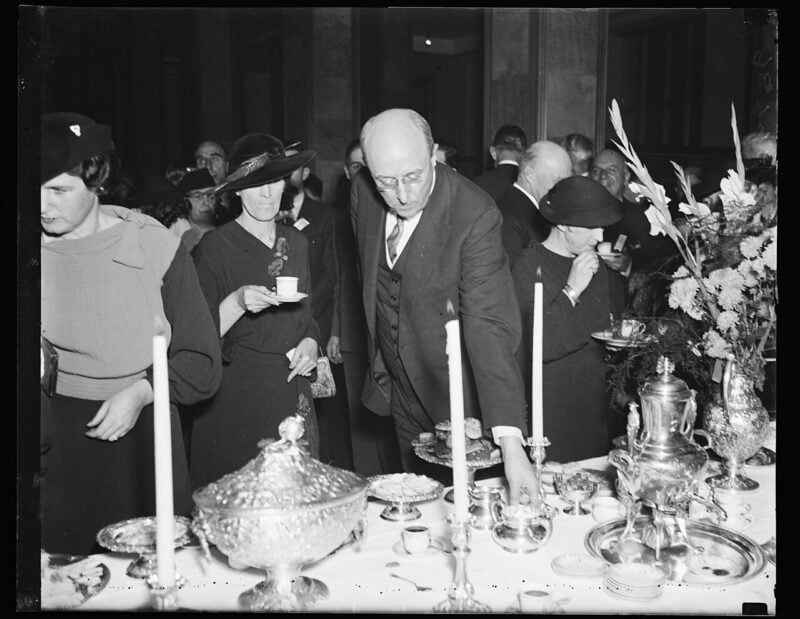
Attorney General Homer Cummings in 1934, the year the NFA passed.
Harris & Ewing, Library of Congress, public domain.
Bad Press From the Start
Maxim was inspired to invent the device because he liked to shoot, and it bothered him that the activity made so much noise for his neighbors. In his own words, his intention was to “meet my personal desire to enjoy target practice without creating a disturbance. I have always loved to shoot, but I never thoroughly enjoyed it when I knew the noise was annoying other people.”
However, not everyone saw it that way. In 1909, Scientific American ran a piece called “The Menace of the Noiseless Gun.” The New York Times wrote that only “the burglar, the highway robber, and the Black Hand assassin” would get any use out of one. Pittsburgh’s police superintendent warned that a gunshot “makes too much noise and attracts too many people. But with a silencer in use this would be different.”
Then the hunting crowd got involved in the uproar. New Jersey banned silencers for hunting. In 1913, William Hornaday, director of the New York Zoological Park, called them “grossly unfair” in a book about vanishing wildlife and said they “should immediately be prohibited.” Poachers and out-of-season hunters, the thinking went, would have a field day with a gun nobody could hear.
I always find the “it will” arguments interesting, because so frequently, the advance conjecture doesn’t reconcile with the subsequent reality. Seems like lots of folks made similarly dire predictions about how citizens would go crazy and start shooting over ever little thing if concealed carry laws ever passed. After decades of experience, we’ve found that legally armed citizens with permits commit crime at a lower rate than virtually any measurable demographic.
So, from the start, there were at least two primary concerns: criminals and poachers. Between 1909 and 1936, about a dozen states passed some kind of silencer restriction. Many of those were limited to hunting.
During the 1910s and ’20s, newspapers (remember those?) reported a handful of crimes involving silencers. The keyword in that sentence is “handful.” Even still, by 1930, Maxim himself had quit making gun silencers, in part because people had come to see his invention as an aid to crime.
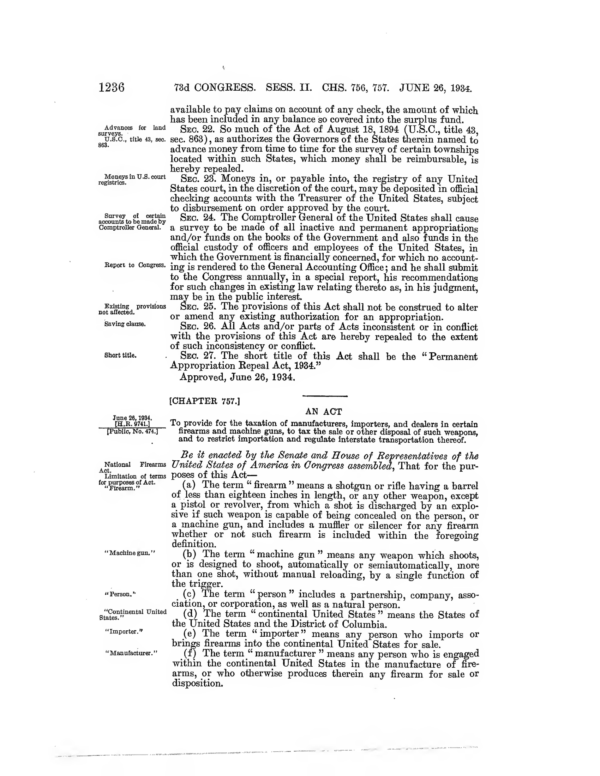
The opening of the National Firearms Act, 48 Stat. 1236. Look for "muffler or silencer for any firearm" in the first definition.
U.S. Statutes at Large, public domain.
Tommy Guns
By the 1930s, prohibition paved the way for gangland shootouts to become front-page news. The Thompson submachine gun got the spotlight was the weapon of choice for many notorious gangsters, and Americans wanted Washington to do something.
In 1934, few seriously thought Congress could just ban guns outright, but Attorney General Homer Cummings found a back door. He later said he modeled the bill on the Harrison Narcotic Act, which aimed to control drugs by taxing them — a lot. Even Congress on a rampage couldn’t easily ban a whole class of firearms, but it could tax one so heavily as to discourage folks from buying them.
Many folks today don’t know how far the first version of this legislation went. H.R. 9066 initially included pistols, revolvers, short shotguns, any other concealable firearm, machine guns, and “a muffler or silencer therefor.”
That’s right. Pretty much all handguns were on the first draft of the mega-tax, de facto ban list. Hold that thought for a hot second.
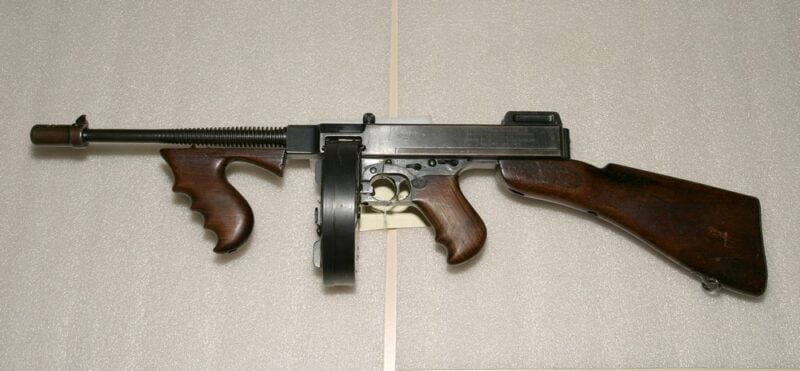
A Thompson Model 1928, the gun the NFA was really aimed at.
National Park Service, Alcatraz collection, public domain.
The Silent Debate
The House Ways and Means Committee held hearings in April and May of 1934. The printed record was 166 pages long. Witnesses argued about pistols, machine-gun definitions, magazine capacity, dealer taxes and the fate of small gun shops.
What they didn’t really argue about was the topic of silencers.
The closest thing to a debate came when Representative Claude Fuller of Arkansas said that anyone carrying certain weapons was up to no good. “I am referring to such a weapon as a sawed-off shotgun or machine gun, or a silencer,” Fuller said.
That was about it on the topic of silencers.
No testimony. No explanation of why silencers belonged on the list, and certainly nobody put up any charts or numbers about the potential dangers to society. The problem, and reason they were included, is that no one went to the trouble to object to their inclusion.
How a $1 Tax Became a $200 Silencer Tax
When the committee came back with a revised bill, the proposed transfer tax was $200 for each machine gun and $1 for every other firearm on the list. Silencers would have cost you a whopping single dollar.
By the time the final bill, H.R. 9741, passed in June, two major things had been changed. Resistance by gun owners had caused pistols and revolvers to be removed from the “bad” list. And the tax was now a flat $200 for every firearm the law covered. That included silencer “accessories.”
The definition of a silencer expanded also. The final law covered “a muffler or silencer for any firearm whether or not such firearm is included within the foregoing definition.”
So, your rimfire rifle wasn’t covered by the NFA, and neither were handguns. But an accessory was: silencers that attached to excluded, everyday guns.
Back then, a Thompson submachine gun cost about $200 back then, so the proposed tax doubled its price. A Maxim silencer cost around $5, give or take. So, for a silencer, the tax was roughly 40 times the price of the thing itself.
President Franklin Roosevelt signed the bill on June 26, 1934, and it took effect a month later. Cummings later admitted the result wasn’t what he’d hoped for. With handguns out, he said, the act became “a Federal machine gun act.”
Why Silencers?
Nobody knows for sure why silencers were included in the deal, although there are plenty of theories.
The story you’ll hear most around gun counters is that they were included to combat the problem of Depression-era poaching. People were hungry and quieter guns “could” facilitate putting meat (that wasn’t yours) on the table discreetly. Other accounts say the Attorney General simply wanted them in. Writing in Small Arms Review, Matthew Moss looked at the usual explanations and concluded that “the true reason for their inclusion in the act remains unknown.”
The hearing record doesn’t explain things, so all we know is that both worries, bad guys and poachers, had already been around for 25 years by 1934.
Flat Tax
Strangely, the $200 tax was never adjusted for inflation. In 1934 dollars, it was close to $5,000 today. It’s easy to see how the exorbitant tax would destroy the silencer market. However, nowadays, the tax, while onerous and still expensive, is less than the average retail price of a suppressor. As I write this, the tax appears to be fixed at zero. Time will tell.
Get more exclusive online content from American Handgunner delivered straight to your inbox. Sign up for our free American Handgunner Insider newsletter.