A Birthyear Colt
From Pimped to Prime
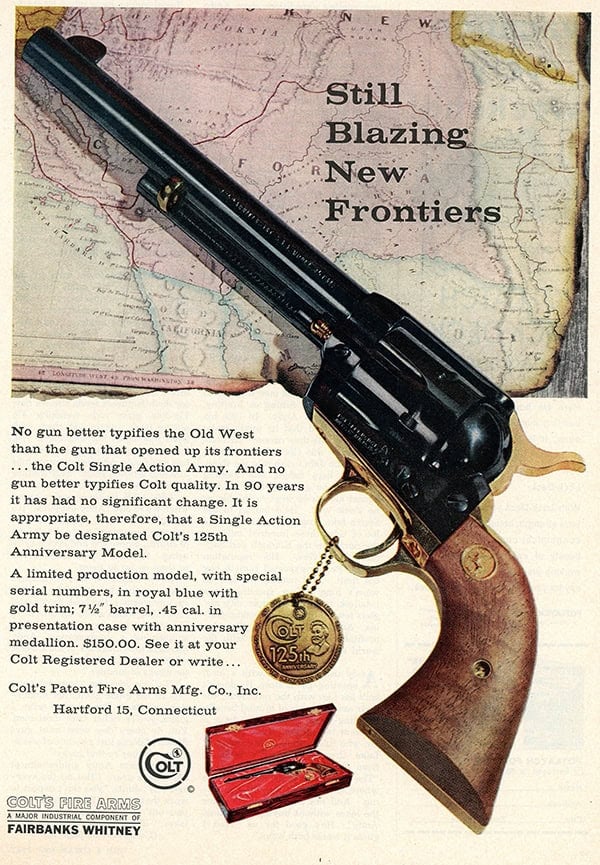
In 1961, Colt realized they could sell more guns by making them
collectible as commemoratives. Six decades later,
they continue to find success.
My love affair with the Colt Single Action Army began when my high school librarian introduced me to Louis L’Amour’s westerns. Within a few chapters of The Man Called Noon, I knew I wanted a Colt.
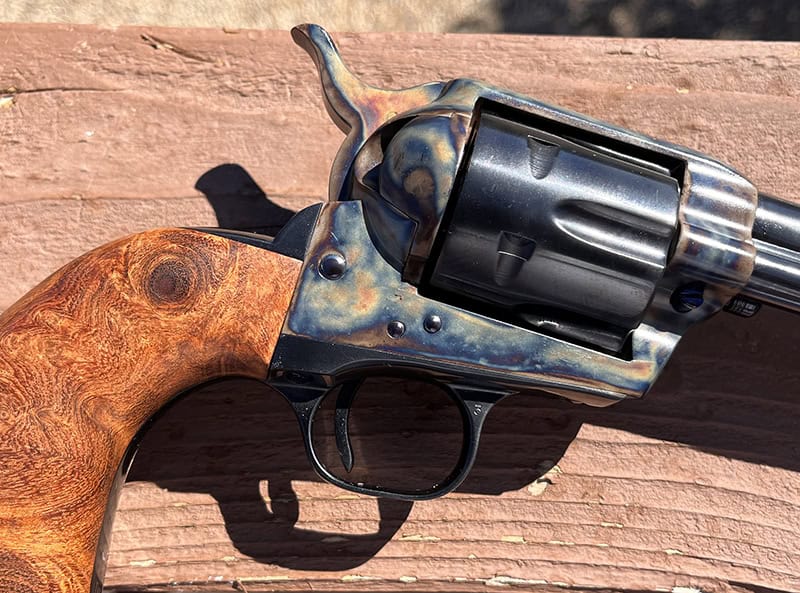
Sunlight highlights color case hardening.
Decades later, Colt buddies kept talking about finding their “Birth Year” gun, meaning the gun was produced in the year they were born. At first, the idea seemed ridiculous, but it persisted. Fate played a hand when I stumbled across the Colt 125th Anniversary Commemorative SAA offered in 1961, the year of my birth. The anniversary model was gaudy, featuring a gold trigger, hammer, backstrap, and trigger guard, along with a blued frame.
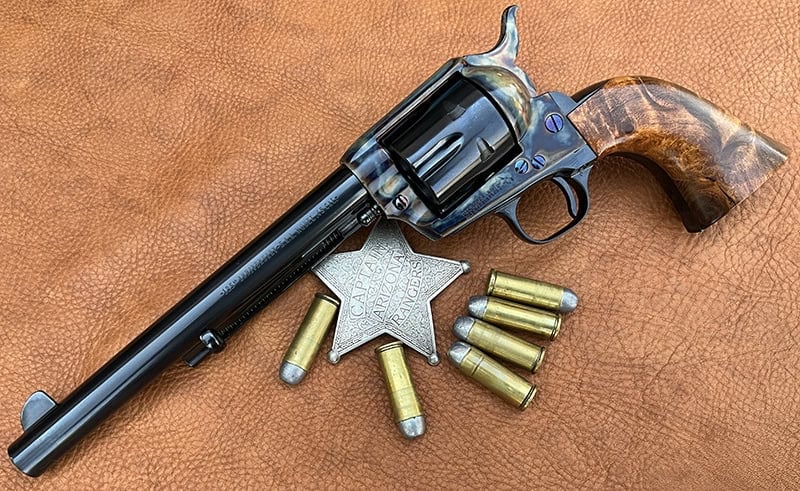
Nothing whispers Old West like the Colt Single Action Army.
The thought continued to grow on me. It was a Second-Generation Colt SAA produced during the Golden Age of TV westerns, when shows such as Bonanza, The Virginian, Cheyenne, Maverick, and hundreds of others dominated the television primetime lineup, and early Second-Generation Colt SAAs were exceptionally well made.
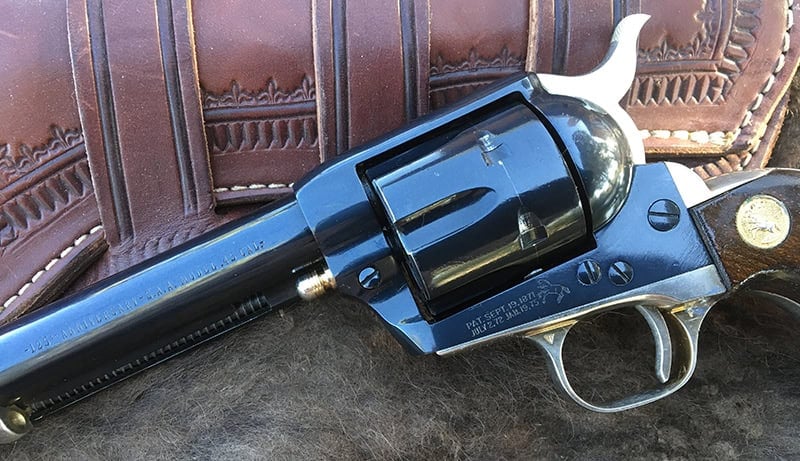
While some prefer a blued frame on a Colt SAA, I am not among them.
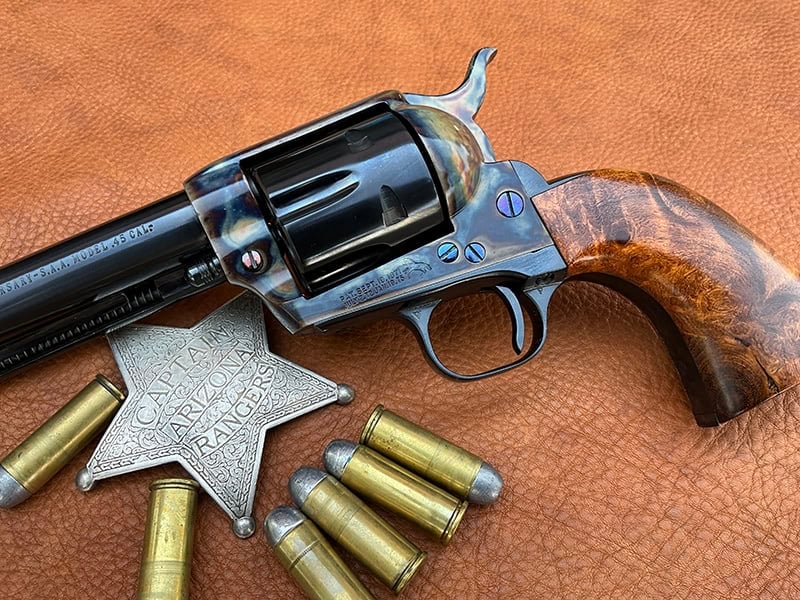
By carefully shopping, I was able to procure this revolver at well below market price.
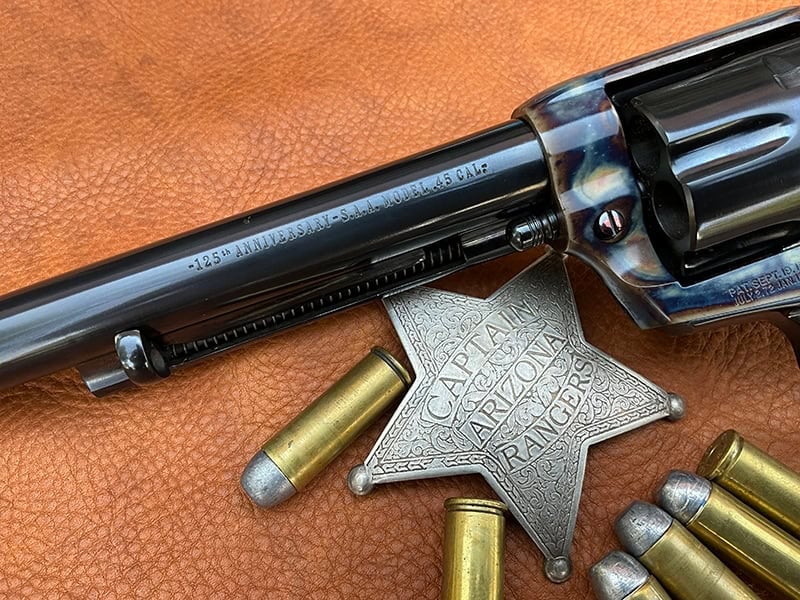
I chose to keep the 125th Anniversary roll mark for economic and aesthetic reasons.
The decision was made when a local dealer offered one at a reduced price because of some condition issues. The gold wash was worn away on the backstrap and trigger. The wood grips were water-damaged, and the grip screw was rusted in place. There was slight rust on the heel of the backstrap, the crushed red velvet liner of the commemorative box was stained, and the keychain medallion was missing. In other words, it was the perfect ugly duckling to be transformed into a beautiful swan!
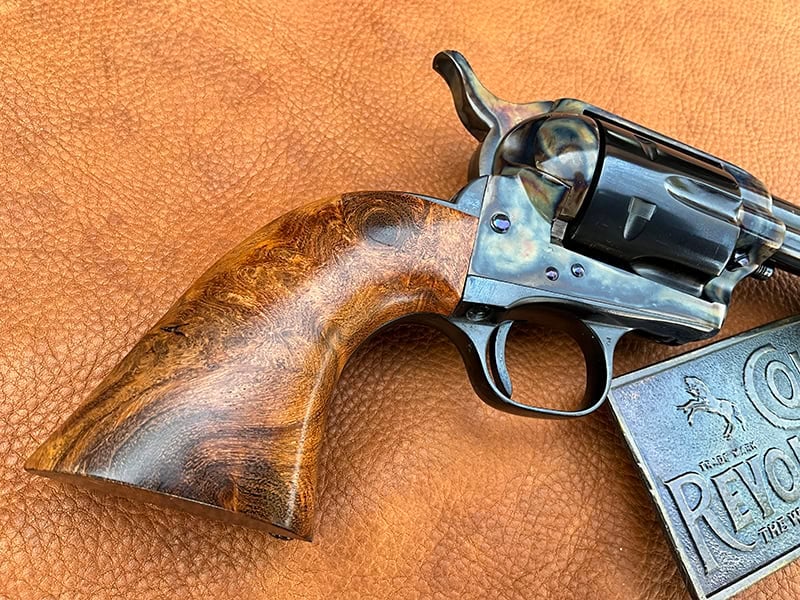
I wanted a Colt to match my life in Arizona, and one-piece mesquite burl grips work perfectly.
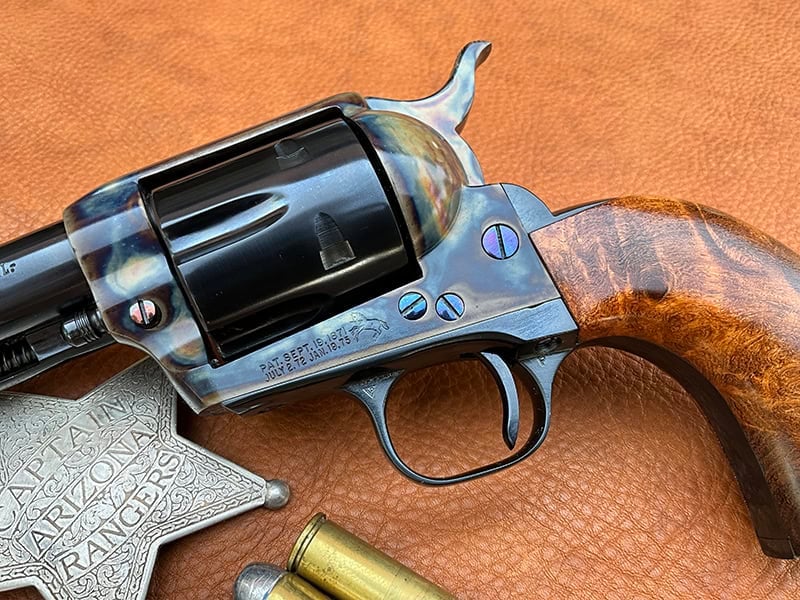
Traditionally, niter-blued screws were reserved for nickel guns, but they look beautiful on any Colt.
My dream was to restore the gun to an original configuration when the Colt SAA was introduced in 1873. This meant stripping the gold plating, color case hardening the frame and hammer, bluing the backstrap, trigger, and trigger guard, and installing one-piece wooden grips, or stocks, as some call them. I decided to make one detour in my transformation. Instead of traditional walnut grips, I wanted Arizona mesquite burl, so I went to Richard Counts. Counts is a fellow Arizonan and a master of making grips, so Mesquite burl was a slam dunk for him.
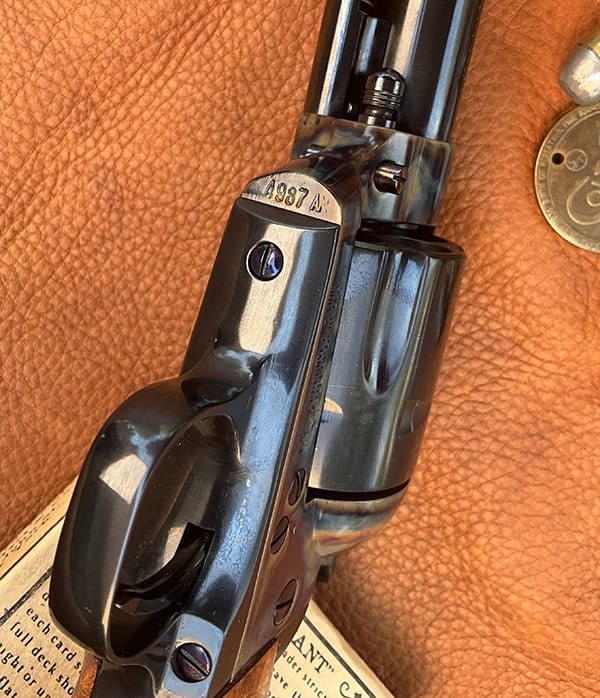
The serial number of the 125th Anniversary model includes AN.
The rest of the transformation would require someone with special skill sets. I contacted Viktor’s Legacy in Ohio. After a few phone and email conversations, it was in their capable hands for the transformation to take place. (Sadly, Viktor’s Legacy has permanently closed.)
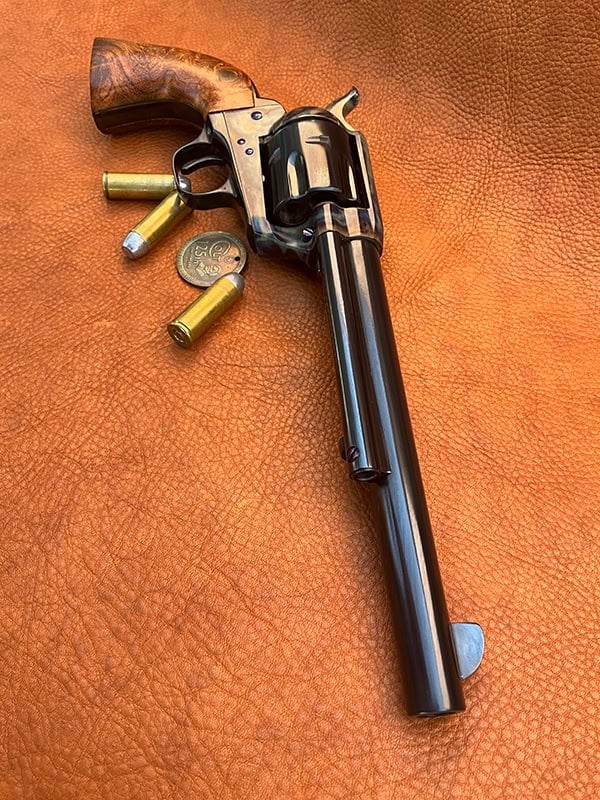
The Colt SAA was initially offered in 7 ½” only.
As a traditionalist, I prefer this barrel length.
Using electrolysis, the gold and silver plating were stripped away, leaving bare metal. The bluing was completed using a complex five-step ballet of degreaser, water, oil, and heated salts. Many gunsmiths keep the exact methods and chemicals they use a secret. The dark blue produced is like a midnight sky, and I can’t imagine a revolver more beautiful.
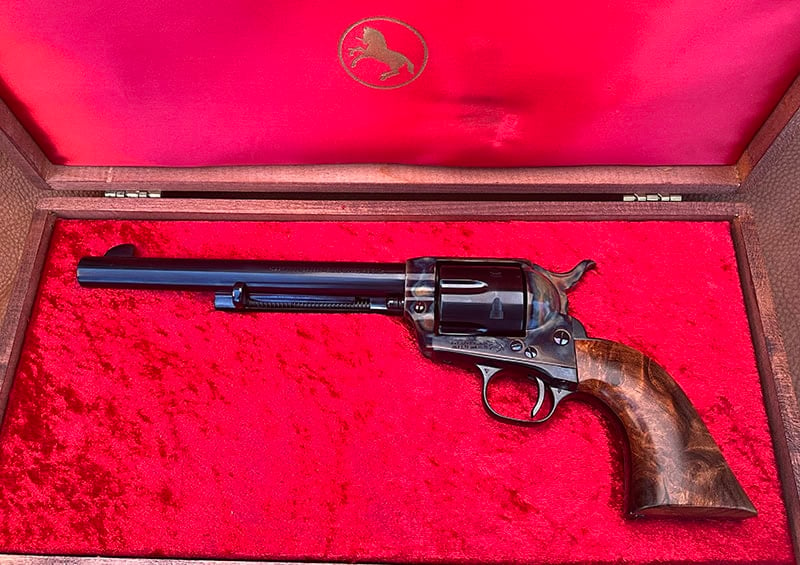
The red crushed velvet makes the bluing show like the original Colt Royal Blue.
Perhaps the biggest hurdle was color case hardening the frame. Initially, the iron and steel used in 19th-century guns were lower in strength than those developed by the early to mid-1900s. Color case hardening was necessary to infuse carbon into the frame’s surface, thereby adding strength and abrasion resistance. The depth of carbon infusion was microscopic but essential.
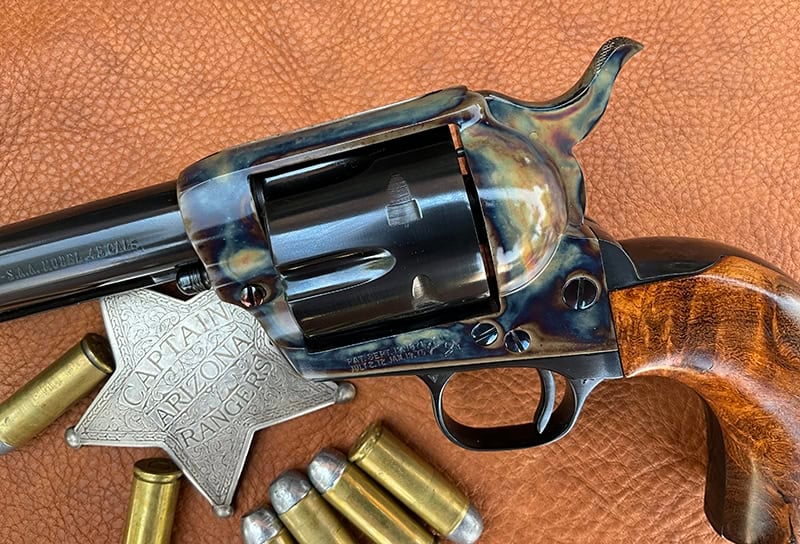
Over the last 150 years, the hammer has been offered in different finishes.
I chose to have it color case hardened.
Color case hardening is traditionally done using crushed bone and charcoal. The parts are packed tightly in a crucible filled with a bone-and-charcoal blend and heated to 1600°F. The exact bone and charcoal recipe is usually a trade secret, and often manufacturers can be identified by the coloring of their case hardening.
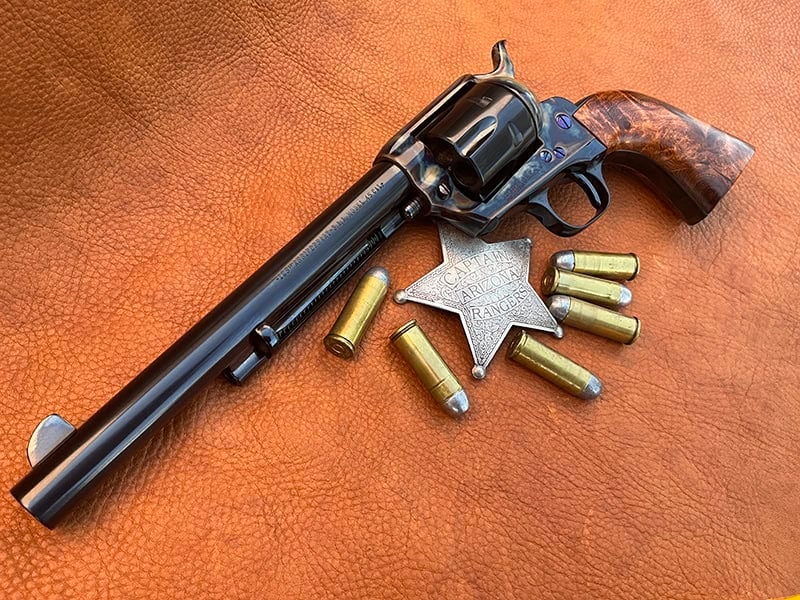
The Colt SAA has been a favorite among westerners, myself included.
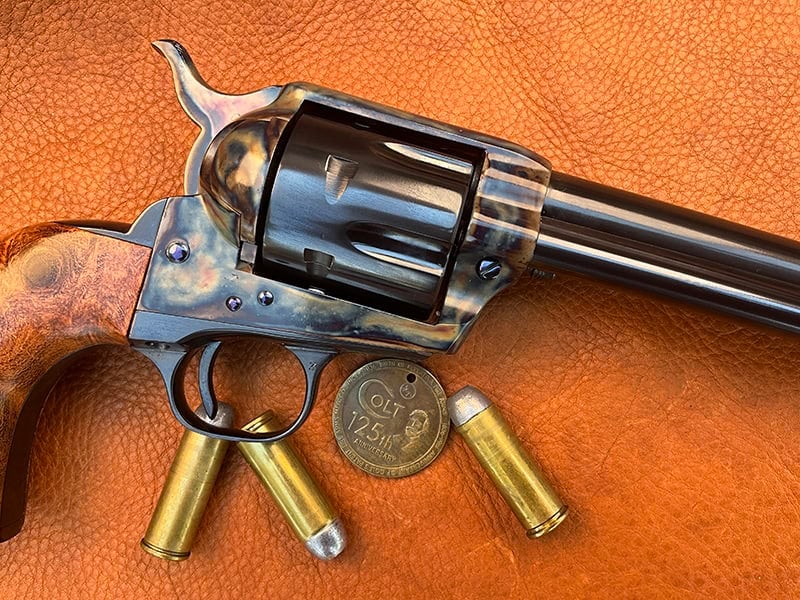
The 125th Anniversary Model came with a medallion keychain.
I was ecstatic to find this one under the case backdrop.
Colt had a policy of niter-blue triggers, hammers, and screws, which added visual appeal to many of their older models. This is especially true for most nickel-plated guns. Unfortunately, the finish is not abrasion-resistant and wears away with constant use. My Colt is primarily for my viewing pleasure, so the screws were treated accordingly.
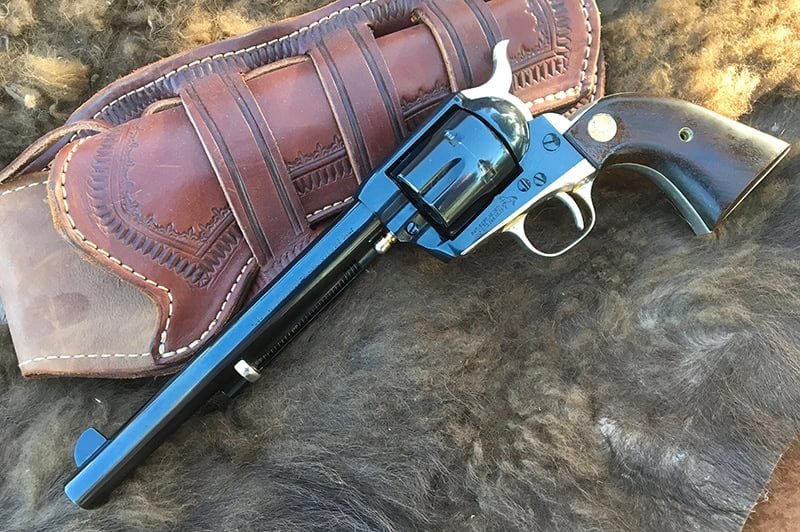
The gold accents assault my senses and quickly wear away with handling.
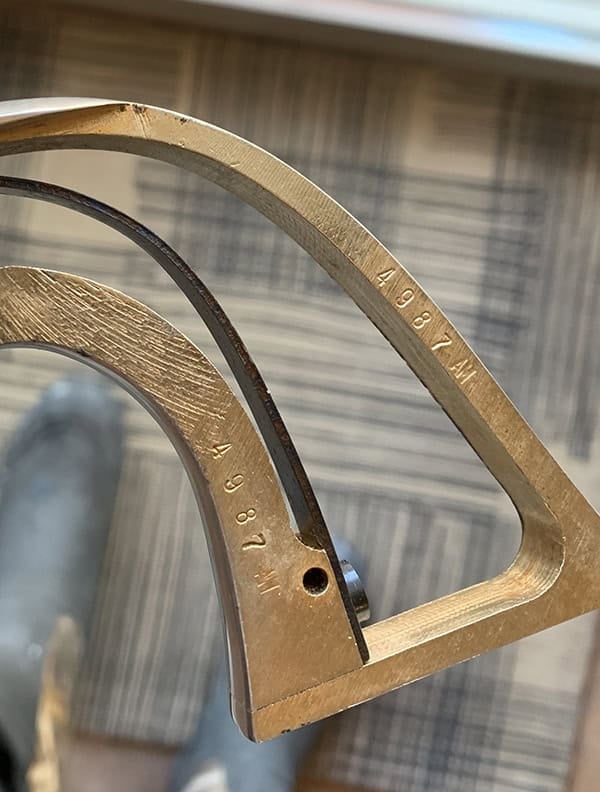
On First Generation Colt SAA revolvers, the serial number was found
stamped on three visible locations. All but one serial number
was moved to a hidden area in later versions.
The Colt transformed into a beautiful swan, and I now think a birthyear Colt is a great idea! The possibilities are endless. Perhaps I’ll find a Colt Gold Cup born in 1961, or a Detective Special, or a Python! While having fellow Colt collectors hanging around is fun, they can also be a wonderfully corrupting influence!
Get more wheelgun content every week!
By submitting this form, you are consenting to receive marketing emails from: . You can revoke your consent to receive emails at any time by using the SafeUnsubscribe® link, found at the bottom of every email. Emails are serviced by Constant Contact