A Stroll Down Accuracy Lane
I made at least one good decision when I started writing about guns a couple of decades ago. Even a blind squirrel finds a nut now and then, right?
I started to keep some basic records about the performance of the guns and ammo that came and went for various stories. I’m mainly talking about the significant stuff, like bullet velocity, basic notes on any performance issues with the guns, and accuracy results.
In fact, I was so OCD about it, I even wrote a custom database to capture, organize and process the results. Although I’m a half-decent Excel nerd, it was a job that required more than columns and rows. I wanted to track the guns, ammo, reloading data, penetration data when appropriate, and information related to the conditions on the day I was testing. That’s a lot of dimensions, so for you fellow tech weenies, that means a relational database.
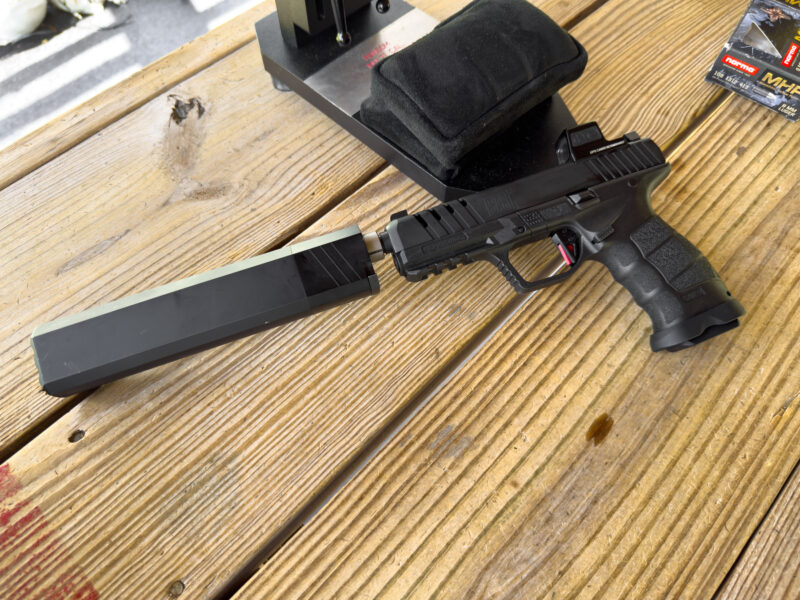
The SAR9 SOCOM is another great buy. Outfitted with a SilencerCo Osprey, it shot very well.
Enough of the tech gobbledygook. I only mention it because, as a Mac user, there aren’t many affordable “off the shelf” solutions to track all this stuff, hence some hours programming my own. But I’m kinda tired of that, so if anyone knows of a gun and ammo-centric system to track all these things, I’d love to hear about it.
Anyway, in addition to organizing and summarizing the data needed for articles, it’s fun to look back once in a while at some of the history I’ve captured to see what trends and patterns emerge.
Today’s look into the data is a review of handgun accuracy. While it’s no surprise that expensive guns usually deliver premium results, it’s always interesting to see which affordable models can print tiny groups. Today, we’ll focus mostly on semi-automatic handguns. At some future date, I’ll take a similar look at revolver results.
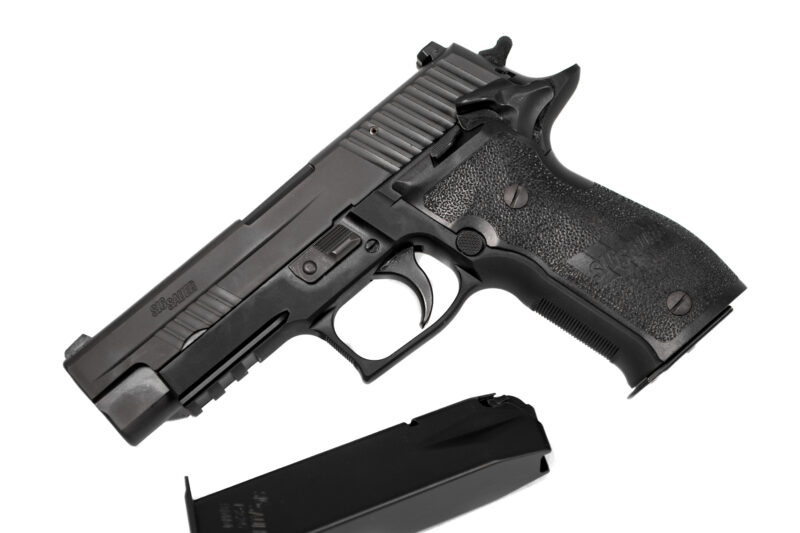
Can someone remind me why I parted ways with this SIG SAUER P226 Single Action Only?
In hindsight, that was a supremely dumb move.
Pet Peeve Exclusions
While I do shoot test guns freehand a lot, that’s for subjective observations and descriptions on how easy a gun might be to shoot accurately. When talking about what a gun-and-ammo combination will or won’t do in the accuracy department, I always remove as many human variables as possible. When I can, I use a scope or at least a red dot to remove as much human eyeball alignment error as possible. I always use a good rest like the Ransom Multi-Caliber rest. And while I’ll test tiny subcompact guns at 15 yards sometimes, 25-yard, five-shot groups is my default.
With that said, and in no particular order …
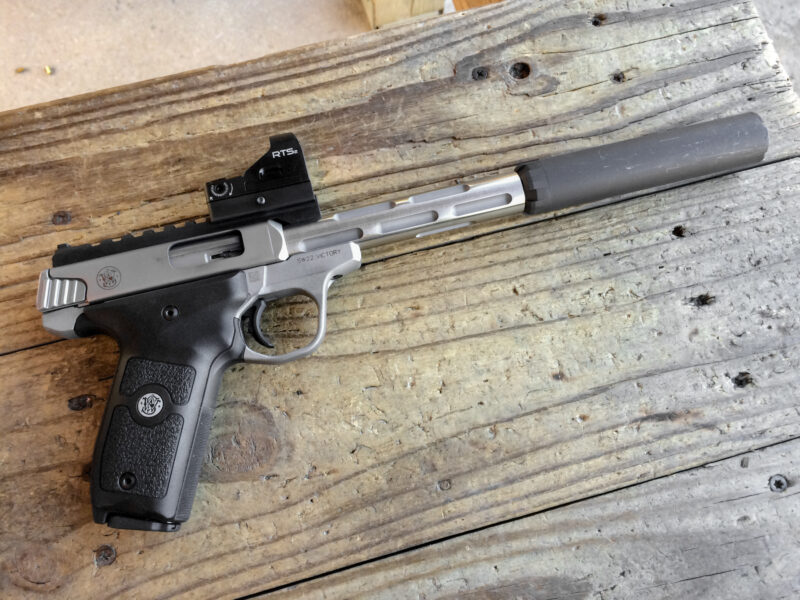
While not a particularly expensive base gun, the S&W Victory is designed for aftermarket upgrades
like this Volquartsen barrel and SilencerCo Sparrow suppressor.
Smith & Wesson Victory
I expected rimfires to make the short list, and this one certainly did. From the factory, it comes ready to perform, but it’s also designed to accept major aftermarket components, like Volquartsen barrels.
Sometimes, rimfires are ammo-picky not just for reliability, but for accuracy. This one cared little and printed sub-inch, five-shot groups from 25 yards all day, every day.
• Eley Practice 40-grain: 0.50”
• CCI Quiet-22 40-grain: 0.58”
• CCI Mini Mag HV 40-grain: 0.62”
• Aguila Super Maximum 30-grain: 0.77”
• Federal Target Grade 40-grain: 0.79”
• Remington Thunderbolt 40-grain: 0.79”
• CCI Stinger 32-grain: 0.86”
• Armscor Precision Standard Velocity 40-grain: 0.91”
• Winchester Match T22 LRN 40-grain: 0.98”
The list goes on. From a quick glance at the notes, the largest groups I’ve recorded still measured maybe an inch and a half.
Taurus TX22 Competition
While the Victory models aren’t priced at the premium level, they still range from $400 to $700, depending on options. The Taurus TX22 carries an MSRP of about $350 and demonstrated a pleasant surprise on the range.
• SK Pistol Match: 0.9”
• Winchester Super Suppressed 45-grain: 0.9”
• Lapua Pistol King: 0.97”
• Norma Match-22 40-grain: 1.17”
• CCI Mini Mag HV 40-grain: 1.45”
While price often correlates with great accuracy, it isn’t always a causal relationship!
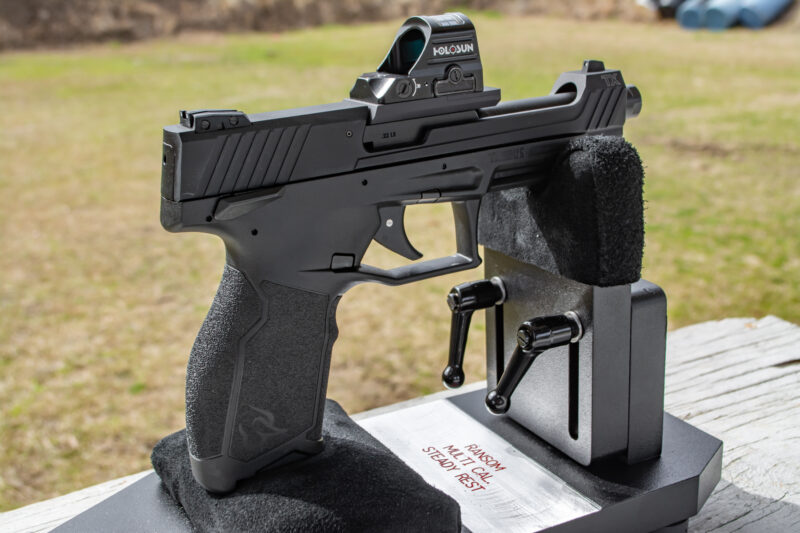
It's great to find a bargain that shoots. This Taurus TX22 Competition delivered lots of really small. groups.
Springfield Armory Echelon
If I listed each separately, quite a few Springfield Armory Pistols would show up on this list, as most compact and larger XD and XDM pistols exhibited similar results. I think the Springfield Armory folks must pay extra attention to not only barrel manufacturing, but also slide-to-barrel fit later in the process. One of the newer guns, the Echelon, lived up to the standards set by a number of the XD and XDM pistols I’ve tested.
• Norma Safeguard 9mm 115-grain: 0.71”
• Norma Hexagon 9mm 124-grain: 1.51”
• Black Hills Honey Badger +P 9mm 100-grain: 1.69”
• Black Hills JHP EXP 9mm 115-grain: 1.9”
• Black Hills FMJ 9mm 115-grain: 1.96”
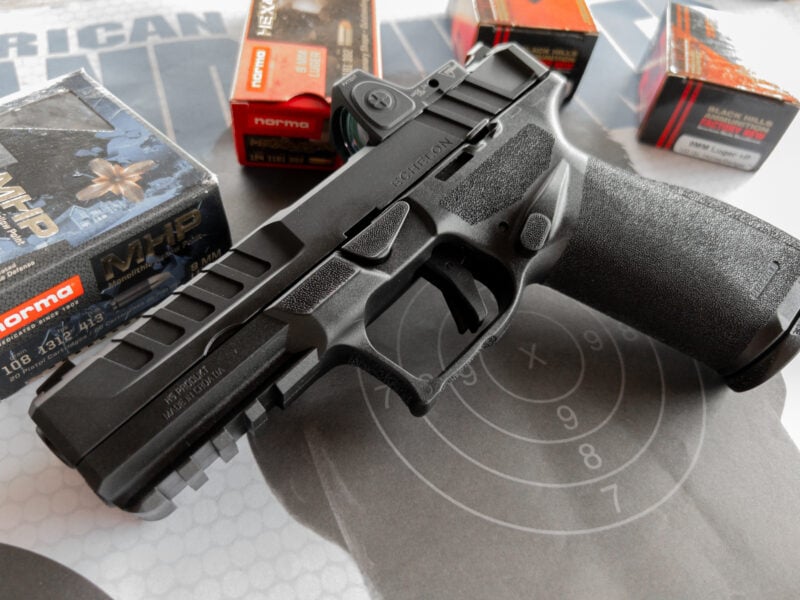
Springfield Armory puts emphasis on accuracy. This Echelon, and plenty of XD and XDM pistols I've tested,
all were capable of 1+" groups at 25 yards.
Staccato 2011 P
This pistol falls into the “it better shoot well” category! With its retail price in the $2,500 range, it does, in fact, perform in all ways. As for accuracy? I’ve started to use this one as the test pistol for evaluating ammunition performance.
• Black Hills Honey Badger +P 9mm 100-grain: 0.75”
• Federal HST 9mm 124-grain: 0.76”
• Handload (125-grain Blue Bullet, CFE Pistol 4.6 grains): 1.00”
• Federal Syntech Action Pistol 9mm 150-grain: 1.01”
• Norma MHP 9mm 108-grain: 1.03”
• Staccato Match 9mm 125-grain: 1.20”
• Liberty Civil Defense 9mm 50-grain: 2.30”
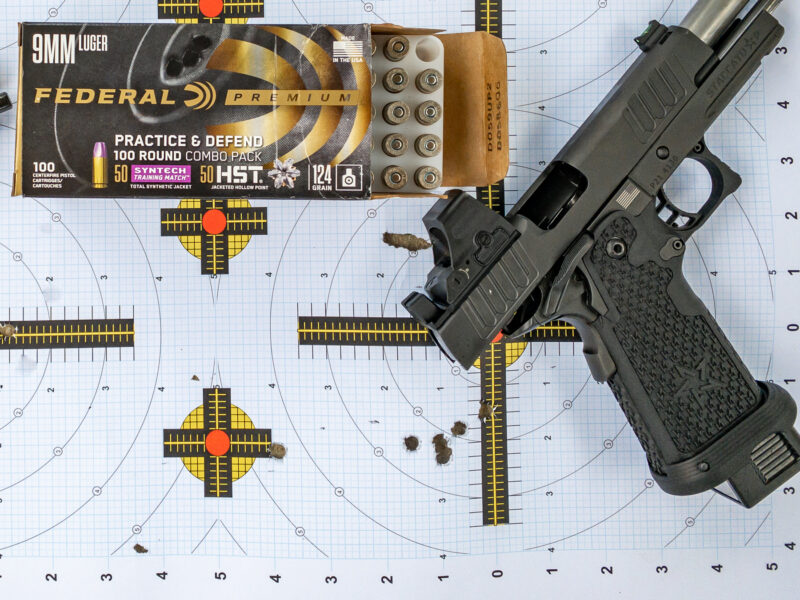
All Staccato 2011 models I've tested, five to date as I recall, perform like rock stars.
Beretta Factory .22LR Conversion Kit
Have you ever sold something, then later wondered why the heck you made such a poor decision? Yep. That’s me in this case. I sold it. Why? I’ll claim temporary insanity.
This is the rimfire conversion, made by Beretta, which seems to come open and off the market over the years. I used it on a stock Beretta 92FS, and as you’ll see, it performed quite admirably.
• CCI Mini Mag HP .22 LR 36-grain: 0.90”
• CCI Stinger .22 LR 32-grain: 0.94”
• Eley Practice 100 .22 LR 40-grain: 0.98”
• Winchester White Box 555 HP .22 LR 36-grain: 1.21”
• Armscor Precison Standard Velocity .22 LR 40-grain: 1.80”
• American Eagle HV Copper Plated .22 LR 36-grain: 2.02”
• Winchester Match T22 LRN .22 LR 40-grain: 1.65”
Ed Brown Kobra Carry
Looking through some of the .45s, this one stood out with a variety of ammo choices.
• Black Hills JHP .45 ACP 185-grain: 1.08”
• Federal HST .45 ACP 230-grain: 1.30”
• Nosler JHP .45 ACP 185-grain: 1.46”
• Black Hills SWC .45 ACP 200-grain: 1.57”
• Black Hills JHP .45 ACP 230-grain: 1.71”
Nighthawk Thunder Ranch Special
Another premium model delivered across-the-board results in the sub-two-inch category.
• Norma MHP 9mm 108-grain: 0.77”
• Federal Punch 9mm 124-grain: 1.08”
• Federal HST 9mm 124-grain: 1.26”
• Federal Syntech Training Match 9mm 124-grain: 1.36”
• Speer Gold Dot Carry Gun 9mm 135-grain: 1.49”
• Liberty Civil Defense 9mm 50-grain: 1.94”
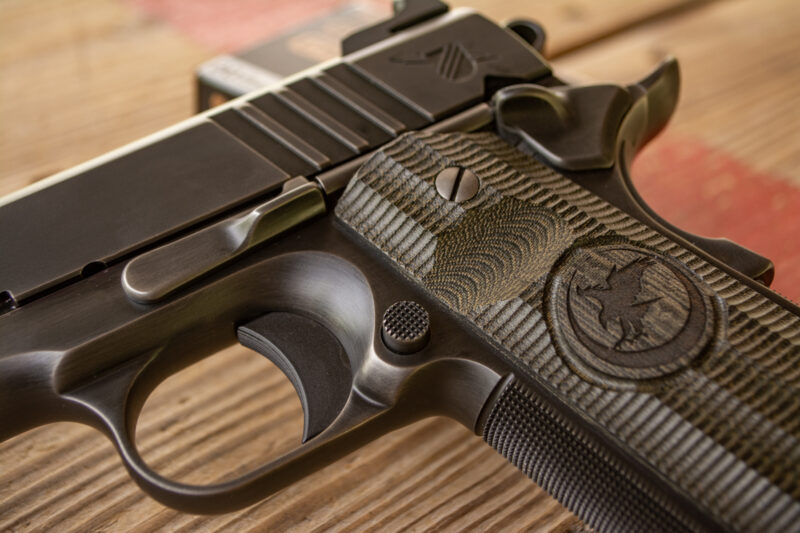
As expected, this Nighthawk Custom Thunder Ranch was a joy to shoot.
The List Goes On
As I continued digging through my database, looking for pistols that shot less than two-inch groups at 25 yards with most or all ammo types, the list got fairly long quickly. I suppose it goes to show what modern manufacturing techniques can deliver in terms of parts quality and consistency.
Some of the others I didn’t have space to include were:
• FN Five-SeveN: Every ammo type I could find averaged about 1.5”
• SAR9 SOCOM: A great buy if you value performance for the price!
• SIG SAUER P226 Elite SAO: Also falls into the bucket of, “Why on earth did I part with this?”
• SIG SAUER P229 Legion 9mm: Still in the regular carry rotation.
• SIG SAUER P320 X-Compact: Great accuracy results across the board.
• Walther PDP: You won’t be disappointed. I couldn’t find ammo that exceeded a 1.8” group.
I guess there are a couple of takeaways. First, there are a lot of solid guns out there. Second, repeatable and proper test conditions are essential. To really evaluate accuracy, it’s important to remove as many variables as possible and stick to that methodology. You’ll likely be surprised at the performance of today’s “regular” guns!
Get more exclusive online content from American Handgunner delivered straight to your inbox. Sign up for our free American Handgunner Insider newsletter.