Big Bore Redhawk
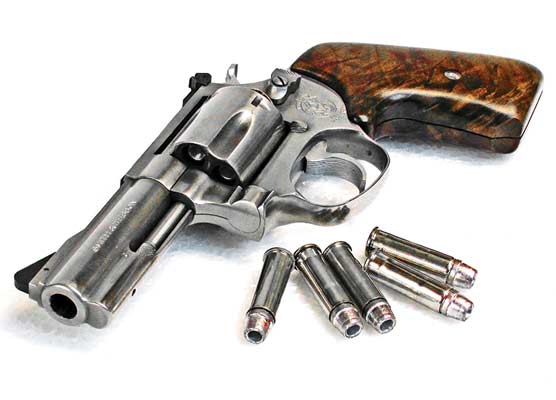
Chambered in .45 Colt, Ruger’s rugged double-action opens new vistas of power for the handloader.
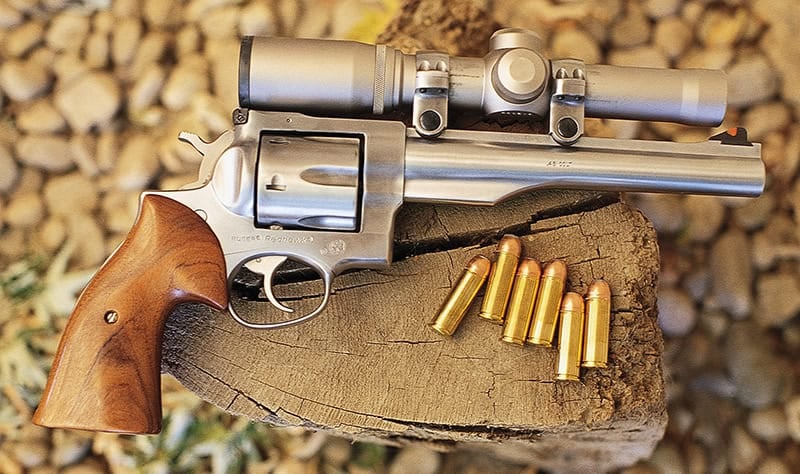
Over the years, the Ruger Redhawk has been offered in .357 Magnum and .41 Magnum, in addition to the standard .44 Magnum offering. The two former chamberings are now long gone, but the big .44 has been recently joined by the .45 Colt in stainless steel.
The Redhawk .44 Magnum is a very strong sixgun. Along with its brother, the Super Redhawk, they are the strongest double-actions ever offered to sixgunners. Since the .45 Colt is built on the same platform, it is by extension the sturdiest double-action .45 ever offered to shooters.
The .45 Redhawk is available in both the easy-packin’ 5 1⁄2″ version, as well as in a 7 1⁄2″ model, both with and without the factory-scope option that consists of two scallops on the barrel to accept Ruger’s integral scope rings.
A Brief History Of The .45 Colt
Let us back up a bit here and look at both the cartridge and the sixgun that are combined to give us the .45 Redhawk. The .45 Colt, often erroneously referred to as the .45 Long Colt, first saw the light of day chambered in the now legendary Colt Single Action Army, the fabled Peacemaker of 1873.
Being a blackpowder cartridge, the .45 Colt case is of large capacity, large enough to accept a full 40 grains of blackpowder under its 255 gr. conical, or flatnose, lead bullet. Muzzle velocities in the 1870s were probably somewhere around 850 to 950 fps.
Anyone acquainted with sixguns quickly notices that the cylinder walls on the Colt SAA are very thin. However, this was not a problem, as the blackpowder load was low-pressure.
When experimenters started stoking up the fire on the .45 to take advantage of its larger case capacity with smokeless powders, inevitable things happened. Cylinders burst, top straps blew, careers launched. Elmer Keith started his writing career in the 1920s describing a blow-up of a .45 Colt. That incident caused him to give up on the .45 Colt and adopt the .44 Special for the heavy loads he wanted to use.
Some said then – and they still do — that .45 Colt brass is weak. Perhaps it was in its old, original blackpowder form. Perhaps it still was at Keith’s time, with folded, or balloon-head, cases. However, when Dick Casull started the experiments that led to the .454 Casull, he used the standard .45 brass available at the time. The balloon-head brass had given way to the modern solid-head brass, and this is exactly what we have
today. It’s exactly what Casull used.
The missing strength factor in Casull’s work was not the brass case, but the available sixguns. He blew several Colts, then started fitting five-shot cylinders and finally built his own custom sixguns to house 230 gr. bullets at 1,800 fps, all in standard .45 Colt brass.
It would be nearly 90 years after the advent of the Colt SAA before we would see a single-action strong enough to take advantage of the voluminous case capacity of the .45 Colt when using smokeless powder. That sixgun was Ruger’s .45 Blackhawk. These sixguns are certainly not as strong as Casull’s five-shooters, so it behooves us to approach loading for the .45 Blackhawk with a great deal of common sense.
Redhawk Appears
Ruger’s Redhawk, which first appeared in 1980, offered a .44 Magnum at a price of $325. The first example to arrive locally went for $800! Why? Such was the state of affairs in trying to acquire a double action .44 Magnum in the late 1970s that Smith & Wessons were often going for double the suggested retail price.
It is hard to say who sold more Smith & Wesson .44 Magnums over the years – Elmer Keith, with his writings, or Clint Eastwood, with his Dirty Harry portrayal.
We do know that Dirty Harry caused the immediate supply problem, as there were many more buyers of .44 sixguns than there were sixguns. Smith & Wesson worked around the clock, but could not keep up with the demand. It was only the arrival of the Redhawk that provided a safety valve that soon allowed everything to resume some form of normalcy.
Ruger not only had an advantage in bringing their double-action out at the right time, but they also built their gun around the cartridge, rather than chambering some existing model. This made it the strongest sixgun ever offered for the .44 Magnum.
Ruger engineers were able to do this without giving us an extra-heavy or clumsy sixgun. The only fault most of us can find with the Redhawk is the fact that it is difficult to get a really good trigger on Big Red.
Strong Revolver
The Redhawk gains its strength in many ways. The threaded area of the frame is very thick– double what one finds in many other sixguns– and the massive cylinder is locked at the rear and front rather than at the end of the ejector rod. The barrel carries a heavy rib, and the top strap literally speaks of brute strength. Like the single-action Blackhawk, the Redhawk just keeps going. And going. And going.
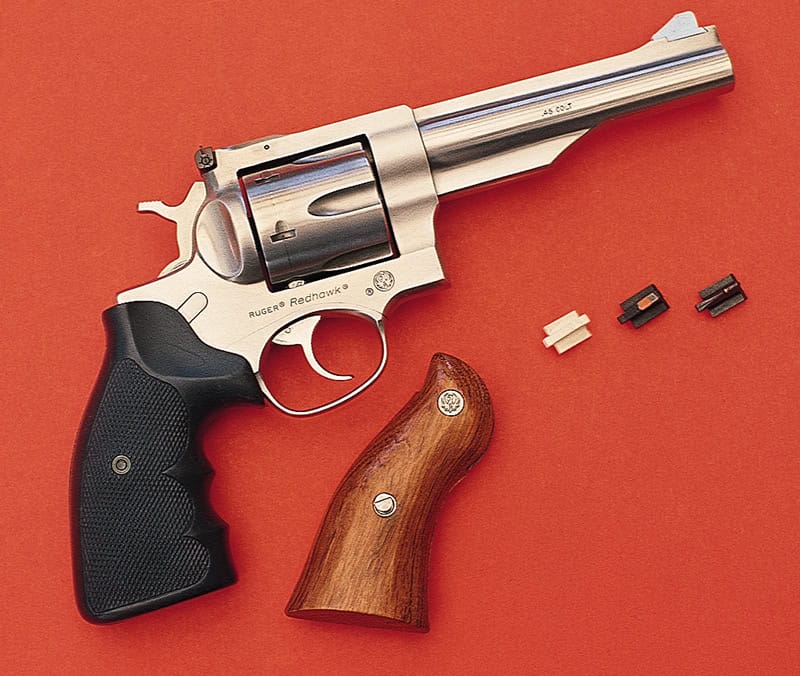
For testing the .45 Colt in the Redhawk, I ordered a scope-ready 7 1⁄2″ version, complete with Ruger rings for mounting a 2X Burris LER pistol scope, and a 5 1⁄2″, easy-packin’ version. The latter was soon equipped with the easy-to-see, baby-blue Ruger front sight, and, to help soften recoil of some of the loads used, a pair of Uncle Mike’s finger groove grips replaced the factory wood stocks. These came in handy when it got to test-firing the Redhawks with 265 gr. bullets at 1,465 fps, 335 grs. bullets at 1,275, and 360 grainers at 1,180.
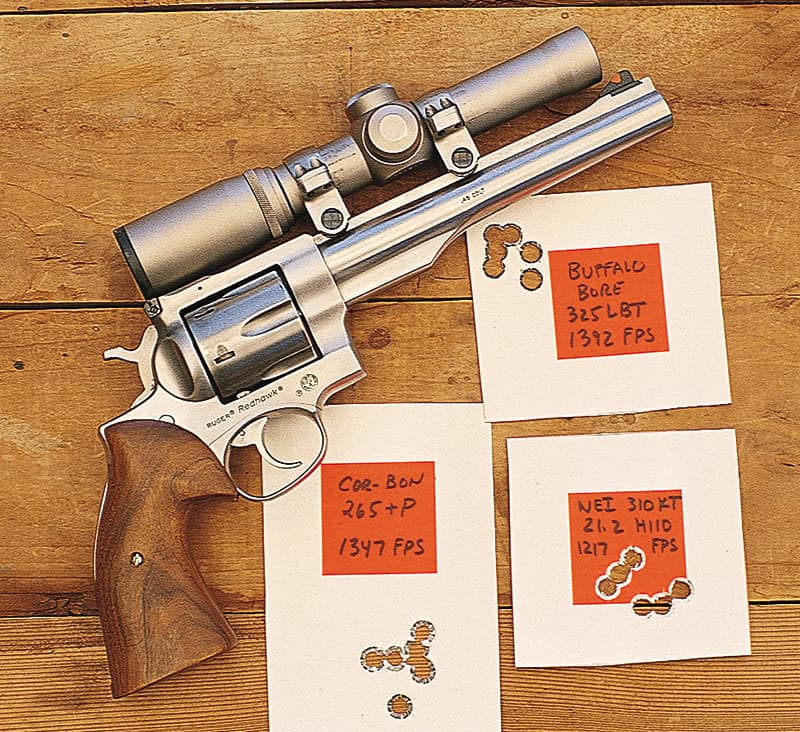
With the scoped Redhawk, accuracy proved to be exceptional– even more remarkable in light of the heavy trigger pull of 6.25 lbs. Of all the loads tested – five factory loads and 23 handloads, using both cast and jacketed bullets with weights from 250 up to 335 gr.– the average group size for five shots at 25 yards with all 28 loads proved to be just over 1″. I call that astounding accuracy.
Factory hunting loads tested included two from Buffalo Bore and two from Cor-Bon. Buffalo Bore’s 300 gr. Speer bulleted load clocks out at 1,367 fps over the sky screens of the Oehler Model 35P and places five shots in .75″ at 25 yards. The Buffalo Bore 325 gr. LBT load exhibits the same accuracy with a muzzle velocity of 1,392 fps. These are not faint-hearted loads! They are for use only in modern, heavyframed .45 Colt sixguns.
Cor-Bon’s serious .45 Colt hunting loads include a 265 gr. bonded core +P at 1,347 fps and a 300 grainer at 1,271 fps. Both loads are right at 1″ for accuracy at 25 yards.
These loads are for big-boned, heavily muscled critters. For whitetails, my preferred .45 Colt load is Hornady’s 250 gr. XTP bullet over 20 grs. of Alliant #2400. In the 7 1⁄2″ Redhawk, this load clocks out at 1,137 fps and has pinpoint accuracy, with five shots in .875″.
The Redhawk has been a popular hunting handgun in its original .44 Magnum chambering. So much so that it was joined rather than supplanted by the Super Redhawk. The Redhawk was simply in too much demand to drop. There is a large segment of the sixgun-shooting population that holds to the idea that anything the .44 can do, the .45 can do better. The .45 Redhawk is definitely for them.
In firing several hundred heavy .45 Colt rounds through the Redhawks, no malfunctions of any kind occurred. This is, of course, exactly what we have come to expect from Ruger sixguns.
We have mentioned that both the .357 Magnum and .41 Magnum chamberings were available in the Redhawk. Both began in 1984 and both were subsequently dropped in 1991. I expect the .45 Colt to have a much longer run.
Get More Revolver Content Every Week!
Sign up for the Wheelgun Wednesday newsletter here:
By submitting this form, you are consenting to receive marketing emails from: . You can revoke your consent to receive emails at any time by using the SafeUnsubscribe® link, found at the bottom of every email. Emails are serviced by Constant Contact