Five Beans in the Wheel
Better Shooting
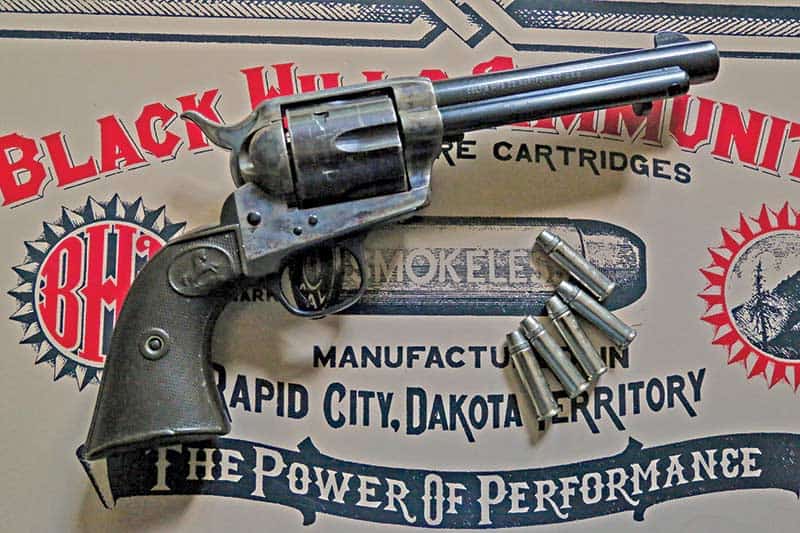
The Colt single-action has been in production since 1873,
virtually unchanged except for metallurgy. Though technically
a six-shooter, “five beans in the wheel” was accepted procedure
from the start.
It must have been around 65 years ago when I read a cowboy novel from the school library. Darned if I recall the name, but I do recall one scene. A good guy, a ranch foreman, I think, had captured several rustlers at gunpoint. He orders them to keep their hands up: “I’ve got five beans in this wheel and an itchy trigger finger.”
For the one or two readers who haven’t heard the phrase, it refers to the practice of loading a six-shot revolver with five cartridges, keeping an empty chamber under the hammer.
In this era of the semiautomatic pistol, many handgunners don’t own or shoot single- or double-action revolvers, but certainly they should be capable of handling any handgun type safely. Most current revolvers have some sort of mechanism so they can be fully loaded. Most, not all.
The danger of keeping a loaded chamber of a revolver under the hammer was recognized virtually from the start. The hammer of a revolver is vulnerable to blows from a myriad of sources. More than one cowboy took a bullet in the leg when the hammer of his holstered revolver was hit. Even worse if the revolver was dropped. The single action seems to have a propensity to fall on its hammer. If the gun fires, no one knows where the bullet will go.
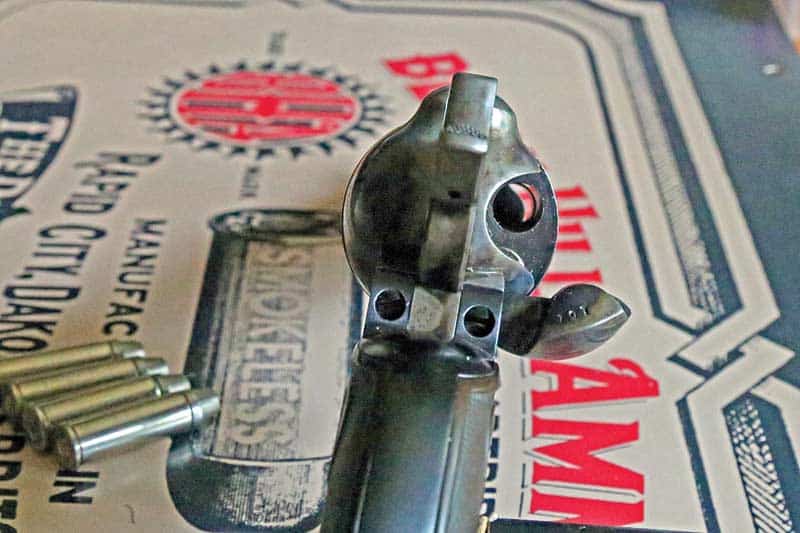
With the hammer in the loading position to allow the cylinder to rotate: load one, skip one, load four, close loading gate, bring hammer to full cock and lower it on the empty chamber.

The cylinder of a Colt single-action: five chambers loaded,
an empty chamber under the hammer and aligned with the barrel.
Safety Efforts
Gun designers recognized the danger and tried to obviate it. The Colt SA incorporated a safety notch (the first “click”) to keep the firing pin from touching the cartridge primer. Though a good idea in theory, it would prove too fragile in reality.
Other solutions would prove more successful. Iver Johnson was one of the first to market a system using a transfer bar; they promoted it with the slogan “Hammer the Hammer.” The militaries of several nations were adopting DA revolvers, providing a strong incentive for makers to design new safety systems. A trained soldier is a valuable asset; losing one to enemy action is bad enough without losing one to his own equipment.
The procedure I follow in loading a traditional SA revolver I first learned from the late Skeeter Skelton. He summed it up as “load one, skip one, load four, bring to full cock and lower the hammer on the empty chamber.” To expand a bit, let’s go step by step with a Colt single-action.
Open the loading gate and bring the hammer to loading position (the “second click”) to retract the cylinder stop, allowing the cylinder to rotate. Rotate the cylinder one full revolution, checking to see all chambers are empty. Now align one chamber with the loading gate and load one cartridge.
Rotate the cylinder, skipping the next chamber and leaving it unloaded. Continue to manually rotate the cylinder, loading a cartridge into each of the next four chambers. After loading the fourth cartridge, close the loading gate, bring the hammer to full cock, then lower it on the empty chamber which will now be aligned with the barrel.
Looking from the side, confirm the empty chamber is under the hammer and aligned with the barrel. Gently attempt to rotate the cylinder to confirm the cylinder stop has clicked into the appropriate cylinder notch to prevent further rotation. This is the only safe way to carry a loaded traditional SA revolver. Even if the hammer is struck, it cannot fire since there is no cartridge beneath the hammer.
The tradeoff is there are only five cartridges in the gun. In the modern era of 15- to 20-round magazines, this seems far too few. One way they got around it back in the day was to carry two or more revolvers. Another solution, which seems almost quaint these days, was to aim carefully and make each shot count. I remember one old-time lawman quoted as saying, “After I’ve fired five shots, I have all the time in the world to reload.”
To be clear, I am all in favor of modern high-capacity pistols. At the same time, I deplore any tendency to just keep firing until the gun runs dry. If one or two shots stop the threat, that’s how many should be fired. As a defensive firearm, the SA revolver has been obsolete for over a century, but skill and courage still matter more than technology. As the old man says at the end of the movie The Wild Bunch, “It ain’t like it used to be, but … it’ll do.”