Silencer Myths: Part 2
Subsonic, Measure and Mice
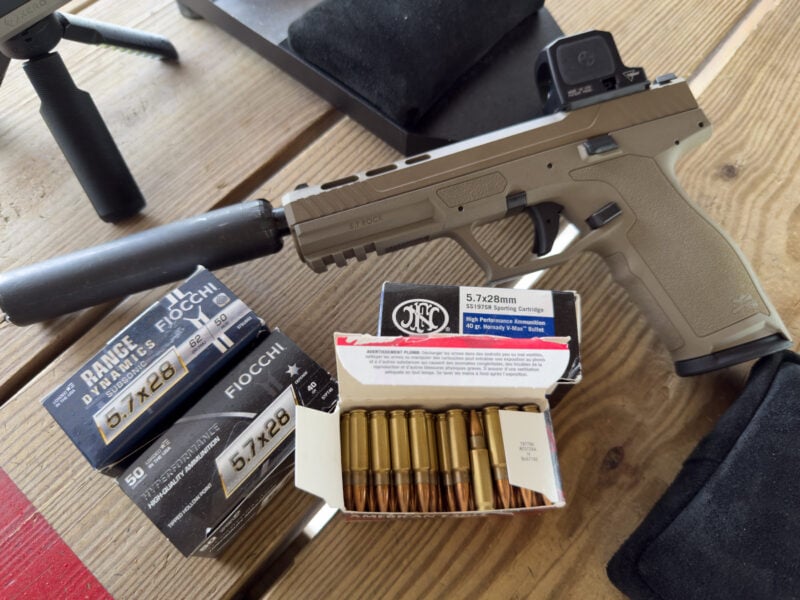
Quietly loud? This Palmetto State Armory 5.7 pistol sends tiny rounds downrange
at between 1,700 and 1,800 fps depending on the specific load.
At least the suppressor quiets it some!
In Part 1, Sound Science and the Real Numbers, we discussed the background of how sound works, specifically regarding firearm noise, and how we perceive it. Now it’s time to get into the facts and myths about suppressors and what they do.
And yes, we’re going to address the “Mine is as quiet as a mouse/bunny fart” claim. Yeah, just for fun. Read on.
How Suppressors Work
For a quick level set, let’s talk about balloons for a second. Fill one up and stick a pin in it, and it will make lots of noise, usually upwards of 150 dB. No powder, no fire, no firearm-ey stuff, yet it still creates a sound as loud as many guns. Now, do the same thing, but instead of the pin, let the air out more slowly. No “explosion noise.” It’s all about the speed at which that pressurized air is released. This is kinda what suppressors do. They tame the high-speed gas expulsion from the muzzle by redirecting it through baffles and the suppressor’s internals, slowing it, cooling it, and reducing the pressure at which it exits the suppressor’s front aperture. Of course, the firearm version of a balloon is a heck of a lot faster and way more powerful, so we can’t reduce the noise to balloon-hissing levels.
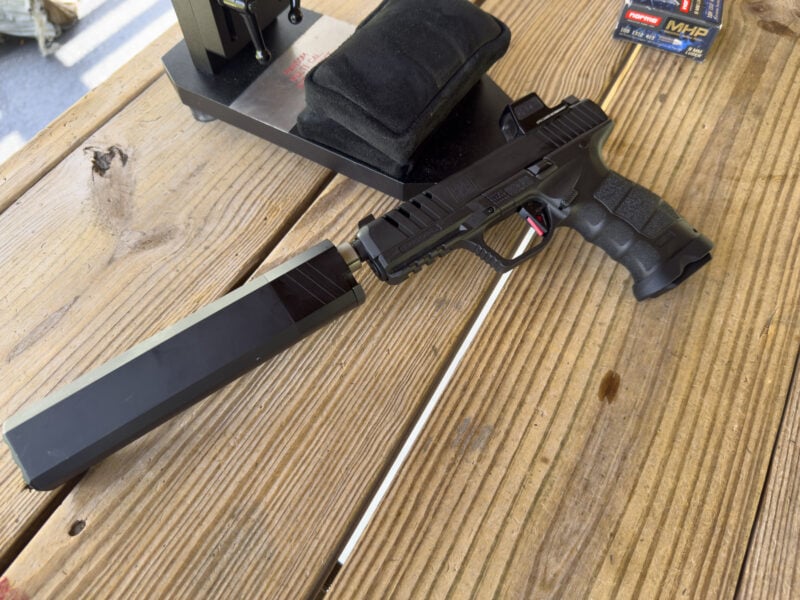
9mm is plenty versatile for suppressed use.
Many load and gun combinations are subsonic anyway, even if barely.
Here’s the important takeaway. While with some ammo and gun combinations, the mini sonic boom also produces gunshot-like noise, there’s plenty of noise regardless, even when everything is subsonic. Just like the balloon, there’s still a lot of rapid pressure equalization going on, which creates loud sounds. This is why .45 ACP pistols are still plenty loud, even though pretty much all of them (when using 230-grain ammo) operate at subsonic velocities.
Myth: But... Subsonic Ammunition!
That leads us right into myth number one. “Yeah, but when shooting subsonic ammo, there’s hardly any noise when using a silencer.”
Like most myths, there’s just enough truth to confuse things. Yes, when a gun-and-ammo combination produces supersonic velocity, there is an additional “crack” as the bullet breaks the sound barrier. This adds to the noise but does not define it, for the reasons we just discussed (the rapid equalization of pressure).
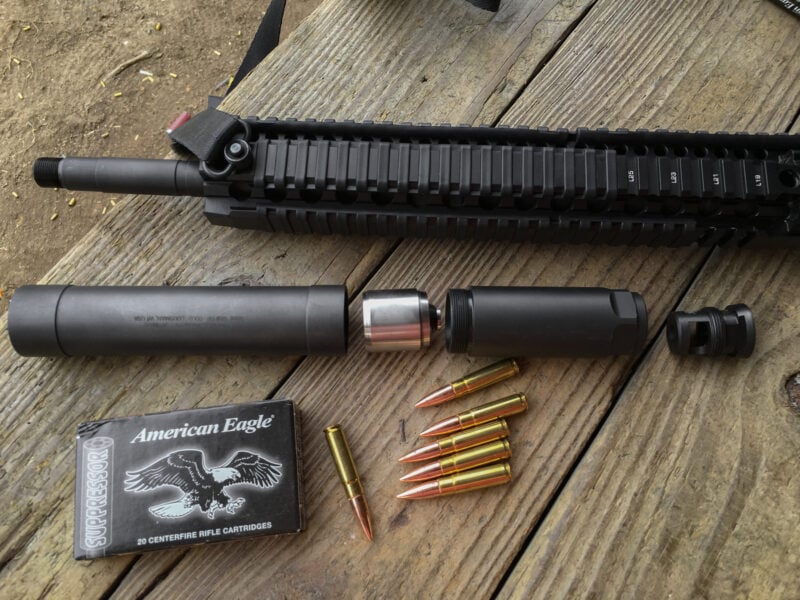
The mythical .300 Blackout with subsonic ammo.
More importantly, there is nothing magical about subsonic ammunition. For calibers that are normally supersonic (usually rifles and some handgun-caliber combinations), it’s just ammo formulated to run somewhere below the speed of sound (about 1,130 fps where I live). Additionally, some manufacturers produce subsonic ammunition with powder blends that create less residue, making suppressor cleaning and maintenance easier.
Here’s another consideration. Most pistol ammunition is subsonic anyway when fired from a handgun. While infinite variables apply, bullet velocity is largely related to not only weight and powder charge, but also barrel length. For example, I picked a couple of Doppler radar velocity measurements from my records for the same ammo fired from two different guns: CCI Mini Mag HV .22 LR 40-grain. From my S&W M&P22 Compact pistol, it averaged 753.7 fps (subsonic). From a S&W M&P 15-22 Performance Center rifle, the same ammo averaged 1,164.3 fps (supersonic). The difference is all about the barrel length of the gun in question. Whether the ammo box says it’s supersonic or subsonic is irrelevant in practical terms. It often depends on the gun from which you’re firing it.
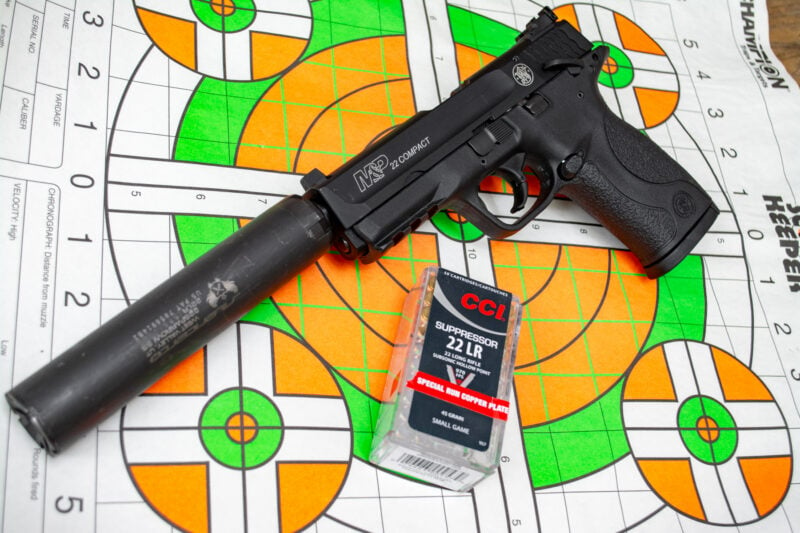
This CCI Suppressor load kept things in the mid-900 fps range from a rifle with a 16" barrel.
Most .22LR will be subsonic from handguns, as well as most .45 ACP and many .40 S&W options. The 9mm loads vary, with some being subsonic and others yielding supersonic velocity. Handguns = short barrel length = lower velocity. Remember, what’s printed on the box is irrelevant. The actual measurement from your gun is the real determinant. Many ammo makers use longer test barrels than what you’ll find in off-the-shelf handguns, and use those velocity numbers as the “box” specification.
Myth: I Measured Mine, and...
This one pops up frequently. A challenger to the science of all this will confidently proclaim something like, “I measured my Subsonic (fill in the blank), and it only generates X decibels.” The problem is that most home measurements rely on the tools we have handy, like smartphones.
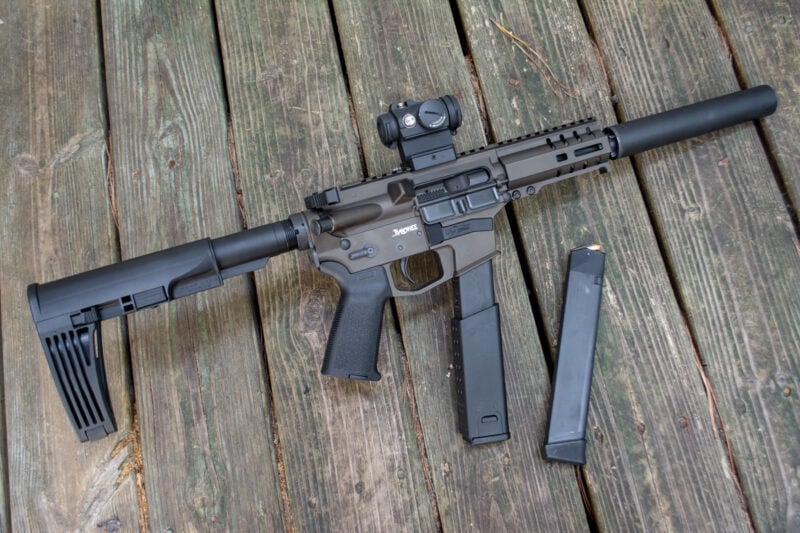
Even from this CMMG Banshee with its longer barrel, all standard (185-230-grain)
loads tested were easily subsonic anyway.
Your phone’s microphone is built for voices, and it maxes out somewhere around 100 to 120 dB, well short of a gunshot’s level, suppressed or not. Point an app at a muzzle, and the mic simply saturates and flatlines, the same way a bathroom scale gives up under a truck. It gets worse: a gunshot peak lasts only a couple of milliseconds, but sound apps average over much longer windows, so they smear that spike into a much smaller number. Your phone’s automatic gain control quietly turns down loud sounds, too, and the mic was never calibrated to begin with. Add it up, and a free app will cheerfully report 100-ish dB or less at the muzzle, which is comically wrong.
Real suppressor testing uses a calibrated peak-reading meter, mic placed to a strict military spec, recording the raw, unweighted peak. That’s the only way to get a number you can trust.
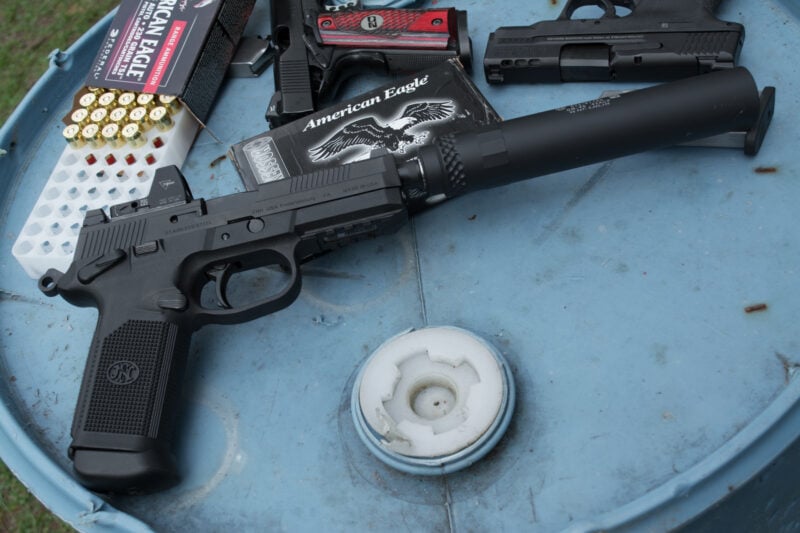
.45 ACP makes a great suppressed caliber. It's not quiet unsuppressed, but almost always subsonic.
Myth: But... .300 Blackout is "Dead Quiet!"
First, considering it’s primarily a rifle caliber, I’d certainly agree .300 Blackout is quiet! Not dead quiet in the literal sense, but as far as rifles go, normally printing audio signatures of 160+ dB, the Blackout subsonics offer an amazing improvement.
But the actual measured numbers may surprise you. A supersonic .300 Blackout load, unsuppressed, say something with a lighter side (faster) projectile, will generate between 160 and 167 dB. Pretty loud. The same configuration with subsonic ammo, and still no suppressor, brings the measured sound down to 150-160 dB.
The mythical .300 Blackout with subsonic ammo.
Now, add the magic of a quality suppressor, and things improve dramatically. Most suppressed configurations, using subsonic ammo, will print according to the microphone at 125 to 135 dB at the peak, and just for a couple of milliseconds. See Part 1 of this mini-series for more on that. A few of the newest and most efficient suppressors will bring that down even further, so the 118-122 dB range.
Great? Yes. Hearing safe in moderation? Also yes. Dead quiet? Not without a moderate dose of exaggeration.
Myth or Fact: Quieter Than the Action?
Here’s one that’s kind of interesting. Can your gun’s action be louder than the “shot?”
Maybe.
Sound is a funny thing and difficult to gauge with the human ear, so these numbers may surprise you.
• Firing pin or hammer fall: 70 – 100 dB
• Bolt or lever cycling: 85 – 100 dB
• Semi-auto action cycling (rimfire): 15-120 dB
• Semi-auto action cycling (AR-type): 110-125 dB
Considering a good .22 rifle, using subsonic ammo and a quality suppressor might get as low as 110 dB, there’s a bit of truth to this one. The gotcha is that few of us would recognize just how “loud” a gun’s action can be.
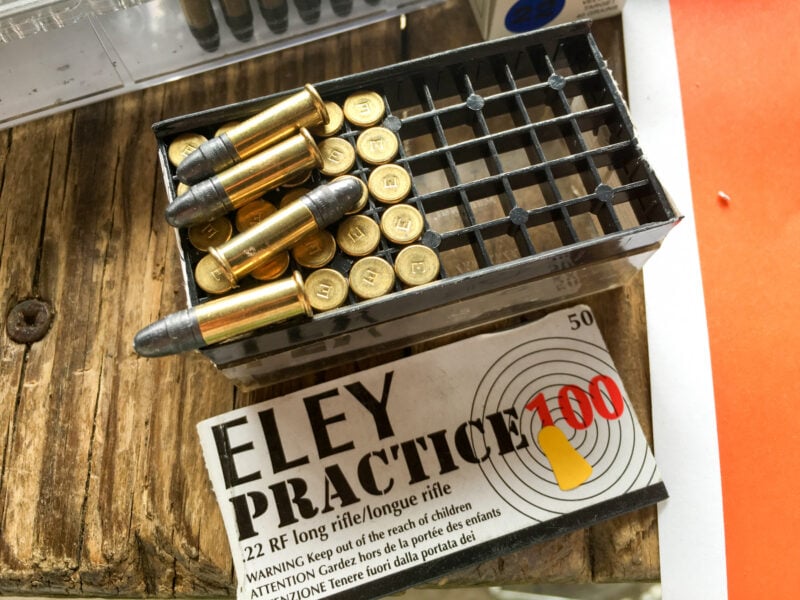
For .22LR, match ammo is almost always subsonic, especially when fired from a pistol.
This averaged in the 900 - 950 fps range, depending on which pistol I used.
Mouse Farts
Yes, I recognize and readily acknowledge it’s just a figure of speech, but since we’re hitting the silencer myths head-on with reckless abandon, I went “there” and dug into the science.
Unfortunately, there is no published and peer-reviewed study on the decibel level of mouse and bunny farts. I did find one where the composition of said gases was examined in detail. Yes, really. Your tax dollars at work. Anyway, we’ll have to use the powers of computational forecasting. The best estimates science has to offer are as follows:
Mouse gas passing: 0 to 10 dB. That’s right on the cusp of human hearing capability, so for practical purposes, we probably can’t hear it anyway. And given the minute volumes of material involved, it’s probably not detectable by the nose either.
As for bunnies, the computers calculate a probable range of 10-25 dB, and maybe as high as 30dB given perfect conditions. I have no idea what “perfect conditions” for this kind of thing are, so we’ll just roll with it. That sound level is in the range of human whispering, so if you have a rabbit, turn down the TV and listen closely.
Sadly, no suppressor-and-caliber combination comes anywhere close to this range, as the lowest I can find in all my research is still in the 110 dB neighborhood.
Figure of speech busted, I guess?
Get more exclusive online content from American Handgunner delivered straight to your inbox. Sign up for our free American Handgunner Insider newsletter.