Silencer Myths: Part 1
Sound Science And the Real Numbers
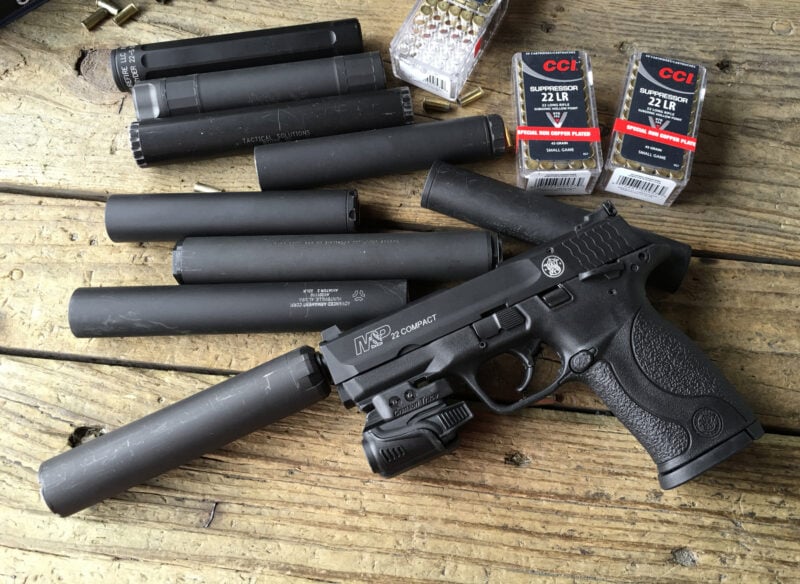
Several years ago, I did a rimfire suppressor roundup.
None were "movie quiet" but different designs and brands
did create different sound profiles. Tones, if you will.
The idea of writing this story became blindingly apparent when I recently made the mistake of discussing some kind of fun, tongue-in-cheek (but true) facts about suppressor myths. On the plus side, I managed to find every Call of Duty player in the known world. I know this because, while some actually owned silencers or had shot them, many others were regurgitating internet hearsay. One guy even quoted “facts” from a TV crime drama called “Burn Notice.” If you’re looking for new challengers to take on in Modern Warfare, Internet Rage Edition, call me. I’ve got their names.
The long and short? Suppressors are not silent like Hollywood portrays. That mousebreath “phfft?” Not real. If you own a suppressor or three, you know this, even if you won’t admit it. They do make noise. Because physics. If we have, in fact, had alien visitors, they’ve violated the laws of physics as we know them just to get here, but so far, no human in the history of forever has managed to do the same, and none of our suppressors have either. I think the root cause of the arguing might be that we are super proud of things we’ve spent lots of money on, and, as humans, we like to embellish to reinforce that pride, so we say things like:
Mine is dead quiet.”
“The only noise is the bullet hitting the berm.”
“The only sound is the action.”
“You can’t hear mine from three feet away.”
You know the drill. The problem is, none of those subjective arguments so often portrayed as “facts” prove Jack squat. Subjectivity and objectivity are different words for a reason.
But if you’re really honest, and you think (and I agree) that suppressors are really awesome, they only dampen the noise of a gunshot. They do not remove ambient sound from the world around us. And, at risk of starting another war, if you shoot them enough without hearing protection, you will permanently damage your hearing. If you shoot suppressed occasionally, that’s much better. Hearing damage potential is not just a function of noise level but also of duration and repetition of exposure.
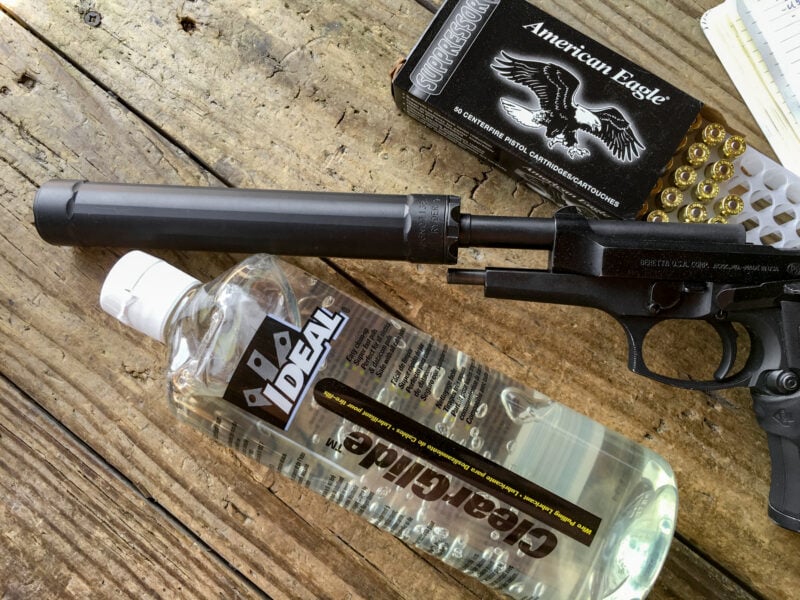
Don't ever use this with a rifle suppressor, but a bit of wire pulling gel
is a fun way to knock off a few more decibels of noise.
Ipso facto, e pluribus unum, this is as good a time as any to march forth into the jaws of internet myth and hearsay, armed with some actual science. Let’s go.
Oh, one more thing. We will stick to handguns since this is American Handgunner. We will touch on one exception — the .300 Blackout. Because that particular one was the source of all manner of ridiculousness and outright exaggeration.
Sound Science
Sound is just air getting pushed around. When something vibrates, a guitar string, your vocal cords, a bullet leaving a barrel, it shoves the air, and that push travels to your ear as a tiny change in pressure. More push, louder sound. We measure loudness in decibels, written dB.
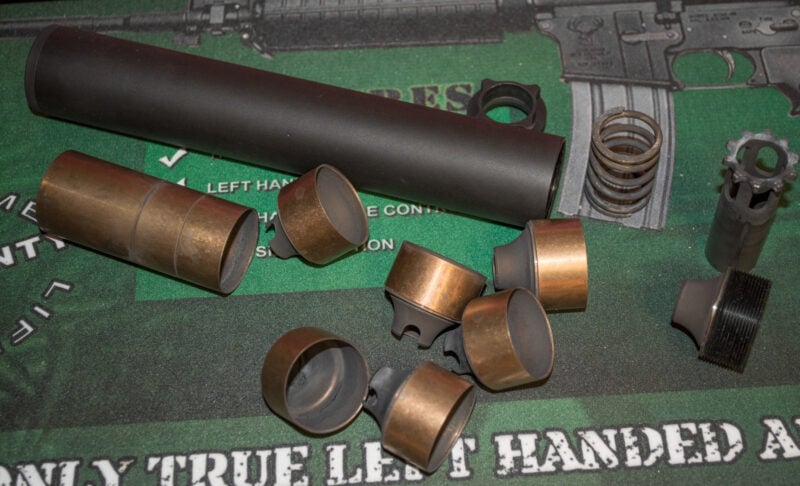
A typical pistol-caliber centerfire suppressor uses removable baffles to disrupt and slow the airflow.
Here’s the part that trips everyone up.
The decibel scale is not like a ruler, where 20 is twice as much as 10. It’s logarithmic, which is a fancy way of saying the numbers climb in leaps, not steps. Every time you add 10 decibels, the actual sound energy hitting your ear goes up ten times. Not ten more units. Ten times as much.
Crazy examples:
• 10 dB more = 10 times the energy
• 20 dB more = 100 times the energy
• 30 dB more = 1,000 times the energy
So the jump from a quiet library at 40 dB to a vacuum cleaner at 70 dB isn’t “a bit louder.” It’s a thousand times more sound energy. Your ears just don’t experience it that way. Your ear can handle everything from a pin dropping to a jet engine without melting, and the only way to pull off that range is to compress it.
Adding about 3 dB doubles the sound energy. Adding 10 dB makes it sound roughly twice as loud to your ear, even though the actual energy went up tenfold. (Yes, those two facts seem to fight each other. The first is physics, the second is your brain. Both are true, and the gap between them is exactly why people get decibels so wrong.)
Hold this thought, because it explains why we “think” suppressors are dead quiet, even though they still generate plenty of noise.
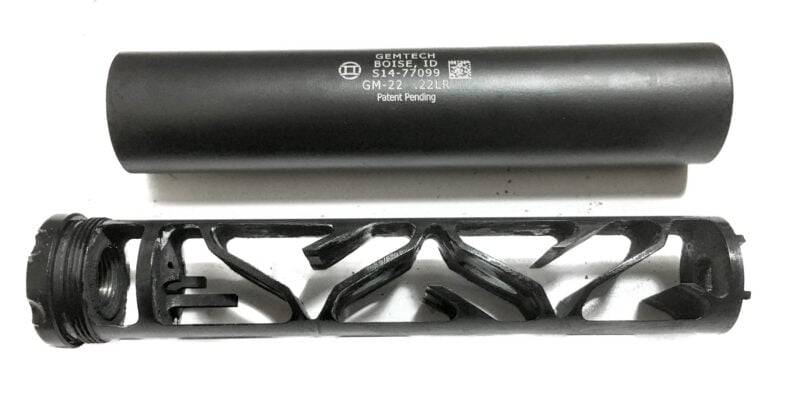
Most .22LR suppressors look something like this on the inside.
Breaking up the gas flow, and slowing it down, is what reduces the sound level.
Everday Noises
Before we go too far down this road, let’s set some baselines for reference. Here’s a list of common stuff we hear. These numbers are easily verifiable, so don’t take my word for it.
• 0 dB is the threshold of human hearing. Total silence, the quietest sound a healthy ear can detect.
• 10 dB is your own breathing, or leaves barely moving.
• 30 dB is a whisper across the room, or a quiet bedroom at night.
• 40 to 50 dB is a library, or a quiet house with the fridge humming.
• 60 dB is a normal conversation at the dinner table.
• 70 dB is a vacuum cleaner or freeway traffic heard from inside the car.
• 80 to 85 dB is a busy city street or a garbage disposal. This is roughly where sustained exposure starts to chew up your hearing over time. 85 is the line workplace-safety folks draw.
• 90 to 100 dB is a lawnmower, a motorcycle or a hair dryer up close.
• 110 dB is a rock concert, a jackhammer or a chainsaw. Minutes here, not hours.
• 120 dB is a jet taking off nearby, or an ambulance siren right next to you. This is the threshold where sound stops being loud and starts becoming pain.
• 130 to 140 dB is a jet engine at close range, or fireworks going off overhead.
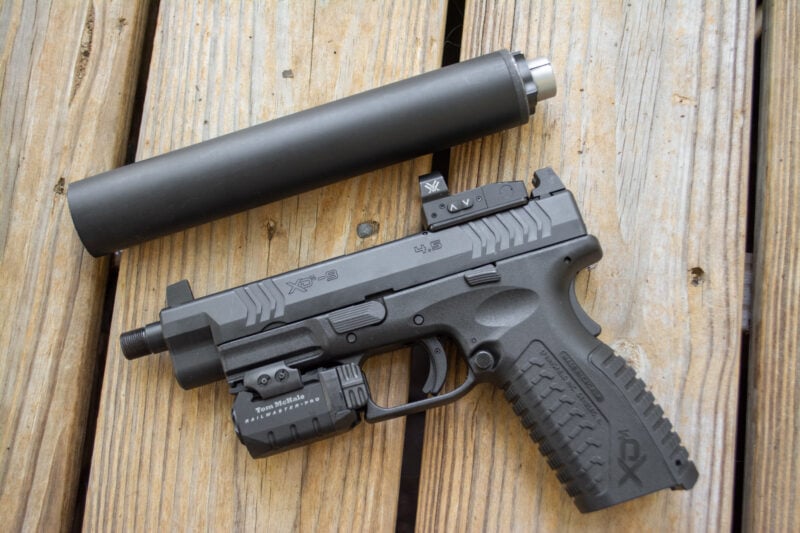
There are lots of variables, but a 9mm pistol, suppressed, will generally produce about 130dB of sound level.
The Real "Noise" of a Suppressed Gunshot
Hoo boy. Here’s where the arguing begins. Let’s talk about the real volumes of various firearm configurations. The numbers shown here are measured and documented by companies that design and manufacture suppressors. Not me. Not by me “listening” at the range. Not by my cell phone. By suppressor manufacturers using very expensive and very sophisticated sound gear under controlled conditions. Don’t take my word for it; the data is readily available.
Specifics vary with all the normal factors, including barrel length, ammo type, etc. Those factors will influence where in the range a specific measurement will fall.
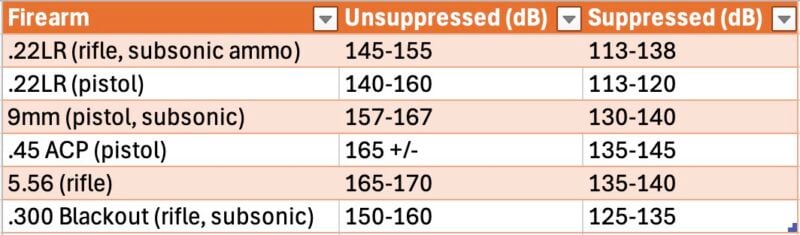
Because the .300 Blackout is the myth that won't die, let's dig in a bit deeper.
While the normal "suppressed" range is in the 130 neighborhood, there are some
newer cans that can reach down into the 118-122 realm.
Why the Confusion?
OK, so the science says a suppressed gunshot is as loud or louder than really loud things like rock concerts, nail guns and jackhammers. But many will argue to the death, “Not MY gun!” What’s the deal?
First, your gun IS louder. The science doesn’t lie about this. As it turns out, a gunshot noise is kinda like a really, really, really fast jet engine, jackhammer, or Van Halen concert. It starts and finishes before the first note of Panama is complete. Different perception by our human ears. If we could design a suppressed gunshot where the exact same peak noise level had a duration of a second or two, no one would argue about any of this. It passes quickly, so our brains don’t get as cranky about it.
Second, subjective measuring by the ear is flawed. Your ear judges loudness by averaging energy over roughly a tenth to a fifth of a second. See? Our brains do something useful. A gunshot peaks in a couple of milliseconds. A jackhammer lasts far longer than that, so you hear its full and proud loudness, and it’s easy for our feeble brains to judge and compare. A gunshot is so brief, not to mention fast and violent, it ducks under that averaging window, which means it can actually feel less loud from the shooter’s position than its true peak. But the peak noise is still there, and still dangerous with repeated exposure.
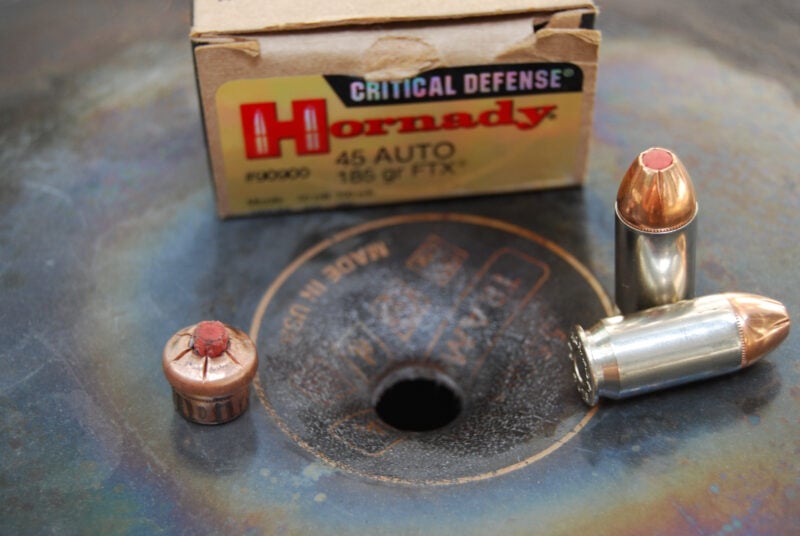
Even this "lighter" (for .45) 185-grain Critical Defense was easily subsonic, averaging 955 fps from a 1911.
Third, you should have a tiny muscle in your middle ear, the stapedius, that clenches when things get loud and dampens the sound before it reaches the delicate stuff. It’s a real protective reflex. The problem is it’s slow. It takes somewhere around 25 to 200 milliseconds to fully engage, depending on the intensity of the offending sound. A jackhammer pounds away for minutes, so the reflex clamps down and rides along, taking some of the edge off the whole time. A gunshot peak is over in one to three milliseconds.
Now, take all this and add the effects of distance from the source of noise. Sound from its source falls off by about 6 dB every time you double the distance. Also, the higher-frequency stuff tends to dissipate in the air more quickly than the lower-frequency noise. So, in simple terms, the nature of the sound we perceive changes as you move from the shooter to several feet away, to dozens of yards away. The result, with a bit of distance, is kinder, gentler and lower-frequency. Think more thump and less sharpness. Still noise.
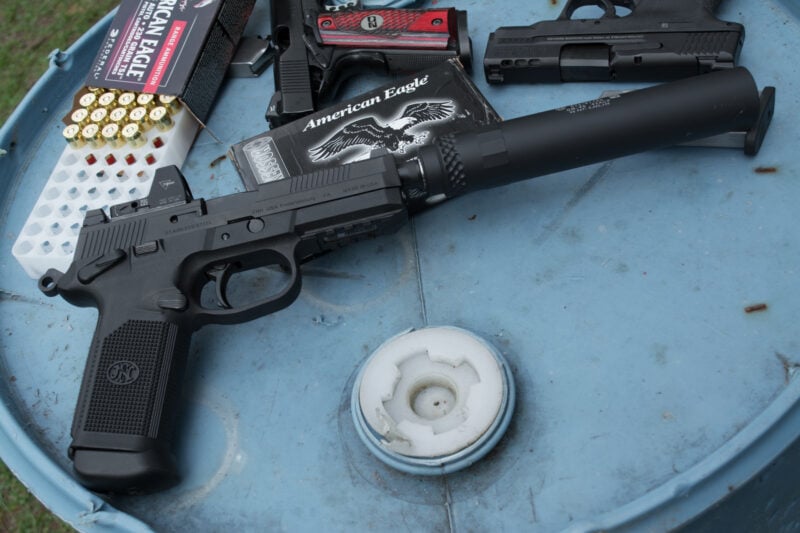
.45 ACP makes a great suppressed caliber. It's not quiet unsuppressed, but almost always subsonic.
The Point?
The main point is this. While we can argue till Chuck Grassley or Mitch McConnell leave politics, suppressed gunshots make noise, and plenty of it. It’s a fast experience, but therein lies the confusion and potential danger.
Let’s be clear: suppressors are a great benefit to hearing safety. I am all for wider use. Knocking 30 or so dB off an unsuppressed gunshot is a big deal. Remember that whole logarithmic scale concept? You can think of a suppressor kind of like a set of ear muffs. Many of those reduce sound levels by 25dB or so as well. Great stuff! Just be careful out there if you shoot suppressed a lot without additional hearing protection, especially at an indoor range or training facility.
Hold these thoughts. In Part 2, we’re going to dive directly into the myths and bust some of those “internet facts.”
Get more exclusive online content from American Handgunner delivered straight to your inbox. Sign up for our free American Handgunner Insider newsletter.