Flattening Recoil:
The Ported CZ P-10 C in Action

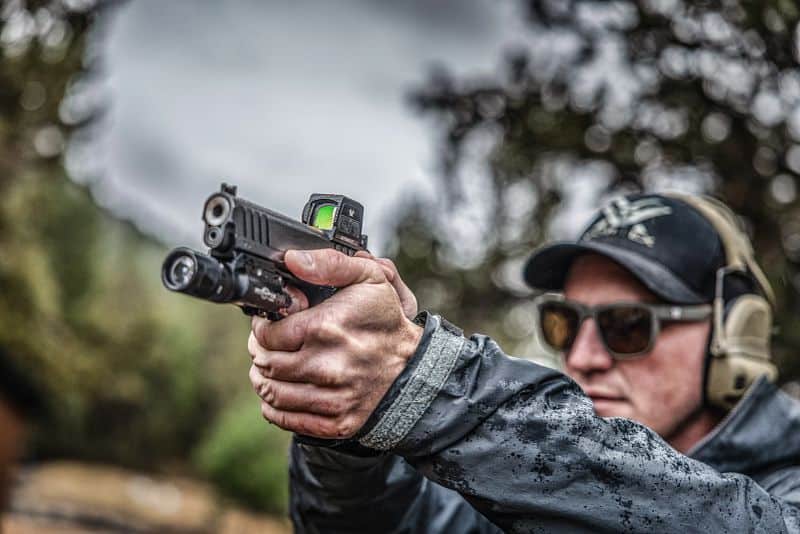
The P-10 C Ported is ready for gear, both up front and on top if you like optics.
The CZ P-10 C Ported is all about continuing to transfer lessons and features from the competition ranges to the street. After all, shooting accurately, under precise control, and fast are desirable attributes for both use cases.
Taming the Recoil Monster
The P-10 C Ported model is all about taming the beast in a carry gun platform. When stress is off the charts and every shot must be fast and on target, recoil is not your friend. Even in the friendly 9mm platform, and even with perfect grip technique, the muzzle will flip with each shot. How much depends on grip strength and technique, but the underlying cause is still there.

The front sight is set back just enough to allow room for the ported slide.
And remember, a self-defense encounter using a smaller carry gun doesn’t provide the luxury of getting set in your stance, assuming a perfect “range time” grip and preparing for one or multiple shots. You don’t even get to decide whether or not you can use both hands to shoot. You might be fighting off an attacker with the other, holding a child, pushing a loved one aside, calling for help, or a million other things. Your ability to execute the perfect range technique in a defensive encounter isn’t up to you; it’s determined by the nature of the event and your attacker’s actions.
Bottom line? Building in features to help shoot flatter with less work required to get back on target is not a bad idea.

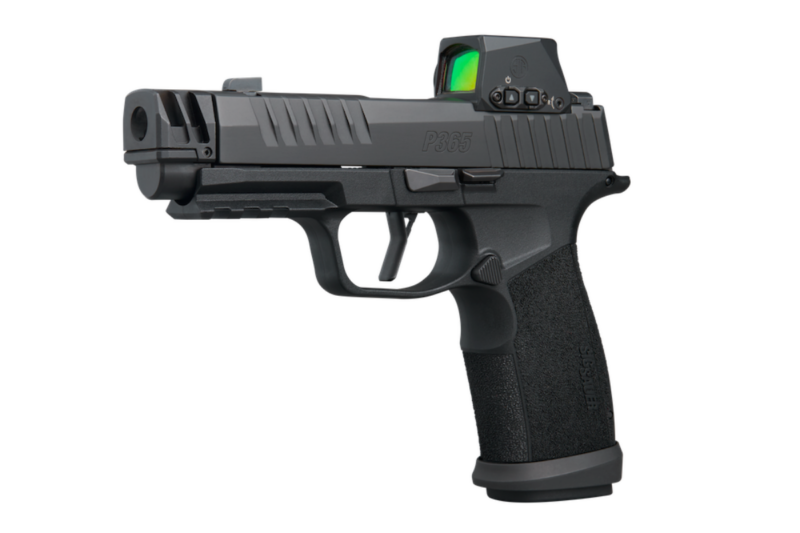
Note the generous port in the barrel. The design is not an "add-on" extension, but built into the slide.
There are two features built into the CZ P-10 C Ported that help achieve this goal.
First, as the name implies, there’s a large port cut in the very front of the barrel along with a corresponding cut in the top of the slide, just forward of the front sight. Just to be clear, the compensator design isn’t an add-on extension. The slide is a one-piece unit with the compensator port cut into it. The front sight is simply moved back to a position just behind that port. When that massive volume of hot gas exits the fiery end with each shot, some of it is directed straight up. Like a miniature rocket engine, this subjects the front of the pistol to the immutable laws of physics. That force pushes the muzzle down as it wants only to move up. And it works — the effect on the range is noticeable.
The second factor is more subtle and an “assist” to the first. The barrel in this ported model is 10% heavier than that of the non-ported model. Every little bit helps!

The CZ P-10 C Ported comes with two 15-round magazines.
Configuration
The P-10 C model is sized for easy carry with its 4” barrel, putting it with the compensator up front, right at 7.3” overall length. As a comparison, the standard full-size P-10 F without the compensator is 8” even.
It’s a double-stack pistol that comes with two 15-round magazines, so the carry capacity is right at 16, including the one in the chamber. The P-10s include trigger block, trigger bar and trigger safeties for safe, chambered carry of this striker-fired pistol. The double-stack, 9mm design puts the width right at the very standard 1.3” width, so nothing unusual there.

The P-10 C Ported is well-proportioned for carry. It's about 3/4" shorter than the full-size model
owing to the space for porting up front.
The P-10 C Ported is well-proportioned for carry. It’s about 3/4″ shorter than the full-size model owing to the space for porting up front.
The P-10 C Ported comes ready to go for forward and rear accessories. It’s got a rail up front for light or laser mounting, and it’s optics ready.
As for ergonomic features, this model comes with two extra backstraps to help you position your hand correctly for the gun and trigger reach. The texture is “good aggressive” with small square “studs” covering sections of all four sides of the grip. It’s sticky in the hand and doesn’t want to move during shooting. Serrations for slide manipulation are on the rear and up front, with side and top cuts in the front sight area.
The sights are luminescent. Hit them with a light and they’ll glow green for a while. In the daylight, you’ll notice a light green tint in the dots centered on the sight posts and flanking the rear sight notch. Both front and rear sights feature horizontal grooves to reduce glare.

This model comes with two additional backstraps to customize fit, two magazine base extensions
and a nifty, self-contained cleaning kit.
Range Performance
Right off the bat, after checking to make sure it was adequately lubed and ready to go (I added a bit in all the right places), I wanted to shoot some casual freehand, focusing on the feel with the compensator system. Wow! What a difference. Obviously, 9mm isn’t going to knock you down, but with a moderate or less grip, and especially when shooting one-handed, you will get muzzle flip with each shot. How much depends on you and your technique. I have to say I was surprised at the difference the compensator made. I was shooting a SIG P229 Legion in the same outing, and while that’s a metal gun and heavier, I could really tell the difference from the ported barrel, especially when shooting one-handed and especially when shooting with my support hand only.

Both front and rear sights have luminescent inserts and horizontal grooves to reduce glare.
Some are concerned about the flash coming up from the port, but I’ve never been able to see that on any ported pistol in the daytime. Maybe if I tried really, really hard to see it, but it’s not something that’s going to interfere with your shooting. As for night shooting, I’ve never found porting to be materially different from non-ported. A non-ported pistol will make a basketball-sized fireball in front of the muzzle, too, so it’s not like ported blinds you and non-ported doesn’t.
Bottom line? When shooting at night, I don’t see the flame, and it certainly doesn’t blind me, shooting with either configuration. I’ve done plenty of shooting in the dark with ported and non-ported pistols, and when firing, I can’t tell the difference. Your mileage may vary. Just don’t blindly (see what I did there?) accept the “ported guns will destroy your night vision” comments that tend to fly around on the forums. Try it sometime and see for yourself.
Back to the range. This is an easy gun to shoot well. The iron sights are excellent for factory standard. The rear sight is cut with a U-notch, so it’s fast to pick up and center.
The trigger has a very short reset, about .15” according to the company. My wooden desk ruler isn’t that precise, so I’ll take their word on that measurement. The weight is fine and perfectly appropriate for carry and defensive use. With a Lyman Digital Trigger Gauge, I measured it right at 5 pounds give or take a couple of ounces either way with multiple tests.
As for accuracy, I set up at 25 yards and shot some five-shot groups over iron sights using Nosler’s ASP (Assured Stopping Power) 115-grain defensive ammo. Over multiple five-shot strings, groups hovered right at the two-inch mark. Given the round shapes of the groups, the pistol is doing its job, with no horizontal or vertical bias. Next time, I’ll have to mount an optic, and I’ll bet I can shrink those by taking my eyes out of the equation.
All in all, I liked the P-10 C Ported. While it’s no pocket gun, and the non-ported version would be just fine to shoot in volume at the practice range, the porting adds a noticeable amount of comfort to the experience.
For more info: CZFirearms.com, Nosler.com
Get more exclusive online content from American Handgunner delivered straight to your inbox. Sign up for our free American Handgunner Insider newsletter.