Get The Lead ... In
Lead Bullets Launched from Sixguns Do The Job
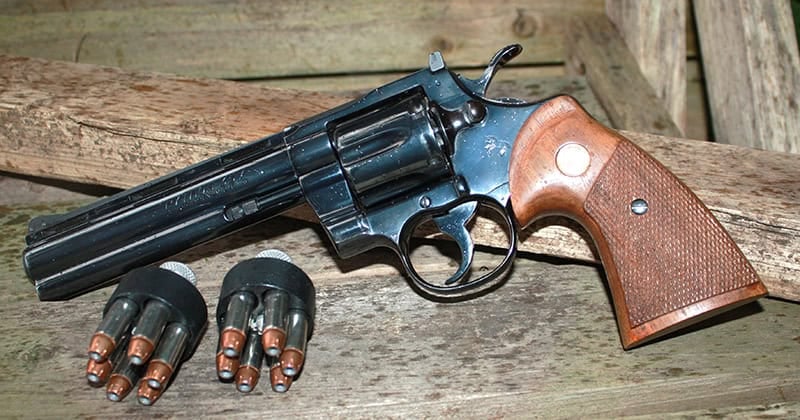
Dave’s vintage Colt Python, wearing a splash of Northwest rain, got a big warm hug
after he watched the opening scenes of a 1980’s action flick in
which the hero carried one in an upside-down ankle holster!
A good story always starts at the beginning, but in this case, there were actually two beginnings, one involving an old Burt Reynolds cop flick and the other a remarkably timely discovery of two boxes of Black Hills .357 Magnum ammunition topped with 158-grain LSWC bullets.
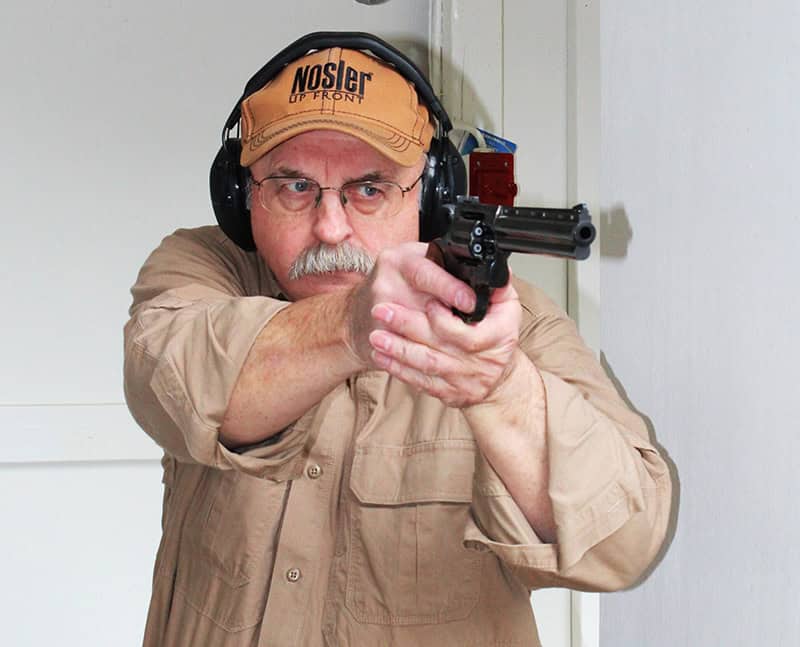
The Colt Python is one of the most recognizable handguns on the planet.
Dave takes his to the range regularly, and he doesn’t loan it to Hollywood actors.
One evening a few weeks ago, I stumbled across the 1981 Reynolds movie titled “Sharky’s Machine,” set in Atlanta, and featuring Burt as an undercover detective working narcotics during the opening scenes. The first ten minutes of this early 80s action film shows Reynolds taking cover during a drug bust gone very bad, and after diving over a barrier, we see him reaching up his pantleg to retrieve a Colt Python with a 6-inch barrel from an upside-down ankle rig.
The bad guy, played to the menacing “T” by the late, great Hari Rhodes, flees from the shooting, commandeers a metro bus, takes hostages and Reynolds goes in foot pursuit, finally getting aboard the bus where he ultimately puts four slugs into Rhodes. End of the first segment, designed to convince the audience that Burt’s cop, Sgt. Tom Sharky, is the ultimate badass. After all, who carries a cannon like a 6-inch Python in an upside-down ankle holster, huh?
Aside from the fact that Sharky’s ankle rig is a horrendously stupid setup, in my humble opinion—a loaded Python with a 6-inch barrel weighs somewhere in the neighborhood of 3-plus pounds, which is a drag on anyone’s ankle, and drawing reliably under stress only works well in movies—what he does with that gun caused me to wince. As he chases the hijacked bus, he has his sweaty hand wrapped around the frame and cylinder. Prior to that, he does some stunt rolls during which he could have dropped that beautiful wheelgun (and maybe he did during outtakes).
And let’s just consider this setup. In real life, carried down there near the ground, that Python is going to end each day covered with crud. It might even suffer some rust and/or corrosion in the action. The adjustable rear sight might get broken. Oh, the humanity!
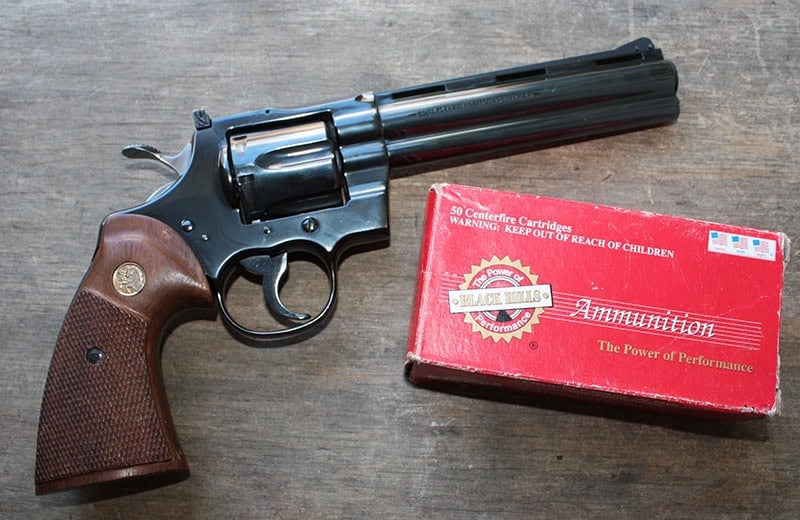
The discovery of 2 boxes of Black Hills .357 Magnum ammunition with 158-grain
semi-wadcutters got the author’s juices flowing.
Surprise Discovery
So, a couple of days after viewing the movie, I’m rummaging around in my workshop above the reloading bench and my gaze locks onto two red, and a bit aged, Black Hills cartridge boxes which I’ve probably looked at a hundred times without paying close attention. C’mon, we all do that at times. This time, BINGO! I hit the Mother Lode because there before me was 100 rounds of the aforementioned Black Hills .357 Magnums.
Now, my early 1980s-era Colt is delightfully accurate with 158-grain Hornady XTPs propelled by a healthy dose of H110, but it had been a very long time since I put lead down the bore. I’ve been shifting my .41 Magnum loads to 215-grain lead SWC bullets from Rim Rock over in Polson, Montana, launched with 16.0 grains of Accurate #9, and the load is accurate enough to hit chunks of orange clay targets at 25 yards repeatedly. It’s quite a departure from the 210-grain Nosler or Sierra JHPs I’ve been shooting for several years, over the H110 or Hercules—and now Alliant—2400, when it’s available. I’ve used JHPs to anchor or finish off three different bucks over the years, so their performance is simply without question.
Likewise, I’ve got a good supply of .38 Special cartridges with 158-grain LSWC bullets for use in either my Smith & Wesson or Colt Diamondback revolvers, pushed along by HP-38, and I’ve had very good luck with Black Hills factory lead bullets in my Ruger fixed sight Single Six in .32 H&R Magnum.
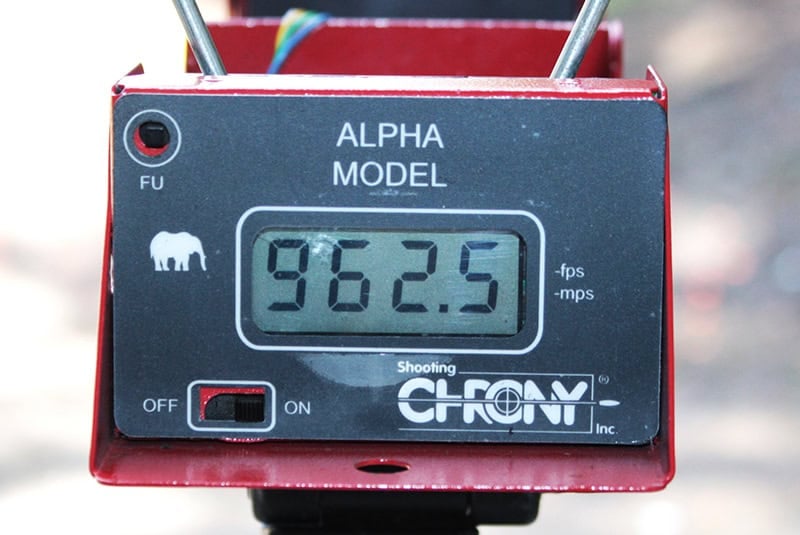
Dave wasn’t surprised or disappointed by the velocity he experienced with the lead loads.
It’s still plenty fast to stop a rabbit or coyote.
So, with my ammunition booty in hand, I beat feet to the range just to see how they did in my vintage snake gun. I discovered they shot slightly low and to the right of the bullseye—my JHP loads shoot into the bull most of the time—but the group was impressive. I may have to get hold of Black Hills to find out what bullet they’re using, and maybe even the propellant, and adjust my sights accordingly before the fall hunting season kicks in, so I can polish off a rabbit or coyote.
I was delighted with the Black Hills load, which delivered a mild recoil and clocked an average speed of 962.5 fps, which is plenty of horsepower to but a bunny in the bag. My 158-grain JHPs warp along at just under 1,300 fps, with a noticeably stronger recoil. A full-house .357 Magnum launched from a 6-inch barrel can put down a whitetail or blacktail buck, or black bear.

While the lead pills shot low and right, they produced a nice group, which is what really counts.
A simple adjustment of the rear sight will solve this problem.
Hot Lead
Several of my pals have also started gravitating toward lead projectiles, and I know one guy who, like me, also shoots a Model 57 S&W in .41 Magnum, and who remarked to me last summer that his gun has never seen a jacketed bullet. I’m not certain about his lead bullet hardness, but I know his propellant charge, and he has never complained about leading.
Historically, revolvers have all fired lead projectiles, and I’ve never doubted the ability of a lead pill to stop a game animal or a threat, so loading up with Black Hills 158-grainers, or brewing up some of my own, doesn’t bother me a bit. They’re great for practice, and a revolver fed a steady diet of mid-range loads pushing lead bullets shouldn’t malfunction if properly maintained.
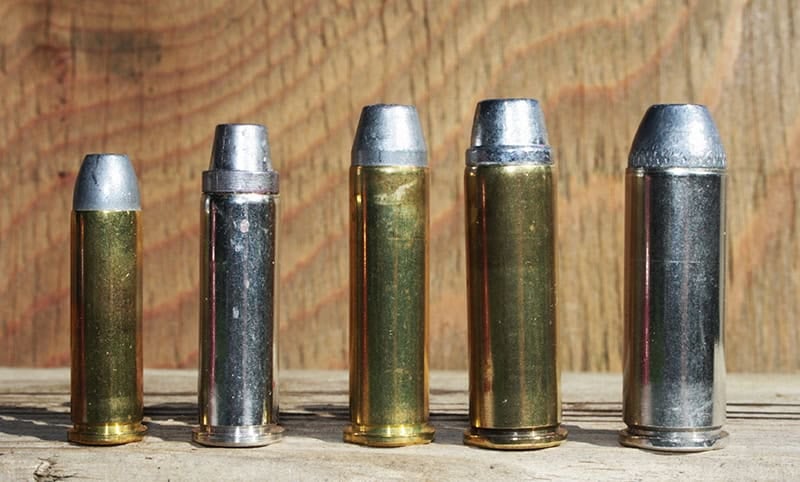
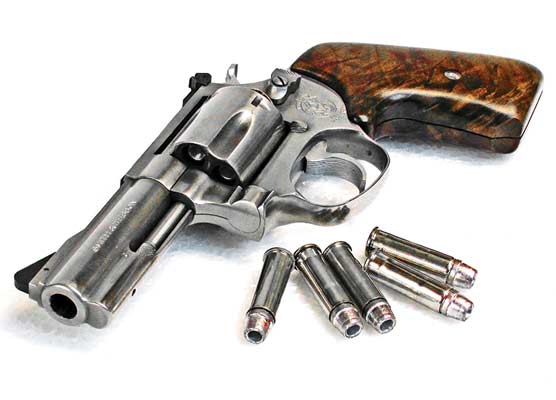
Dave is getting fond of lead projectiles for all of his wheelguns. From left, .32 H&R Magnum/90-grains;
.38 Special/158 grains; .357 Magnum/158 grains; .41 Magnum/215 grains, and .45 Colt/255 grains.
Where trouble begins is when somebody suffering from an overload of testosterone starts experimenting with “hot” loads just to see the results, and whether his sixgun can handle the chamber pressure. I happen to value my revolvers, not just as tools but as old friends. The Python, for example, has been with me to Idaho, Montana, Wyoming and Oregon, and it has never failed. I would no more mistreat that gun than I would kick the family dog.
Just to keep my revolvers running reliably, I will strip them down, pull the cylinders, clean and oil the crane/yoke and center pin/extractor rod around which the cylinder revolves and add a drop or two of oil into the action, and on the pawl/hand which comes up out of the frame to rotate the cylinder. I’ve been lubricating all of these parts with True Blue oil, but don’t overlook gun oil from Outers or Hoppes, or some other reliable brand.
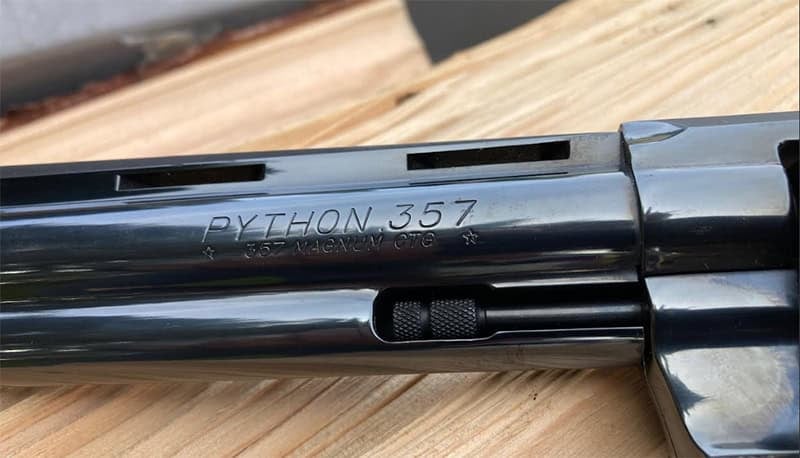
Despite being reintroduced with certain improvements, the classic Colt Python in Dave’s battery
is from the early 1980s. He doesn’t need to see it in a Burt Reynolds movie
to know this sixgun is a star performer.
Best Lead Bullet?
I don’t know there is such a thing as the “best” lead projectile. Some folks favor semi-wadcutters, others like round-nose bullets, conicals or such bullets with flat points. I use the latter in my .45 Colt reloads, and so far they’ve performed quite well.
Of course, lead bullets should be hard enough so as not to lead-up the bore, and there are several companies which commercially offer lead bullets for guys like me who don’t mold our own. The late Elmer Keith experimented with bullet design and composition, and things he discovered a century ago are considered to be the proverbial “gold standard.”
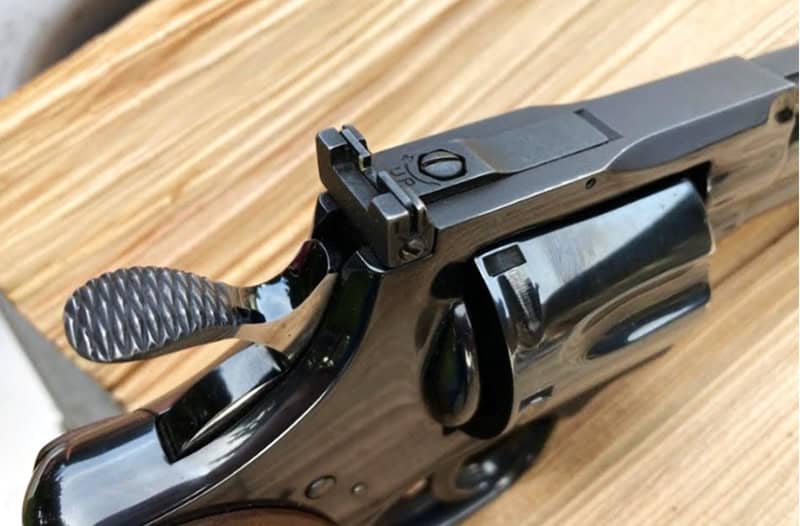
One thing which makes the Python a winner is the adjustable rear sight,
which author Workman considers top-of-the-line.
I’ve recovered a few lead bullets over the years, fired from single- or double-action revolvers and even some fired from semi-automatics. I can’t say any of them failed to perform. In addition to bullets from Rim Rock, I’ve also used .41-caliber SWC bullets from Stateline, and .45-caliber SWCs from Speer, or RNL bullets from Hornady. One of my pals sent a hundred 225-grain SWC bullets he personally molds for use in .41 Magnum loads, and they were satisfactorily accurate as well out of my guns.
Wheelguns in different calibers have served me well for decades, and America for almost 200 years, beginning with the Colt Paterson. I’ve carried the Python in either a belt holster or old Safariland shoulder rig with no complaints. Hereafter, it may be stoked with lead semi-wads instead of JHPs, depending upon the circumstances, and I won’t worry about delivering the goods, as one might say with a wink and smile.
Get more wheelgun content every week!
By submitting this form, you are consenting to receive marketing emails from: . You can revoke your consent to receive emails at any time by using the SafeUnsubscribe® link, found at the bottom of every email. Emails are serviced by Constant Contact