Not Quite a 1911 Convertible
The Argentine Ballester-Molina

The Argentine Ballester-Molina is a simplified 1911 derivative that
was used during WWII during the British SOE, their version of the OSS.
If imitation is the sincerest form of flattery, few handguns have been flattered like the 1911. Virtually every modern handgun incorporates some of the elements John Browning included in it, even “That One Pistol” everyone says is its nemesis. Some derivatives, of course, are closer than others, and that brings us to Argentina’s Ballester-Molina.
The first thing you’ll notice about the Ballester isn’t the spur hammer (most autopistols had them in those days), the slightly more streamlined triggerguard, or even how the slide tapers from rear to front, like a Hi-Power, but the cocking serrations, which are three groups of vertical serrations with smooth sections between. It would be SVI/Infinity, and later Cabot, before cocking serrations were that interesting again. The vertical grooves on the grips (originally wood, later black plastic) are also a dead giveaway.

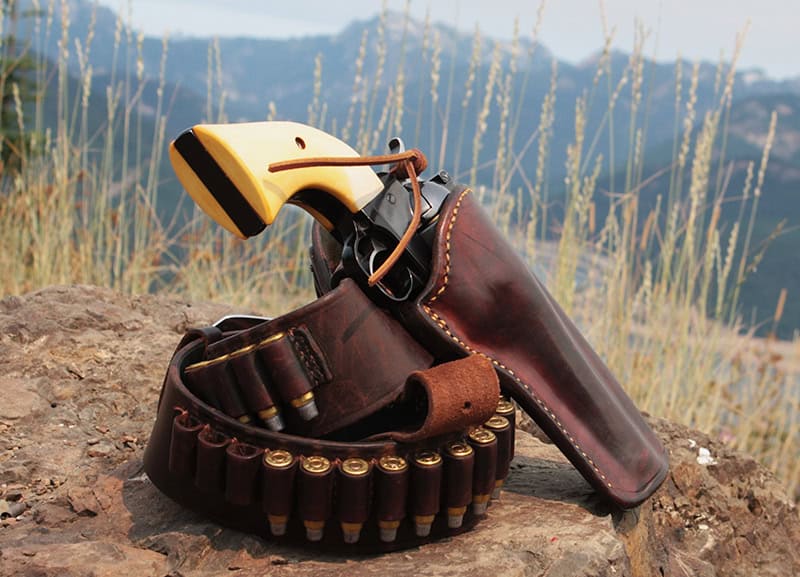
Argentina clearly loved the 1911, using both Colt 1911 and 1911A1’s
as well as the Ballester-Molina and their own 1927 pistol based on the
“Colt System,” usually called a Sistema Colt. This reproduction flap
holster by World War Supply is for the 1927, but is a natural fit for the Ballester as well.
Origin Story
Hispano-Suiza (“Spanish-Swiss” en Español), was founded in 1898 by a Spanish artillery captain who wanted to make electric cars. Manufacturing capacity being somewhat fungible, especially in a continent about to be thrust into flames for half a century or so, the company branched off into aircraft and military endeavors. This resulted in such diverse creations as a 20mm cannon licensed to the British RAF, a brake patent licensed by no less than Rolls-Royce, and ejection seats.
Clearly, such goodness couldn’t stay just on that side of the Atlantic, so in 1929 Arturo Ballester and Eugenio Molina created H.A.F.D.A.S.A. in Buenos Aires, Argentina, for the purpose of assembling Hispano-Suiza vehicles. Confusingly, among their employees was an engineer (and apparent relative), Carlos Ballester Molina.
Machine tools again being multi-use, in the mid-1930s, the company was approached by Argentina’s General Directorate for Army Materiel, the D.G.M.E., about manufacturing firearms, which the country did not yet have the ability to do at scale. One flare gun (copied from a German design) and one carbine (copied from a Beretta) later, the D.G.M.E. asked for a pistol along the lines of the Colt 1911s they had in service. These, the Modelo 1916 and 1927, were straight up Colt 1911 and 1911A1s, not to be confused with the decade-later Sistema Colt Modelo 1927, manufactured in Argentina under license according to the “Colt System.”

Hampel’s Woodland Products made him this custom case for the conversion
setup, similar to a cased 1911 and conversion made for an OSS officer. Special
Projects Editor Roy Huntington made a sledge-style hammer for the project,
carefully brazing a brass striking face onto the hammer, which he mounted
on a handle made from wood from his property.
Wartime Adventures
Part of the Ballester-Molina’s history is its use by the wartime SOE, Britain’s companion agency to the American OSS, for whom pistols were purchased in 1942. The big Argentine gun had a considerable power advantage over the FMJ-firing .32s and 9mm pistols of the day, without being traceable to the U.S. But when the British placed their order, steel was in short supply in Argentina, partially because of a naval blockade. This gives rise to one of the most intriguing legends about the Ballester.
In December 1939, the German pocket battleship Admiral Graf Spee was forced into port in Montevideo, Uruguay, after being heavily damaged by British warships. The Brits had taken the worst of the engagement, but from there they ran the table, using false radio transmissions to convince the Germans serious reinforcements were on the way. Unwilling to have the Graf Spee’s advanced technology captured, the captain scuttled it, whereupon MI6 promptly purchased the salvage rights through a shell company. Now they were in possession of the ship’s radar targeting system … and an enormous quantity of Krupp’s finest steel, which, the story goes, was used to manufacture the English Ballester-Molinas. Alex Gherovici’s definitive book, Military Pistols of Argentina, firmly disputes the story, but Michael J. Parker did a deep dive into the legend for American Rifleman about a decade ago, including metallurgical testing. I commend you to his article, which is easily found online. Suffice it to say, it may be a bit hasty to assume it’s only a myth.
That’s not the gun’s only surprise. I’ve long been a sucker for a .22 conversion, but it was only a few years ago I learned the Ballester-Molina had one. Like Colts of the era, it incorporates the same floating chamber designed by David “Carbine” Williams that amplifies the .22 LR’s recoil enough to cycle the heavy steel slide.

The Ballester-Molina has a spur hammer. Note the safety’s multiple
positions — in the middle position, the safety can be applied
and the slide still cycled.


Like Colts of the era, the Ballester-Molina barrel incorporates the same floating chamber designed by David “Carbine” Williams that amplifies the .22 LR’s recoil enough to cycle the heavy steel .45-sized slide.


The Marcati conversion uses a pinned-in breechblock that’s sized to fit a .22 casehead, offsets the firing pin to the correct height to hit the rim instead of a centrally located primer, and is further forward than a .45 casehead.
Rare Gear Indeed
Matt Olivier of M&H Classics is a fellow Gunsite Irregular and a heck of a handgunner with the unnerving (and dangerous-to-me) knack of usually having for sale whatever rare, fascinating piece of iron intrigues me at any given moment. I should thus not have been surprised when I saw he had a Ballester-Molina .22 conversion listed for the price of the much more common Colt unit. I was interested but not committed until I learned what he was selling was an already-converted pistol.
Ballester-Molinas in .22 come in two flavors: factory-built, a la the Colt Ace, and those converted after the fact. Most of the info I could find about the conversions seemed to be posted by collector Larry Stringfield, who reports that Industrias Marcati and Estableciminetos Venturini SA did these conversions.
Mine was manufactured in 1950 and is a former Buenos Aires PD gun, which appears to have been converted by Marcati. It was imported by the Gibbs Rifle Company (later absorbed into Navy Arms), likely after 1985. The conversion is simple: a rimfire breechblock is pinned into place in the slide, where it mates with a floating chamber barrel. Unlike most U.S. conversions, which have an ejector mounted to the barrel, the frame-mounted .45 ejector was modified by adding a strip of steel that’s both longer and sits further inboard to line up with the smaller diameter of the .22 casehead. A .22 magazine (which will not interchange with Colt Ace mags) completes the conversion. Stringfield posted that Venturini mags also will not interchange, as the ejector is incorporated into the magazine, which seems like a neat bit of engineering.

1911 lockwork (top) with simplified Ballester-Molina parts (bottom).
While the 1911 requires complex machine work, some of the
Ballester parts could be made with a file.

.22 conversion ejectors are usually connected to the barrel, as on this Colt (middle) and the FCW/Marvel (foreground). The Marcati Ballester-Molina conversion varies by adding material to the stock frame-mounted .45 ejector.

Due to the solid frame design which doesn’t allow room
for a full trigger bow, the Ballester-Molina has a pivoting trigger.

The Ballester-Molina ejector is a massive piece that spreads the width of the frame, forming a section of rail on either side of the gun.

The Ballester-Molina omits both the grip safety and separate
mainspring housing of the 1911, making the receiver a single, solid piece.
Retro Conversion
A gun that’s been converted can’t always go back, but I’ve seen enough multi-cals to think it was worth a try. Since only the barrel and magazine of a 1911 will interchange (supposedly an original design requirement) with the Ballester-Molina, I began the search for a parts kit. $227.22 and one Gunbroker auction later, I had a complete parts kit, minus receiver, for a .45 caliber Ballester-Molina made in 1943 for the Gendarmeria Nacional.
Once assembled, the top end slid on with a single obstruction — that ejector. I’m not one to question John Browning, but the Ballester-Molina ejector may be one place where they improved on his work. The tiny pin that holds the 1911 ejector in place provides endless opportunities to score frame rails and break 1/16″ punches, which I do like they’re free. The Ballester-Molina ejector, however, is a massive piece that spreads the full width of the frame, forming a section of rail on either side of the gun. Pin or no pin, once the gun is together, that sucker is not gonna escape. It’s also a firm fit and has to be driven out from underneath through the magwell. Being unwilling to batter it while swapping it out, I ordered a 6″ length of 3/8″ brass rod from McMaster Carr to serve as a drift. Since I planned on having a case made for the whole shebang, Special Projects Editor Roy Huntington made a sledge-style hammer for the project, carefully brazing a brass striking face onto the hammer, which he mounted on a handle made from wood from his property. As expected, the combination makes it simple to tap the ejector in and out of place to swap calibers. It also looks unbelievably classy.
During WWII, the OSS used Colt Ace .22s in training, and I ran across a photo of a case for an OSS officer that held both a 1911 and a conversion. Starting with that design, I sent a drawing and tracing of the pistol to Hampel’s Woodland Products to have a black walnut case made. Although they advertise English-style cases for percussion pistols, Hampel’s does custom work as well, and I’d been very pleased with a case they did for my second-generation Colt 1851 and its own Kirst .22 conversion. Turnaround and cost were both very reasonable. The finished case has sections for the pistol, .45 top end, magazines, and a pair of slots for the hammer and brass drift. It’s almost too pretty to take to the range. Almost. So far, it works every time in both calibers.
For more info: MandHClassics.com, HampelsWoodlandProducts.com, McMaster.com, WorldWarSupply.com