Ruger LCP MAX .380 with Manual Safety
It’s All in the Thumbs

Top, LCP Max with thumb safety, compared to first generation LCP, below with Crimson Trace laser sight.
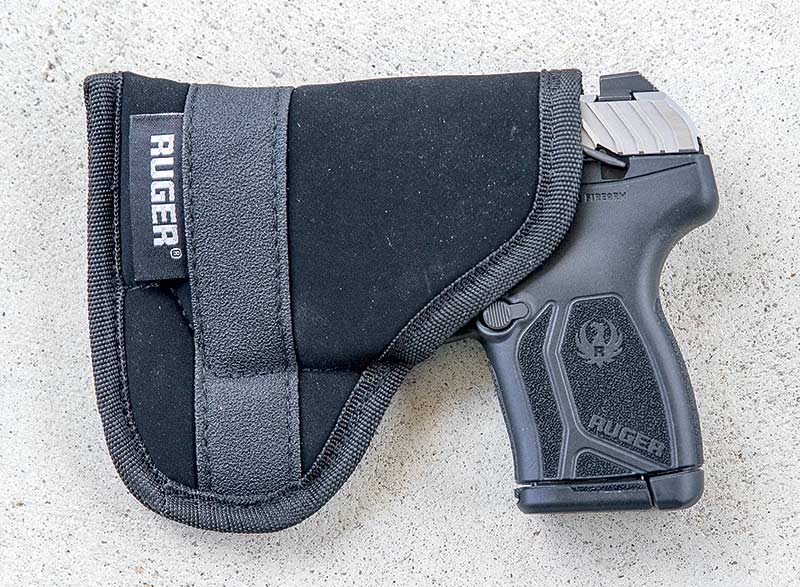
LCP Max comes with a fabric pocket holster.
Ruger’s LCP (Light Compact Pistol) in .380 ACP, an homage to George Kellgren’s P3AT design, was an instant hit the moment it was introduced and quickly rocketed to seven figures in unit sales. Over the years, Ruger added to the line. There was the LCP-II, which had an easier trigger pull. There was the LCP .22 LR for those who needed minimum recoil, or an understudy practice gun for their daily carry pocket .380. Most recently, Ruger introduced the LCP MAX, its cartridge capacity upped from the original single-stack magazine’s six rounds to 10 in a “stack and a half” format with a flush bottom, and a slightly extended 12-round mag.

Trigger reach was suitable for both long and short fingers.
Safety First
Now comes the LCP modification many traditionalists have called for: an LCP MAX with a manual thumb safety. The typical LCP format is point and shoot with no “safety catch” to wipe off. My LCP .22 has a sliding thumb safety (back is “on safe,” forward is “fire”) on the upper left of the frame. I found it a bit awkward and not at all intuitive. The thumb safety on this optional variation of the LCP MAX is much more ergonomic. It’s still located on the upper left of the glass-infused nylon frame, making it suitable only for right-hand use, unfortunately, but it works rather like a 1911 thumb safety under the thumb and is well placed. I found it easy and positive to off-safe, and just as easy and positive to on-safe.
The sights are as good as I’ve yet seen on an LCP. Up front is a big, blocky post with a large white circle inset, and centered therein is the good-sized green ball of a Tritium night sight. The rear sight rises considerably — to catch the eye without catching on the pocket when it’s drawn, thanks to its slanted back face — with a big U-notch. The result is a sight picture you can actually see at speed and/or in poor light. That’s a big plus for a defensive handgun, and my hat is off to Ruger for it.

Petite pistola: LCP Max in an average-sized adult male hand.
Gun In Hand
Like a lot of tiny pocket pistols, this one points low. I found myself cocking the wrists of my firing hand slightly to get on target and take advantage of those good sights.
Trigger reach was excellent, not too short for big hands nor too long for short fingers. The trigger itself is tabbed as a hedge against inertia discharge from the trigger moving rearward if the pistol is dropped or knocked from the shooter’s hand.
Typical of subcompacts, this one only allows two fingers of the firing hand on the grip. No biggie; just tuck your pinky finger under the magazine’s floorplate, bring it in tight (for sympathetic tightening of the other digits), and you’ll still have a solid hold.
This pistol’s trigger pull bears discussion. Ruger describes it as an internal hammer-fired, single-action, but it has a long stroke. Much of that distance is a very light take-up before it meets “the wall,” firm resistance. Then there’s a short roll, fairly smooth, and finally the shot breaks. Further rearward movement of the trigger, known as “backlash,” is prevented by an inconspicuous little stud in the inside rear bottom of the trigger guard, which acts as a trigger stop. There are different types of trigger stops in revolvers and semi-automatic pistols that can get out of adjustment and block the trigger; that isn’t going to happen with this simple little addition, which is molded into the frame and integral. Trigger reset is fairly long, but full forward trigger return is not required.
Pull weight was an average between seven and eight pounds measured from the center of the trigger, more like five to six pounds measured at the toe (bottom tip) of the trigger. Simple leverage with a pivoting trigger: the farther from the fulcrum, the less effort is required.
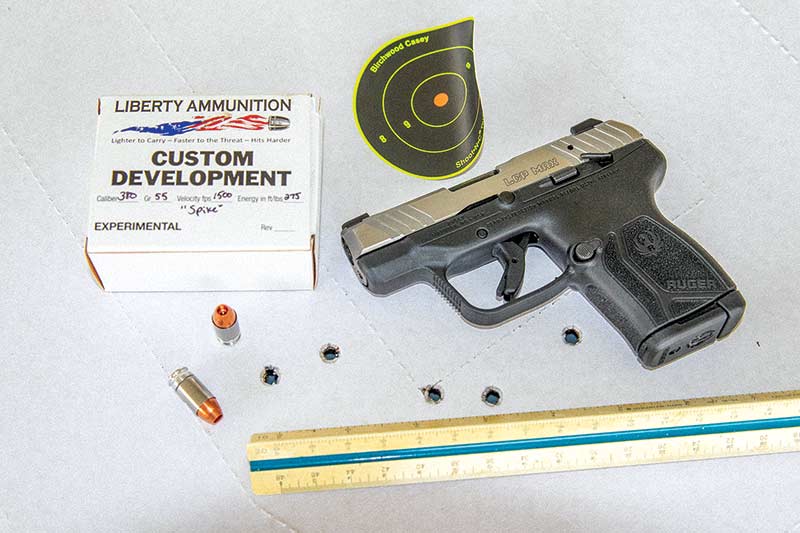
At 25 yards, LCP Max with thumb safety and five hits with
Liberty’s experimental 1,500 fps .380 load.
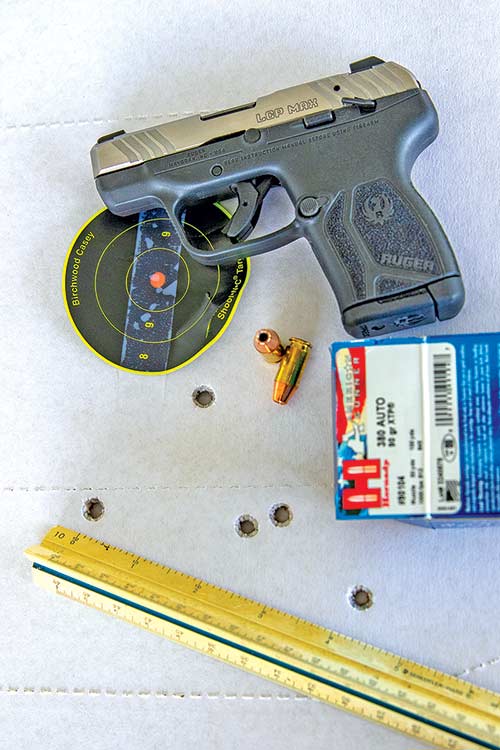
25 yards, LCP Max, Hornady 90-grain XTP JHP.
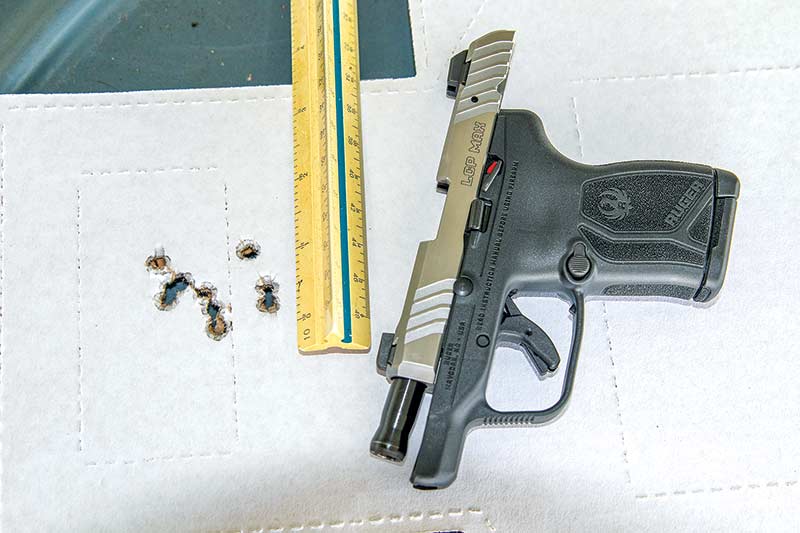
At 7 yards, here’s a 10-round magazine of head shots with LCP Max.
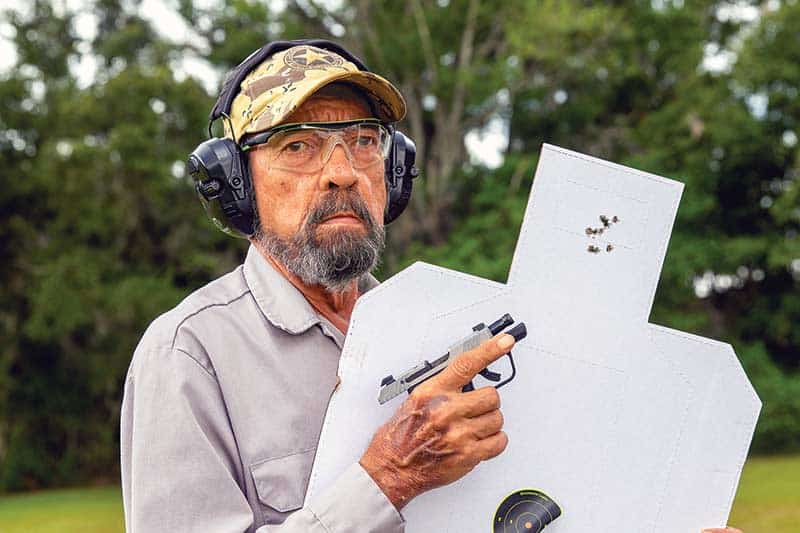
Mas found center head shots at 7 yards no problem with LCP Max.
Shooting The LCP MAX
LCPs have always had rather snappy recoil. What does one expect with a 10-oz. centerfire pistol? It’s manageable, though. The trigger pull takes a little getting used to, but hey, that’s part of the fun of a new gun anyway, isn’t it?
Accuracy? Let’s talk about perspectives. At the national bulls-eye championships, which are won or lost at the 50-yard line, Ruger pistols have been known to win the national title overall in the .22 stage, and Ruger’s GP100s give a good account of themselves in the revolver event. I once won a state shoot for cops in a 50-yard course of fire with my department-issued Ruger P90 .45 auto.
The LCP lives on a different page of the Ruger catalog.
On one hand, it is widely believed the minimum accuracy standard for a full-size police service pistol is five out of five shots in four inches at 25 yards. On the other hand, few expect that kind of accuracy from a tiny .380 pocket pistol such as the LCP MAX. That said, my sample, serial number 381577887, came surprisingly close.
The .380 ACP is on the ragged bottom edge of acceptable power level for a defensive handgun. There are three schools of thought on adequate ballistic power with this cartridge: full metal jacket “ball” ammo for penetration, jacketed hollow points for the traditional expanding bullet, and exotic conventional loads. I tried it for accuracy with one of each, on a day so humid I needed to Scotch tape Shoot-N-C bulls-eyes to the backer.
Hornady’s EXP bullet, a jacketed hollow point designed for deep penetration with some expansion, weighs 90 grains in the .380 loading and is spec’d for 1,000 feet per second muzzle velocity. It will sometimes, but not always, reach the FBI’s stated minimum of 12″ in their ballistic gelatin testing, and the rest of the time it comes close. It generally affords at least some expansion, though. At 25 yards from a Matrix rest on a concrete bench, it put five shots into 4.15″, with four of them inside the 4″ standard and the best three in 1.90″.
Another theory is that penetration is most important, so we should use ball. The 95-grain FMJ, like the Remington UMC I tested, will indeed go way beyond 12″ penetration, though it’s easy to forget that 95-grain FMJ is the round that earned .380 its reputation for dismal stopping power in the first place. In the LCP MAX, I couldn’t get five shots anywhere near four inches, though all shots would have been inside the 8″ diameter center zone of an IDPA silhouette target.
It’s hard to find an “exotic” load more exotic than my box of Liberty Ammunition’s all-copper 55-grain hollow point in a box factory-marked “Custom Development, Experimental,” promising 1,500 feet per second velocity and 275 foot-pounds of energy. Recoil was indeed snappy, given bullet speed more than half again greater than standard .380, and the group came close to the “service pistol standard” with 4.55″ for five shots at 25 yards.
All three loads shot low left. I was using a conventional post-in-notch sight picture. The Tritium dot sits well below the top edge of the front sight, and “driving the dot” for sighting brought elevation up where it needed to be. A close look showed the rear sight was very slightly left of center in its dovetail, accounting for the windage being off; that’s easily fixable by drifting it in the notch. No biggie.
We can see why so many gun magazines test these tiny pistols at close range, like seven or even five yards. Unfortunately, in the real world, the opponent decides the distance, not us, and we want to know where our pistol will put its bullets at longer ranges. At seven yards, the LCP MAX put a full magazine into the center head of an IPSC silhouette at seven yards, the group measuring an inch and a half.
Reliability? It’s always wise to fieldstrip and lubricate a new auto pistol before shooting. However, most of my readers don’t do that with new guns, so I don’t do it in testing, either. The gun was dry out of the box. At somewhere between 150 and 200 rounds, I had the only malfunction of the test, a failure to go into battery. I applied some Wilson Combat light gun oil, and there were no further malfunctions. Point taken, lubrication lesson reinforced.
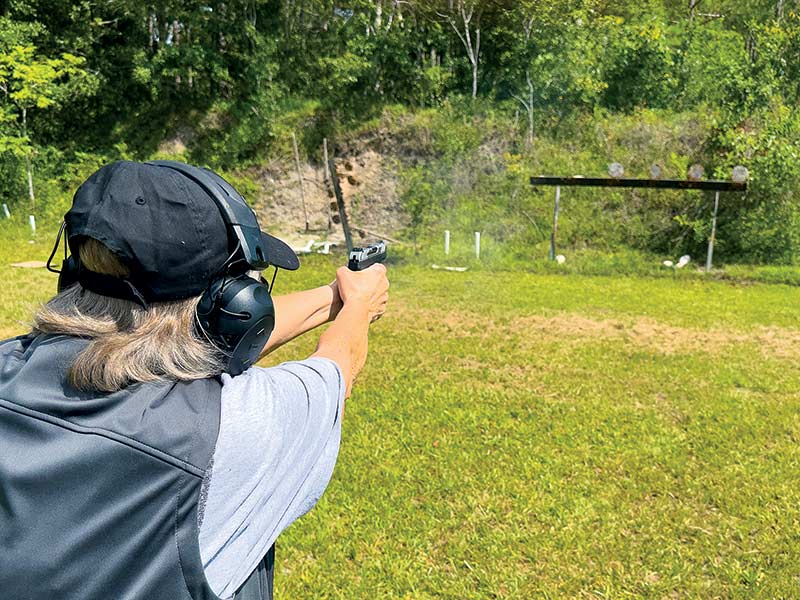
From 11 yards, Gail Pepin dropped 48
Bianchi plates with 48 shots with LCP Max.
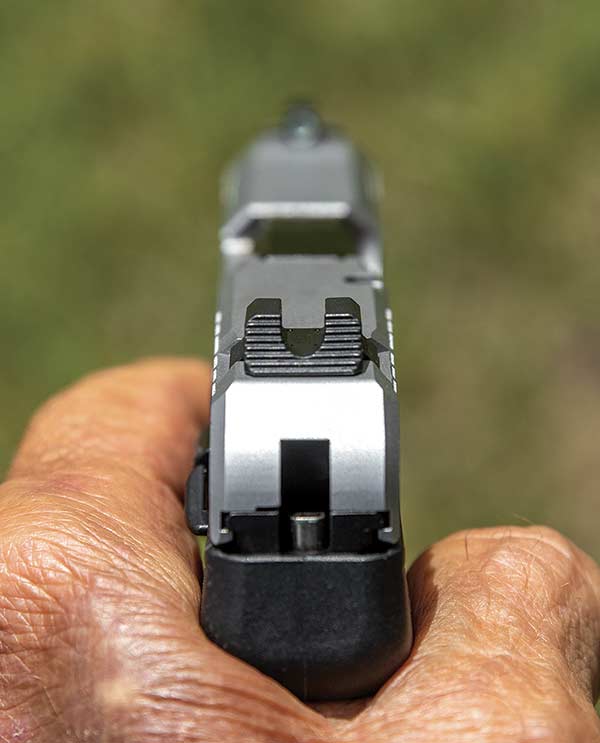
The rear sight was excellent for a pocket pistol.
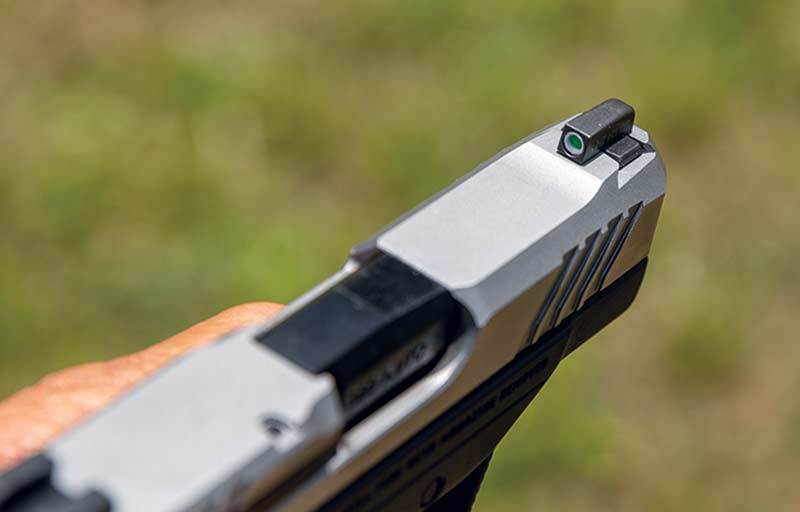
High visibility front night sight and front as well as rear slide grasping grooves are standard.
And About The Safety
Does the LCP need a thumb safety? Seven figures worth of them carried safely says “no.” Is the thumb safety desirable? That’s situational … and personal.
Ruger puts a nylon pocket holster in the box with every LCP because they know the dangers of someone being stupid enough to have something besides the gun in the same pocket, something that could get inside the trigger guard. Murphy’s Law and all that. Moreover, in a close-range fight, there is always the chance of a criminal opponent gaining momentary control of our gun. If it’s on safe, he’s going to have to find “the lever that turns on the killing machine” before he can shoot us with it. I’ve seen on-safe guns save a lot of good people in those situations over the years. I see it as a feature, not a bug.
Some cops and armed citizens like manual safeties, and some don’t. That’s why Ruger has given us a choice. And choices are always good.
At MSRP $379, the manual safety version of the LCP MAX upholds Ruger’s three-quarters of a century reputation of good value in good firearms.