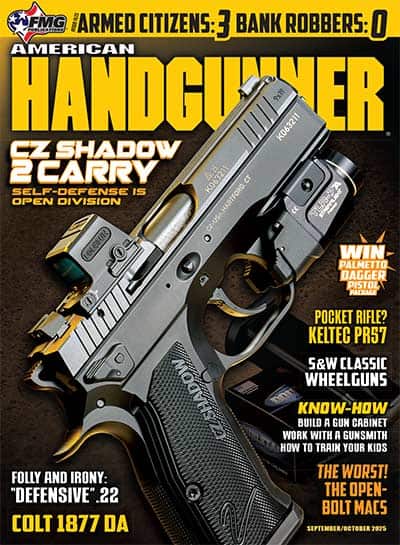
CZ Shadow 2 Carry 9mm
Self-Defense is Open Division

The argument between the gamesmen and the martial artists is a long one: Whether a shooting competition is a game to be won, using equipment specifically and solely for that purpose, or whether it is training for self-defense and should be limited to guns, calibers and ammunition suitable for fighting. Just like the idea that we have an imagination, so our thoughts die instead of us, most of us in the martial artist camp understand that competition is a useful venue in which new technology can be tested and developed, where failure only means losing points, not your life.
This makes it not-so-surprising that innovations once considered only viable for competitions are now commonly used for concealed carry — dots, comps and 2011s, I’m looking at you. CZ’s Shadow 2 Carry is intended to do just that: incorporate the lessons learned from competition into a serious daily carry pistol.
Unless you’re immersed in it, the names, numbers and even colors of the CZ world are a bit confusing. Candidly, it took some digging to figure out exactly what the Shadow 2 is and what makes it different from some of CZ’s other compact pistols. So, let’s start out with a bit of a tour of the Czech company.

Shadow Roots
Like the most popular of its offerings, the Shadow 2 Carry is based on the iconic CZ 75, but even with its match heritage, the Carry is a more direct descendant of the P-01 military pistol. The original 75 was little known in the U.S. until after the fall of the Iron Curtain, which had barred its importation, but well respected by no less than Col. Jeff Cooper, the founder of practical shooting, who championed it as the basis of the 10mm Bren Ten with which he was involved. More than a little Hi-Powery, but with a double-action trigger and the slightly bulbous design aesthetic that keeps most Czech pistols from being elegant, the CZ 75 was unique in that the hammer could be carried down for a DA first shot or cocked and with the safety applied for single action use.
After nearly 30 years as one of the standard military pistols used worldwide, in 2003, NATO approved the P-01 variant (NSN 1005-16-000-8619). Gone was the short dustcover and Hi-Power-style narrowed muzzle, replaced by a rail that went to the muzzle. A single dramatic scoop from the side of the wide-ish receiver (thanks in part to the slide rails, which run inside the frame) provides clearance for the trigger finger. A compact model expected to deliver the performance of a full-size pistol, the P-01 averaged over 2,000 rounds between malfunctions, over four times the acceptable rate of 500 rounds, which coincidentally also happens to be my personal standard.
Unsurprisingly, this compact P-01 was followed by the full-size SP-01, also intended for military and law enforcement, but still quite effective in competition. After taking 1st and 3rd in Production class at the IPSC World Shoot in 2005, the SP-01 was refined with input from the shooters who put it on the podium, becoming the SP-01 Shadow. The Shadow 2 further trimmed down the already low-profile slide (similar to the Blue and Orange Tactical Sports pistols) and offered an optic-ready variant, as did the CZ Shadow 2 Compact.

Shadow 2 Carry
The Carry (which we’re covering here) and Compact share the same 4″ barrel and other dimensions, plus an aluminum frame that shaves a pound off the optic-ready Shadow 2 and a couple ounces from the steel-framed CZ 75 Compact. This puts them neatly in the size window occupied by the GLOCK 19 and the CCO-size 1911, which many of us consider the ideal balance of accuracy, controllability and concealability ideal for a compact carry gun.
Gone is the familiar Coke bottle grip shape of the classic CZ 75. Both have flat machined aluminum grips like CZ’s “color” competition pistols, with silver on the Compact and black on the Carry. To add strength, the aluminum frame guns run about 0.10″ thicker than their steel counterparts, but those grips keep the overall width nearly a quarter inch flatter than a traditional ’75. And they’re not uncomfortable. While my personal taste runs more to the Nill grips I have on my ’75, the Carry grips seem to help the gun index better. Both the rear and frontstrap of the frame have raised panels of coarse, flattened checkering that gives good purchase without being draw-blood sharp.
The Compact and Carry 15-round magazines interchange with one another and other CZ 75 9mm mags. The models vary in sights and action: While both are optic-ready, the Shadow 2 Compact uses a plate system and its adjustable rear sight is attached to the cover that has to be removed to add an optic, while the Carry’s fixed rear sight stays in place, providing a valuable backup. The Compact has CZ’s familiar pinned-in front blade, while the Carry’s is dovetail mounted.
The Carry is cut for an RMSc footprint with no plate required. I promptly removed the cover and mounted a Holosun EPS Carry directly to the slide, using one of the included sets of screws and laying aside the unneeded RMSc-to-K adaptor plate. Boasting 50,000 hours of run time and a shake-awake feature, the closed-emitter Holosun is powered by a CR1620 battery in a slide-out tray and has a solar backup. The MRS version I used has a 2 MOA dot or 32 MOA circle reticle, from which I chose the plain dot. I’ve been shooting Holosun’s similar open-emitter 507 for the last few years and have been duly impressed with it; the EPS worked every bit as well. As I was taught by Gunsite instructor Aimee Grant, I used the face of the optic to cycle the slide for reloads and other manipulations.


Operations & Handling
Like the original P-01 from which it came, the Carry has a decocker instead of the usual cocked-and-locked option offered by the Compact, making it the only decocker gun of the 8 Shadow variants listed by the manual. Candidly, this seems a bit of an anachronism to me, as I thought everyone disliked the transition between double-action first shot and single afterwards as much as I do. The sheer dearth of such pistols on the market compared to single-action and striker-fired pistols would seem to support that, but I’m sure CZ knows something I don’t.
What I wanted to know was how it affected my ability to hit, so I fired a series of five-shot groups at 7 yards, double action, decocking between shots, then another set with a DA first shot followed by four single action. I managed several one-hole groups DA, followed by a number of one-hole groups DA/SA — a lesser number, but still, I managed it. When I shot controlled pairs at the same distance, with a DA first shot, SA second, I had no problem keeping them close, but had I picked up the pace to a fast split time, I imagine they’d have spread pretty quickly. The gun handled well, with all the controls where your thumb expects, and while the slide dropped a few times when I was slamming in a reload, it never failed to load a round into the chamber when that happened.
The trigger on the test gun averaged 10 lbs., 5 oz. from the decocked position, and 5 lbs. single action, compared to an advertised 11.9/4.7, respectively. It broke with the expected roll, which, when tried alongside my CZ 75B Omega and CZ 75B Compact, felt a little less smooth than the Compact, but about the same as my Omega.

Range Testing
Test ammo consisted of 500 rounds of Colt National Match 147 ball provided by DoubleTap, as well as 20 rounds of Winchester +P 124 JHP, 25 rounds of Hornady +P 124 XTP, and 50 rounds each of Fiocchi 124-grain Training Dynamics FMJ and 115-grain Defense Dynamics JHP, for a total of 645 rounds.
And here’s where I learned a hard lesson. CZs are known to have chambers on the shortish side: My 124-grain handloads would chamber easily in my Hi-Power but simply wouldn’t go into my CZ 75. That, along with a cold hammer forged barrel, is part of how CZs get their accuracy. As it turned out, 147-grain bullets also have a bit of a bad reputation in CZs. The 147 ball fed flawlessly — the gun never bobbled in over 500 rounds — but once we got past the 7 yards at which it would punch one hole, well, better not to talk about it. Mystified, I chronographed 43 rounds, which averaged 861 fps with an extreme spread of 59 fps and a low standard deviation of 11. I have shot thousands of rounds of DoubleTap ammo in nearly a dozen calibers, and it has been uniformly excellent, and this specific load showed consistent ballistics. But whether it was rifling twist rate, chamber depth or some other variable, this gun just didn’t like that bullet weight.
My usual test, which I know is out of the mainstream, is to take the pistol out of the box and put 500 rounds through it without cleaning or oiling. Abusive perhaps, but a pistol that passes it is almost certain to be reliable — and most do. Once past those 500 rounds, the Carry got a little sluggish in feeding, and when I field stripped it, the slide rails were bone-dry. Adding oil to the rails and outside of the muzzle and chamber area of the barrel helped, but it still needs a good cleaning.
With defensive ammo, it performed exactly like what I would expect from a CZ 9mm — better, even. I shot 14 groups at 25 yards, resting my hands on the bench. If we generously include one group that went 2.026″, ten of those 14 were 2″ or under. Five of them (again, including a close one at 1.538″) went 1.5″ or tighter, with a best group of 1.084″. Standing unsupported, I put 4/5 of my rounds into 1.33″, with a flyer landing a couple inches away, and managed five DA hits from the top half of a mag on the 10″x16″ steel ram at 100 yards.
I’d be happy with that on any platform I shoot. Sub 2″ accuracy from a defensive gun that runs all the time is generally the province of high-end 1911 pistols that run multiples of the Carry’s $1,300 street price, and below 1.5″ is near-mystical. I have guns that will do it, but not many — and they did it out of a Ransom Rest, not handheld.
I used to believe CZ was the most underestimated gun company in the world, but since then, word has gotten out. And they’re still better than you think. As for the Carry? I’d carry it.
For more info: CZ-USA.com, Holosun.com, DoubleTapAmmo.com