Jake McNasty
The Real Guy Behind The Dirty Dozen
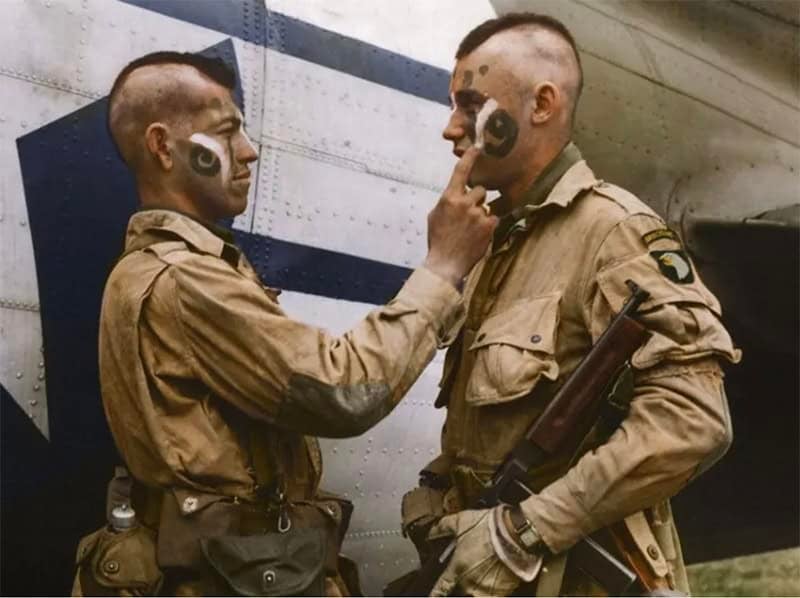
Jake McNasty and his fellow paratroopers shaved their heads into Mohawk haircuts
and applied warpaint before dropping into combat on D-Day. Public domain.
Jake “McNasty” McNiece was a “Break Glass in Case of War”-sort of soldier. Born on May 24, 1919, in Maysville, Oklahoma, James Elbert “Jake” McNiece was the ninth of Eli Hugh and Rebecca McNiece’s ten children. Part Irish American and part Choctaw Indian, McNiece entered the world sort of broken. He was forever in trouble. The young man worked in road construction before taking a job at the Pine Bluff Arsenal. As a civilian, that’s where young Jake first became familiar with the refined application of high explosives.
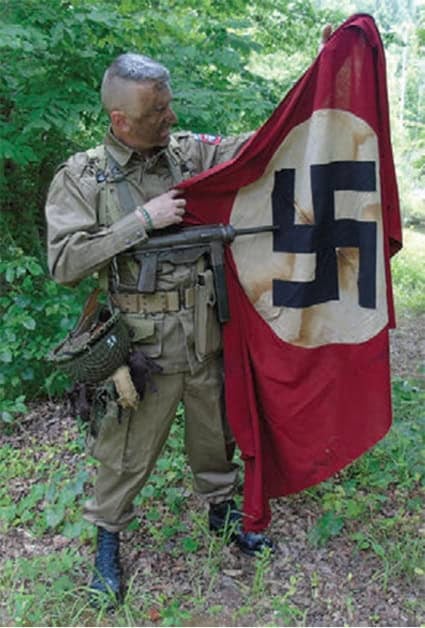
Paratroopers during World War 2 were some of the boldest,
most audacious combat troops in action.
Origins
In 1942, McNiece enlisted in the U.S. Army alongside literally millions of his fellows. The Nazis and the Nipponese were bent on world conquest, and Jake McNiece figured he’d do his bit to stop them. Never one to do things halfway, he promptly volunteered for the paratroopers.
Following Airborne training, McNiece was assigned to the 1st Demolition Section of the Regimental Headquarters Company, 506th Parachute Infantry Regiment, 101st Airborne Division. Lieutenant Charles Mellen commanded McNiece’s unit. However, Mellen was promptly killed on June 6, 1944, in the opening salvoes of the D-Day invasion. At 25 years old and brand new to combat, McNiece now found himself in command.
McNiece was a natural soldier. He was comfortable in the field, unusually brave, and an inspirational leader. However, he also exhibited a wanton disregard for the military rank structure. His superiors tolerated his insubordination because he got results. His men christened him “McNasty.”
Before the D-Day drop, McNasty suggested that his thirteen-man demolition section shave their heads into Mohawk-style haircuts and apply colorful Indian war paint. He was inspired by his mother, who felt that Indian haircuts would make the men seem more fierce to the Germans. War correspondents caught wind of the practice and did their best to make McNiece famous. Jake McNiece, for his part, couldn’t care less. He was just there to fight.
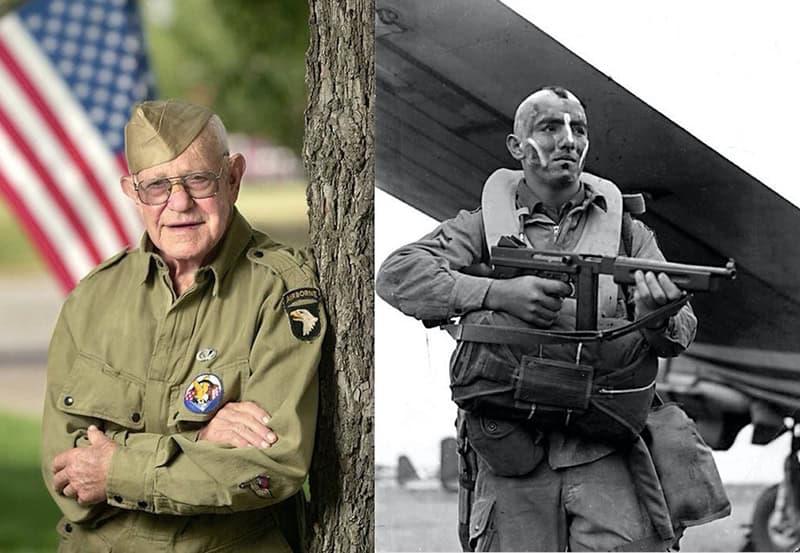
McNiece spent the last years of his life touring the US and Europe entertaining
and educating younger generations with his exploits during the war. Public domain.
Real War
McNiece and his demo specialists infiltrated deep into enemy territory to destroy or secure strategically important targets like bridges. They lost fully half their number on D-Day yet still seized their assigned bridge. They also took part in the capture of Carentan.
They were later assigned to defend three bridges over the Drommel River in Eindhoven, the Netherlands, as part of Operation Market Garden. German aerial bombing again killed or wounded half the demo paratroopers. After such sordid chaos, McNiece went AWOL for a time to sample the temptations of Paris. Once back to his unit, he volunteered for the Pathfinders in the expectation that the associated training in England would take him out of the rest of the war. The surviving members of his demo platoon volunteered along with him. It would have been a great plan, had it not been for the unexpected German assault through the Ardennes. We call this audacious attack the Battle of the Bulge.
The German Ardennes Offensive of December 1944 wrecked McNasty’s plans. As soon as they completed the Pathfinder course, these twenty experienced veterans parachuted into the Bastogne encirclement to guide supply drops. In some of the most vicious combat of the war, McNasty’s Pathfinder unit lost but a single man.
Once recovered from the Battle of the Bulge, Jake McNiece, now an acting First Sergeant, jumped with the 17th Airborne Division across the Rhine as part of Operation Varsity. McNiece ended the war with four combat jumps, one of the most rarefied accomplishments in the American military experience. However, it wasn’t necessarily his combat exploits that earned McNasty his spot in the annals of military lore.
Unhygienic Heroes
While training in England, McNiece’s demo unit was allotted a certain ration of potable water to use for hygiene. McNiece and his men chose instead to forego bathing so they could use their limited water to prepare game poached from a nearby estate. This practice earned the men the sobriquet “The Filthy Thirteen.” In 1965, E.M. Nathanson published a novel inspired by McNiece and his unconventional mob of saboteurs. He used a spot of poetic license and titled the piece The Dirty Dozen.
Blessings Of Freedom
After the war, Jake “McNasty” McNiece returned to Ponca City, Oklahoma, and took a job with the U.S. Postal Service. He worked there for some 28 years. He married his wife Rosita, but she died a year later. He subsequently remarried, had two sons and a daughter, and remained married until his death in 2013 at age 93. Jake’s oral history was published in 2013 by author Richard Killblane under the title The Filthy Thirteen. McNiece spent the last years of his life touring the U.S. and Europe, entertaining and educating younger generations with his exploits during the war. McNasty McNiece, the archetypal unconventional warrior, did what it took to get the mission accomplished. In so doing, he and his fellows helped secure the blessings of freedom for us all.