The Curious Origins of K-Rations
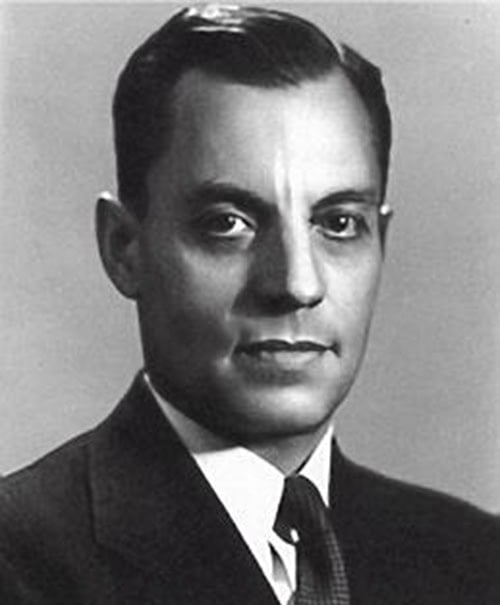
Ancel Keys was a polymath who, among many other things,
personally developed the US Army’s K-rations.
Fair use.
It is a soldier’s lot to gripe about his food. That has been the case since well before Hannibal’s hordes coaxed their elephants across the Alps. For literally millennia, those were pretty reasonable gripes. Then America happened.
Ours is the best-equipped, most powerful military in all of human history. In addition to $13 billion aircraft carriers and $600 toilet seats, Uncle Sam invests breathtaking amounts of effort and treasure in feeding our boys and girls serving downrange. I can attest from personal experience that he’s pretty darn good at that nowadays.
T-ration is short for Tray Ration. These are pre-cooked group meals sealed in big tins. To prepare them, you simply dunk the sealed can in boiling water for a while. Think Chef Boyardee on steroids. That stuff was actually quite good.
We used to refer to MREs as “Meals Refused by Ethiopians.” That’s not really fair. MREs are quite tasty these days. Additionally, every meal includes a flameless ration heater that offers a hot meal almost anywhere on Planet Earth under almost any circumstances. All that really began back in 1941 when a University of Minnesota physiologist named Ancel Keys developed the U.S. Army’s first K-rations.
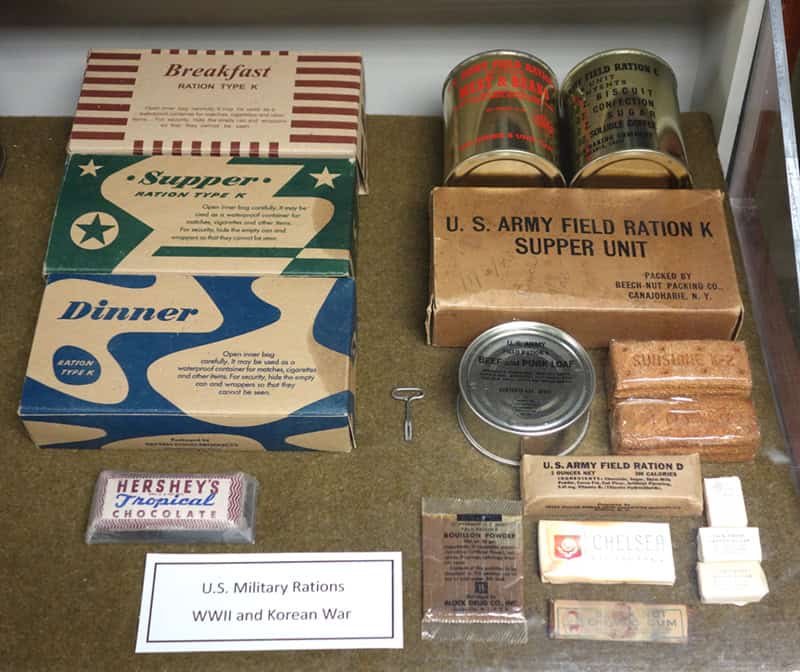
The US Army’s K-rations helped keep American troops healthy and fed
in some of the world’s worst places. Public domain.
Food of the Gods
With World War II just beginning to conflagrate around the globe, American troops needed a compact, lightweight meal that could be eaten with minimal preparation. This ration needed to be palatable and nutritious. It also had to be shelf-stable and amenable to mass production. With all this in mind, Keys hit the local supermarket to do some research.
Keys started out with dry sausages, hard biscuits, candy, and chocolate bars. The resulting DIY field ration weighed 28 ounces and provided 3,200 kilocalories. He divided everything into thirds and christened it breakfast, dinner, and supper. He field-tested the resulting amalgam on six soldiers at a nearby Army base. They rated the meals as “palatable” and “better than nothing.” It was a start.
The Army called this new field food K-rations. Uncle Sam already fielded A-rations, B-rations, C-rations, and D-rations. While the military claimed that K was simply an easily recognizable letter, it was widely understood to have been chosen in homage to Dr. Keys.
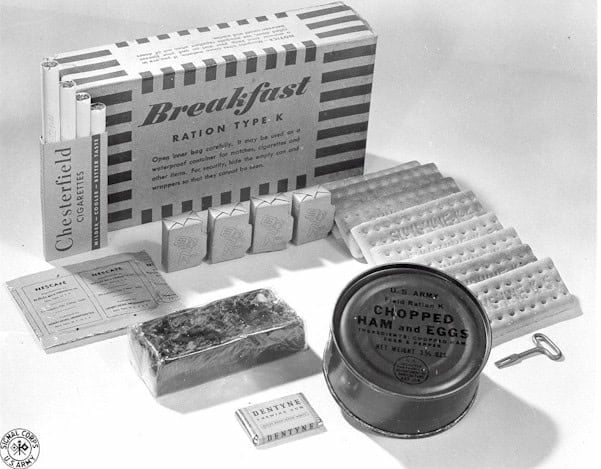
Each ration contained a breakfast, dinner, and supper.
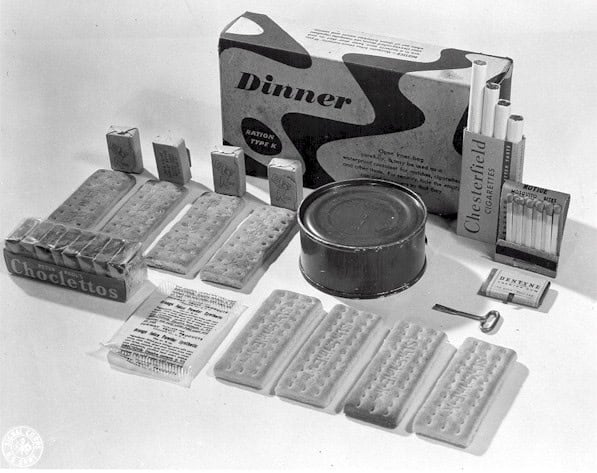
K-rations were never intended for long-term use.
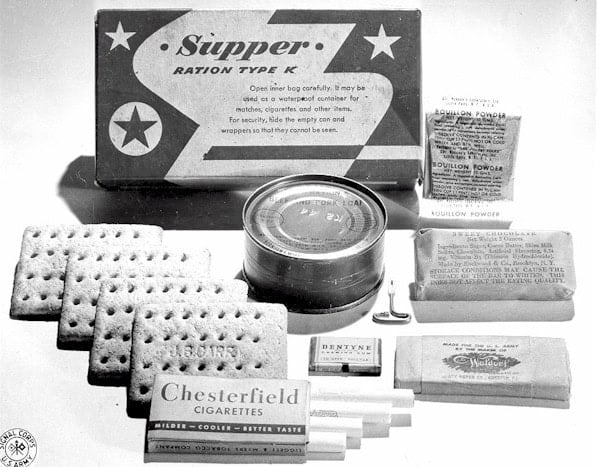
Some of the K-ration’s contents were downright nasty.
Details
Army grunts soon referred to K-rations as “Paratrooper Rations.” The boxes and contents were standardized. The fatigue pants pockets of the standard M1943 uniform were specifically designed to carry them.
K-rations were never intended for long-term use. The original stipulation was a maximum of 15 days, but this was later reduced to 10. Issue versions provided some 2,830 kilocalories, which really wasn’t adequate to support a soldier for an entire day if he was operating in hostile environments or engaging in heavy physical work. However, K-rats were portable, filling, and tolerable. Troops in austere environments subsisting solely on K-rations predictably lost weight over time, but they didn’t starve.
Some of the K-ration’s contents were downright nasty. The lemon powder was designed to be dissolved into water to make lemonade. However, it was so acidic as to be unpleasant. Additionally, the pork loaf was heavy on fat and tough to get down. As a result, troops oftentimes discarded these components, further reducing the calorie content.
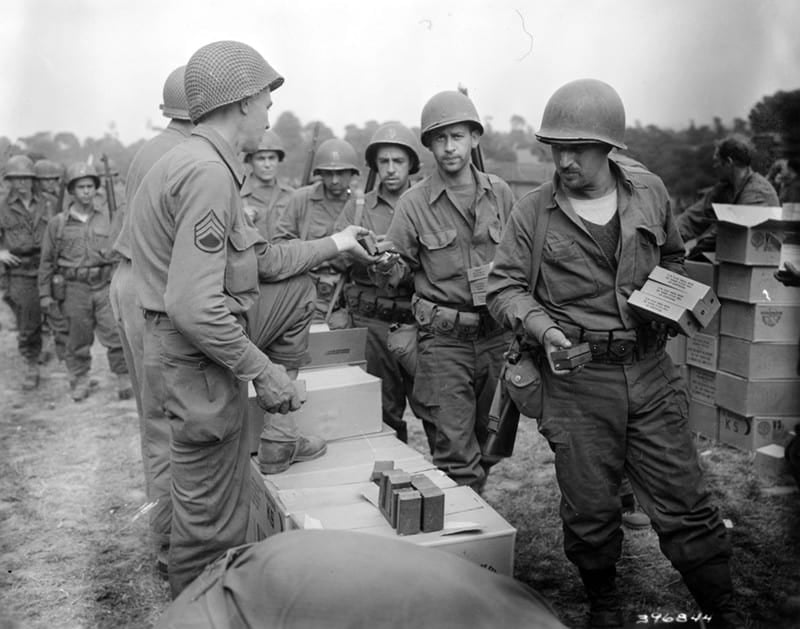
Weapons, vehicles, and equipment are important, but an Army
really does run on its stomach. Public domain.
The Gift That Keeps on Giving
Nicotine is a shockingly effective anxiety drug, and back then nobody knew how horrible smoking was on the human body. Each K-ration included a total of 12 cigarettes divided into three 4-cig packets. The really popular brands were represented, including Chesterfield, Camel, Lucky Strike, Pall Mall, and others. A dozen coffin nails a day lays the foundation for a proper smoking habit. Millions of GIs came home hopelessly addicted to cigarettes as a result.
While cigarettes served as a welcome diversion for troops stuck in some of the world’s most horrible places, they were actually much more than that. Troops hoarded their cigarettes and then used them to barter for local goods and services. Across both theaters of war, American cigarettes became a sort of ad hoc currency.
Ruminations
Early K-rations were short of ascorbic acid or Vitamin C. Troops feeding too long from K-rats alone began to show signs of scurvy. Subsequent upgrades fortified the drink powders with Vitamin C and rectified that problem.
Untold millions of K-rations were produced, but the Army tired of them soon after the war. They were replaced by C-rations, the famous canned ration packs of the Vietnam War era, starting in 1948. Remaining stocks of K-rations were distributed to U.S. Aid programs in recovering war zones overseas.
Each ration contained a breakfast, dinner, and supper. Twelve rations came to a case. Three cases made up a crate made of either wood or fiberboard. With a total of 36 daily rations per crate, a single crate would usually support a platoon in the field for a day.
K-rations included such sketchy stuff as chopped ham and eggs, canned pork luncheon meat, cervelat sausage, beef or pork loaf, and a nearly inedible hard D-ration emergency chocolate bar. The menu was upgraded over time and also included such stuff as chewing gum, matches, a bouillon packet, toilet paper, halazone water purification tablets, a simple flat wooden spoon, and fifteen dextrose sugar pills. The end result supported literally countless GIs.
Food in the Army evolves over time. Modern stuff is diverse, well-reasoned, nutritious, and packable. WW2-vintage K-rats were much less so but still kept a little meat on a guy’s bones no matter where he served. The humble K-ration likely did more to win World War II than all of the Navy’s battleships combined. It has been said that an Army marches on its stomach, and Ancel Key’s K-rations kept those stomachs filled.
Get More Guncrank Stories Every Week!
By submitting this form, you are consenting to receive marketing emails from: . You can revoke your consent to receive emails at any time by using the SafeUnsubscribe® link, found at the bottom of every email. Emails are serviced by Constant Contact