The Unexpected Perks of a Long-Barreled Handgun
Going the Distance

When Colt announced they were going to bring a redesigned Anaconda to market after a long period of absence, you’d have needed to look far and wide to find someone more excited than me. But when Colt finally offered me one to test and evaluate, I was left with a difficult choice: should I ask for a model in 4″, 6″ or 8″? I decided to go long.
When the package arrived at my FFL, I uncased the revolver and realized just how massive it was. There before me was more than a linear foot of gleaming stainless steel. As I hefted all 59 oz. of the revolver there in the shop, one of the clerks let out a chuckle.
“Went with the Joker barrel, huh?”
He was, of course, referring to an iconic scene from the movie Batman. You know: the one in which Jack Nicholson’s Joker pulls a four-foot long revolver from his trousers and promptly uses it to ground the caped crusader’s airplane.
It was about then a gloomy thought crossed my mind: Did I make a mistake? Was this a barrel length that bordered on the comical? Was there, in fact, a good reason why the market didn’t have more of these extraordinarily long handguns?
All of these fears vanished after my first range session, and I should have placed more trust in my own intuition. Long-barreled handguns had worked wonderfully for me in the past, and this newest acquisition was no different. In fact, I’ve so enjoyed shooting my Anaconda in the 8″ barrel length that I’ve since added a few more long-barreled handguns to the stable. Let me see if I can capture a bit of that magic here.

Sometimes a long barrel is essential to performance. This Automag III
needs every inch it can get to burn as much powder as possible.

The 83/8" barrel of the S&W Model 17 seems comically long. In reality, it’s quite lithe and easy to shoot.
Sight Radius
While I believe elevated recoil and stiff springs are the main reasons why snubbies and sub-compact handguns are hard to shoot, the compressed distance between front and rear sights certainly doesn’t help.
To illustrate the point, I measured the sight radius on my short-barreled Model 15 and my 6″ Colt Python; those figures were 3.75″ and 8.25″, respectively. From there, I applied some basic high school geometry. It turns out that with my Python, 1mm of misalignment of the front sight with respect to the rear notch will cause a round to fly just 4.3″ off target at 25 yards. On the Model 15, snub, however, that same degree of slop will send a round 9.5″ wide at the same distance.
For a melon-sized target, that’s the difference between a miss and a hit. I’d also add it’s not exactly the fairest comparison, because alignment errors tend to be magnified with additional sight radius. On a snubby, things always tend to look “pretty decent” when the front and rear units are so close together.
I’ve written it before, and it remains true today: When it comes to handguns, absolutely nothing else I own is as accurate as my S&W Model 41. I own a lot of good kit, but with the 41 especially, bullets seem to go exactly where I want them to. Certainly, the 7″ barrel contributes mightily to that phenomenon, and the platform offers a superb sight picture when everything’s aligned on target.
All that said, I realize this long-barrel benefit is obviated by a modern trend: The proliferation of red dot sights. Certainly, a dot doesn’t care how much distance is between the front post and rear notch; you have just as precise an aiming point regardless of whether the sight unit is mounted atop 12″ of tube or 2″.
I’ll admit that at one point I did have an RDS on the Model 41. But, it wasn’t very long until I took it off and went back to the irons. At least for the kind of shooting undertaken purely for recreation, I get a deeper sense of accomplishment when I drill the target just so without any extra help, and I haven’t lost anything in the accuracy department by forgoing an optic.

One of my favorite pistols ever, the Model 41 is long but also well-balanced. Note the tapers and scallops to keep weight down near the muzzle.
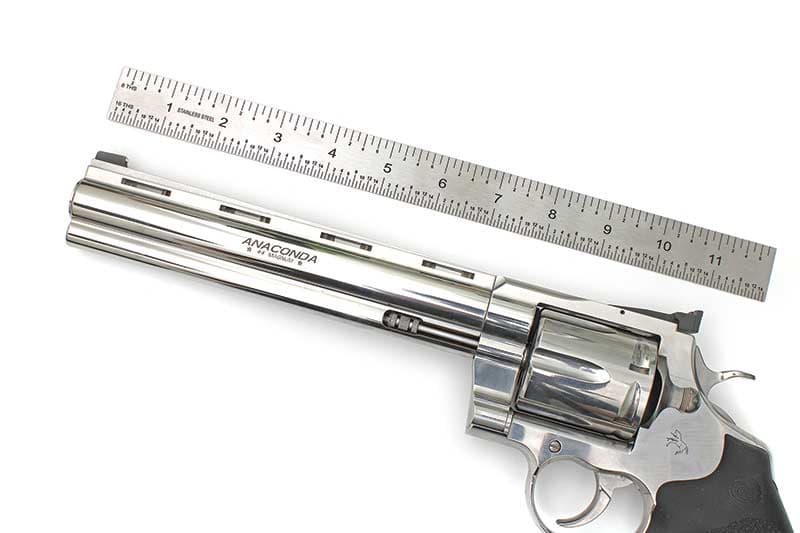
Nearly a foot of sight radius on this Anaconda is quite a boon
to accurate shooting! Sight misalignment becomes patently obvious.
Velocity & Consistency
It’s thrilling when a fired round is accompanied by a big plume of fire. However, it’s ballistically inefficient, since it signals that so much gunpowder is being converted to flash and noise rather than being used to propel the round in front of it.
Simply put, long barrels provide more runway for the propellant behind a bullet to more fully and completely ignite. That effect is magnified for slower-burning powders, especially the kinds used in magnum cartridges. By way of example, I ran a .44 Magnum load I’d worked up through Quickload, a well-known and heavily vetted ballistics calculator. Through my 3″ Model 629, I could count on only 60% of the H110 burning behind a 210-grain bullet for an estimated velocity of 1,105 fps. However, my 8″ Anaconda had enough barrel for 80% of the same charge to burn, resulting in a projected velocity of 1,610 fps — a 45% increase in performance.
That extra velocity is about as close as you can get to a free lunch in terms of handgunning. When an identical cartridge is fired out of a long barrel as opposed to a short one, bullets fly straighter and hit harder without any additional recoil. Additionally, when it comes to defensive rounds, a few hundred extra feet per second could be the difference between a JHP that fails to expand and one that mushrooms nicely.

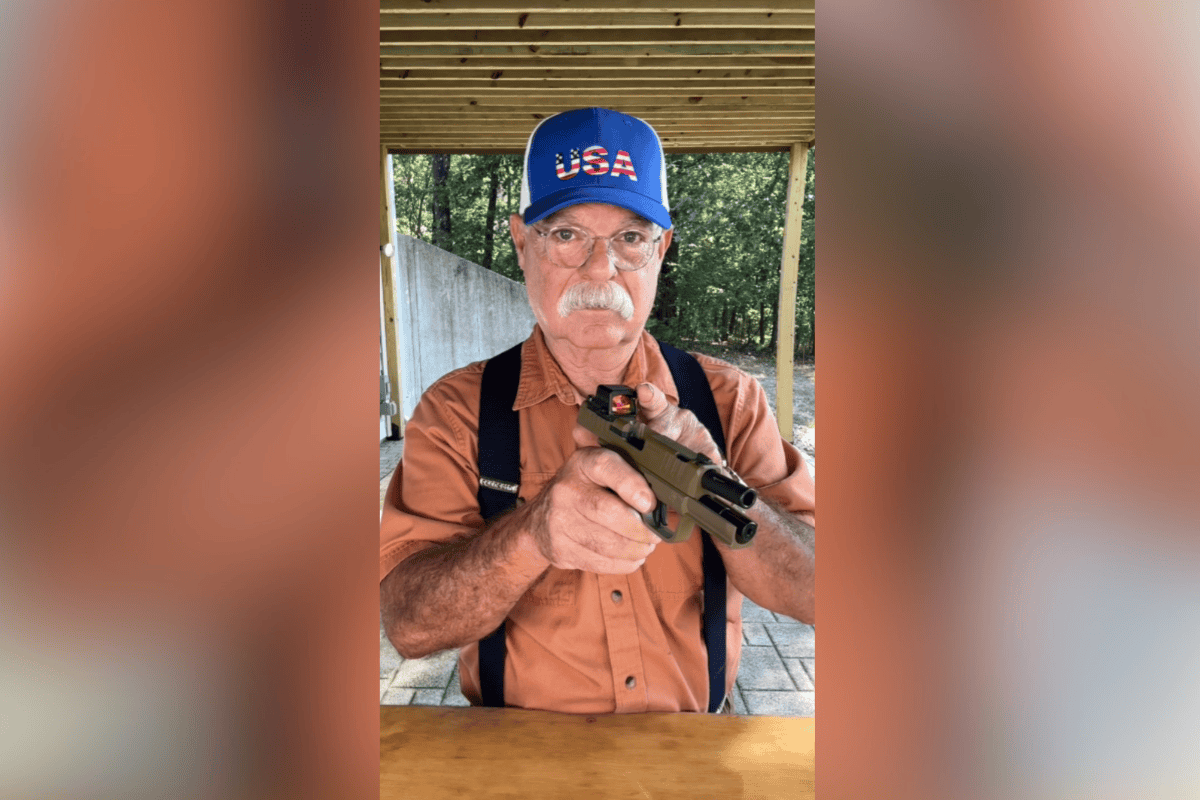
In a milieu where CCW reigns supreme, longer-barreled guns
like this USP Expert are instantly suspect. A pity!

This (repeatable) feat of accuracy is made possible only
by a superb sight picture and a generous sight radius.
Extra mass
The overwhelming majority of my rounds are fired at paper and into dirt berms, so I’ve never been too concerned with terminal ballistics. What I do appreciate more than anything else is the extra mass a long barrel imparts.
When it comes to recoil, more mass translates to more inertia. If gun A is twice as heavy as gun B, it will kick half as much. When you have an extra 2″ to 4″ of barrel hanging off the end of your pistol or revolver, the additional mass helps to tame the power of magnum cartridges. Add a full lug underneath that barrel, and you have even more “special sauce” when it comes to prolonged, comfortable shooting. It’s one reason why the Colt Python was especially beloved, and why the S&W L-Frame revolvers were an instant hit upon their introduction.
How much of a difference does this make? Quite a bit. Now that I’ve shot a few thousand rounds through my Anaconda, the biggest praise I can heap on the platform (with the 8″ barrel) is that it makes shooting .44 Magnum enjoyable. Not bearable, not tolerable, but downright fun. PMC catalogs a pretty spicy and relatively attainable .44 Magnum load that pushes a 240-grain bullet at 1,497 fps. Through the Anaconda, little discomfort results even after several boxes of the stuff are sent downrange.
“But won’t it be heavy?” Some shooters may be apprehensive about their ability to heft 3 lbs. of gun at arm’s length and hold it there. Fact is, a little extra mass is actually helpful when it comes to stabilizing a gun on target. Indeed, most serious target pistols tend to be a little heavier and larger than they need to be for exactly that reason. When guns are too light, they tend to float around at arm’s length, and any less-than-perfect manipulation of the trigger tends to push the gun to and fro that much easier.
Beyond that, I’d argue shooters should trust the manufacturers to put good products on the market. Many of my long-barreled handguns, such as my S&W Model 17 (and of course, the Model 41), have long but gracefully tapered barrels that help to preserve an ideal balance point. I promise your arms won’t get sore.

At one point, the recreational shooter faced a limited choice of 4" or 6"; service and target. Those days seem long gone.
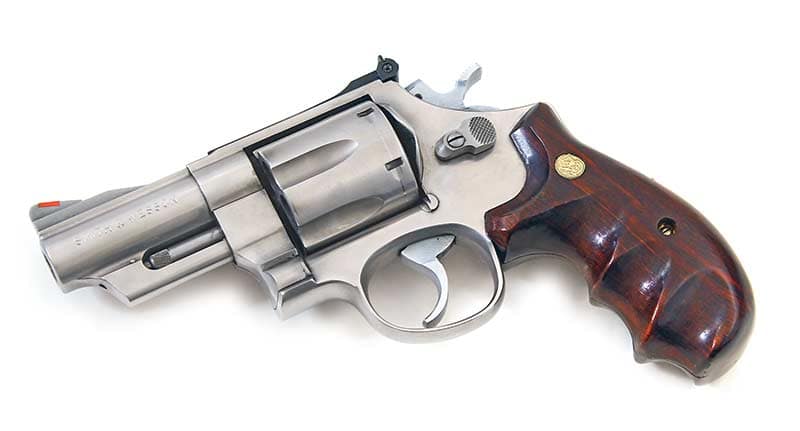
My 3" S&W 629 in .44 Magnum is a neat rarity, but the short barrel doesn’t exactly make it pleasant or easy to shoot.
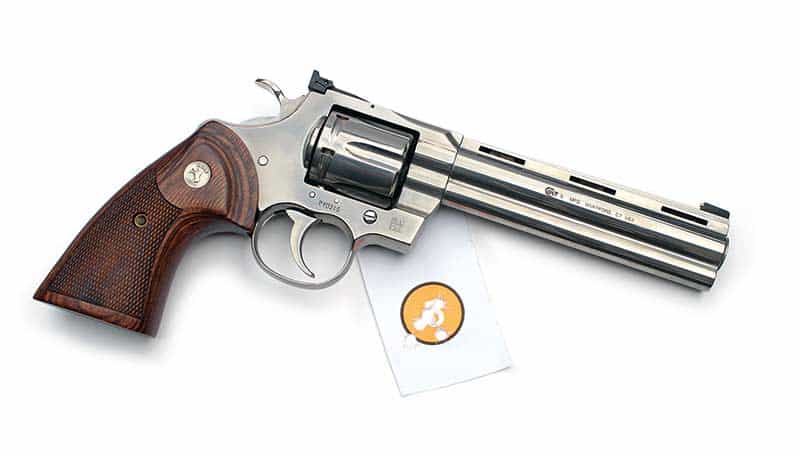
It does much to aid the practical accuracy of guns like this 2020 Colt Python.
Changing Times
It wasn’t too long ago when a 6″ barrel was considered the standard for recreational shooters by companies like Colt and S&W, with a 4″ barrel denoting a “service” model and the 6″ barrel indicating a “target” platform.
These days, compact is king. Over the last 10 years, especially, we’ve seen a number of companies outdo themselves to engineer handguns that are increasingly smaller, but also increasingly tougher and better engineered. Platforms like the SIG P365, S&W Shield, Springfield Hellcat, and GLOCK 43 are really quite marvelous: Numerous manufacturers have cracked the code of shrinking a firearm’s dimensions without sacrificing reliability or requiring a less potent chambering.
But here’s the rub: I think collectively, we’re so used to smaller firearms and assessing everything through the lens of concealed carry that longer-barreled handguns — hell, even medium-sized guns — now arouse a sense of suspicion. I know quite a few shooters who look at a heater with more than 4″ of tube like it’s some kind of design aberration.
Some guys seem to go downright apoplectic at the thought of owning anything that isn’t a serious-business CCW tool. For the rest of us, though, I think you’ll be a little surprised by how much fun you’ll have by letting things run a little longer than you’re used to. You might not be able to stuff it down your waistband (well, unless you’re really trying to emulate the Joker), but give one of these platforms a try and see if you don’t become a convert yourself.