There's No Perfect Carry 1911.
That's the Point.
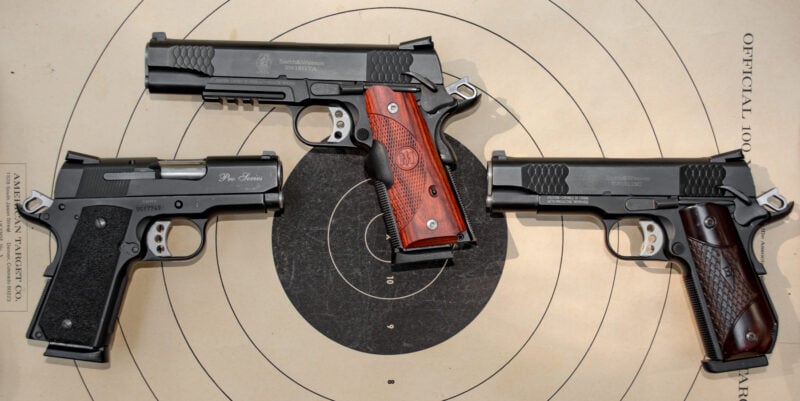
Left to right: The SW Pro Series Subcompact, a smaller variant of the Officers model;
an SW1911TA E-Series Government model; and an SW1911Sc Commander model with a bobtail grip.
I like carrying a 1911. A lot. But you won’t catch me quoting the bumper-sticker gospel, you know, “I carry a .45 because they don’t make a .46,” or “one shot is all you need.” The .45 ACP is a fine cartridge. It’s been quietly, or maybe not so quietly, doing its job for more than a century, and I’ve got zero complaints about it. Well, maybe one, and we’ll get to that in a second.
Here’s the thing, though. The caliber isn’t why I carry it. I carry the 1911 because of the platform. It just fits me. That slim frame rides on the belt like nothing else in my safe. I shoot it well. The grip angle that points naturally for me, the heft, and that crisp single-action trigger add up to a pistol I trust to put rounds where I’m looking. None of that has anything to do with what’s stamped on the barrel.
These days, 1911s come in every size you can imagine, and keeping the models straight is a chore, mostly because we gun folks insist on naming them after military ranks. Government. Commander. Officer. Give it a few years, and somebody will roll out the Vice-Rear Admiral, the Field Marshal, and the Sub-Leftenant.
Even the basic three get slippery because manufacturers love to fiddle inside each category. And that doesn’t even consider the multi-caliber issue. So treat what follows as “guidelines,” in the immortal words of Captain Barbossa, rather than hard and fast rules.

While it's not a true 1911 in the purest sense, the Springfield Armory EMP
puts good use to the classic 1911 action features.
The Government model is the granddaddy, the original full-size rig with a 5-inch barrel. The Commander trims things down a touch and runs a 4.25-inch barrel. And the Officers model? Well, officers don’t usually tote around heavy stuff like mortar base plates, now do they? Colt’s original 1985 version had a 3.5-inch barrel, though plenty of makers have since built Officers-style guns down to around 3 inches. Muddy it up a little more, and you’ve got the CCO, the Concealed Carry Officer’s setup, which bolts a Commander-length slide and barrel onto the shorter Officer’s frame.
To hunt down my “perfect carry 1911,” I’ve run a multi-year wear-off. Think dance-off, but with holsters and a lot less rhythm. The plan was simple: carry all three sizes over time, rotate in some variants in different calibers, toss in the new(er) double-stack varieties, and see what shook out. I’ll spoil the ending now: the perfect carry 1911 isn’t a caliber or a size at all. It’s the platform. And that’s exactly why it now stretches from a single-stack .45 to a double-stack 9mm and everything in between.

To me, it's all about the action, not the caliber. SA trigger, feel, and layers of safeties
designed-in for its cocked and locked design.
Comfortable? How About Sneaky?
I carry the 1911 because that slim profile tucks in and rides easily. I’ve spent years lugging some form of the big Government model, so I figured the smaller two would feel like an upgrade on the belt. They did.
Before the verdict, a word on size and weight.
The Government model is our baseline, and let’s be honest, it’s a lot of gun to carry. Not so much for its footprint as for its weight. For inside-the-waistband work, barrel length barely matters; your pants cover the barrel either way. Height is the fly in the ointment. A taller grip sticks out the back, especially when you lean forward, and even under a shirt or jacket, it can print that telltale bump. And the weight? Plan on a stout belt and a committed attitude to carry this one all day. The flip side: all that mass turns into your friend the moment you actually press the trigger. I’ll take that tradeoff every day of the week. Your decision tree may vary.

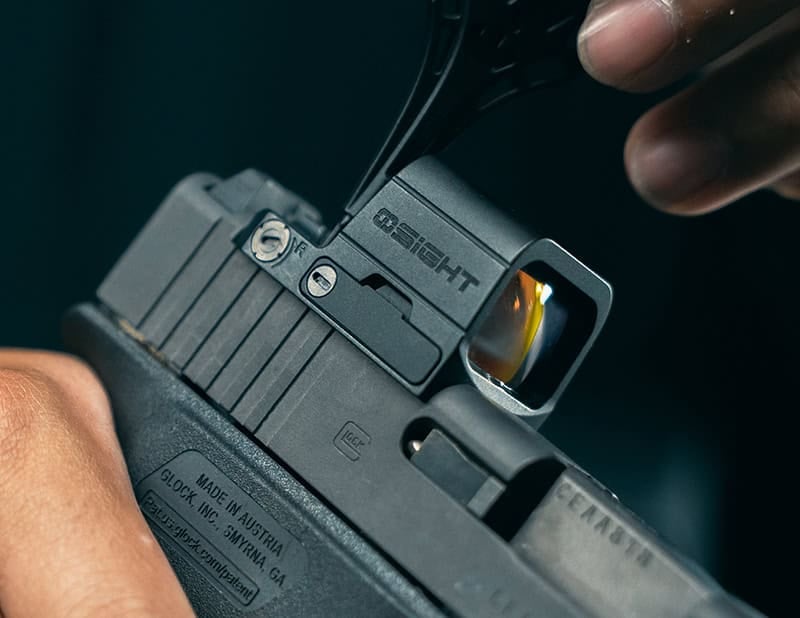
For those of you who like the dots, they're now standard equipment on some 1911s
like this Springfield Armory Operator 9mm.
The 2X Factor
Everything above assumes the traditional single-stack 1911 in .45 ACP. But remember my whole argument: I carry a 1911 for the platform, not the caliber. Once you accept that, a door swings open, and it’s got “2” written all over it.
Enter the 2011. Or the 2311 from the EAA folks. Team Springfield Armory dispenses with the “X911” altogether and calls their series the Prodigy. Although they also talk about “1911 DS” models.
Take the 1911 you love, the grip angle, the single-action trigger, the way the slide runs, layers of safeties, and swap the single-stack steel frame for a two-piece setup: a metal chassis up top married to a replaceable polymer grip module that swallows a double-stack magazine. The payoff is right there in the name math. Instead of seven or eight rounds of .45, you’re carrying somewhere north of 15, often 17 to 20-plus, of 9mm. That’s the 2X factor, roughly double the ammo in a gun that still operates like the 1911.

While other companies have made double-stack 1911 models, it was STI, later Staccato,
who put the race gun for carry design on the map.
Chamber it in 9mm and you get more than capacity. Recoil softens up, practice ammo costs less, and it makes fast strings easier to keep on target. For a carry gun, that’s a stack of upside without giving up the handling that made you a 1911 person in the first place. The catches, historically: 2011s can get expensive fast; the magazines are proprietary; and cheaper examples have earned mixed reputations for reliability, so the “prove it runs” rule from above goes double.
And the big catch, of course, is the grip. One of the classic 1911’s defining characteristics is the slender feel all around. A double-stack magazine leads to a fatter grip. And therein lies the big tradeoff. More capacity costs you some of that wonderful “slim” factor.
Then there’s the newer wrinkle, the 2311. Where the classic 2011 leans on that two-piece chassis-and-grip-module design, the 2311 approach generally reaches for a simpler frame, aiming to deliver the double-stack 1911 experience for less money. It also opens up double-stack to bigger calibers like .45 ACP and 10mm. I’m waiting on someone to build a 2311 in .357 SIG, because why not?

Another entry in the new series of 2X11 double-stack options: the EAA 2311 series.
Do these belong in a “carry 1911” conversation? Absolutely. They’re the same platform I’ve been praising all along, just wider in the grip and doubled up on rounds. If the only thing keeping you off the double-stack train is the “but it’s not a real 1911” reflex, pick one up. Your trigger finger won’t know the difference.

Here's the gun that started my 1911 carry habit - the Springfield Armory TRP Government model .45 ACP.
The Winner?
So which one wins? None of them, and all of them. That’s not a cop-out; it’s the whole point. The winner was never a caliber or a size. It’s the platform.
Part of that depends on your chosen carry method. I’ve done a multi-year experiment with appendix carry. One of its benefits is that you can conceal (with shocking ease) pretty much anything. 2X11 full size with an optic? No problem. However, when you shift to a traditional hip-placed IWB, the thin factor of the traditional 1911 is hard to beat. On or near the hipbone, every sixteenth of an inch really matters.
So I don’t carry the perfect 1911. I carry the right one for that day, that season, and that carry method, and every one of them is a 1911. That’s the perfect part.
Get more exclusive online content from American Handgunner delivered straight to your inbox. Sign up for our free American Handgunner Insider newsletter.