This Old Gun: Ruger’s Speed Six
If You Ever Need to Drive Railroad Spikes with a Revolver

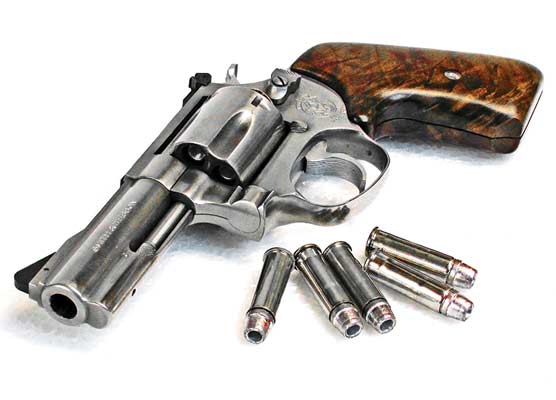
Ruger Speed Six .357 Magnum, left side.
Back in the day, not long after station wagons roamed free and kids slept on the rear window shelf on long highway trips, a highway patrolman bought this Ruger Speed Six .357 Magnum as a backup and off-duty carry gun. As you can see, it’s still in (not surprisingly) great health and ready for the range. The holster might be overdue for an upgrade, but I consider those consumable parts anyway. Well, after 30 or 40 years in this case.
When that young patrolman later got accepted into the Secret Service, the gun was sold, and after an interim stop with my father, it ultimately made its way into my safe. As the story goes, the highway patrolman couldn’t use it in his new federal job, so its utility was greatly diminished, and he and this Ruger parted ways. That’s OK. It landed in a good home.
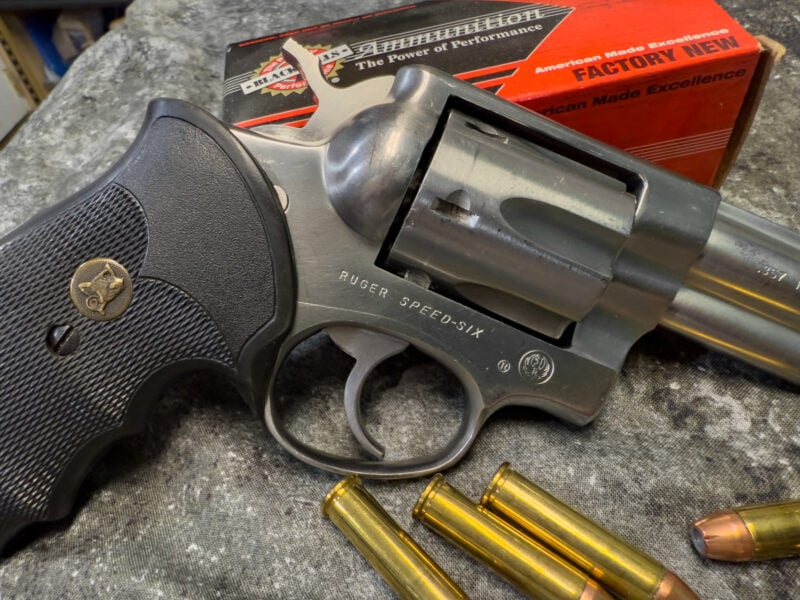
The smooth profile up top means no sights to break and a smoother profile for carry.
Sixes in Series
Officially launched way back in 1970 (or 1972, depending on how you count), the Six Series began Ruger’s innovation phase for double-action carry and duty revolvers. The effort to break into the law enforcement and defensive markets wasn’t a new idea. Ruger designers Harry Sefried and Henry Into had been working on double-action designs since about 1966. Prior to the launch of the various “Six” models, the company only had single-action designs to offer. Great for recreational shooters and hunters, but not appealing for broad-scale defensive or law enforcement use.
While figuring out their take on a safe, double-action design complete with transfer bar operation, they made some design choices that defined the family. For example, investment casting combined with heat treating after the machining work was done held down production costs, making it affordable for both government agencies and widespread civilian use. Since the company sold almost 1.5 million of them, I’d say the strategy worked. The manufacturing process also helped create some of the heft, durability, and profile attributes we’ll talk about in a minute. Bottom line? Think large, heavy-duty parts translating to rugged durability.
Anyway, the “sixes” came out in three flavors: the Security Six, Service Six, and the Speed Six, shown in this article. All siblings in the family of sixes were primarily made to chamber .357 Magnum, but some were produced in .38 Special and even 9mm. I’ve heard some .38 S&W showed up here and there, also. The family member differences were subtle, and many models across families were offered with 2.75, 3, 4 and 6-inch barrels.
The idea behind the whole thing was Bill Ruger’s desire to break into the law enforcement market, then dominated by Colt and Smith & Wesson.
Models were manufactured between 1972 and 1988. From a quick look at the Ruger website, this one appears to have been made in 1981 or early 1982. I guess it’s four score and four years old. A spring chicken as far as these go.
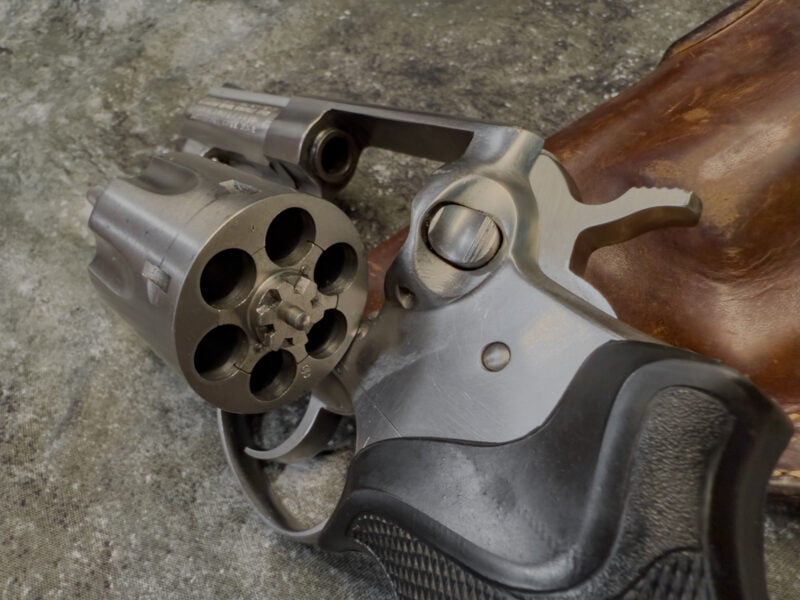
As the name implies, six in the cylinder. The transfer bar design means it's OK to load all six for carry.
Built for Ruggedness… And Carry
There are a few features about the Speed Six that make it ideal for duty and carry use. Bottom line, it’s built to be rugged.
For starters, there is no adjustable rear sight as on other members of the Six Family. It is the old school traditional top strap groove, and that’s all you get—nothing to break or get knocked out of whack. The front sight is black, serrated, and ramped. It’s also low, so it doesn’t have what I’d call the ideal sight picture for fast shooting.
It likely goes without saying that this is an all-steel model, but you will also notice that this is a no-cover-plate design. The frame is solid, and when I say solid, I mean tank-like. Given its 33-ounce (give or take) weight and sturdy construction, you could drive railroad spikes with this beast. That might or might not void the warranty.
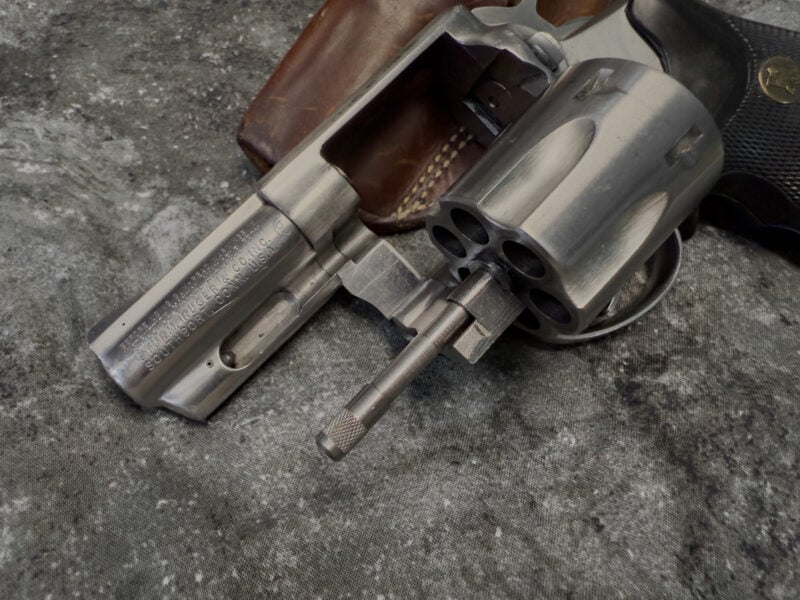
Note the under-barrel lug shielding the ejector rod. It adds some desirable weight up front.
Of course, the secondary benefits of some of these features, like the smooth upper surface without the adjustable sight, make it convenient for concealed carry, too.
Tough often relates to simple, and this one is designed with field maintenance in mind. Unless you have an adjustable sight model, there’s only one screw in the whole revolver. That one holds the grips on, and you can remove the original with nothing more than a cartridge case, as that factory screw has a wide slot. The rest of the recommended field strip procedure is pretty much doable by hand.
Old Leather; Cushy Grips
This one arrived with its original Bianchi Number 3 holster. Also called the “Pistol Pocket,” it’s an all-leather inside-the-waistband model designed specifically for concealed carry.
This one is worn beyond safe use, but originally, part of the appeal was the lockable leather belt loop, which allowed one to set the ideal angle for the gun and carry location. You could even rig it for upside-down use if your scenario called for that. A leather thumb break guaranteed the revolver would stay with you during vigorous activity.
I’ll have to shop around for an appropriate leather replacement for this one.
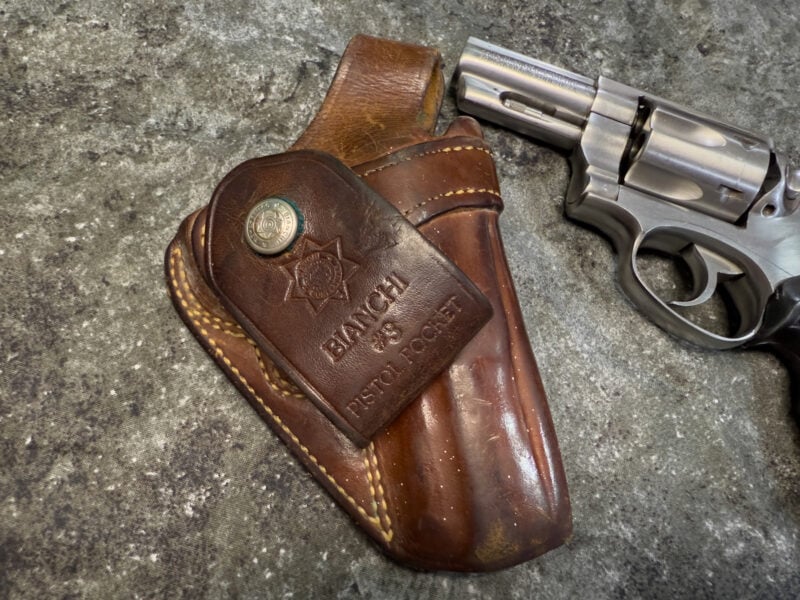
The Bianchi #3 Pistol Pocket did great, but hard-use leather holsters usually aren't expected to last for decades of use.
This Speed Six arrived here with (by the looks of it) an original set of Pachmayr “Grippers.” Designed for hard-kicking handguns like this one when firing full-power .357 Magnum loads, they’re a wrap-around design, covering the front and back straps. Finger grooves up front help control things during recoil, and the reinforced rubber material construction absorbs some of the shock. After who knows how many years, these still have some cushion and give, but a refresh might be in order.

This Pachmayr Gripper does an admirable job of reducing .357 Magnum recoil after decades of use. Money well spent!
Action
In the early days, the affordable Speed Six line didn’t necessarily win accolades for the smoothest trigger on the market, with many users experiencing some unnecessary pull weight and a gritty movement. This one is either well-worn and polished through lots of use over the years or perhaps it had a little “smoothing out” done at some point.
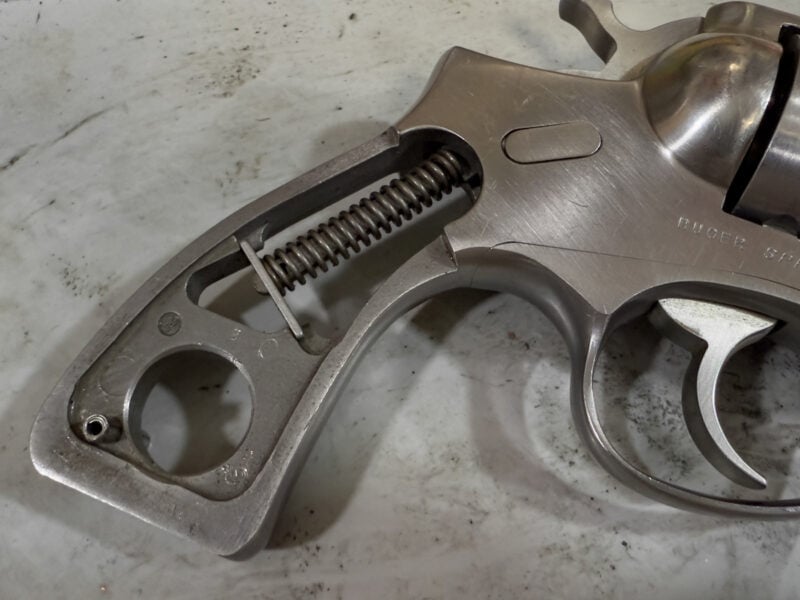
Ruger tended to prefer coiled mainsprings for consistency and reliability.
Whatever the reason, it sports a nice trigger now. I measured pull weights with a Lyman Digital trigger scale and found the double-action to average out to 9 lbs., 8 ounces. The single-action pull weight worked out to 2 lbs., 10 ounces. As for the sensation, it’s butter smooth with a single noticeable click just before the break when the cylinder locks into position. Whether from use or some shop work, this has become a very pleasant gun to shoot.
I won’t hesitate to use it as intended, with full-power .357 Magnum loads. After all, these old Rugers are known for durability. But just for fun, I think I’ll whip up some pussycat wadcutter loads using .357 cases (so I don’t have to clean the cylinders) with a nice, mellow Trail Boss recipe just for fun.
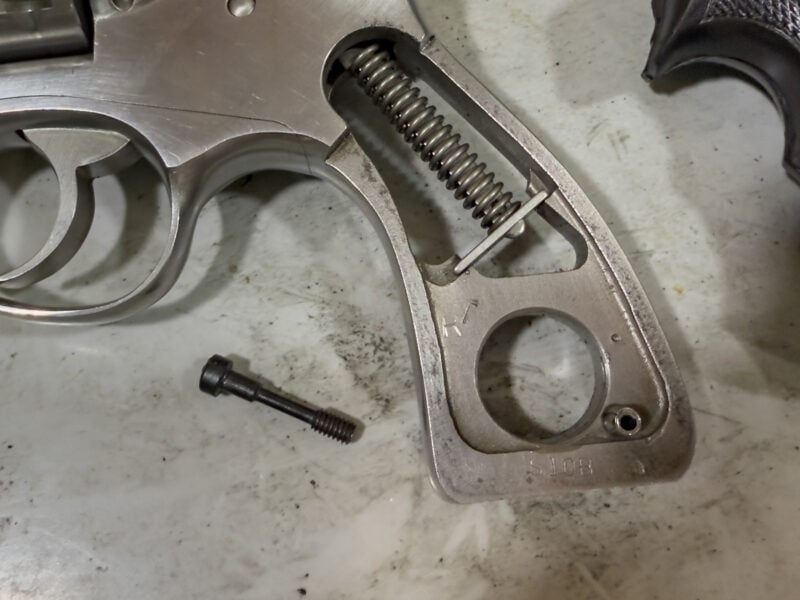
Unless the model has an adjustable rear sight, there is precisely one screw in this whole Speed Six revolver.
You're looking at it. It holds the grips on.
Get more exclusive online content from American Handgunner delivered straight to your inbox. Sign up for our free American Handgunner Insider newsletter.