Alexander The Great’s Nose

This depiction of Alexander the Great was unearthed in Pompeii.
We actually have no idea what the man actually looked like. Public domain.
Finding oneself in the presence of greatness carries a timeless allure. We humans tend to venerate things. The planet is dirty with scraps of ephemera or plots of dirt that hold some sacred significance or other. We all flock to such places by the zillions just to say we’ve been where something awesome happened.
That’s not a recent phenomenon. Alexander III of Macedon was the son of Phillip II. He ascended the Greek throne in 336 BC at the age of 20. Ten years later, he had created one of the most extensive empires in human history. Alexander’s realm stretched from Greece all the way to northwestern India. At the time of his untimely death at age 32, he was undefeated in battle. This earned him the timeless honorific Alexander the Great.
Nobody is completely sure why he died. He might have been poisoned. Regardless, folks were homogenously impressed with the guy. The Greek people did their best to venerate him in death. In the year 323 BC, Alexander was laid to rest in a magnificent tomb. His sarcophagus was custom fit to his body and formed from solid gold. A purple robe embroidered in gold was draped around his torso and legs. That was all great, right up until King Ptolemy began looking lustfully upon all that bling.
Ptolemy had Alexander removed from his custom casket and melted the whole shebang down so he could keep it for himself. It’s not like Old Alex was actually getting a whole lot of enjoyment out of it. Writers of the period claimed Alexander was then laid to rest in a tomb made of glass. This was likely a translucent alabaster of some sort — not quite as gaudy as gold but nonetheless still pretty rad. There the great man remained until the year 30 BC.

This bust of Alexander was discovered in Alexandria, Egypt. Public domain.
Keep Your Hands to Yourself
Augustus Caesar was no slouch himself. The first true Roman emperor, Augustus’ exploits saw the Roman empire expand to include Dalmatia, Egypt, Pannonia, Noricum, Raetia, and large swaths of Africa. Augustus ascended the Roman throne after the untimely death of his maternal great-uncle Julius in 44BC. Perhaps you’ve heard of him. A fairly famous English playwright once wrote a bit about it. Et tu, Brute?
Before he got just super famous, Augustus was known as Octavian. Octavian later instituted the practice of emperor worship. However, at this point, he was still just some rich dude who liked to travel. Once while in Alexandria, Egypt, he figured he’d drop by and check out the tomb of Alexander the Great.
Then as now, it’s cool to be a VIP. Presidents, Prime Ministers, CEOs. Army Generals, rock stars, and the like all typically expect a little extra special TLC whenever they’re out mingling with the peasants. In Octavian’s case, he said he’d like to get a good close look at what remained of Alexander. The local flunkies duly removed the lid to his alabaster sarcophagus.
Alex had been there for 306 years. I doubt he smelled too bad by then. However, he was in a bit of a fragile state. The Roman historian Suetonius wrote that all Octavius wanted to do was place a gold crown on the dead king’s head and adorn his tomb with fresh flowers. However, at some point Octavius apparently got too close or let his emotions get the better of him. In all the chaos, Caesar Augustus broke the nose off of Alexander the Great’s corpse.

This is Phillip II of Macedon, Alexander’s Dad.
Apparently the whole family suffered a bit of a nose problem. Public domain.
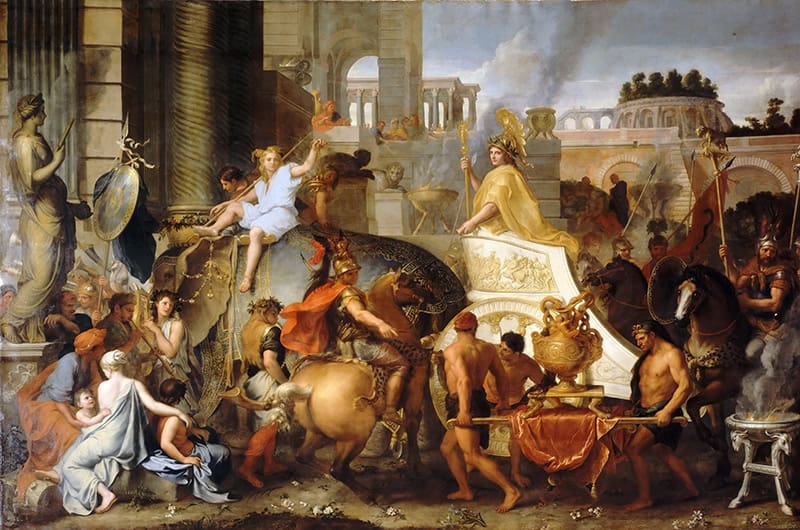
Alexander the Great was one of antiquity’s most famous figures. Public domain.
Whoops …
We’ve all been there. You’re visiting somebody else’s home and admiring some nifty widget when a piece of it comes off in your hand. If you’re lucky, you can claim it was like that when you found it. Perhaps your host will be gracious and run fetch the Super Glue. If you’re caught red-handed, then your relationship with that person might suffer some long-lasting damage. In this case, however, this just couldn’t be readily undone.
The historian Cassius Dio had this to say, “After this he viewed the body of Alexander and actually touched it, whereupon, it is said, a piece of the nose was broken off.”
Nobody recorded what happened next. I rather suspect that Octavius just tossed the severed shnoz back into the box and acted like he had an important meeting elsewhere. Regardless, Alexander’s body was later moved several times until they lost track of it. Nobody is really sure what ultimately became of him.

We have no idea what Octavius looked like, either. However, his hawk-beaked visage
did make it onto a lot of currency of the era. Public domain.
Ruminations
So, the next time you inadvertently scratch one of crazy Uncle Earl’s vintage LPs or crack the arm off of one of Aunt Edna’s priceless collectible porcelain figurines, take heart. At least you didn’t break the nose off of one of the most famous military figures in all of human history. Octavius overcame this little faux pas and went on to make something of himself. I’m sure you can, too.
Get MORE Gun Crank Diaries every week!
By submitting this form, you are consenting to receive marketing emails from: . You can revoke your consent to receive emails at any time by using the SafeUnsubscribe® link, found at the bottom of every email. Emails are serviced by Constant Contact